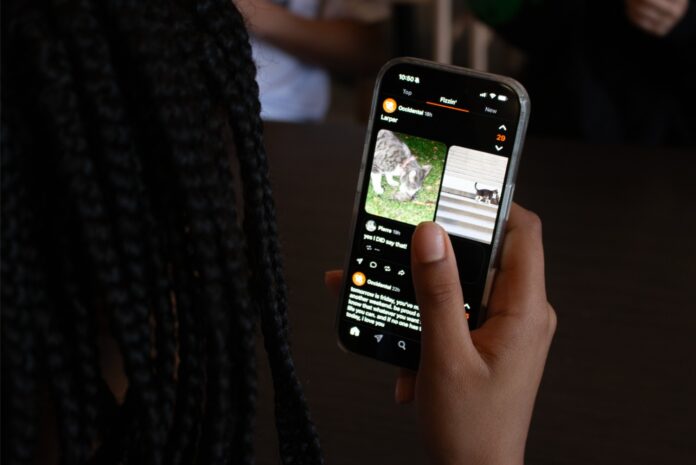
A task force is being organized to address cyberbullying at Occidental after students raised concerns over harassment and offensive speech on the anonymous social media platform Fizz.
Fizz is an app on which users post anonymously to forums dedicated to their schools. Servers exist at more than 800 colleges across the U.S., and every account is .edu-verified, according to the app’s website. The Fizz community at Occidental has been active since a guerrilla marketing campaign brought the app to campus January 2024.
Vice President for Student Affairs and Dean of Students Vivian Garay Santiago sought feedback on Fizz usage at an Associated Students of Occidental College (ASOC) Executive Committee meeting Oct. 12.
Lilian Siegl (sophomore) is co-student leadership liaison for the ASOC Diversity and Equity Board (DEB). Siegl said she volunteered to be part of a task force organized by Santiago, which is still in a preliminary phase.
Siegl said rumors and gossip spread over Fizz because users can share information without being held accountable for their speech, and that a student transferred out of Occidental after being cyberbullied on Fizz.
“If you’re holding a grudge against someone, or if you don’t like a person for whatever reason, it is very easy to talk about that on Fizz, because no one will know [it is you],” Siegl said.
Kevin Castellanos (junior) said he downloaded Fizz his first year after a senior told him to at a party. Castellanos said Fizz is a good way to get the word out about events happening on and off campus.
“[When I go on Fizz], I’m usually looking for who’s throwing [a party] that weekend,” Castellanos said.
Castellanos said a Campus Safety officer told him the office uses Fizz to see students’ posts.
“[The officer] was like, ‘Oh yeah, we know everything on Fizz, we know what you guys are saying and we know where the parties are, so that we know where there might be problems,’” Castellanos said.
Ava Navales (junior) said she heard about Fizz when the Instagram account @fizzoccidental followed her during the summer before her first year. Navales said the app was a way for her to be part of an in-group when she arrived on campus.
“When I was struggling to make friends, [saying], ‘Oh, did you see that thing on Fizz?’ was an easy conversation starter,” Navales said.
Navales said the app has changed since she first downloaded it, and that cyberbullying and misogyny have become prevalent.
“Instead of it being [used for] genuine posts, [Fizz] started being about who can say the raunchiest, most incendiary thing and get the most upvotes,” Navales said.
Devon Sakamoto, Assistant Dean of Students for Emmons Wellness Center, said fellow staff shared concerns with her that students have used Fizz to harass or bully other students.
“[We should be] setting some expectations as a campus that ‘This is how we treat each other,’” Sakamoto said. “Whether we’re in person, on Zoom together or in an anonymous space, we [should be] maintaining and upholding community standards.”
Siegl said she knows Occidental students moderate Fizz, but that it is unclear how much these moderators are actually contributing to keeping the app a safe space. Siegl said one of her goals in joining the new task force is to help moderate Fizz.
“[Moderation] could be a very effective and beneficial thing that we’re doing, and I just don’t think we’re doing it right,” Siegl said.
Nathan Kim ’26 said he worked as a moderator and an ambassador for Fizz in 2024. According to Kim, Fizz paid him for these roles. Kim said he and other ambassadors and moderators communicated using a chat on the messaging service GroupMe, which contained 47 members. According to Kim, multiple moderators reviewed every post reported.
“That [large] body of people moderating was allowing [for] more diverse input,” Kim said.
Kim said as an ambassador, he was encouraged to make three posts each day. Kim said real students made all the posts and upvotes on the app.
“To get into Oxy’s Fizz platform, you need a student email, and you can only make one account,” Kim said. “It leaves no room for any sort of bots.”
Maxine Reid Brewer (junior) said people have made insensitive comments about her appearance on Fizz multiple times this year using her full name. Reid said it disturbed her to see how many people engaged with these posts given Occidental’s small student body.
“If I see somebody saying something about me, and then it has 100 upvotes or something in an hour, I’m like […] ‘How many of those people are people around me, or people I know?’” Brewer said.

Lizzy Denny, Project SAFE Director and Survivor Advocate, said Fizz has had an impact on students on both an individual and a community level. According to the Occidental website, Project SAFE is a prevention education and advocacy support program dedicated to ending sexual violence on Occidental’s campus.
“[Students] are feeling more nervous to interact with one another,” Denny said. “I don’t want people at Oxy to be so scared of being called out or bullied on an app like Fizz that they don’t want to go out and meet their fellow classmates and build community.”
Navales said the anonymity the app provides creates distrust.
“You could be walking around and never know [that] perhaps the person that sits next to you in class just said this horrible thing about gay people on Fizz,” Navales said.
Denny said Project SAFE employs students as peer advocates, and that these students are working on a series of public service announcements to talk about best practices for using an anonymous platform. According to Cecilia Nichols (junior), peer advocate, the “PA PSA” series is meant to make students more mindful of what they post on Fizz.
“If you get called out on Fizz, how [should] you respond?” Nichols said. “[We’re] trying to give some tips [on] the best way that you can protect yourself [and] protect others.”
Peer advocate Sunny Tuazon (sophomore) said she has observed students being called out for sexual harassment, assault and other types of harm on Fizz.
“The callout culture on [Fizz] focuses so much on the perpetrator in a situation,” Tuazon said. “[Callouts] take away from the more survivor-centered approach — thinking about the people who were harmed in that situation.”
Denny said she hopes to see students start having serious conversations in person, rather than on an anonymous platform.
“There are some posts that are just adorable pictures of Pierre, or squirrels on campus,” Denny said. “Many good things can come from students having a space that is just for them and that is anonymous, but [Fizz] does perpetuate a fair amount of harm on our campus, and from what I’ve seen, on other campuses as well.”
Francine Ghazarian and Lucinda Toft contributed reporting
Contact Eli Heringman at heringman@oxy.edu