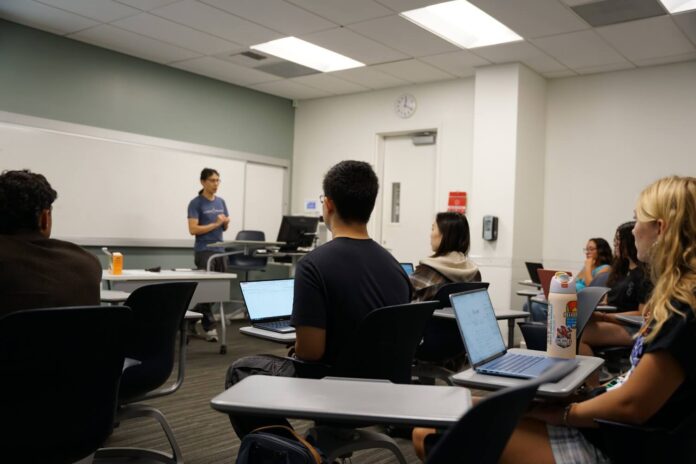
The 2026 school year marks the 10-year anniversary of the computer science department at Occidental College. Established as a major in 2017, the interdisciplinary department is now adapting to the rise of AI and broadening the perspectives of Occidental students.
Justin Li, associate professor of cognitive science and chair of the computer science department, said he was hired in 2015 to strengthen computer science offerings at Occidental.
“At the time, computer science was only a minor that was primarily run by the math department,” Li said.
According to Li, during the 2016-2017 academic year he collaborated with associate professor of mathematics Jeffery Miller to expand the computer science course offerings into a separate department.
“When I started, the main person teaching in the computer science minor was [Miller],” Li said. “As we were thinking about the major, I was teaching classes in computer science as well, but then in the 2016-2017 year […] we ended up hiring professor Kathryn Leonard, who became the chair of the computer science department starting in fall of 2017.”
Li said three students graduated with degrees in computer science in the first year the major was offered.
“The second year, 2018-2019, we had 20 students,” Li said. “It was a relatively big class. These were students coming from all across the college. There were students who were cognitive science […] math [and] economics [double majors].”
The tech downturn and the pandemic
According to Li, interest in computer science has fluctuated over the last 10 years based on the changing landscape of the tech industry.
“The tech downturn over the last couple years has meant that we have had fewer majors, because students are hearing from the media that computer science is maybe not a guaranteed path to a high paying job right after college,” Li said. “People are thinking maybe AI means people don’t need to study computer science anymore. We never needed to advertise computer science before and we are starting to think about doing more of that in the CS department.”
Li said a decrease in interest in computer science at Occidental first became clear during the pandemic.
“Specifically with remote teaching in the 2020-2021 academic year a lot of our computer science students were not getting the support they needed to do well in classes,” Li said. “Computer science is a relatively difficult topic. [Students were] struggling to understand the topic, struggling to finish assignments. So that led to a drop. ”
According to Li, before the COVID-19 pandemic members of the computer science department at Occidental were very supportive of each other.
“We had a lot of in-person events,” Li said. “Students were even working together in the same room even if they were doing work for different classes. That helped build a community — students helping each other out. With the remote year that completely went away.”
Trisha Bhima (senior), economics and computer science double major and co-president of the computer science club, said the current students of the department are close-knit.
“Going into junior seminar, I felt like it was just a group of people that I had been taking classes with through my two and a half years leading up to that,” Bhima said. “These are people that I’ve worked in group projects with and had study groups with.”
According to Bhima, the computer science club has been a key contributor to the community within the major.
“Last year [the computer science club] started a mentorship program,” Bhima said. “Pairing underclassmen with upperclassmen, giving people guidance. By virtue of it being a small major it has a really nice community.”
CS+X Pathway
According to Li, the major requirements and senior comprehensive project have remained the same since the department was founded.
“Students are picking their own projects and have been for the last decade,” Li said.
Li said a program called the CS+X pathway allows computer science majors to direct their own major requirements under a self-designed theme.
“What the CS+X pathway lets you do is count non-CS classes as part of a CS major, as long as it meets the theme,” Li said. “This has existed from the very beginning. This was something that we were very deliberate in creating.”
According to Li, the theme comes entirely from the student and not from a fixed list.
“The theme has to be specific,” Li said. “It could be computational simulations across the sciences, or someone several years ago did computation and machine learning for ecological conservation.”
Bryanna Hernandez ‘25, currently studying game design and development as a graduate student at Rochester Institute of Technology, took the CS+X pathway.
“It was basically self-directed, so I came up with what the X was going to be,” Hernandez said. “For me it was world-building.”
According to Hernandez, through the CS+X pathway she was able to count a writing course called “Writing is Art and Art is Writing” toward her computer science major.
“I have a double degree in Media Arts & Culture [MAC] and computer science,” Hernandez said. “I was able to funnel a lot of MAC classes towards [CS+X] as well.”
Li said Hernandez was encouraged to take classes that ranged from traditional computer science courses and mathematics to theater, filmmaking and writing courses.
“[CS+X] means that students can pursue whatever they are actually interested in and they get the support of the CS faculty in doing that,” Li said.
According to Hernandez, her experience with the CS+X pathway was like designing her own degree.
“I knew I wanted to be able to customize my education so that it wasn’t solely focusing on programming,” Hernandez said. “I wanted to make sure that I was more well-rounded and exposed to more opinions and ways of communicating and thinking.”
Hernandez said for her senior comprehensive project she chose to create a set design software that allowed designers to plan out sets for theater.
“It is a really great opportunity that I wish people were more vocal about,” Hernandez said. “It takes some more work. You have to be in charge of what you’re doing and you have to plan out and think about which classes could potentially go towards that degree, and you have to submit a plan. But it is worth it to be in control of classes and if you really want to do a class, it is really nice when it can go towards your degree.”
Jose Bustamante Ortiz (senior), double majoring in economics and computer science, said his CS+X theme is at the intersection of technology and education.
“My work sits in between translating student needs and staff needs and turning them into technological solutions,” Bustamante said.
According to Bustamante, he is currently collaborating with Joel Walsh, assistant professor of computer science appointed in 2025.
“I work with professor Walsh, currently training a phonetic model to help multilingual learners, which are students that are acquiring English, to help practice for the English Language Proficiency Assessments for California,” Bustamante said.
Walsh said teaching at a liberal arts college was appealing to him because of the wide variety of interests students have, such as social justice, language learning and education.
“You need students to push you along in your research,” Walsh said.
According to Walsh, his research more broadly focuses on education and building learning technologies that use AI.
“Last semester I taught a course on AI learning technologies and the final projects were almost entirely AI, but there’s a right way and wrong way to do it,” Walsh said.
Walsh said he taught students about the components of AI, such as how a local language model works.
“This is the second semester in a row I’ve taught [Cognition and] Deep Learning, which is the underlying technology behind ChatGPT,” Walsh said.
According to Walsh, he has noticed a demand for AI courses even among students who are not majoring in computer science such as students majoring in physics, math, cognitive science, psychology and education.
“Everybody brings something unique into it because AI is an incredibly interdisciplinary field,” Walsh said.
According to Li, computer science course offerings depend heavily on faculty. The computer science department is very interdisciplinary and currently has six tenure track faculty that each have a PhD in a different field, Li said.
“We have very different views on how to think about computer science and students are able to find a professor who can help them with a specific interest,” Li said.
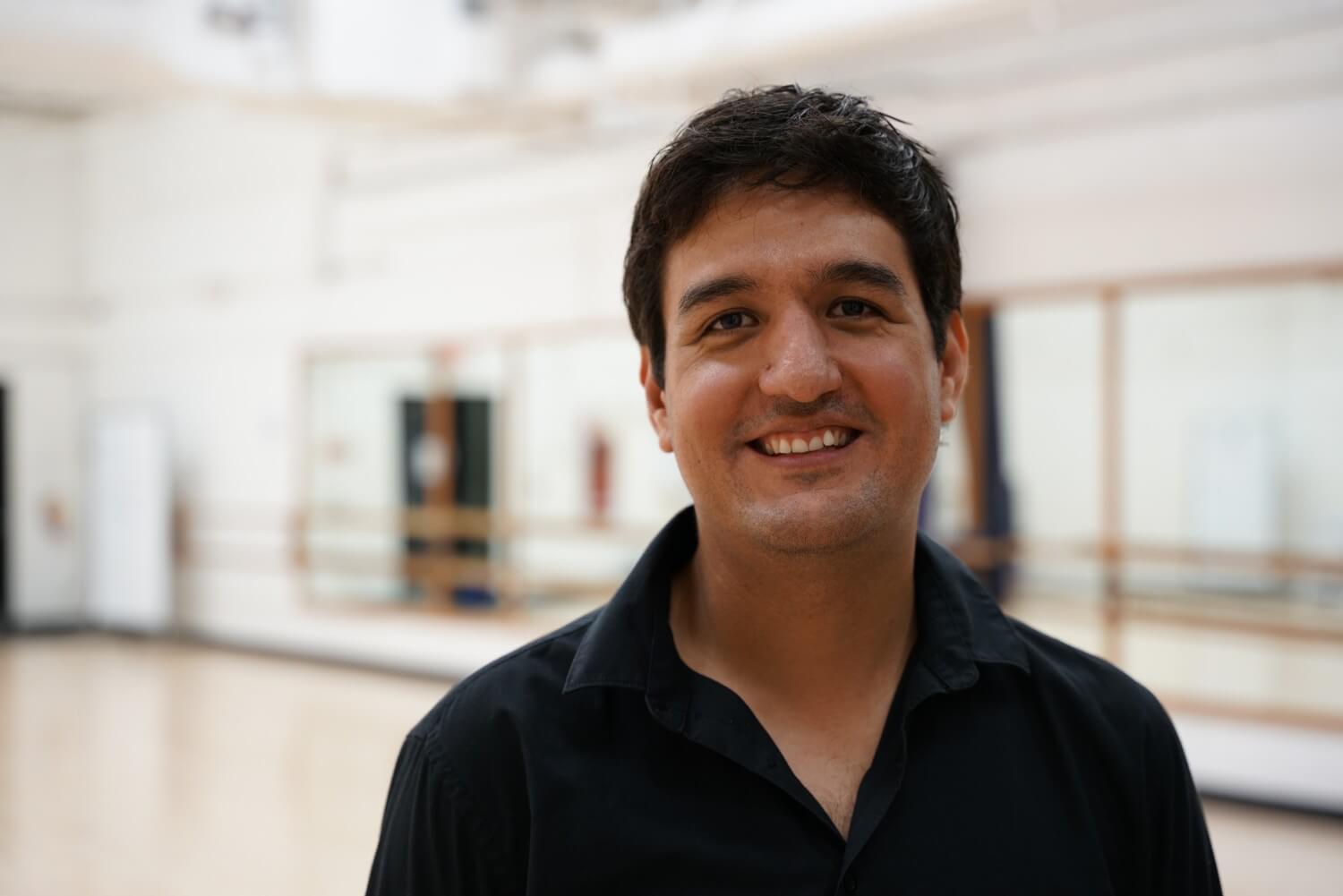
Hector Camarillo Abad, assistant professor of computer science, joined the department in the 2024-2025 academic year.
“My research area is on how to combine technology with dance [through] wearable technology,” Camarillo Abad said. “To get information on how you move.”
According to Camarillo Abad, the interdisciplinary aspect of the computer science department is what drew him to Occidental.
“I think it is an ongoing question — the place of technology in a lot of interdisciplinary areas,” Camarillo Abad said.
AI and Ethics
According to Li, Occidental College and the computer science department itself do not currently have an AI policy.
“We have talked a lot about AI,” Li said. “All the tenured track faculty were on a panel during homecoming last year to share our views on AI.
Li said the department has a variety of opinions on AI.
“As a whole we see both sides of it,” Li said. “We see AI being a helpful tool, some of us use AI on a daily basis. Others are more skeptical.”
According to Li, the principles and core values of the computer science department have not changed since its founding, but the emergence of AI is informing teaching methods.
“AI is able to solve 99 percent of all the questions we ask in an intro computer science class,” Li said. “We now have to do a lot more justification of why computer science is interesting as a field.”
Li said remote learning during the pandemic and the rise of AI have pushed him to ensure students go beyond writing code and develop a better understanding of theory in computer science coursework.
“In the past computer science is often, you submit some code to the auto-grader, which grades your code for you, and if you pass the auto-grader you’re done,” Li said. “Now we think a lot more about being able to explain how your code works, being able to understand what is actually happening.”
Meiqing Zhang, assistant professor in computer science hired in 2025, said computer science courses should adapt with AI as it continues to evolve.
“We should acknowledge it as a reality because that is the environment we operate in,” Zhang said. “In the future it might be worth redesigning the course assessments, like for example how [professors] evaluate the final product or process of their thinking.”
Zhang said while AI provides a challenge in academics, computer science students are encouraged to grow their critical thinking skills.
“I’ve encountered many students who, even though I told them ‘for this assignment AI is permitted,’ still try to work through it themselves,” Zhang said.
According to Zhang, adoption of AI in all areas is only increasing and educational institutions should work to accept them into their programs.
“Proficiencies in AI also better prepares [students] for the job market and I think they should know how to use it productively to solve other problems,” Zhang said.
Finlay McAfee (senior), mathematics and computer science double major, said in his computer science 101 class “Justice and Equity in Technology,” he learned about the influence of technology and AI on society.
“We discussed the implications of using AI and the advantages and drawbacks,” McAfee said. “We talked about mental health, we talked about how AI limits cognitive ability.”
Bustamante, who took the class as a junior, said it has been taught by different professors over the past three semesters.
“I love being able to see the different methods that they approach the class […] and the course being able to highlight their pedagogical differences,” Bustamante said.
According to Li, the department has always been very aware of typical demographics in computer science. Professors make an effort to create a welcoming environment in introductory computer science classes, Li said.
“Nationally, if you look at who works as a software engineer and or in technical roles in tech companies in general, what you’ll find is less than a quarter of them are women and a majority of them are white and Asian men,” Li said.
According to Bustamante, the “Justice and Equity in Technology” class exposed him to diverse voices in academics and the tech industry.
“We read ‘Discriminating Data’ by Wendy Chun and it covered the inherent built-in biases and reproduced ideologies of people that collect data and ultimately decide what it gets to represent, whether that’s people or certain behaviors,” Bustamante said.
According to McAfee, the class gives computer science majors context on the social impact of technology.
“We read a paper about Amazon Echo and how much social labor is involved in it and how detrimental it was for everybody involved in it, so I feel like it gives you a little bit of flavor, things you don’t really think about when you’re wanting to be a CS major,” McAfee said. “It helps you understand the multifaceted nature of computer science.”
McAfee said “Justice and Equity in Technology” is a core component to the philosophy of the computer science department at Occidental.
“I want to do good for the world,” McAfee said. “I want to build interesting technology and I feel like with this class you understand the nuances and what it is actually like being in big tech.”
Contact Sophie Ha at has@oxy.edu