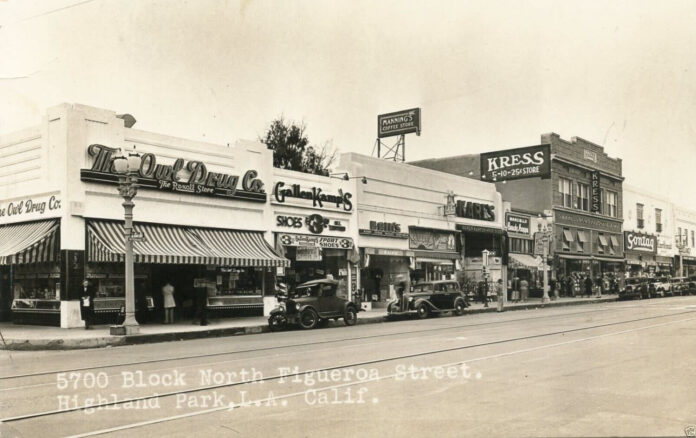
There are many ways to measure how a neighborhood has changed: researchers study US Census Bureau data, residents tell personal accounts and academics cast a story in a broader sense. To understand the history of Highland Park, south of Occidental’s campus, both quantitative data and human experience are necessary. Family-run businesses have adapted, demographics have changed and the area continues to evolve.
What census data reveals
According to Occidental social science librarian Kristin Peace, understanding how to use census — or any — data involves being aware of its biases.
“Nothing we know is neutral,” Peace said. “Sometimes you might think numbers are more neutral, but actually, data is not neutral.”
Peace said researchers should be clear about what they are looking for and open to looking at their research questions from different angles, rather than seeking out data that is a perfect fit for a specific question.
“There is no such thing as unicorn data,” Peace said. “Think about what data you have and how you can look at your question from different angles.”
In 1960, the Highland Park census showed that the neighborhood was 98.1 percent white, but the numbers are misleading — Peace said the US Census Bureau categorized Hispanics and Latinos as white until 1970.
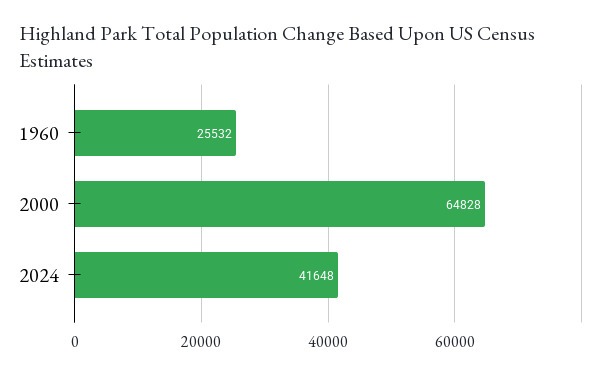
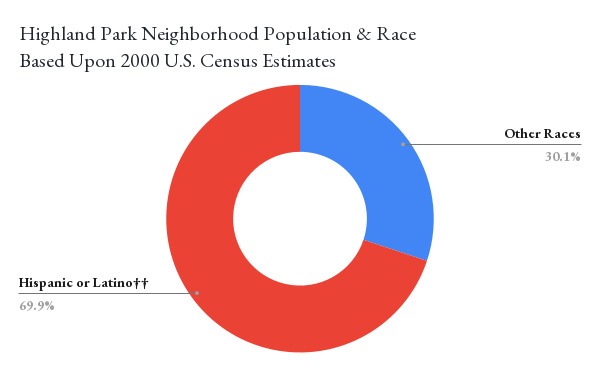
According to the LA Almanac, in 2000 the area code 90042, representing Highland Park, had 64,828 residents. 69.9 percent were Hispanic or Latino and 12.4 percent were non-Hispanic white.
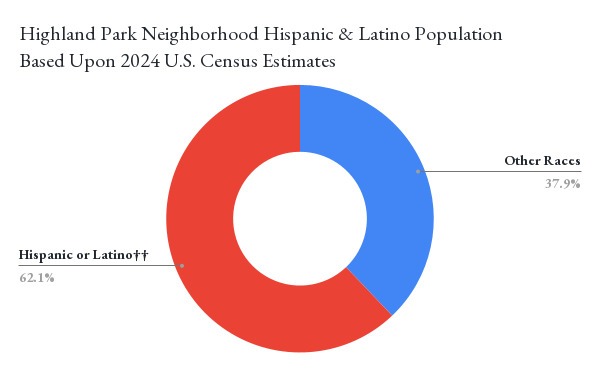
In 2024, of Highland Park’s 41,648 residents, 62.1 percent were Hispanic or Latino and 22.7 percent were non-Hispanic white, according to the LA Almanac.
Quantitative data from a census can numerically show population and demographic changes, Peace said, but human experience will tell more of the story.
“The numbers will tell you what has changed, but the people will tell you what it means,” Peace said.
How local businesses see neighborhood evolution
The Florence family has owned Delia’s Restaurant at 4501 York Blvd. since 2003. Mark Florence, son of the owners, said the family has seen demographic changes in the last two decades.
“It hasn’t been instant, but we could definitely see changes because we were getting new families,” Florence said. “There have been lots of Latin American families moving in and opening their own shops.”
According to Florence, at Delia’s the family tries to balance rising food prices with staying affordable for the neighborhood.
“Everything has gotten more expensive every year,” Florence said. “We can’t always keep our prices low, but we will try our best to keep them as low as we can for our loyal customers.”
Florence said he wishes to continue the family business after his parents retire.
“I would never want to change everything,” Florence said. “We try to keep everything friendly. My parents are always friendly to everyone. I have always wanted to be in the middle of what my parents are doing.”
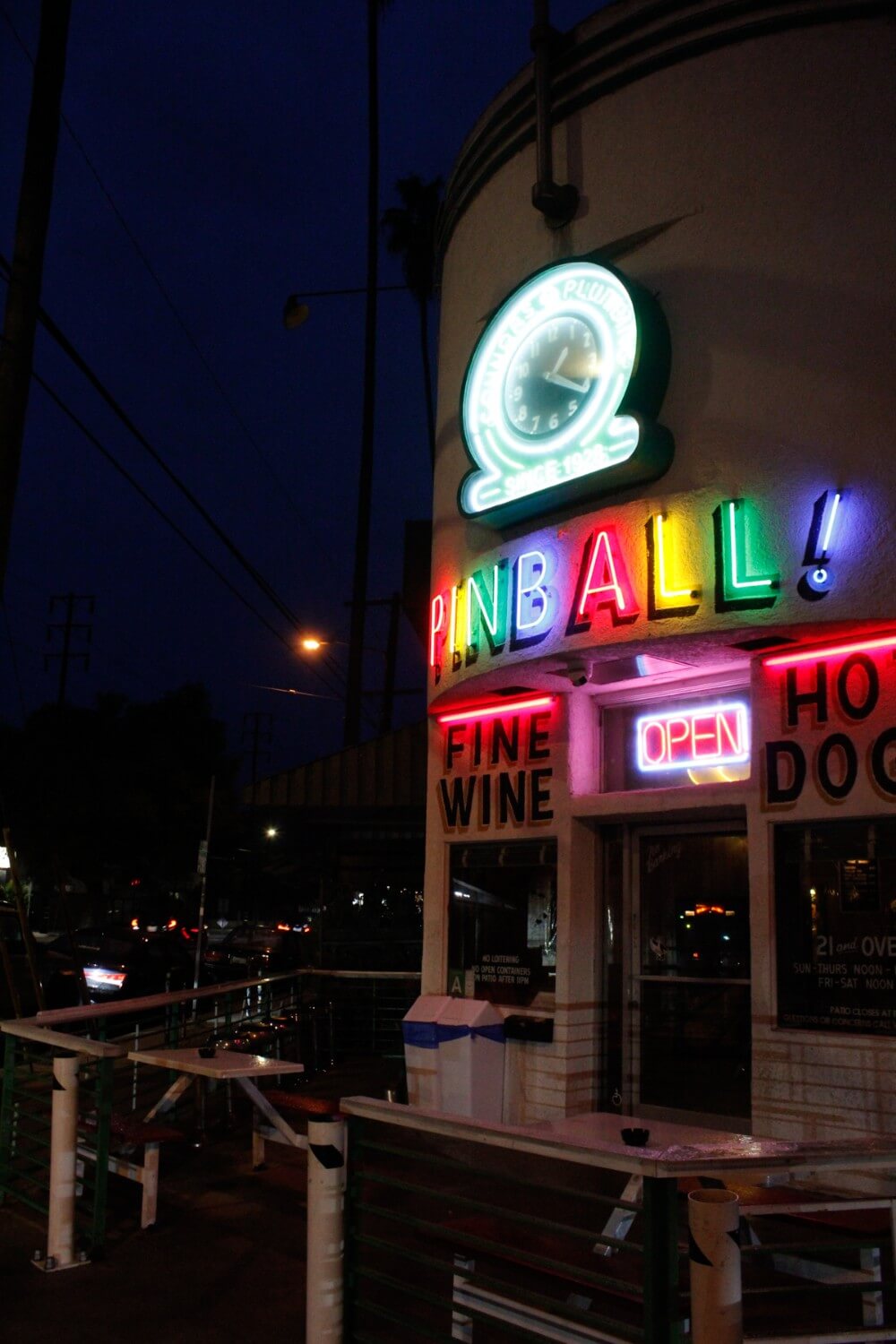
Walt’s Bar, at 4680 N. Eagle Rock Blvd., is located in the former showroom of Connor’s Plumbing, a Northeast LA (NELA) fixture that has been in business since 1928 and still operates out of the back of the building. Walt’s opened in 2018, taking advantage of the iconic neon signs and corner location.
Toni Verdura, a bartender at Walt’s, said the barcade has a strong crowd of regulars.
“We have lots of regulars that have been coming in for the whole time we have been open,” Verdura said. “I have been seeing people since 2018. We still feel we have a good base of a tight community of people who are close to the area.”
Verdura said Walt’s has become a third space for the community.
“I think the best thing a bar can offer a community is a third space where people who wouldn’t normally talk to each other can come together and become friends,” Verdura said.
During the COVID-19 lockdown in 2020, Walt’s had to take out loans to survive, like many other local businesses, Verdura said.
“The pandemic was a huge change for us,” Verdura said. “We have a little back patio and tables outside – we didn’t have any of that before we reopened. A lot of people felt like they wanted to support Walt’s, so we increased our capacity by opening outside.”
Verdura said she has seen customers become unlikely friends. Some customers have money to spend, while others rely on friends to buy them a $5 beer, according to Verdura.
“I am glad it is a welcoming place for people of all economic backgrounds,” Verdura said.
New businesses, such as Capri Club and Vidiots, have recently opened nearby. According to Verdura, these businesses have brought new people into the neighborhood.
“They have brought in people from outside the area to come and see what this side of town is like,” Verdura said.
Verdura said she is concerned that new businesses are better funded than older, longer-standing establishments.
“I really like the people who work at these places and I like that the area is becoming more well-known,” Verdura said. “However, obviously there have been a lot of businesses that have shut down because there has been a lot of investment by corporate. It has been a bit sad to see.”
Rising prices and their impacts
The Highland Park Historical Society cites the Stupey Cabin as the oldest standing structure in the neighborhood. The San Gabriel Railroad promised two rail stations in the area in 1885, and since then, the area has grown and changed multiple times. By 2020, the LA Times was publishing columns decrying the onslaught of hipsters.
Demographics have changed in NELA, just as macroeconomic changes are happening across Southern California. The property prices in Los Angeles County have increased dramatically, causing stress on small businesses and their workers to keep their prices affordable.
Martha Matsuoka ’83, professor of Urban & Environmental Policy (UEP) and the executive director of the UEP Institute (UEPI), was a student at Occidental from 1979 to 1983 and returned in 2005 as an adjunct professor.
“When I was a student here, it was a working-class area,” Matsuoka said. “York Boulevard had very practical shops. We were an immigrant working-class area. Auto body shops, churches and little ethnic pockets. It’s not like that anymore. It still has some of those things, but they aren’t the same.”
According to Matsuoka, gentrification has influenced which small businesses are able to operate in the area.
“There have been many gentrification periods,” Matsuoka said. “[Local businesses] aren’t the same when you have investment banks pretending to be local businesses with infinite money,” she said.
Changes in the area have had a real impact on the community, Matsuoka said, including pushing working-class families with small children to move out of the area. According to Matsuoka, the UEP department did a study 10 years ago that found that all of the Head Start childcare centers in the area had closed down.
“For folks that still rely on that [childcare], that’s a huge loss,” she said.
Matsuoka said she is concerned that changes in the way the US census is conducted may affect who is included in the census in the future, which will have tangible community impacts.
“They’re going to strip out anyone who is not a full US citizen,” Matsuoka said. “When you have reductions of people like that, it will affect the number of representatives we have in Congress. We will have likely much fewer. Services tied to counts in the census will likely be much lower.”
Matsuoka said she encourages students to think critically about how they are experiencing the area where they attend college.
“In some ways, the data is socially constructed. […] Oxy students can’t just think of these places as trendy places to eat,” Matsuoka said. “Look around critically and see where the changes have happened.”
Diana Trutia contributed to this story.
Contact Maddie Gamble at mgamble@oxy.edu