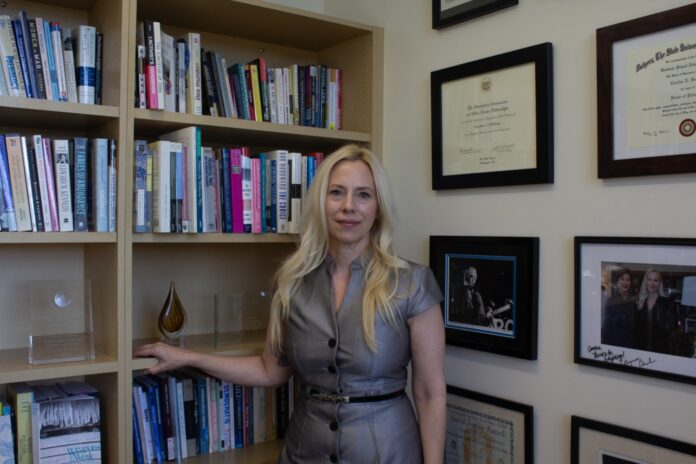
Caroline Heldman, chair and professor of Gender, Women, & Sexuality Studies at Occidental, has been a leader in the college’s reckoning with its handling of sexual assault.
A survivor advocate, Heldman said she cannot walk past certain campus buildings and houses without thinking of students who told her they had been raped there.
As an Occidental professor for 20 years, Heldman was at the college for the 2013 federal complaints of mishandled sexual assault cases and the 2016 federal findings.
This fall, events at another campus have brought the subject of sexual assault to the forefront of national discussion. In September, a woman identified in court documents as Jane Doe sued Cornell University and seven members of its Chi Phi fraternity. She alleges the men gave her alcohol and drugs and that several of them sexually assaulted her at the fraternity house Oct. 19, 2024. Lawyers for two of the men have denied the two men took part. On Sept. 28, 2026, less than two weeks after the suit was filed, the Tompkins County district attorney announced he was reopening the case, in which no charges had ever been filed.
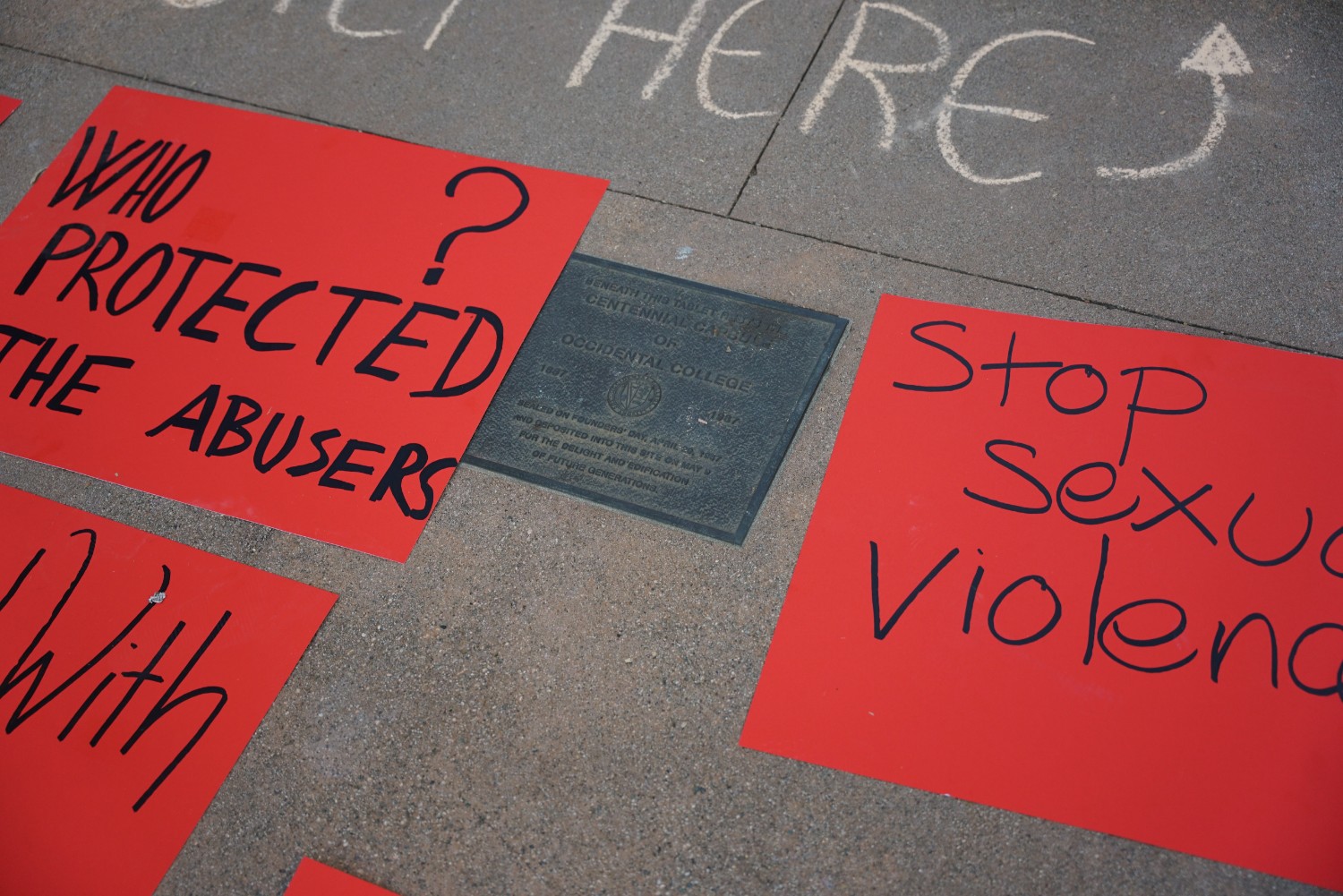
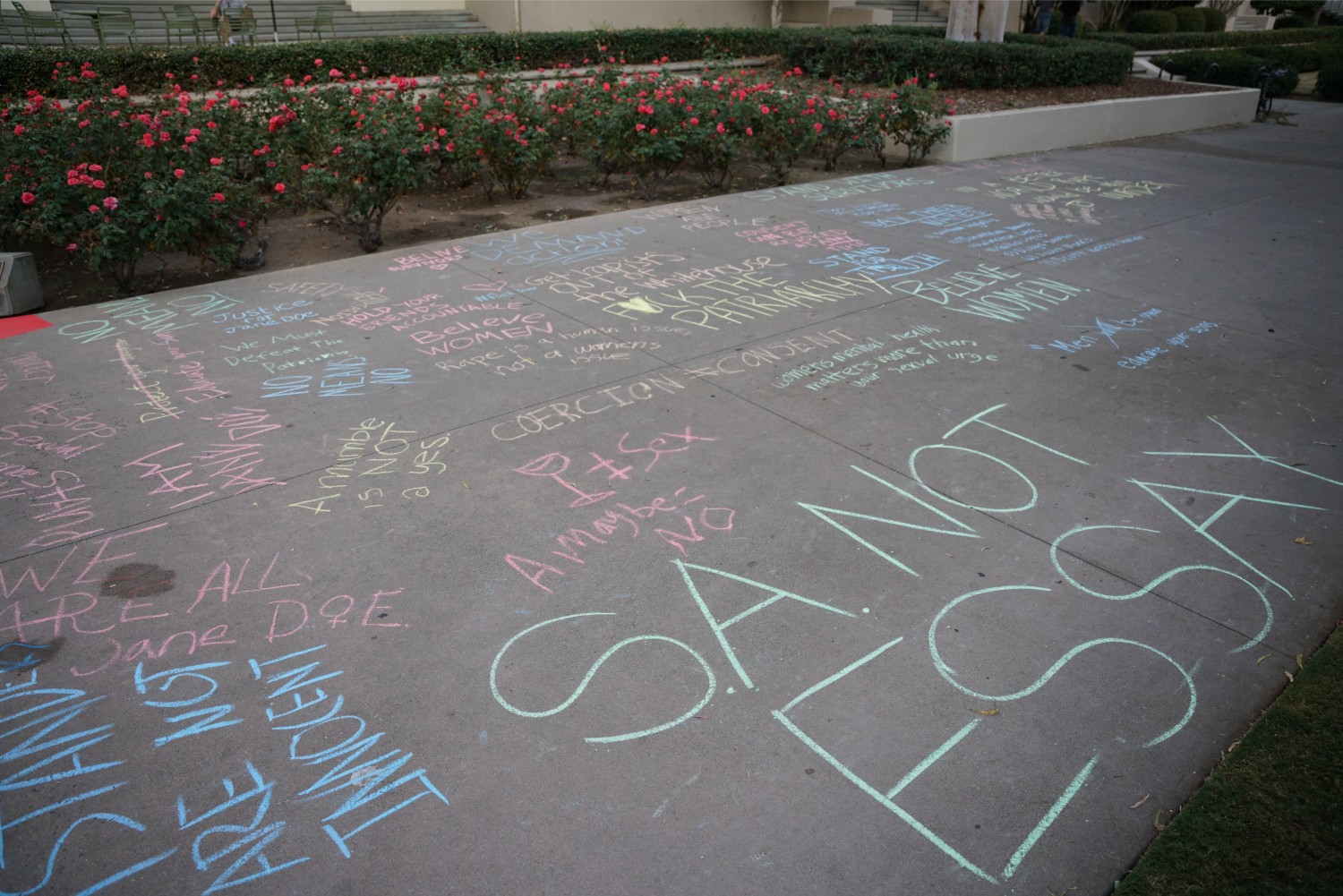
Lola Forbes-Black (sophomore), co-president of Occidental’s Planned Parenthood club, said the club had a discussion on consent and then a rally Oct. 8.
“Everybody at Oxy is turning their disappointment into action and advocacy to really focus on making Oxy a safe place for everybody,” Forbes-Black said.
In 2013, after student protests, about 50 Occidental students and faculty members filed federal complaints saying the college had fostered a hostile environment for survivors. The college settled confidentially with at least 10 women, admitted it had underreported assaults to federal regulators and in 2016 agreed to reforms under three years of monitoring by the U.S. Department of Education, which ended 2020.
Heldman, who helped lead the 2013 protests, said the college’s environment has changed, with a clearer process in place for survivors and nearly all of the Oxy Sexual Assault Coalition (OSAC)’s demands met.
“[The college] actually started making pretty significant changes as soon as we filed,” Heldman said. “And then when the Department of Education findings came down, they made even further changes.”
The long way around
The 2013 protests did not come out of nowhere. OSAC, the faculty-and-student group that led these protests, reported in its timeline that its members had spent six years in forums, meetings and task forces before anyone filed a complaint.
“We tried to do everything by the book internally in the most civil, professional way possible,” Heldman said. “We didn’t file complaints until our hand was forced to do so, because it was obvious that the leadership was not actually going to make serious changes.”
According to Heldman, the breaking point came in February 2013, when a student reported Feb. 25 that another student had raped her the day before and no campus alert was sent out. The dean of students at the time said the case was determined not to be a continuing threat, according to the timeline. Nearly 300 students gathered in protest outside the Arthur G. Coons Administration Building March 1.
The coalition and attorney Gloria Allred announced a federal complaint April 18 alleging that 37 students had been assaulted, harassed or retaliated against for speaking out since 2009. The Los Angeles Times said it could not independently verify all 37 incidents.
According to Heldman, the timing of the filing was strategic.
“We knew that if we filed formal federal complaints, then the press would have something to talk about,” Heldman said.
It was also a risk, Heldman said. Her colleague Danielle Dirks, an untenured sociology professor at the time, is no longer at the college.
“Danielle and I fully expected to get fired,” Heldman said. “And the only reason I’m still here is because I have a good attorney.”
A 2013 alumna, who requested anonymity, said she remembers a campus on edge. She had transferred to Occidental in 2011 after being assaulted at her previous school, she said.
“It never felt like the administration was listening,” she said. “It always felt performative.”
Jane Drinkard ’17, who arrived at Occidental in Fall 2013 and became editor-in-chief of The Occidental in Spring 2017, said parts of the college’s response felt disingenuous.
“There were aspects of [the college’s response] that did feel a little bit like a front or a checked box,” Drinkard said.
Drinkard said some of Project SAFE’s most vocal members at the time were fraternity members who she felt took part to protect their fraternity’s image.
“It kind of felt like, OK, you were doing this for the optics and for the safety of the fraternity rather than concern for your fellow students,” Drinkard said.
The anonymous alumna said she remembers the punishment for at least one student was writing an essay.
The Los Angeles Times reported on the outcome of a 2013 complaint: a student who admitted to sexually assaulting a woman was required to write an apology letter and a 15- to 20-page essay. The complaint reported that the student submitted a two-and-a-half page essay full of grammatical errors.
Coming forward about sexual assault carried its own cost on a small campus, according to the alumna.
“It felt really unsafe to come forward,” she said. “The people who did come forward were just extraordinarily brave and resilient to have done that.”
A settlement, then a correction
In September 2013 the college quietly settled with at least 10 current and former students, the Los Angeles Times reported, citing three sources. The women were barred from discussing how the college handled their cases and from taking part in OSAC, according to The Nation. At the time, then-college spokesman Jim Tranquada said only that the matter had been resolved. Dirks, a coalition member, said the settlement effectively erased the assaults and the college’s wrongdoing.
Heldman said she does not know the terms of the settlements and supports whatever survivors choose, but she has her own view of the timing.
“It certainly took some of the wind out of the sails of the movement,” Heldman said.
Then came a correction. October of that year, Occidental disclosed that it had left 24 assault reports out of its federal crime statistics for 2010 and 2011, bringing its total for those years to 36.
“It was a mistake,” Tranquada told the LA Times.
Then, Occidental’s revised 2013 security report said the college had drawn its reporting boundary incorrectly. The 2013 boundary had treated everything inside the Campus Safety escort zone, from Eagle Rock Boulevard to Avenue 50 and from Las Colinas Avenue to York Boulevard, as off-campus, instead of the sidewalk-street-sidewalk area federal law uses. Heldman, then chair of the politics department, said she saw a motive.
“The college is making a concerted effort to report lower numbers,” Heldman told the LA Times in 2013.
The federal answer arrived June 9, 2016. The U.S. Department of Education announced that Occidental had not promptly resolved three complaints in 2012-13 school year, but had not otherwise violated federal civil rights law, according to the department’s resolution letter. Of the 16 cases in which a student was found responsible, eight ended in expulsion. The letter said the complaint described allegations on behalf of 46 students, former students, faculty and staff, but investigators examined only one timely claim from a student who had given consent. Two others who consented had settled with the college. Under the resolution agreement, the college agreed to annual training on retaliation, annual campus surveys on sexual misconduct and annual reviews of complaints for three years, with federal officials monitoring.
Seven weeks earlier, The Occidental had published survivors’ accounts. Many said little change had been made to improve their safety or trust. One said that if survivors were asked who felt comfortable going to the administration, the answer would be about one in 100.
The former president
Jonathan Veitch, who became Occidental’s president in 2009 and announced in 2019 that he would step down, continues to teach in the history department. Veitch did not respond to The Occidental’s written questions about the confidentiality terms of the 2013 settlements, the underreporting the college disclosed that year or what has replaced federal monitoring. Instead he provided a statement, which he asked to be shared in full. Veitch said in the statement:
“Sexual assault on college campuses is a pervasive, nation-wide problem. Recent events at Cornell remind us of the need for continued vigilance. While Occidental had good policies in place at the time when these concerns were first raised on our campus, they weren’t good enough. I learned a great deal from my conversations with survivors. As a result, we added significant trauma-informed resources for survivors of sexual assault, made a number of improvements to the adjudication process, enhanced bystander and consent training for incoming students. This was and remains an iterative process. Each case provides an opportunity to learn from any mistakes and improve the outcome. The health and safety of our students has to be our highest priority.”
Heldman said the coalition decided to file federal complaints after Veitch shared information he learned from survivors in a December 2012 meeting he promised would stay private.
“He immediately turned around and used the meeting politically, to make it appear as though he was doing more than he was,” Heldman said.
In a March 5, 2013, letter to the campus, Veitch criticized some who had questioned the college’s motives, including on local television news, saying it reflected poorly on their commitment to the conversation. The federal resolution letter later said those comments could have discouraged students from speaking out.
Two weeks later, Veitch apologized in a letter to the editor of the Occidental Weekly, now The Occidental.
“I would like to begin by apologizing for a tone that might have alienated those I most wanted to reach,” Veitch wrote.
Reporting and support today
Heldman said the college today is unrecognizable.
“It’s fundamentally different from top to bottom,” Heldman said. “It’s a new day, new leadership. I can’t say enough about how it matters to have effective, competent, empathetic leadership at the top of an institution.”
Heldman said survivors are no longer questioned in the same room as the accused during on-campus hearings and can bring an advocate.
“I will send survivors to Title IX knowing that they’re going to face a professional process, a clear process,” Heldman said.
Alexandra Fulcher, Title IX coordinator and assistant vice president of OSAC, runs that hearings process. According to Fulcher, most reports reach her office from faculty and staff who are mandatory reporters, and she then offers the affected person a meeting.
“There’s never any obligation for someone [affected] to meet with me,” Fulcher said. “They can ignore me entirely.”
Federal Title IX regulations that took effect in 2020 narrowed the cases that schools were required to investigate, leaving them free to respond to fewer reports. Occidental did not take that option, Fulcher said. Her office still offers support in cases it cannot investigate, including when something happened before a person became a student, Fulcher said.
“Oxy has always been committed to providing more support and more options than we’re legally required to,” Fulcher said.
Lizzy Denny, who has directed Project SAFE since October 2022, runs an office that is independent of both the Title IX office and the Dean of Students office. It is confidential, with narrow exceptions for risk of suicide or harm to oneself or another person.
“They can speak very freely with us, and as long as it doesn’t breach the limits of our confidentiality, we don’t have to involve any other offices,” Denny said.
Survivors, Denny said, often tell her what they want most.
“A lot of times, the survivor’s goal is to feel healed, but also for it to not happen to someone else,” Denny said. “And I feel like that is so heartbreaking because it’s as though the responsibility is being put on the survivor.”
Heldman said there is much more work to be done.
“Oxy does a great job once you’ve been raped,” Heldman said. “Better than before. But it’s the prevention piece that is missing. No system is perfect, and we still haven’t really addressed rape culture.”
Heldman told The Occidental in 2015 that a school can benefit from being forced to confront sexual assault publicly, even if it hurts the school’s reputation.
“What a lot of people get wrong about campus rape is the idea that schools that have federal complaints are schools you should avoid,” Heldman said. “It’s actually the opposite.”
What the numbers cannot say
The clearest public measure of whether the reforms worked is the crime data the college is required to publish each year. The 2026 Annual Security and Fire Safety Report, a publication of certain campus crime statistics required under the federal Clery Act, counts one rape on campus in 2025, down from four in 2023. Reports of fondling fell from six to one. Reports of stalking fell from nine to two. By comparison, the college’s revised 2013 report listed six forcible sex offenses on campus for 2012.
Fewer reports could mean fewer assaults. Fulcher said it could just as easily mean something else.
“It could be either,” Fulcher said. “I think there’s always going to be a difference between what occurs and what’s reported. Just because the reports decline or reports aren’t happening doesn’t mean that the conduct itself is not happening.”
Her office’s own records tell a different story from the Clery report, she said, because the federal report covers only certain crimes in certain places.
“The types of things that get reported to my office and the types of things that end up in the Clery reports, like a Venn diagram, there’s some overlap,” Fulcher said. “But they’re not the same.”
Her office counted 143 reports of discrimination or harassment, including sexual and interpersonal misconduct, in 2023-24, and 150 in 2024-25, according to its annual reports. The 2024-25 report counts each incident once, even if several people reported it. It lists four rape allegations and eight fondling allegations, though a single report can include more than one type of conduct, so those counts do not add up to a number of reports. Self-reports rose from 32 to 55, while referrals from the college’s survivor advocate, made with the survivor’s consent, fell from 10 to two. Responsible employees remained the largest source, though their reports fell from 90 to 78.
In 2013, the college admitted it had left reports out of its federal crime statistics, including anonymous reports gathered in a 2010 Project SAFE survey. Today, confidential visits to Project SAFE may not appear in those statistics either, because federal law exempts counselors from reporting them.
Every one of those counts depends on someone deciding to report, and not everyone does, Fulcher said.
A current student, who asked to be anonymous, described a recent experience of sexual harassment that will not be counted. The student never reported what happened to any college office.
The size of the campus weighed on the decision, the student said. So did the fear of how other students would see them if they spoke up.
“If I were to pursue anything, I worry how many people would find out about that,” the student said. “And how many people would change their perceptions of me as a person?”
The student said they cannot put distance between themselves and the accused.
“If we were at UCLA, I could completely forget they even exist,” the student said. “I’m not allowed to do that. I see him everywhere on campus.”
Fulcher said some students may stay silent because of a misconception about what a report sets in motion.
“Despite me covering this in orientation, they think if something is reported, it’s automatically an investigation,” Fulcher said. “And that’s not true. It’s up to the person who experienced the misconduct to decide what they want to do.”
A familiar story
For some who were at Occidental during the 2013 protests and the years after, the Cornell case is familiar.
“Some of the things that I have heard about the Cornell case and the reporting process really did take me back to my days at Oxy,” the alumna from the class of 2013 said. “It felt especially disappointing because we fought so hard.”
The Cornell lawsuit alleges some of the men were allowed to write essays to mitigate disciplinary action. Kyle Kimball, Cornell’s vice president for university relations, said essays were not the only consequence and confirmed that expulsions and suspensions were issued, the Cornell Daily Sun reported.
“Are you kidding?” the alumna said. “These people are accused of sexual assault, and they have to do homework.”
Forbes-Black, who said she was assaulted a few months before she came to Occidental and does survivor advocacy work off campus, said attention comes only in bursts.
“It takes someone coming out about their absolutely horrible assault for people to care about survivors,” Forbes-Black said. “I think that is really important for us to continue to support survivors 24/7, and not just when it becomes sort of a trend on social media.”
Drinkard said she chose Occidental knowing it was in the news over campus sexual assault and Title IX complaints.
“I felt kind of heartened by the fact that I was about to attend a school that at least was being pushed to deal and grapple with some of these really thorny issues and have to really take accountability for it,” Drinkard said.
Drinkard said she was inspired by the persistence of Cornell’s student journalists, who have followed the case for more than a year. What the case has shown, she said, is discouraging.
“It’s really upsetting to be an alumni, looking back at my college experience almost a decade ago, and feeling like there’s still so much bias in the media and so much stigma for survivors who do come forward,” Drinkard said.
Drinkard said she sees a pattern.
“It gets forgotten, and then it gets brought up again, and we act like it’s new, and then it gets forgotten,” Drinkard said. “We’ve already been here, and we already talked about this, so why is nothing changing?”
Heldman said the fight was never about the administrators who she thought took it personally, but about the affected students.
“It had nothing to do with them personally,” Heldman said. “It had everything to do with students who were sitting in the chair you’re sitting in right now, telling me that they had been raped again and again and again.”
Contact Samhita Krishnan at krishnan@oxy.edu