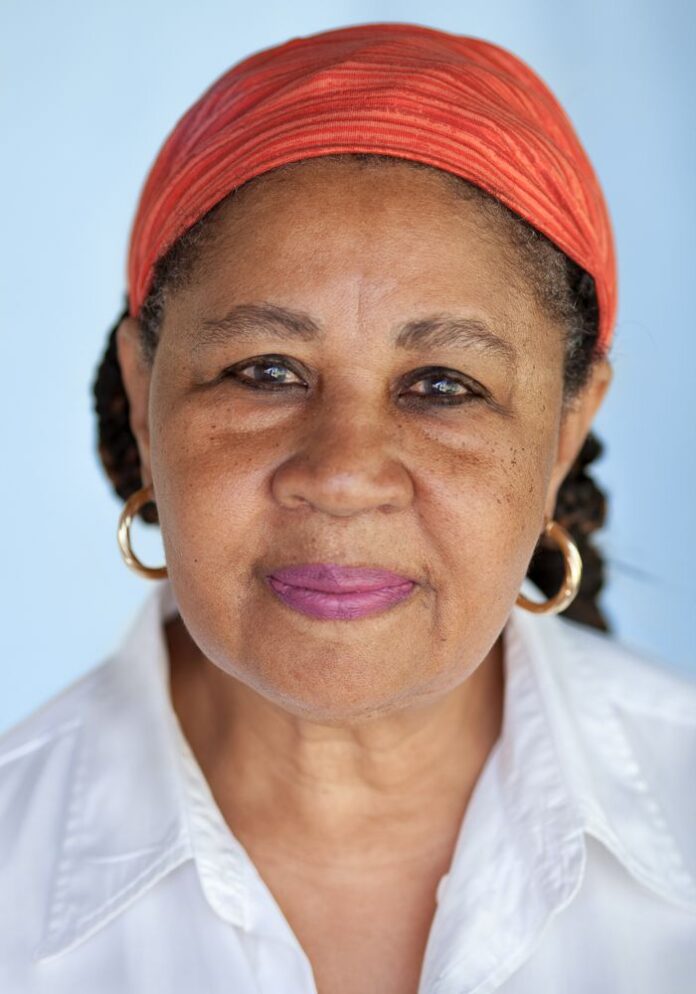
Acclaimed author Jamaica Kincaid accepted the Lifetime Achievement Award presented by the Los Angeles Review of Books and Occidental College at Choi Auditorium Nov. 9. Kincaid taught a masterclass in writing and later participated in a discussion with Professor Robert Faggen of Claremont McKenna College. Kincaid is a prolific writer of post-colonial, feminist and African literature.
Kincaid was born in 1949 in Antigua and Barbuda, a Caribbean island colonized by the British Empire. During her talk, she sported a shirt with the words “I can’t breathe” and a multi-colored skirt.
According to English professor Chekwube Danladi, Kincaid’s visit to Occidental was an impactful event for the college.
“It’s really special to be able to have [Kincaid’s] presence in the room with us,” Danladi said. “The Los Angeles Review had a few heavyweight contenders they [could] have selected for the award, and the fact that her name rose to the top unanimously speaks to the potency of her writing practice in terms of how it’s impacted the literary world at large.”
Danladi said Kincaid’s work has been influential both to her personally and also to the world of literature.
“I see [Kincaid] as a literary elder, both in my own practice [but also] to contemporary writers, Afro-diasporic writers, women writers [and] minority writers,” Danladi said. “Her bravery has empowered us to tell the truth and take up space in ways that might have been previously unimaginable.”
Danladi said Kincaid’s success lies in her uniqueness and unabashed honesty.
“[Kincaid] spoke during her masterclass about how she is understood now as being a part of the postcolonial canon, but in her case she was simply in pursuit of telling the truth,” Danladi said. “She’s able to explore certain depths that other writers might not feel comfortable navigating.”
Emaline Ricketts (senior) said Kincaid was an inspiration to her career in literature, having revolutionized her idea of what writing could be.
“I was in high school when I read ‘Girl’, which was one of the pieces that made me want to be an English major,” Ricketts said. “A lot of what I had been reading in class was the basic curriculum, a lot of classic novels and rhetorical essays. Looking at something that combined fictionalized narratives with expressive rhetorical argument was mind-blowing at the time.”
Jack Cheatham (senior) said getting guidance from Kincaid during the masterclass was inspiring.
“It was really cool to listen to someone who has a ton of experience in a field that I’m interested in,” Cheatham said. “She mentioned that even if no one reads it, you have to write it. To not shy away from [writing], to not be dissuaded.”
Cheatham said Kincaid’s unique worldview and upbringing make her writing particularly captivating.
“A lot of [Kincaid’s short stories] deal with colonialism during her time growing up in Antigua [and Barbuda],” Cheatham said. “I found that a lot of her writing has a cynical sense of humor, but a very funny one [that’s] palpable in her writing.”
Kincaid said during her talk that the education she received while Antigua and Barbuda were under British rule was not for her own benefit — it was to demonstrate colonial literary superiority.
“[The colonial power in Antigua] didn’t mean to educate me,” Kincaid said. “The education of Shakespeare, Wordsworth and Milton was a display of power. When you live in an empire, everything in the empire is a display of power.”
Cheatham said despite the oppressive environment of Kincaid’s education, she’s embraced many Western teachings.
“[Kincaid] quoted a piece from ‘Paradise Lost’ [during her masterclass]: ‘Better to reign in Hell, than to serve in Heaven,’” Cheatham said. “[I interpret it as] to live honestly and to write your experiences as it happens, and not let other people dictate how you live your life or how you write about it.”
Ricketts said reclaiming the once oppressive mantra shows her pushback against her colonial education.
“Having read ‘Paradise Lost’ before, looking at it from a post-colonial lens is interesting, especially considering how Christianity has been used for empire,” Ricketts said. “The fact that that line has stuck with her for so long, the idea that being under someone’s rule is the worst fate, so much that being cast out and being in hell is preferable [if you are free].”
Ricketts said having Kincaid on campus demonstrated the value of literary speakers at Occidental.
“I think it’s really important to get more speakers in the arts,” Ricketts said. “I see a lot of talks and resources set up for people in the sciences, business and psychology. It’s a bit rarer to see these examples of successful people in the humanities. Having these opportunities to see these really inspirational figures here is really important.”
Contact Quinn Godfrey at qgodfrey@oxy.edu