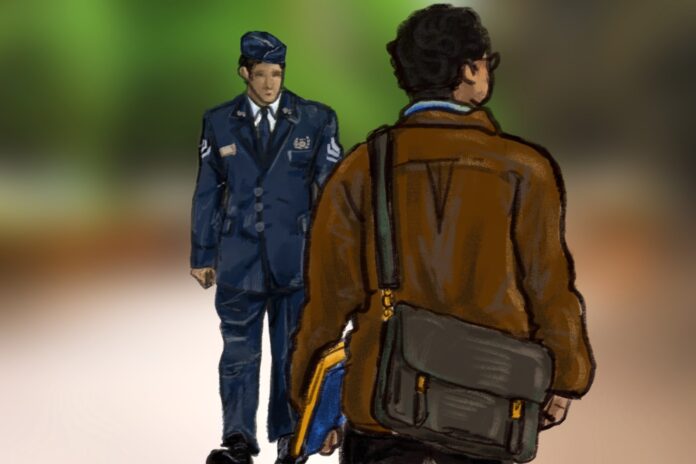
I was sitting at my high school graduation rehearsal, looking at all of my classmates celebrating their acceptance letters and decorating their graduation caps with the logos of their future colleges. Meanwhile, I was worried I would not be able to graduate on time. I was lost. My GPA had fallen below 1.5, I had fallen into the wrong crowd and the darkness was now surrounding me. I had to find a way out.
I hardly knew my father, but what I did know was that he was in the army. I spoke to my history teacher, Mr. Solano, who told me he spent four years in the military and then used the GI Bill to pay for college. I knew my only way out was through service, so five days after graduating high school, I was in San Antonio, TX for basic training.
I had a big culture shock when I joined the military because so many people were unlike anyone I had known before. In the military, I met people who grew up on the farms of Illinois, ate bagels from the bodegas of the Bronx and spent their time hunting in Wisconsin. Some of us were there to pay for college, and others were there because they wanted to shoot guns and fly on helicopters with no plans of ever going to college.
We were diverse not only because of where we grew up and our identities, but we were also different ideologically and politically. Even so, the military gave us all a common mission, so we were always able to find solidarity in one another. The military taught me the meaning of solidarity — that no matter how different another person might be from me, with a common purpose we can always come together as one.
Eventually, I accomplished my goal. I got out of the military and used the GI Bill to pay for college. At first, I thought I would study electrical engineering. I was an avionics technician in the Air Force and worked closely with engineers from companies like Lockheed Martin and Raytheon. It was a job that I would already have some familiarity with, and I knew they made good money.
However, that all changed when I took the class “Ethics” with Professor Paul Klumpe at Santa Monica College (SMC), a community college which I attended for two years. “Ethics” taught me to reconsider my values, and it gave me the tools to articulate and defend my viewpoints. I also joined the Philosophy Club at SMC, where we would meet weekly to debate with one another and further our understanding of our worldview.
I decided to switch my major to philosophy because I knew it would provide me with the foundational skills and knowledge needed to advocate for myself and for the world I want to see. When I was in the military, I saw a world in which everyone was given a roof over their heads, healthcare, dental care, clothes on their backs, a nice warm meal and a community that cares for them. One of the hardest lessons of leaving the military is learning that the civilian world is nothing like that.
As much as I loved SMC, you can’t get a bachelor’s degree at a community college, so I had to transfer to a four-year institution. Occidental has a beautiful campus — and incredible benefits for its military students — but really, it was the veterans community that sold me. Occidental has a small but tight-knit group of veterans, something that is rare in college environments. Being a student veteran has taught me that the most important thing is having a loving community around you.
At Occidental, I was able to compete in the Ethics Bowl competition — where we made it all the way to Nationals! I had the opportunity to write and be an editor for The Occidental, where I was able to learn from a very talented newsroom staff and Barbara Thomas, our adviser. These opportunities, along with all of the classes I’ve taken, have only enhanced my ability to continue to advocate for a world where all people are able to live with dignity.
I have also learned a lot from living in LA with my partner Hana Morita. I volunteered at the nonprofit she worked at, Asian Pacific Islander Reentry Through Inclusion, Support & Empowerment (API RISE), where we would serve a community of people who were previously incarcerated. Also, through my “Public Health Ethics” class at Occidental, I was introduced to Silver Lake, Echo Park, Los Feliz, Atwater Village and Hollywood Neighborhood Homeless Coalition (SELAH NHC) — where we would provide meals, hygiene kits and clothing to the homeless population.
One of the most valuable lessons I’ve learned as a student veteran is that I love to be of service to people. In my life, whenever I was chasing my own personal success or triumph, it always felt ephemeral and empty. Only by succeeding in the service of others have I learned to be fulfilled. We were made to live in community, and it is by serving our community that we achieve happiness.
Contact Edgar Zatarain at zatarain@oxy.edu