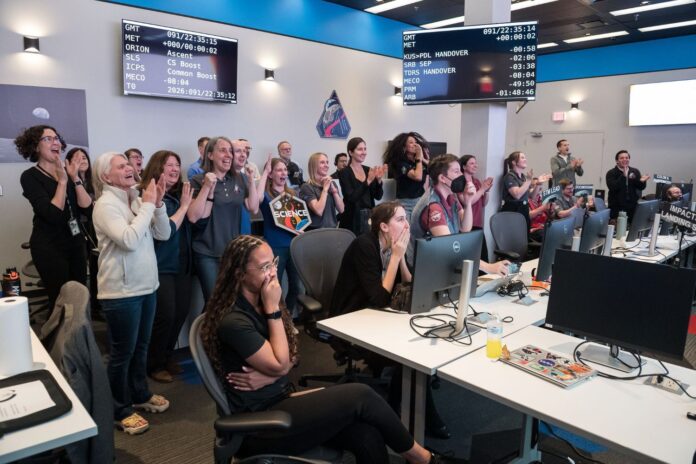
Megan Borel, a geologist for the National Aeronautics and Space Administration (NASA)’s Artemis II lunar science team, delivered a talk titled “The Moon Joy of Artemis” hosted by the departments of geology and physics Oct. 29 in Fowler Hall.
Geology professor Nikki Seymour said she knew Borel previously and organized the talk. Seymour said her “Structural Geology” class had watched the liftoff together at planetary geology major Maya Bhandari’s (senior) suggestion, and reached out to Borel after realizing she had worked on the mission.
According to Seymour, the geology department often invites speakers with knowledge that give students a broader perspective on geology career possibilities; however, Borel is the first planetary geologist speaker Seymour has invited to speak. Seymour said she collaborated with the physics department since they offer astronomy courses.
“It broadens everyone’s perspective to learn things beyond the expertise of our faculty,” Seymour said. “We, [the geology department professors], are accomplished scholars in our own right, but you can only do so much, and there’s entire portions of earth science that we don’t get a chance to talk about in classes, or that we don’t directly research, which may be fascinating to a student. So we want to make sure that we bring in people that expand those horizons and really demonstrate what’s possible.”
Borel said during her talk that because Artemis II was the first crewed mission to observe the far side of the moon, the team especially focused on training the astronauts in geology terms and software so they were specific in their observations, allowing the researchers to get the most detailed data possible.
Scientists on the ground were given two additional rooms that did not exist during the Apollo 17 mission: the Science Evaluation Room (SER) and the Science Mission Operations Room (SMOR), the latter of which was created specifically for the Artemis II mission, Borel said during her talk. Borel said she worked in both rooms as an observation planner in the SER — developing prompts to guide the astronauts in their research — and as a crew data analyst in the SMOR — analyzing and cataloguing the astronauts’ data in real time.
In her talk, Borel said that the mission was historic: it was the first time humans traveled to the moon since the Apollo 17 mission in 1972, the Artemis II crew included the first woman, person of color and Canadian citizen to travel to the moon, and it was the first time scientists could directly support the astronauts through the flight control room.
“I was really impressed with Artemis II because it seemed like science had a voice, and it seemed like people really cared about science,” Borel said. “Being a part of something so huge that was really impactful for seemingly the world was incredible, since we hadn’t gone back to the moon in such a long time.”
Bhandari said she attended a similar presentation by lunar science team lead Kelsey Young at a recent Geological Society of America conference, which mainly focused on the team’s findings and data. Bhandari said she expected Borel’s presentation to be similar, but was pleasantly surprised.
“This last cohort [of astronauts] was so incredible, and being able to hear their sound bites, and then also having Megan give some anecdotes about them was probably my highlight,” Bhandari said. “This is a great era of science, and I think it’s bringing us all together as a scientific community, and also as just people being excited about going to space. I feel like even non-scientists have so much to be excited about.”
Borel said she implemented input and suggestions from students she met with prior to her presentation.
“[Students] know way more about Artemis than I thought they did, so I really wanted to include some stuff that was new and cool for them,” Borel said. “I think it was the right call because everybody was way more interested and knowledgeable than I thought. I was really impressed with all of the students at Occidental.”
According to physics professor Janet Scheel, in addition to the talk, physics and geology majors had opportunities to attend one-on-one meetings with Borel, as well as a dinner hosted by the two departments. Scheel said one-on-ones are especially beneficial to students who may not feel comfortable asking questions in a bigger group.
Seymour said that the meetings allow students to develop a relationship with someone in the field they are interested in.
“It is pretty standard practice for us to take the speaker out and to give the students the opportunity to have that one-on-one time to ask, ‘How did you get where you are? What are you excited about?’” Seymour said. “And that person may become a resource to them that they can reach out to later.”
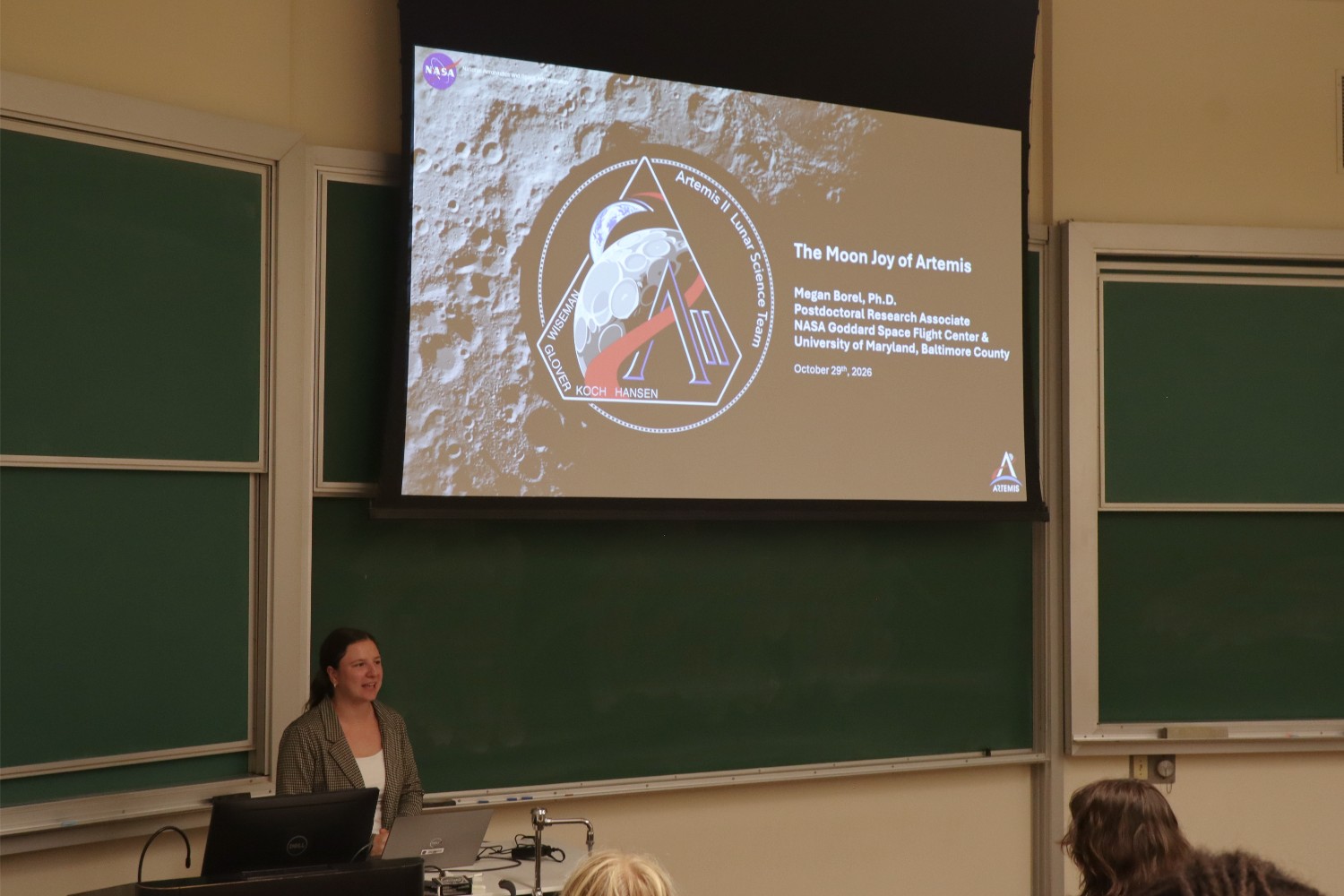
Bhandari said she attended both a one-on-one session and the dinner.
“[Borel] was very helpful because I am also interested in having a career at NASA potentially,” Bhandari said. “She gave me a lot of contacts […] tips and advice, which I thought was really helpful, and programs that I can do to get my foot in the door […] it was also just great to get a more inside perspective of Artemis and what was happening in the control room and in the SER.”
Borel said this was her first talk with undergraduates, and that she found connecting with students to be a rewarding experience. Borel said she hopes she can do more outreach and college talks in the future.
“I was super excited [because] I have been wanting to get back onto [a] college campus, especially for Artemis talks,” Borel said. “When I was an undergrad, I had no idea that somebody with an earth science background could have a part in something like a lunar science mission. So I was excited to pass that torch to geology undergrads and let them know that there are more options than the traditional geology path.”
Contact Corinna Kuo at ckuo2@oxy.edu