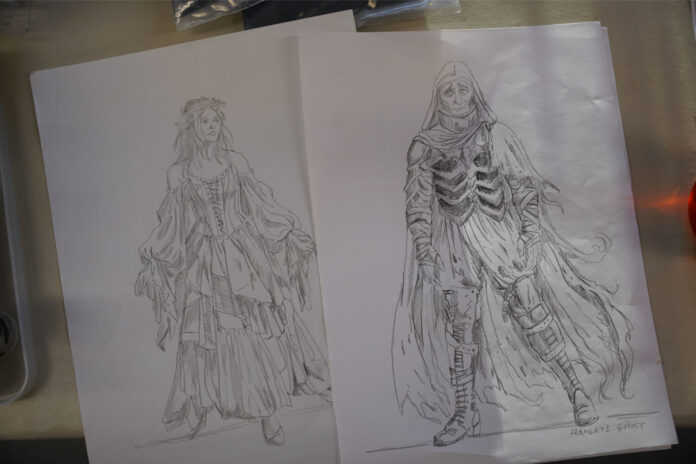
Set not in Middle Ages Europe, but 100 years from now in post-apocalyptic LA, Occidental’s theater & performance studies department aims to take Shakespeare’s “Hamlet” into a future without modern conveniences.
Department chair and professor of theater Will Power is directing Occidental’s production of the Shakespearean classic in Keck Theater Nov. 19 to Nov. 22. According to Power, the department has not performed a Shakespeare-related show in five years.
“[Hamlet] is a really unique foundational thing for our culture and for our field as theater artists,” Power said. “There was a lot of excitement, both in our department, among students and also throughout the campus, because people know ‘Hamlet.’”
Power said “Hamlet” asks people to reevaluate the world in the current moment.
“These questions of human existence […] are really relevant today,” Power said. “‘Do you act on what you know is right, or do you hesitate? Should we persevere or not persevere? It’s a hard play to explore.”
Finn Crumlish (junior) plays the titular Hamlet, prince of Denmark. Crumlish said he auditioned with hopes of being cast for the leading role.
“I didn’t have a very robust theater program at my high school, so I was part of a Shakespeare teen troupe, and I did six Shakespeare shows over the course of three years, including Hamlet,” Crumlish said. “I love Shakespeare and I’m very familiar with Shakespearean language.”
According to Crumlish, he has performed physically demanding and comedic roles for most of his time at Occidental.
“My character [in ‘Rumors’] was really angry and screaming a lot of the time — I had a long monologue where I was running up [and] down stairs, falling over, getting back up [and] running around the room,” Crumlish said. “Those shows really helped, but Hamlet is a really emotionally intense role. I describe him as the king of hyperbole.”
Elizabeth Kugler (senior) plays Gertrude, Hamlet’s mother. According to Kugler, her past roles as George in “Scapin” and Officer Pudney in “Rumors” taught her about staying in character with fewer lines.
“You really have to concentrate on staying fully present in the moment, which is something a lot of us struggle with, not only in the theater, but in life,” Kugler said. “I’ve taken so much of what I learned in those roles in how much you contribute to the scene even when you’re not speaking. I feel like that has really translated to the work I’m doing with Gertrude.”
Crumlish said the main difficulty he faced while rehearsing was discovering his own version of Hamlet.
“He’s been done by so many incredibly talented actors and actresses over history, so stepping into those shoes of the character — it’s so intimidating,” Crumlish said. “Hamlet is someone who I believe feels emotions stronger than other people.”

Crumlish said Hamlet’s self-loathing character is apparent in his various outbursts. According to Crumlish, Hamlet’s misogyny is an important part of his personal struggle.
“One of the first things he says in the play is ‘Frailty, thy name is woman,’” Crumlish said. “He feels he has to live up to his father, who is the peak of what masculinity is, and even Laertes, his foil, really exemplifies what a proper masculine character in Hamlet’s time is when Hamlet is not that. A lot of Hamlet’s hatred of women really is his own feelings of inferiority.”
Kugler said although Gertrude does not have as many lines as Hamlet, she has a constant presence throughout the play and a multifaceted identity to explore.
“Gertrude is very much the key to the throne; Claudius knows that, Hamlet knows that and the previous King Hamlet knows that,” Kugler said. “You have to look at a particular scene and say, ‘Which of my identities am I putting forward the most here? Am I the queen? Am I a mother? Am I a peacemaker?’”
Kugler said one aspect the cast has kept in mind while acting in “Hamlet” is de-roling. Kugler said while actors may be able to separate performance from reality in their mind, acting can still take a mental and physical toll on the body.
“You have to remind your brain every time, ‘I know we just got yelled at for a false scene, but that’s fake,’” Kugler said. “Our cast is super supportive of each other, especially in those moments of those scenes where we have really emotionally charged interactions. For example, me and Finn, who’s playing Hamlet, always check in with each other before our scene.”
According to Crumlish, despite placing “Hamlet” in a new setting, the play follows the original script.
“Even though our version is set after the great collapse of everything […] society has started to rebuild itself,” Crumlish said. “We can change the setting of the play and the impact that it has on the audience, but keep it true to what the original is. The conflict of Hamlet is so human that it can work in any time period.”
Contact Vivian Pei at vpei@oxy.edu