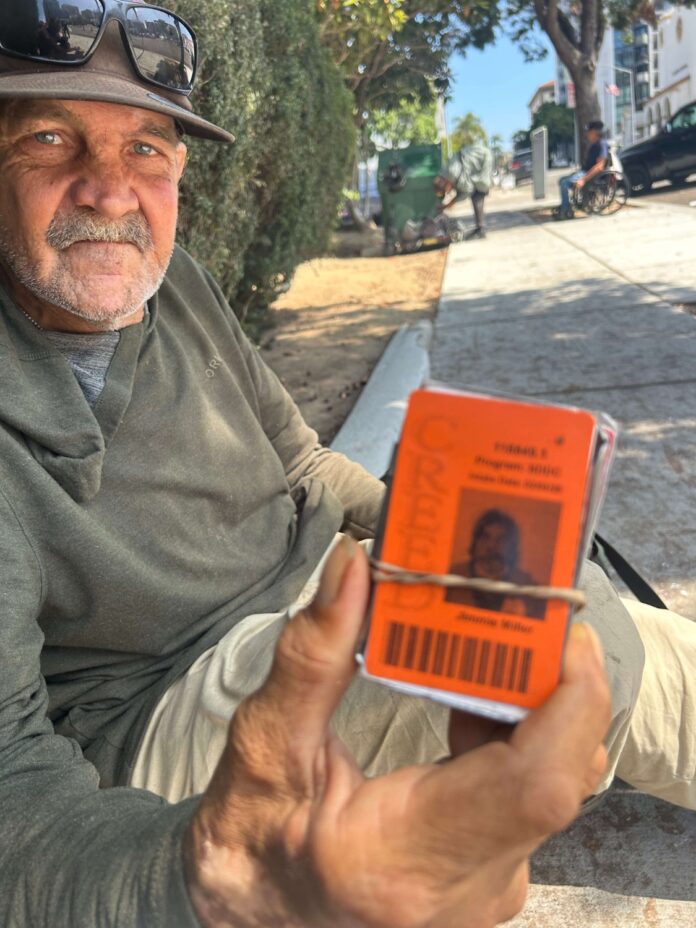
Meeting Jimbo Miller
Two James Millers sat together on a curb outside of the Third Avenue Charitable Organization (TACO), a homeless services organization in downtown San Diego, June 2, 2025.
One of them, Jimmy Miller, 21, had rambled six blocks from Times of San Diego — the fledgling local newsroom based just north of downtown where he interned on the housing and homelessness beats — to the organization in search of a two-stall mobile shower.
The nonprofit distributes daily meals, charges devices, holds mail for 1,400 of San Diego County’s roughly 10,000 homeless people — and offers free showers in a converted horse trailer.
Lorena Galligan, the organization’s director, parked the hygiene Airstream trailer in a filthy parking lot where drug addicts tied belts around their biceps. The lot is adjacent to TACO’s offices on the second floor of a church’s administrative wing, which oversee a tidy courtyard where food is served.
Outside that courtyard, Jimmy met Jimbo Miller, 65, and interviewed him for about 10 minutes about being homeless.
Jimbo said in a gruff voice that he was from Cabazon, CA — a rural desert community along Interstate 10 between Riverside and Palm Springs.
After his wife, Kathy, died, he had been homeless “on and off forever, man.”
He now stayed in a shelter downtown run by one of the largest homeless services organizations in San Diego, Father Joe’s Villages, which sheltered more than 11,000 different people in 2025. In the past, Jimbo had worked as a day laborer, cleaning construction sites in El Cajon, a town of 100,000 east of San Diego.
But Jimbo had trouble finding laboring work close to his shelter downtown.
“There’s nothing I can do,” Jimbo said of his unsuccessful job search.
Plus, Jimbo was having trouble registering for a Social Security appointment, which meant he wasn’t receiving the benefits he was entitled to.
In the interview, Jimbo was easygoing and laconic — but also bumbling and incoherent. He mentioned a court-ordered stay at a shelter in Riverside County that turned out to be a now-defunct drug treatment center. When discussing how hard it was to register for Social Security benefits, he blew a raspberry and grew upset, although not irate — which would’ve been a rational response, too.
In many ways, Jimmy was to blame for some of Jimbo’s ambiguity. Listening to the interview 10 months after the fact, the silences between questions seemed drawn out, as if the interviewer was grieving. Jimmy realized he hadn’t asked the right follow-up questions, or really any at all. When he had probed, he’d focused on Jimbo’s experiences navigating the regional network of homeless services, like the soup kitchen and the shelter. It’s not a bad line of inquiry, but it dodged the real story: that two people with the same name — the same starting point for the self — could live such different lives.
I’ll drop the bit and admit I’m Jimmy. But I’m also not the Jimmy who met Jimbo last summer. When he met Jimbo, that Jimmy was speechless because homelessness became personal in an instant.
Jimbo’s bright blue eyes and his obfuscations about substance use and unstable family life didn’t remind me of my own story, but I recognized them as running themes in my own family.
Now, I’m not sure that linking Jimbo to all the James Millers, so to speak, that I know, is right.
I only spoke to Jimbo for 10 minutes. While he hinted at a few possible reasons that he was homeless during our interview, I didn’t know for sure that he was an addict or that he had family problems. Those were projections of mine, which came from the stories of financial dependence and homelessness that resonated the most for me — but they weren’t necessarily true for Jimbo.
For instance, when I asked Jimbo if he had kids, he said he did.
“I haven’t talked to them in a long time,” Jimbo said. I took his answer to mean that he had been in some sort of family dispute. His disgruntled tone supported my interpretation — but our brief conversation hardly outlined the complex life I’m sure he’d lived.
The night I met Jimbo, I made a rare entry into my journal about him. I jotted down Jimbo’s lack of family and that his “teeth had rotted and he spoke with the grandfatherly drawl of a man who is old and tired. But he was only my dad’s age.” I sketched in Jimbo’s story by working him into my family story — both my dad and grandfather are James Millers. But this move of mine overdrew Jimbo, whom I hardly got to know.
When I re-listened to my interview with Jimbo in April 2026, I realized that my interest in his possible family problems or a substance use disorder — aspects of his story I found captivating, in part, because they were just out of reach — had led me away from a glaring component of his homelessness: the paucity of work near his shelter.
According to Jimbo, an average day for him involves going to different soup kitchens downtown and then going to “try and find some work.” In addition to his day laboring gigs in El Cajon, Jimbo said he had previously bussed tables at a hotel downtown.
But at the time we spoke, Jimbo’s mercurial personal life seemed like a more obvious source of his homelessness than his trouble finding work did, or his lack of permanent housing.
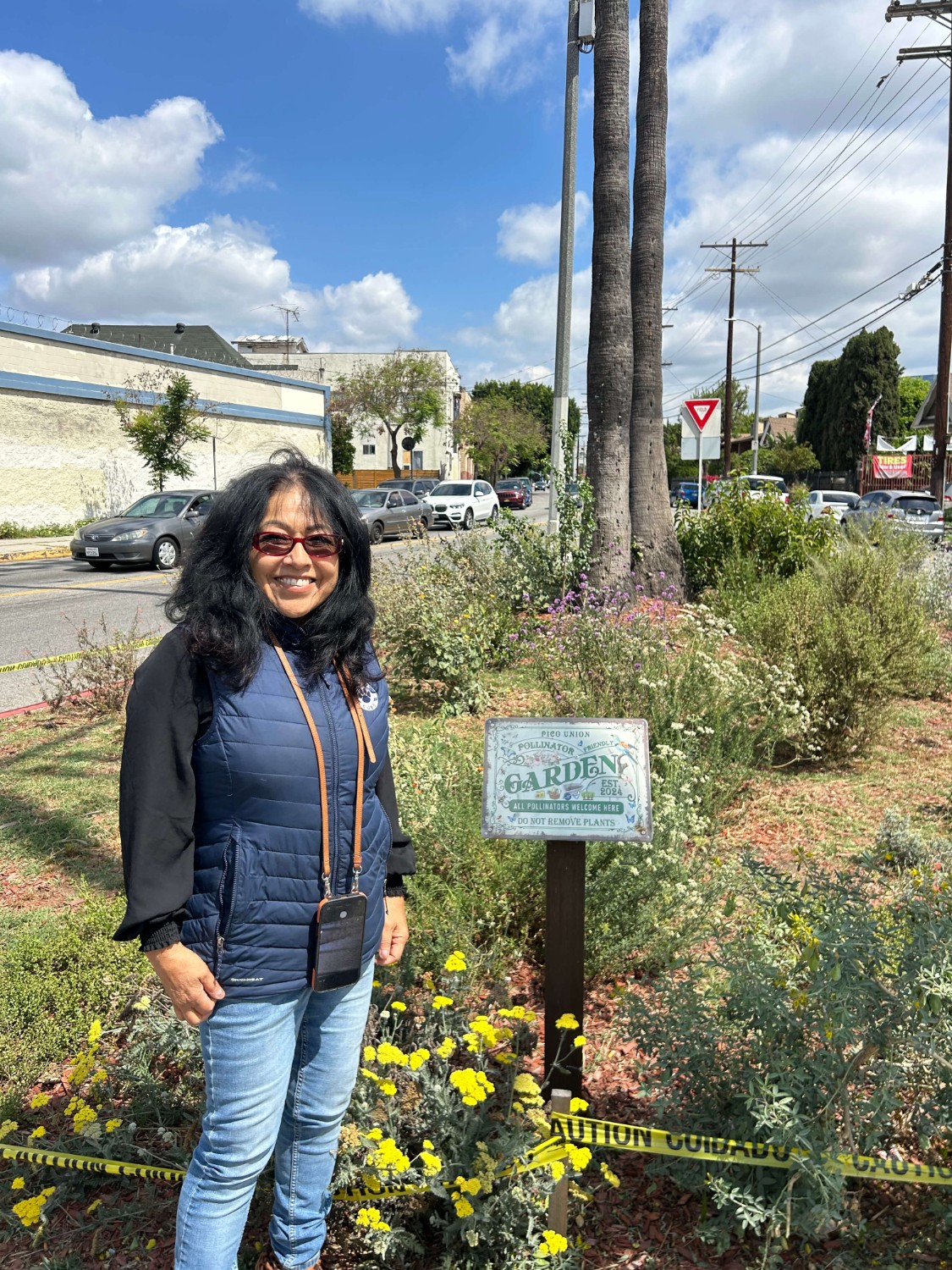
Homelessness in LA’s urban core
Occidental alum Aurora Corona ’77 is a community activist who has served on the neighborhood council in Pico Union, the neighborhood just west of downtown Los Angeles where she grew up.
An art history major, Corona caught the travel bug while studying abroad in Florence, Italy. After graduation, her career at American Airlines allowed her to live abroad in New Zealand, Venezuela and Argentina.
Corona organizes biking safety and poetry events at local schools. She spearheads neighborhood revitalization events, such as a native plant garden in a street median and a trash pick-up in February — attended by Los Angeles Mayor Karen Bass — at MacArthur park in Westlake.
When Corona moved home after 9/11, she said she became a Spanish linguist for law enforcement — which involved wiretapping cartel communications.
Now, addicts abound on the streets in her community.
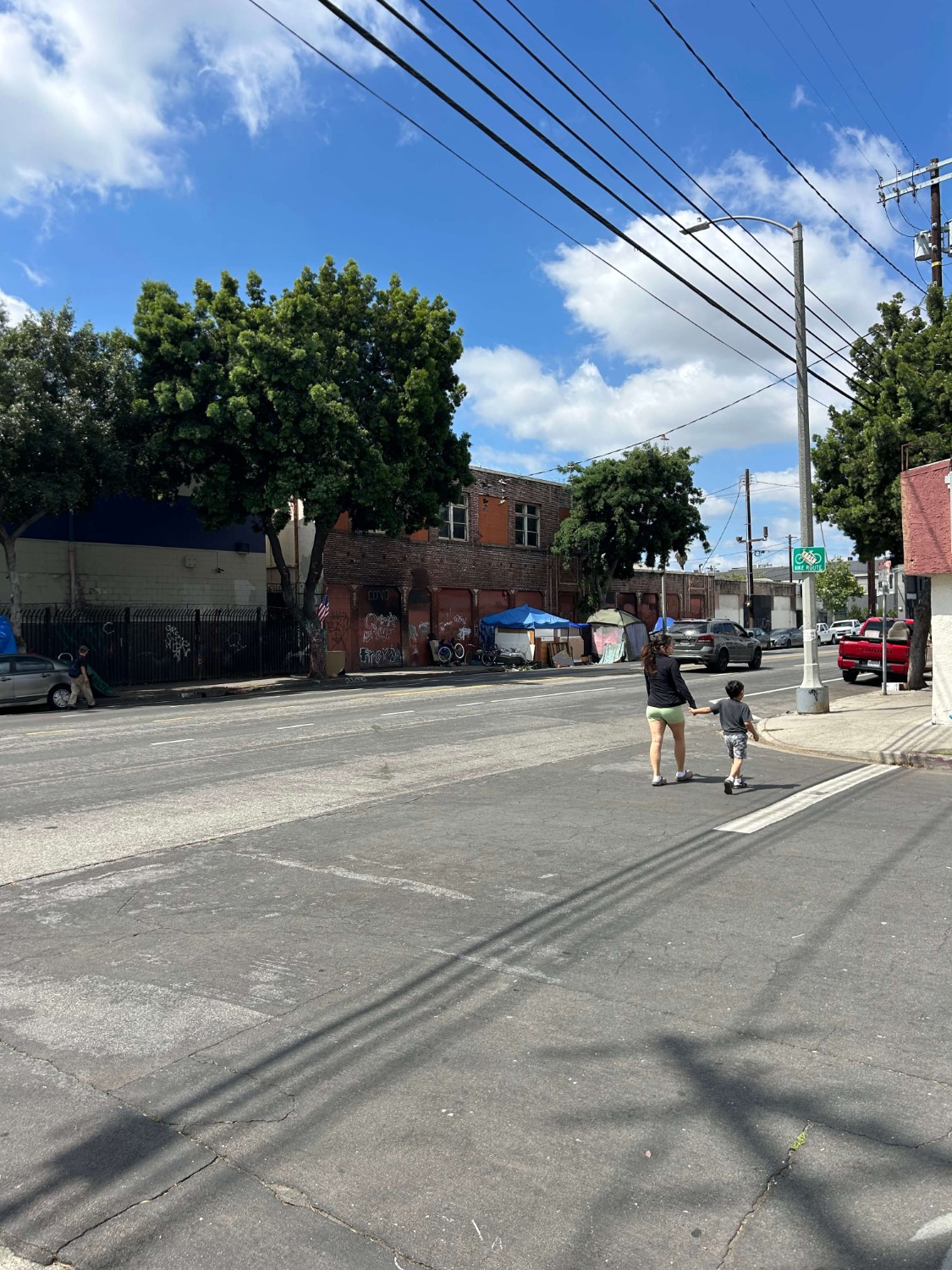
According to Corona, Pico Union has had gangs since the 1980s, but now there is a drug dealer on her block, and two nearby homeless encampments littered with bicycle parts that she said are stolen.
MacArthur Park — where Corona led a clean up in February — is an open-air drug marketplace where gangs sell drugs out of tents in the homeless encampments, the US Attorney’s Office claimed in a March 5 press release about the indictment of 12 members of LA’s largest street gang.
A larger-than-life statue of Prometheus in the park was revised by LA artists S.C. Mero and Wild Life in early 2024, when the guerrilla van Goghs put a giant meth pipe in the mythological figure’s left hand.
In early 2025, the city enclosed sidewalks around the park, displacing street vendors selling illicit and legitimate goods, according to LA Taco. Per The LA Local, Westlake has a sizable Latin American immigrant population, and one quarter of its workers are not U.S. citizens.
Corona said that until the 2000s, MacArthur Park was mostly known for drunks, not drug users.
“You could still go there, you could still shop there,” Corona said of the park two decades ago.
Drugs have since become more prevalent in the park.
“Nobody wants to go there. Everybody’s afraid to go down there at night, or even during the day,” Corona said of MacArthur Park today.
According to Corona, the profligate drug use in MacArthur Park and the gangs that have infiltrated the encampments have made it difficult for social service providers to reach addicts who might want to get clean.
Per the LA County Dept. of Public Health, approximately 20 to 35 percent of homeless people have a substance use disorder, a statistic supported by data from department programs.
During the 2024-25 fiscal year, 41.7 percent of people admitted to a publicly-funded substance use disorder treatment center in LA county — 14,938 individuals — were homeless. That number is 20.7 percent of the 72,195 people who were homeless county-wide in early 2025, according to the LA region’s most recent annual point-in-time count.
According to the Los Angeles Homeless Services Authority (LAHSA), in 2025, the homeless population in LA proper was 43,695, of which nearly 27,000 were without shelter.
According to the Mayor’s office, homelessness declined for the second year in a row in 2025, and the unsheltered homeless population has decreased 17.5 percent since Mayor Bass took office in late 2022.
Corona said that to shrink the population of unsheltered addicts in MacArthur Park and her neighborhood, the city needs to expand CIRCLE, a program that dispatches unarmed response teams to non-emergency situations involving homeless people.
CIRCLE operates in south-central LA and a swathe of the city from Hollywood to Lincoln Heights that includes Westlake, but not Pico Union.
Corona also said that homeless people who are granted temporary housing through Inside Safe — the mayor’s signature anti-homelessness program — should be connected with jobs.
“Once you get people in the homes, what do you do with them? How can we sustain people just [by] paying for them?” Corona said. “They’ve got to be given an incentive to work, an incentive to get jobs. Give them some pride and find out what their talents are.”
According to Cal Matters Homelessness Reporter Marisa Kendall, Inside Safe transfers encampment inhabitants to hotels or motels until they can find permanent housing — at an average nightly cost of $121 per bed.
Inside Safe has faced criticism for its high recidivism rate. As the LA Times reported April 5, 40 percent of participants in the program that has cost more than $323 million are once again homeless.
According to a dashboard of Inside Safe’s outcomes and finances published in November 2025 by LA Controller Kenneth Meija’s office, of the program’s 5,808 beneficiaries, 24.6 percent are now housed and 29.6 percent are in interim housing — mainly motels. More than 45 percent of Inside Safe participants have exited the program, and for the most part, they’re back on the streets.
A former LAHSA employee spoke to me about homelessness in LA — anonymously, to avoid professional reprisals. The employee criticized Bass’ Inside Safe as a temporary solution to homelessness. They said that when funding for the program runs out, formerly homeless individuals in temporary housing will likely be released back to the streets.
That day is right around the corner, they said. The city of LA faces a $1 billion budget shortfall, the county is moving their funds from LAHSA to a new homelessness agency due to fraud concerns and Republican leadership in Congress jeopardizes federal funds for housing and urban development.
According to the employee, California doesn’t have just a homelessness problem. It has a housing shortage, inaccessible medical care and growing poverty. They said the root issue is that the city lacks enough housing.
Seasoned journalists and progressive stalwarts seem to agree. In a rejoinder to a moderate conservative’s book about homelessness in San Francisco, Occidental’s E.P. Clapp Distinguished Professor of Politics Peter Dreier pinned the growth of homelessness nationwide in the 1980s on “the combination of closing the nation’s mental hospitals (without providing the promised funding for community-based treatment settings) and the Reagan administration’s cuts in federal funding for low-income housing.”
Former LA Times Senior Editor Mitchell Landsberg and staff writer Gale Holland chronicled the history of LA’s homeless in a feature of epic proportions published last year. They write that the average cost of a home in LA today costs six times what it did in the early 1970s — and that’s accounting for inflation. From 1975 to 1979 — before Reagan — prices doubled.
In their feature, Landsberg and Holland write that there are poor people, drug users and those who need treatment for mental illness in every U.S. city — but those cities don’t have “this many people without homes.”
According to Dreier’s article, “when more low-rent housing was available, including many rooming houses since lost to gentrification, even people on society’s margins could afford a roof over their heads.”
Whether cheap boarding houses were lost to gentrification or less clear market forces is debatable — what is for certain is that they just weren’t hovels keeping the infirm and the debauched out of sight. According to an LA Times article from 2024, the single-room occupancy hotels on Skid Row that now reek of feces were acceptable havens in the early 2000s.
Homelessness is a catch-all at the confluence of many issues, as Landsberg and Holland acknowledge in their article, writing that “the poverty, lack of support system, childhood trauma, domestic abuse, financial and legal problems that sent people into homelessness in the first place won’t just vanish in new housing. But it removes the chaos of living on the street.”
When I met Jimbo last summer, I wanted a simple explanation for why he was homeless, so I lent him a story I knew. Now it’s clear to me that there are many reasons he ended up outside the soup kitchen on Third Avenue, including that his housing and work opportunities were determined not by human need, but by profit. That force explains his malaise, but maybe not entirely.
I changed my thinking about why Jimbo’s homeless, but the reason his story matters in the first place remains the same: he’s family. During our interview, I saw my father in another life, or my grandfather or me.
It took meeting someone with my name to see myself in a homeless person, to see the people I love on every sidewalk, in every median, doubled over with needles in their arms, smoking from glass pipes, sleeping in their cars or on the beach or on a bench or on the bus. And even when I don’t see someone I love, I know I’m seeing a son, or a father.
Contact James Miller at jmiller4@oxy.edu