Christmas 2019, my aunt surprised my grandma and me with tickets to see the Golden State Warriors play at Oracle Arena in Oakland. Being 13 and very new to basketball, I didn’t understand the significance of seeing that incredible dynasty play together right after winning a championship (looking back now, I kick myself a little for not fully appreciating it, considering the dreadful state of the current Warriors). The arena was vibrant and vivacious, so loud it was almost impossible to hear the person sitting next to you. I left that stadium with a little ringing in my ears, questioning why I ever played a sport besides basketball.
While that was an incredibly formative experience, I’ve been exposed to the uglier side of the NBA as I’ve gotten older. The NBA’s advertising, politics and attitudes have made it clear to me that the league has been designed for cis straight men. We can see this in how the league has protected players accused of violence against women, like Josh Giddey, Kevin Porter Jr. and Miles Bridges — all players who still have active, thriving careers in the NBA. Not to mention NBA legends who are still beloved within the league like Kobe Bryant and Karl Malone. Malone was invited to judge the All-Star Weekend Dunk Contest in 2023.
Blatant misogyny within the league is also evident in the treatment of female referees. Despite there only being eight female referees in the entire league, they are heavily scrutinized by both fans and players. There have been many instances of these refs being disrespected by players themselves, one instance being Houston Rockets forward Alperen Sengun calling female referee Jenna Reneau a “b****” during a game earlier this year. The few women who have been able to break into this male dominated space face harsh ridicule and disrespect.
When it was announced that the Bay Area would have its own WNBA expansion team, I was ecstatic. I had seen the Seattle Storm play in Climate Pledge Arena the summer of 2022, where WNBA legend Sue Bird played one of her last games before retiring. It was an awesome atmosphere despite the lack of attendance. Only one third of the stadium was filled. Regardless of the turnout, every fan was overjoyed to be there.
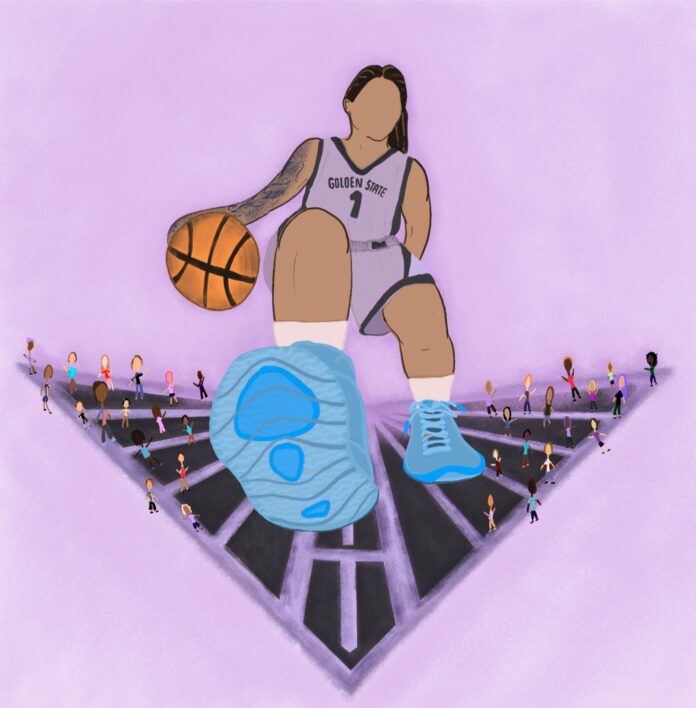
I was incredibly excited to see the Golden State Valkyries play in person for the first time this summer; I had kept up with their season, and watched games on TV, but had not experienced it in person. I was happy to go into the merchandise shop and see an entire section of Valkyries gear — not just a miscellaneous WNBA pin or shirt tucked away in the corner but a full section of purple jerseys, hats, bags and pins. The capital investment in women’s sports was something I had not seen at that grand of a scale before. It felt like something I loved was truly made for me, and I’m sure the hundreds of little girls at the games felt the same way.
The arena was filled with women and young girls. It was weird to see a male minority at a sporting event. As each player was introduced, the sea of purple jerseys were in an uproar and the stadium came to life; the feeling of being in Oracle Arena seven years ago flooded back to me. I sat there amidst the exhilarated crowd, next to my mom and sister, on the verge of tears. I remember the words ringing in my head: “Wow, people really care about us.”
Unlike at NBA games, all of the referees, announcers and commentators were women, along with most of the fans in attendance. The WNBA is a league founded by women which has fought tooth and nail for the past 30 years to gain the recognition it deserves, and it felt like that mission was coming to fruition. Before me was a league that embraced and celebrated the queerness of its audience and players, one that is unafraid to stand up for the rights of those members.
In just their second year of competition, the Golden State Valkyries won their first WNBA championship while also becoming the first women’s professional sports team to reach a franchise value of one billion dollars. The Valkyries’ success proves that with the right exposure and marketing, along with the opportunity to play in NBA sized arenas, women’s sports are desired by fans and profitable to owners.
Women’s sports are no longer the opening act of the men’s main event; they are the stars of their own show. It is incredible that I got to experience the sport I love in a league that was made for me.
Contact Quinn Godfrey at qgodfrey@oxy.edu