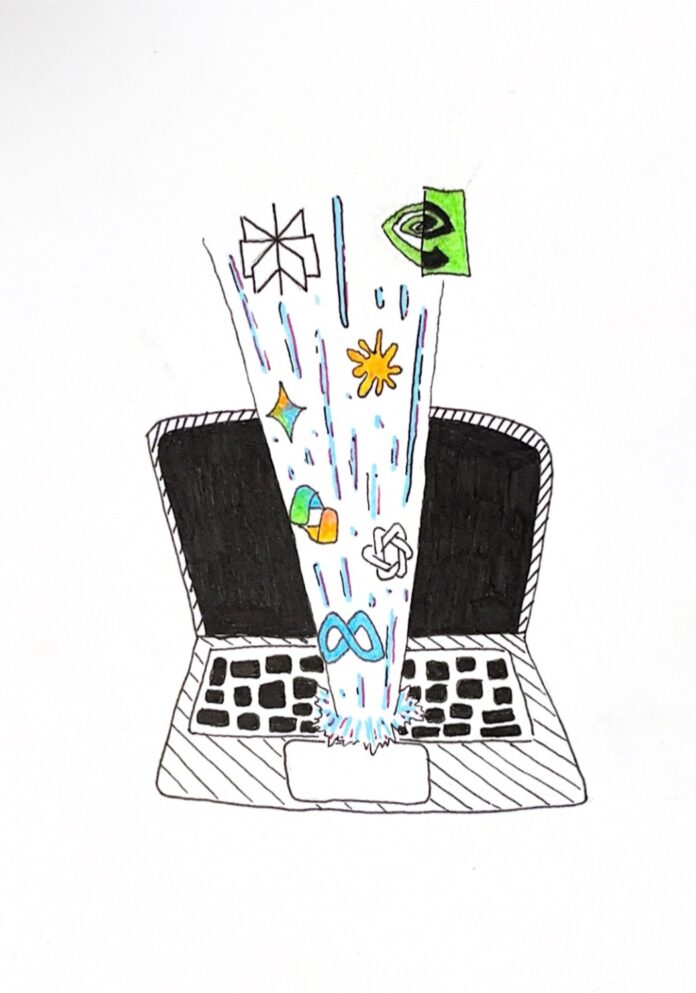
It seems like it’s become impossible to navigate contemporary daily life without encountering some form of AI. From Google automatically incorporating Gemini into its search results to the Pentagon utilizing Claude for its defense systems, AI has practically attained societal ubiquity in the four years since the popularization of LLMs.
Regardless of where you look online, it’s impossible not to be constantly inundated with a deluge of AI generated content, from memes to ads and even fake news stories. It’s becoming a pillar in the political realm too — when octogenarian politicians start using AI, you know it’s become a cultural mainstay.
For proof of this, look no further than TIME Magazine, who bestowed their prestigious Person of the Year title upon AI (or rather, its architects). In attaining this title, AI bested a slew of esteemed competitors, including tech magnate Jensen Huang and political superstar Zohran Mamdani.
As with any major innovation, AI has drawn its fair share of outrage, particularly as it’s encroached upon the world of artistry. Chances are someone you know has sent you a message at one point containing the dreaded elements of “AI slop” — visually repulsive and holistically insipid AI content with no real usage besides occupying server space.
The destructive power of AI extends far beyond these minor grievances. The data centers that power the AI boom have caused an exponential increase in e-waste, in addition to skyrocketing energy consumption and water usage. In the social realm, numerous public figures have found themselves at the center of controversy — or even harassment campaigns powered by artificial intelligence.
As the whirlwind of AI-induced hysteria continues, numerous economists have predicted the bursting of what is referred to as the “AI Bubble.” Within such a scenario, the decimation of AI’s financial prowess would subsequently lead to its lessened usage in society as a whole. This would entail a global downturn of the tech sector, as the top eight global companies by market cap are heavily invested in AI technologies.
This theory has led many detractors to treat AI as the latest iteration of a technological fad (Google Glass, anyone?) rather than a permanent mainstay in the global community. While this supposed “AI bubble” may indeed burst, historical precedent has shown us that AI isn’t going anywhere.
If you’re old enough to recall the turn of the millennium (for reference, I am not) you almost certainly remember the dot-com bubble. As the world adopted personal computers en masse and the world wide web was established, information technology and communications sectors experienced unprecedented growth. This also led to an abundance of internet startups as entrepreneurs across the world attempted to capitalize on the supposed new era of economics.
As with any gold rush, however, the party was short-lived. The collapse of the dot-com bubble in 2000 obliterated a host of prospective industry giants, including Webvan and Pets.com. But as these companies faded into the ether, the demand for their services did not — spiritual successors like DoorDash and Chewy merely refined their business models into more profitable forms. As for the internet itself, it’s safe to say it rebounded nicely — after all, there’s a good chance you’re reading this article online right now.
The story of the dot-com bubble teaches us two major lessons that can be applied to AI: financial disaster does not erase innovation, and demands for a service will persist regardless of whether their supplier fails. Put simply, AI isn’t going away anytime soon.
Even if we hypothesize a world where the “AI bubble” bursts, the technology itself, as well as the demand for it, is unlikely to dissipate. If we consider how tech giants like Google, Apple and Amazon managed to survive and thrive following the dot-com bubble, anything short of an economic cataclysm may not be enough to capsize AI titans like OpenAI and Anthropic.
This leaves us to contend with a world where AI is not merely a transient aspect, but a permanent presence. Even the most fervent AI adversaries ought to reckon with the likely reality that AI will have some role in their lives whether they like it or not. As someone who spent much of his college career deriding those who used AI in any capacity, I have recently been forced to reckon with its nigh-inescapable impact on my everyday routine — to the extent that I sometimes check Google’s Gemini summaries prior to actual search results.
That is not to say that people should forfeit AI-concerned activism. Pushback is vital to keeping the industry in check. Reframing our perception of AI, however, is indispensable if we seek to effect lasting change. People and organizations opposing AI should shift their goals to be centered on reform and regulation rather than its nigh-inconceivable obliteration. Much like how our parents and grandparents begrudgingly accepted the advent of the internet, we must find a way to grin and bear our fate without completely submitting to our new AI overlords like Anthropic’s engineers have.
In this same vein, it is paramount that we treat AI as a nuanced existence rather than the irredeemable spawn of corporate avarice and technological overreach. As easy as it is to deem something as intrinsically evil, doing so will only serve to further separate us from understanding our shared situation. More than half of American adults regularly interact with AI, and we have a duty to the majority to accommodate their desires as best we can while simultaneously striving to make the world a better place.
Contact Mac Ribner at ribner@oxy.edu.