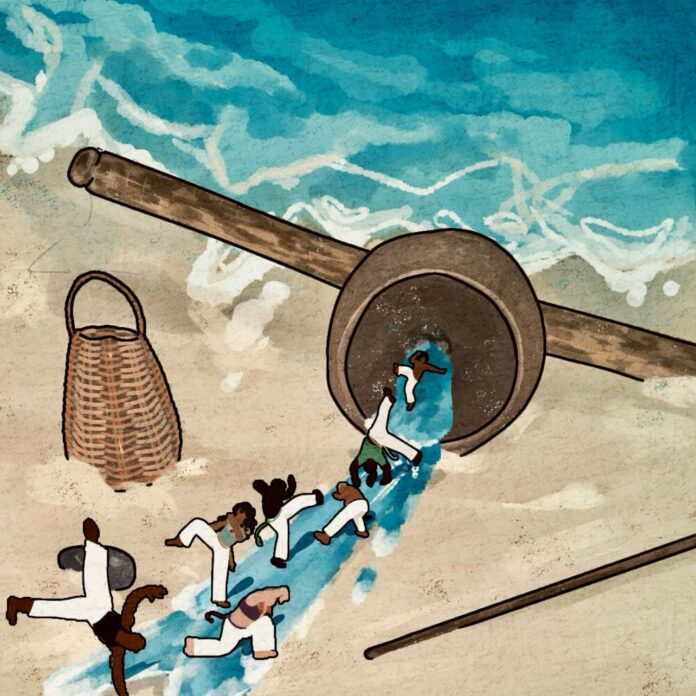
The other night, I dreamt of berimbaus (single string gourd instruments) singing in the distance and gravelly voices whispering along to “Deixa eu passar.” I remember trying to run after the sound, but everywhere I stepped it drifted further. When I awoke, I was still attempting to hear the lost sounds of my dream.
Capoeira is said to have begun in the 16th century by enslaved Africans in Brazil hiding their martial arts from enslavers as a form of dance. As Brazil grew as a country its people evolved, so did Capoeira. The art was banned by the Brazilian government in the 19th century due to its association with violent urban street gangs and a fear it would be a force of rebellion for the Afro-Brazilian community.
In 1932, martial artist Mestre Bimba created the first official capoeira school in Salvador, Bahia, Brazil. This school helped format the style of capoeira regional, which is often played more upright with large sweeping kicks, whereas the alternate style, capoeira Angola, is played slower, more compact and close to the ground. While there is a long standing cultural history involved in capoeira, it has since spread across the world.
I started learning capoeira about two years ago in my backyard by watching old COVID-19 YouTube classes made by Grilo Preto, all to surprise a teacher of mine. English and Black Studies Professor James Ford III has been a prominent mentor who has guided me through my journey with capoeira. He once told me that capoeira really takes hold once you start dreaming about it.
Spring 2026 semester, I took Ford’s class on Afro-surrealism, and all I could think about was the way capoeira mimics the key themes of the Afro-surrealist movement. Both capoeira and surrealism offer a way of looking at the world through the lens of a connection to our self and the people we surround ourselves with. Ford taught us about Andre Breton, a key founder of European surrealist movements, who described surrealism as an activity and not an art form. Surrealism as a movement often steps up in the face of authority or control. Afro-surrealism is also a callback to ancestors; a journey through history and generations, always drawing on those before us, but creating something new.
The “roda” (wheel or circle) refers to the people surrounding the combatants, who are engaged in a hypnotic call-and-response song. The “roda” creates a trancelike zone from which capoeira is produced. Similar to surrealism, the art flows freely from an unknown space, presented in its randomness and flux, tricking the mind. The hypnotic repetition of capoeira music is akin to the trance and possession of surrealist art which attempts to manifest the world beyond the visual.
In surrealist art, using a mask does not often show the true face of reality. Anamorphic masks are a symbol of ancestors and the spiritual realm of the unseen. The mask is both a part of you and not a part of you. Similarly, your capoeirista nickname can be seen as a mask from reality, an altered identity inside the space of capoeira — both a part of your true self, but also something different. When I enter the training space, I am greeted by my nickname, and it is me as a capoeirista.
Capoeira is more a conversation than a fight. The slight movements and rhythms are all to create a beautiful game from which you learn about your opponent. A term often used to describe the playful attitude of a capoeirista is “malícia”. This can be described as “malice”, or a trickster sense of conversation, as the fight is guided through your feints and deceptive movements. This was best described to me as not kicking your opponent’s face, but “when they strike your foot with their face.” However, malícia cannot be taught, it is an aspect of you which you incorporate into your play style. Malícia, like surrealism, is a way to subvert the expectations of reality, often turning the concept of violence into a system of play; which is why we actually use the verb “to play” instead of dance or fight.
At the end of last school year, I got both my capoeira nickname and the next Corda in my progression. The Corda is a representation of time spent training capoeira, similar to the belts of taekwondo or karate. I earned my Corda and name at an event called a “batizado” (or “baptism” as a literal translation), which is a ceremony to celebrate the work you have put in and the community of capoeiristas. The name they gave me was “Jeitoso”, which they described in the context of “jeito”, meaning “way” or “path” — saying I “have a way with capoeira.” A bit cocky, but I didn’t give it to myself.
Capoeira taught me to look at life as something constantly changing. The improvisation of violence into playful movement converts a structurally focused mindset into one more open to change. When playing capoeira, there is no space for you to think about problems outside of the “roda,” or a kick may appear where you aren’t looking. The “roda” is where you can let go and forget about everything weighing on your mind. Now, I am always looking out for “rasteira” (a foot sweep technique), because you have to be vigilant, or you could be swept away.
Contact Cole Banks at cbanks@oxy.edu.