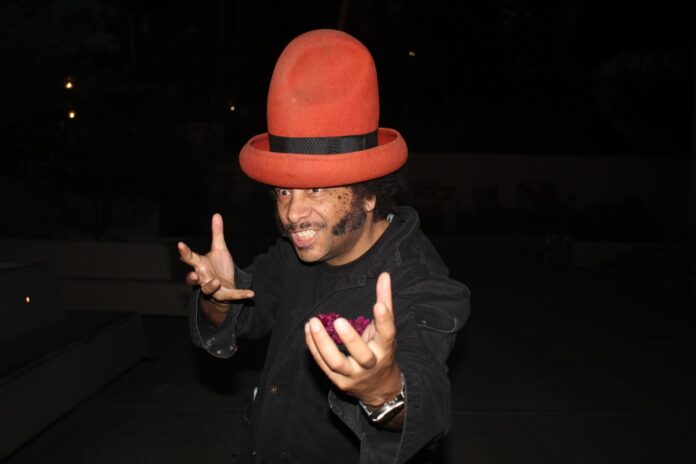
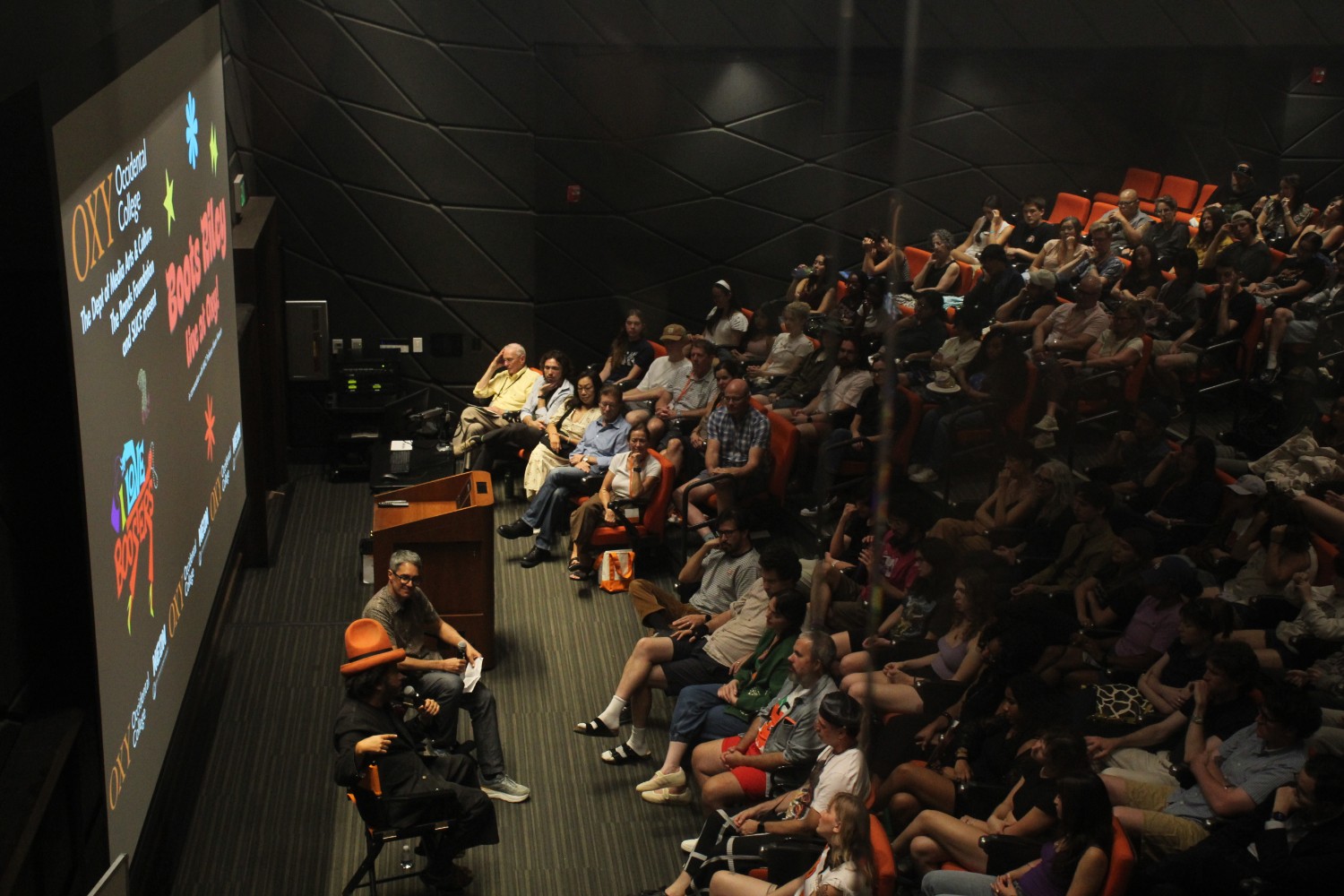
Occidental’s Media Arts & Culture (MAC) Department, SLICE and the Rands Foundation hosted award-winning musician and filmmaker Boots Riley for a conversation with MAC associate professor Aleem Hossain Oct. 2. Held in collaboration with NEON and Evil Twin Booking Agency, the event was part of Occidental’s Homecoming and Family Weekend. The discussion, titled “Can Films Be Revolutionary and Fun!?” took place at Choi Auditorium, and was followed by a screening of Riley’s most recent film “I Love Boosters.” Prior to the event, Riley participated in a reception for MAC seniors.
Riley is the lead vocalist of political music groups The Coup, founded in 1991, and Street Sweeper Social Club, founded in 2006. Alongside “I Love Boosters,” Riley’s filmography includes his 2018 debut feature “Sorry to Bother You” and the 2023 limited series “I’m A Virgo.”
At the event, Riley discussed his political and creative philosophies, his history in political organizing and the impact of his films on real labor movements. “I Love Boosters” and “Sorry to Bother You” both follow workers striking. According to Riley, “I Love Boosters” recently inspired a union campaign at AutoZone, and “Sorry to Bother You” inspired significant union organizing between 2020 and 2024.
“I got a lot of direct messages saying ‘We were organizing a union at our place, or we were trying to organize a strike […] we were skeptical, but we had everybody watch “Sorry to Bother You,” and they voted to strike or to have a union,’” Riley said.
According to Hossain, while art is often credited with shifting people’s perspectives, an overlooked aspect of art is its ability to ignite motivation in people who already share the sentiments being depicted.
“There’s the mind-changing aspect [of Riley’s films], but also I think [Riley’s films are] inspiring and fueling those that are already with the cause,” Hossain said. “Sometimes I watch a film, and I already agree with its message, but it feels really invigorating to see it portrayed.”
According to Riley, seeking out stories of people fighting for real change — both successful and unsuccessful — is a way to maintain hope when it seems that change is impossible. Riley said art can showcase lived experiences in a new context or expose audiences to new possibilities which can become reality.
“When you go through the story of a movie, it’s possible that you are seeing the world change in front of you,” Riley said. “You’re seeing the world change inside of there, but it also reflects a different change that you’d see in real life.”
Professor of English and Black Studies James Ford III said revolution and joy are inherently intertwined, with joy providing hope for change.
“Many of the most compelling, critically-minded, radical intellectuals in the Black diaspora say very upfront that they’re doing their work to change the world so there will be more joy in the world,” Ford said. “You can’t stick through the difficult process of changing the status quo if joy isn’t guiding you along the way.”
Ford said he teaches “Sorry to Bother You” in his Afro-Surrealism class. According to Ford, the film’s extensive originality and sharp messaging make it a compelling example of a surrealist work.
“All of the experimentation with the storytelling and the filmmaking style captures your attention,” Ford said. “Surrealists, those in the Black diaspora as well as their European counterparts, all cared about critiquing capitalism — about class conflict and labor exploitation.”
According to Ford, “Sorry to Bother You” and Riley’s other works critique the perception of Blackness in American culture and contend with simultaneous desires to fit into an oppressive society and to break free from it.
“Surrealists are also really concerned with the life of the mind, how our fantasies and our desires can either get us to contribute to our own oppression, or push us towards liberation,” Ford said. “In the United States, pop culture has been critical to shifting people’s desires. American pop culture can play a role in homogenizing society, but it can also be a place where you get some poignant criticisms of the status quo.”
According to Hossain, Riley is frequently discussed in the MAC department due to his work being not only socially relevant and politically conscious, but also created with unique, distinctive approaches to filmmaking.
“In terms of the reputation of films that are trying to achieve goals or be political, people sometimes think of them as being very pedantic or dry or serious,” Hossain said. “[“I Love Boosters”] is really none of those things — it’s crazy and surreal and absurd, yet it’s still having an impact.”
Hossain said films denouncing injustice through comedy, such as Charlie Chaplin’s parody of Hitler in “The Great Dictator” (1940), have a storied history.
“All genres — funny, scary, surreal — they get at the brain and the heart in different ways,” Hossain said. “Sometimes you need to go door to door and tell people about an issue, and sometimes you make a really scary horror film or a really funny farce and that’s what changes hearts and minds.”
During the event, Riley said his advice to young artists is to have a meaning behind their work, no matter what that meaning is.
“I think you need something that you’re more passionate about than the art you’re making,” Riley said during the event. “Art is a communication tool.”
According to Riley, having a sense of purpose is what guides artists through creative decisions, pushes them toward their imagined futures and helps them navigate challenges.
“I’ve had to make a lot of sacrifices throughout my life to make [my work] happen and it never felt like a sacrifice,” Riley said during the event. “I thought the reason I was doing it was way more important than me, and then it becomes a gift.”
Contact Diana Trutia at trutia@oxy.edu