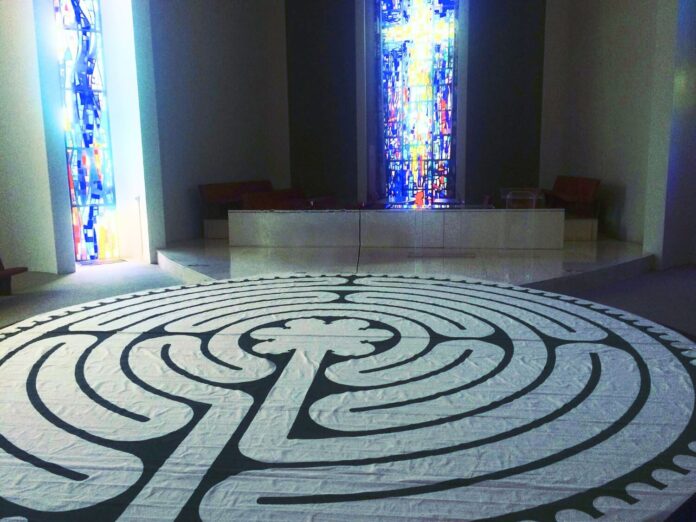
For almost two decades, the canvas labyrinth in Herrick Interfaith Center has been a space for Occidental students to meditate, pray and focus on their spirituality. Every Wednesday, the labyrinth is rolled out in upper Herrick, and students are invited to walk along its path at their own pace while engaging in prayer, meditation or mindfulness.
Director for Religious and Spiritual Life Rev. Dr. Susan Young, who organized the purchase of the labyrinth in 2006, said it is an ancient religious tool with a complex history.
“Labyrinth patterns can be found all over the world in different cultures and for different purposes,” Young said. “They became more popular around the 13th century as a resource for Christians in Western Europe who wanted to engage in a spiritual pilgrimage in solidarity with people who were doing actual pilgrimages to Jerusalem.”
According to Young, pilgrims without the economic resources to go on a pilgrimage to the Christian Holy Land would visit labyrinths in their local churches and cathedrals and walk the designs embedded in their floors. Through this action, Young said Christian practitioners would feel communion with the people taking the long and arduous journey to Jerusalem. The labyrinth at Occidental is modeled on these ancient stone labyrinths.
“We designed ours to match the historic pattern of a labyrinth within the Chartres Cathedral just outside of Paris,” Young said. “Ours is slightly smaller, but it follows the same shape and walking pattern.”
According to Special Collections librarian Helena de Lemos, there are many different stories of varying historical veracity associated with the stone labyrinth in the Chartres Cathedral.
“One story mentions that pilgrims who couldn’t make the trip to Jerusalem would crawl along the labyrinth on their knees in order to empathize with the suffering of the pilgrims,” De Lemos said. “Another claims that the labyrinth originally contained a metal plate at its center containing an image of the minotaur, linking it to the ancient labyrinth of Minos.”
According to de Lemos, labyrinths have also had other secular functions throughout their long history, particularly in the gardens of the baroque nobility.
“In the 1600’s, it became popular to make these very elaborate labyrinths within French palace gardens, and it’s interesting, because the labyrinth kind of changes from representing the suffering of the pilgrimage to being a place of enjoyment for the upper class,” de Lemos said. “You can imagine all the secret kisses and political plots being devised within the thick foliage.”
According to Young, there are many different ways to engage with labyrinths, including the one at Occidental. Young said that despite the labyrinth’s Christian origins, it was important for the Herrick team to create a space that was welcoming for students of all religious orientations.
“There’s no right or wrong way to walk the labyrinth. They were originally used as a way of doing traditional Christian prayer, but over the years people have adopted different patterns and ways of walking them,” Young said. “My hope is that all students will be able to use the labyrinth as a place to center and ground themselves and to be at peace.”
Nicky Dobbs (junior) said he walked the labyrinth because he was interested in seeing how the college is cultivating a space accessible to both people of faith and people who might not consider themselves religious.
“In my class, there was a lot of debate about this, because Herrick Chapel is built like a traditional chapel and shaped like a cross,” Dobbs said. “But based on the interior, it really seems like an accepting and welcoming space. I feel that even if I wasn’t Christian, there would still be a benefit to walking the labyrinth.”
Dobbs said he has found Herrick Chapel to be a pleasant and quiet space that he can use for his religious needs, even when the labyrinth isn’t up.
“I go in there sometimes to pray, and it’s also just a nice place to free myself of stress and anxiety because it’s very calm,” Dobbs said.
According to Young, providing a calm space for meditation or prayer in the midst of all the pressures of college life is the most important function of the labyrinth.
“Being a college student can be really stressful at the best of times,” Young said. “At a time like this when we’re dealing with so many social issues and political polarization, finding a quiet place on campus to just reflect can be really hard.”
Young said that she hopes the labyrinth can be a place to find emotional respite for students who are personally affected by events happening around the world. According to Young, the Office of Religious and Spiritual life has previously used the labyrinth in workshops for students grieving tragedies abroad, such as the 2011 Fukushima earthquake.
“We all bring our own stories and lived experiences to the labyrinth when we walk it. That’s why I think it’s such an important resource to have,” Young said.
Contact Adam Zahavi Pildal at pildal@oxy.edu