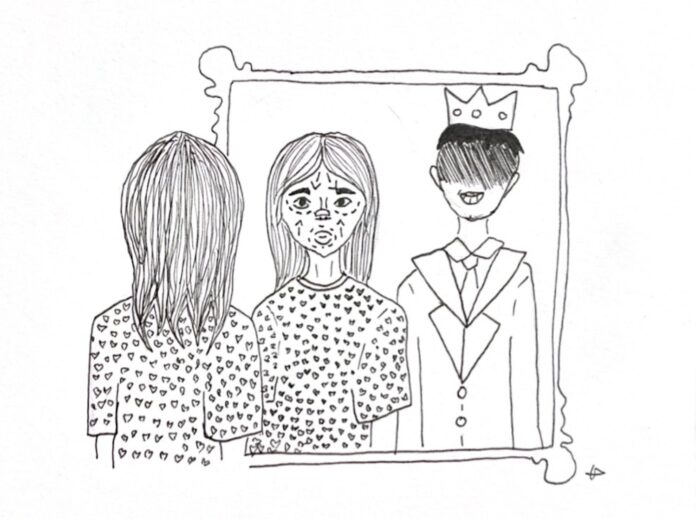
Looking back at my life growing up in Seoul, I noticed how quietly misogyny started seeping into everyday life in the form of beauty standards. I was in third grade when I first encountered a “real” makeup product other than my mom’s. It was a bright red lip tint that my friend was proudly showing off. My other friends seemed to know what it was, and comfortably tried it on. It seemed to me that I was already supposed to know that paying attention to how I looked mattered.
Built on traditional patriarchal ideals, gender expectations continue to shape how Korean women live. Women are expected to get married and raise children without a job. Korea has normalized a subtle anti-feminist society where women are expected to be quietly compliant. Over time, these ideas have extended beyond women’s roles to how women are expected to look, making beauty another way to enforce these gender constructs.
Through this framework, a woman’s beauty becomes a condition of social value. For example, in marriage, they are expected to have a preferred 관상, or “face reading.” This means that a family’s luck will be determined based on the bride’s face. From this pressure, women work hard on their appearance. The pressure is reinforced by the entertainment industry that showcases flawless actresses in K-dramas and K-pop idols. This dynamic creates conditions for two major industries to exist and profit from: plastic surgery and makeup.
These industries exploit this societal dynamic by selling a deceptive “protection” from social consequences. These products and procedures range from basic makeup to harmful jaw surgeries that come with severe health risks. In 2020, it was reported that nearly 25 percent of young women in South Korea have had procedures. A common procedure is double jaw surgery, with the intent to create a “V-line.” Although it is common, it has incredibly dangerous side effects, including airway blockage, severe hemorrhage and permanent nerve numbness.
One of Korea’s most popular beauty trends this summer was 강아지상, meaning “puppy face.” This trend was advertised as the “ideal face” for men in many blogs, videos and magazines. The trend refers to a face with soft features, a youthful appearance and natural makeup. There were hundreds of YouTube videos advertising certain procedures that supposedly achieved this look, while makeup companies created ads for products that promised an innocent, approachable appearance.
A problem emerges when a trend becomes a necessity — when women feel they must create a particular version of themselves out of fear of judgment and discrimination. They may feel constricted to specific makeup looks or undergo plastic surgery to fit the ideal instead of expressing their true selves, just to be accepted in society.
Living in Korea, I saw how women who had the bravery to go outside these expectations could be looked down on by men and even other women. For example, bold makeup has a negative social connotation, so most women try to avoid it. Tan skin is the opposite of the beauty standard, so women perform skin bleaching treatments.
The consequences of this appearance culture can also extend beyond women. Men can be subject to this problem when attractiveness is a standard for social value, and the pressure to physically conform may spread to those who do not experience the same gender expectations.
When I visited my family in Korea this summer, I was surprised to see my cousin as a completely different person. He told me that after being rejected from several job interviews, he decided to get two surgeries and painful microneedling treatments. This landed him a highly selective position in a top tech company. This is normalized in Korea, but his experience does not prove that his appearance caused his rejections, nor does it attribute his success to his procedures. It does, however, reinforce the belief that altering your appearance may impact how others view you.
Still, the pressures and social perceptions men and women face are completely different. In a society shaped by patriarchal expectations, women’s appearances are more intensely scrutinized. Men may be praised and benefit more from being attractive without facing the same pressure to maintain a particular appearance. Meanwhile, women face more discrimination for being considered unattractive, yet also dismissed as superficial for being “too concerned” with their looks. Women who get many cosmetic procedures can also be stigmatized as 성괴, which is a derogatory term meaning “plastic surgery monster.”
The broader consequence is that people, regardless of gender, feel compelled to modify their appearance to meet standards treated as an advantage in social life and employment. It reveals how a country that normalizes appearance-based discrimination can expand the market for these industries beyond their targeted audience.
Ultimately, the plastic surgery and makeup industries reinforce the problem from which they profit. Misogyny creates the conditions in which women fear being judged for their appearance. These industries capitalize on that fear by selling an individual solution to a systemic problem, while not actually eliminating the problem. Their marketing reinforces the very standards that make these products and procedures seem like a necessity.
If women must continue altering their appearances to live in a society that holds prejudice against them for how they look, the problem is not only that beauty has become a commodity, but also that society has made it a necessity.
Contact Irene Jung at ijung@oxy.edu