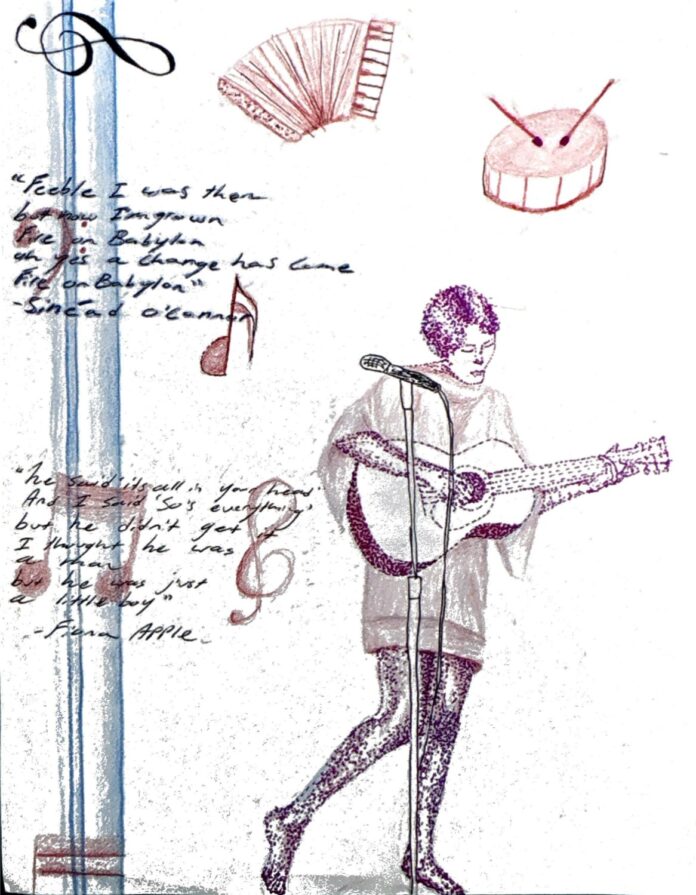
Nearly every day this summer, anytime I sat down to watch TV with my mom, I was asked the same question: “Can we watch the Lilith Fair documentary?”
My mom had seen the Hulu documentary earlier this year, and wanted to share it with me since I am a female musician who adores many of the artists who once performed at Lilith Fair.
I didn’t agree to watch the film until the very last week of summer. Not because I was uninterested, but because I thought I knew enough about the festival already.
I had previously thought of Lilith as a fun, female-driven music festival, full of great artists and huge crowds of women and girls from all generations. While all of this is true, Lilith was so much more than I previously thought. The festival was a global event that created real, tangible change for women in the music industry forever — change that we still need to build upon today.
Despite its ultimate success, Lilith Fair’s creator Sarah McLachlan faced many challenges as she began putting together the all-female festival in 1996. This was not just because Lilith was the first of its kind, but because music and concert industry executives did not believe a female festival would be profitable.
At the time of Lilith’s creation, the music industry did not consider women as a customer base, something that may come as a surprise in our current-day ultra-capitalistic society. As a result, female artists who were assumed to only bring in female fans were forced into the shadows.
As a female musician, I was shocked to learn that less than three decades ago, the obstacles in place to exclude women from the music industry were so extreme.
Prior to Lilith, radio stations set aside few spots on their playlists for music by female artists. They denied space to many women whose songs were worthy just because they had already hit their capital.
However, after Lilith Fair became the highest grossing music festival of the late 1990s, this began to change. Lilith Fair made the industry a more welcoming place for women while simultaneously paving the way for new female artists to follow in the footsteps of its creators.
Lilith Fair not only proved that women were a profitable customer base for the music industry, but also provided an opportunity for women and girls all over the world to see themselves onstage, often for the first time, and be inspired to create their own music.
Nevertheless, the unfortunate truth is that Lilith Fair alone could not fix everything. Female musicians still deal with many obstacles when entering the music industry. This is something that I, at only 18 years old, have already experienced on a number of occasions.
Often, when working with other musicians, I am the only woman in the room. I regularly find myself fighting to have my voice heard in spaces primarily dominated by men, where it is commonplace for female perspectives to fly under the radar. When I do have my opinion considered, it is frequently less valued than those of the men in the room, especially if it is in disagreement with the male majority.
On a broader scale, male domination is still seen in the music industry. Less than a quarter of 2025 Grammy nominees in six major categories were women and in 2024, only 37.7 percent of artists across the Billboard Hot 100 Year-End Chart were female.
Although these are major improvements from statistics seen prior to Lilith Fair, it is still disappointing that work created by female artists continues to be undervalued and less recognized than the work of their male counterparts.
This lack of recognition is precisely why female music festivals continue to be important. Olivia Rodrigo’s Daisy Chain Fields is a music festival that launched this year and highlighted both original participants of Lilith Fair, such as McLachlan, and newer female artists, like Chappell Roan.
Efforts such as these follow in the footsteps of Lilith Fair by showing the world that female artists continue to make music that deserves to be seen and heard. These festivals give young girls role models to look up to and shine a light on a section of the music industry that many try to leave in the shadows.
I am excited that Rodrigo plans to continue her Daisy Chain Fields festival in coming years, especially in light of the massive fundraising she accomplished for organizations advancing and advocating for women and girls.
When we create spaces to center women in music, we encourage the world to recognize the contributions of female artists and motivate women to express themselves in artistic ways, no matter what the world may have to say about it. As a woman pursuing a career in music, I owe so much to the women who have come before me, and I hope to do everything in my power to make it easier for those who come after me.
Contact Sadie Maguire at smaguire@oxy.edu.