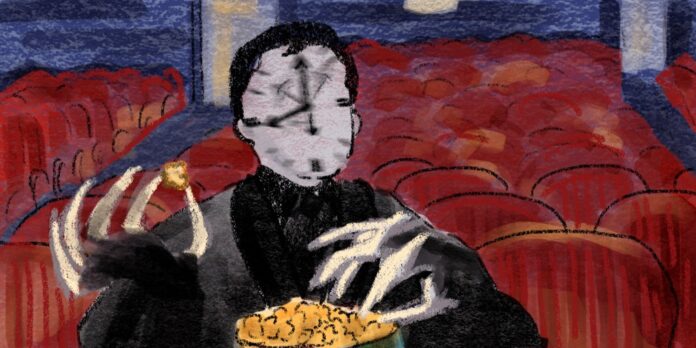
Time is money, and movies are certainly no exception. The entertainment industry has made it no secret that money drives production. In the past, movies were trimmed and cut mercilessly to maximize studio profit. Today, directors often get more freedom to shoot as they wish. Directors like Christopher Nolan have been the ultimate decision-makers for their own films lengths. As a result, an increasing number of movies reach the three-hour mark. Although I love the expanded creative freedom, storytelling is often compromised by the length of the film. More films should strive to stick closer to the 90-minute mark.
In the ’80s and ’90s, intense cutting of films allowed for more showings throughout the day. Figures like Sally Menke and Steven Soderbergh were known for keeping films concise and articulate. Menke edited every Tarantino film till her death in 2010. Harvey Weinstein famously intended to trim Hayao Miyazaki’s 1997 film “Princess Mononoke” and earned himself the nickname “Harvey Scissorhands” for his habits.
As home video and streaming emerged, cinemas had to switch gears. Nowadays, it seems studios and directors want to make movies cultural events and special occasions that draw you out of the home to the silver screen. Think of blockbusters and film events like Barbenheimer, “The Odyssey” and “Avengers: Doomsday.” These films are marketed as events. Not just a film, but an undertaking, a plan to last the entire day.
For an audience used to the convenience of seeing a film from home, it is effective to differentiate films in theaters as cultural phenomena. But what happens to up-and-coming filmmakers, who lack the draw of celebrity or preexisting cultural impact? In an environment of 90-minute films, it seemed more feasible to squeeze in an extra film when it caught your interest. Now? An extra film is not only a financial burden, but a time-consuming one. Cinemas just don’t work as a place to linger and consider options anymore. That has been pushed to streaming.
On the surface, it sounds like a great deal: we still get our quick flicks through home services and get to experience the big productions on screen. However, the slow disappearance of 90-minute films is damaging to cinema as a whole.
I recently watched three thriller/horror films: “Resident Evil” (2026), “Dead Calm” (1989) and “In the Mouth of Madness” (1994). All three films happily cap off at around 95 minutes. They rely on tension in their storytelling, partially as a result of their genre. Often with longer productions, I tire out, or feel particular sections are moving too slowly. With these three thrillers, every pause was experienced with bated breath. I was kept on my toes up until the end, sometimes even beyond that.
The shorter length of a film allows for more compact, impactful storytelling. Each frame must convey something specific to the story, exactly as the author intends it. I believe this is why horror and thriller films tend to become cult classics, and why more films from these genres join the hall of fame. Where action can get away with losing plot tension through entertaining action sequences, thrillers, horror and even drama must cling tightly to the anticipation of the audience. Without tension, the story and its effect on the audience fall apart. As such, most horror and thrillers tend to stick close to the 90-minute mark.
On the other hand, it is increasingly commonplace for superhero films to be two and a half hours long. For larger productions, like “Avengers: Endgame” (2019) or “The Batman” (2022), the run time can approach nearly three hours. It takes mental energy to stay engaged and observant — the longer a film is, the less likely an audience is to pick up on the details. Longer run times encourage audiences to turn off their brains to maximize enjoyment. Not to mention, you don’t want to always check in advance for when you can pee during the film without missing anything.
One example of a film I consider too long is “Casino Royale” (2006). This film ranks as one of my favorite Bond films, and sits comfortably in my top 10 for movies as a whole. Despite having watched the film over seven times, I still get baited by its ending. The first 100 minutes are a delight, and up to the two hour mark of the film I’m on the edge of my seat. It’s at that two-hour mark when my brain instinctively insists the film should be over. No matter the rewatch, I am almost always fooled into believing the movie will soon end, even with another 30 or so minutes on the clock.
“Casino Royale” experiences what many longer films tend to suffer from: filler in service of a larger franchise, or an urgent desperation to explain the entire fictional universe in a single go. Think of modern Star Wars or Marvel films, and the other Daniel Craig Bond films. All these franchises are so occupied with drawing you back to the silver screen for some grand finale that they actively sabotage plots and characters to hint at a sequel. Marvel’s end credits scenes are a great example. The films don’t just tell their own story; they have to include something to hint at the next film, the next team-up. If you keep thinking about the next step, you can lose sight of the little details that hold the current story together.
Occasionally, I see a four-hour film, like “Lawrence of Arabia” (1965), that I consider great. In those four hours, I truly believe that each scene serves nothing but the story itself. My gripe with longer films is not the exact run time, but the currently lax length standards allow for sloppier storytelling. In pursuit of making a splash on social media and in pop culture, modern films lose sight of the heart of cult classics: good storytelling.
If films continue to stay this long, or even get longer, I believe the audience’s ability to engage with cinema as more than an event will decrease. Why bring yourself out to engage in the arts when the task requires not only financial but so much mental labor? Reducing the length of a film can make cinema more accessible to moviegoers, and make exploration of new films more approachable. We often speak of limits as an inherently negative thing. Sometimes, a limit is a great reminder to get to the point. Without limits, it is easy to go wild and lose track of your own work — learning to work within them is just as valuable as the freedom to express yourself.
Contact Levi Lee at leev@oxy.edu