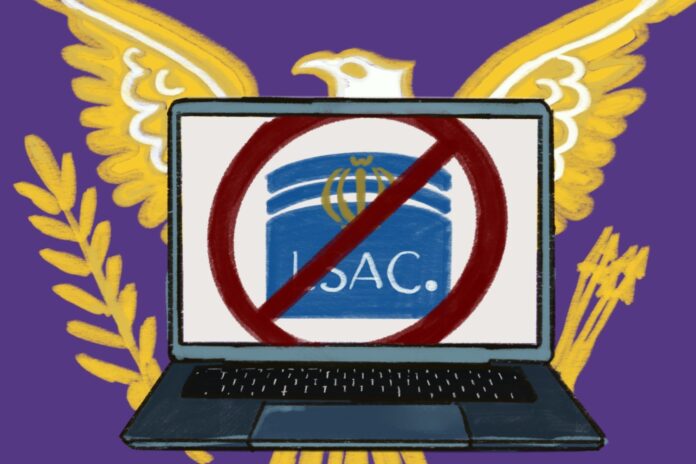
In early September, the Law School Admissions Council (LSAC) banned many Iranian-American students from accessing their LSAC accounts for taking the Law School Admissions Tests (LSAT). As an Iranian-American dual citizen, this is something that I have been dwelling on over these last few weeks.
Growing up, I was a part of an immigrant family who idolized the job trio of lawyers, doctors and engineers. I strictly expressed my lack of interest in anything medicine-related early on. Since my brother had a talent for making complex, functional Lego sets from a very young age, he leaned towards engineering. Naturally, my parents urged me to become a lawyer.
It became so engrained in my head that I considered myself a future lawyer. Towards the end of high school, though, I realized that being a lawyer was not for me. However, there is a difference between choosing not to pursue a career in law, versus experiencing discriminatory obstacles that can push you away from it.
This is exactly what Iranian-American pre-law students currently face.
I learned about this when I got a text from my friend, who is also Iranian.
“I’m honestly really upset about LSAC banning Iranians from taking the LSAT. I’m not able to log in,” she said through text. “Yeah, I left my wannabe lawyer era, but I can’t even entertain the idea of being a lawyer.”
Aug. 24 the Department of the Treasury’s Office of Foreign Assets Control (OFAC) issued a licensing policy under Operation Economic Outcast — or “Economic D-Day,” as President Trump has said — designed to sever any economic ties with the Islamic Regime. This new policy suspended many general license authorizations that had previously been allowed under OFAC’s Iranian Transactions and Sanctions Regulations. According to the Iranian American Bar Association (IABA), due to the complexity and unclearness of sanction rules, organizations and businesses sometimes impose “restrictions broader than the law requires.”
Members of IABA argued that institutions relied on “Iranian nationality as a proxy for sanctions compliance,” rather than assessing an individual person, service or transaction to be restricted.
Iranian-American Rep. Yassamin Ansari (AZ-03) and Rep. Davin Min (CA-47) — who serve districts with sizable Iranian-American populations — both took one of the best steps so far in addressing this problem. In a letter directed to LSAC, they demanded the council review their mistakes and allow people access to their accounts. They also went a step further by asking LSAC to disclose the criteria they followed that led to all the restrictions.
LSAC’s regulations have affected many Iranian-Americans, and even Iranian-Canadians. Many of these students shared their experience and opinions on a Reddit thread. The thread is filled with people saying that they have never even been to Iran and are still facing this discriminatory action. Others say that LSAC is acting beyond their scope of power, and claim that this would be an easy lawsuit against LSAC.
“This OFAC sanction means paying again, studying for months longer, missing application deadlines, submitting later in rolling admissions, losing scholarship opportunities and potentially delaying law school by an entire year,” a user said.
The U.S. Central Command (Centcom) under President Trump’s orders began Operation Epic Fury Feb. 28 to dismantle security threats in Iran. It seems that ever since then, regular civilians have been paying the price of warfare.
For several months, my immediate family could not talk to my grandparents and other family members who live in Iran. I was living in almost complete oblivion as to what was happening in my other home. Airstrikes ravaged multiple residential areas, including an elementary school, and thousands of ordinary Iranian citizens were killed. Through a phone call with my family, I discovered that the street where I used to attend English classes had been hit.
If my family had not moved to the comfort the U.S. can offer, I would be living in fear about whether the next U.S.-Israeli airstrike would land near me and my family. That is what millions of Iranians had to think about during the operation — what many of my family members still think about.
Why have the consequences of this war trickled down to American citizens? It is as if LSAC sees young Iranian-American students as so much of a threat they feel the need to hold them back from important tests.
It is also concerning that Iranian-Canadian students have been affected. Although LSAC is an American non-profit, over 200 law schools across Canada and Australia are members of LSAC and use the services it provides, including testing. Why should Iranian-Canadian students wanting to take the LSAT to go to a Canadian law school be affected by American laws? This conflict with Iran involves the U.S. and Israel, not Canada.
This is not the only example of education and scholars being affected by the sanctions. The Educational Testing Service (ETS) stopped offering two tests in Iran. One of them is the Test of English as a Foreign Language (TOEFL), a test designed to measure English language efficiency for those planning to work and study in English-speaking environments, and the other is the Graduate Record Examination (GRE), a standardized test accepted by many institutions. Iranian students residing in Iran who wish to take either of these tests now have to travel to another country and take them there.
By imposing unfair regulations without carefully assessing OFAC’s policy, LSAC has jeopardized the academic lives of many Iranians. Iranian students, whether they live in the U.S., Canada, Iran or anywhere else, should not be discriminated against in these sanctions. Warfare and political views should not be negatively affecting the education of hundreds of thousands of youth worldwide. This is an active threat to Iranian scholars and Iranian education.
Contact Francine Ghazarian at ghazarian@oxy.edu