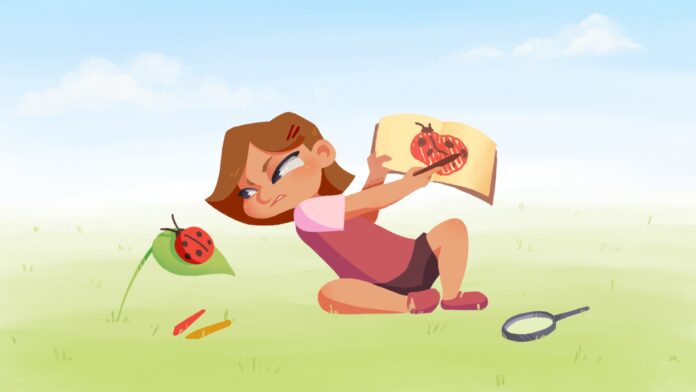
There is a scene in the 2010 animated Walt Disney movie “Tinker Bell and the Great Fairy Rescue” where Lizzy, a young human girl, works on a fairy field journal with Tinker Bell. Each page is decorated with her drawings, and next to each drawing is a description to explain its meaning. Ever since I saw that scene as a child, I have been very keen on putting all my stories and imagination onto paper.
I have journaled throughout my life, but have been the most consistent over the past two years. I wouldn’t be the person I am today if it weren’t for that specific scene, which is why children’s media should include more representations of journaling.
The scene with Lizzy working on her field journal is a great example of how journaling is a limitless art form that is messy and imperfect. For example, Lizzy’s drawings of fairies have stick arms, and her handwriting is spaced and uneven. But none of that matters because the lack of boundaries allows for freedom of exploration. In C.S. Lewis’ letter to a young fan about writing advice, he never emphasized the structure of writing or how it should be framed. He simply said, “Write about what really interests you … if you are interested only in writing you will never be a writer, because you will have nothing to write about.”
There are many forms of writing: journaling, commonplacing, creative writing, argumentative writing, analytical writing etc. Regardless of the form, when people write, they write to express and be understood. Kids should be taught that self-expression has no boundaries; perfection should be the least of their worries.
If you look up “journaling” on Pinterest, you’ll probably see photos of beautiful cursive writing organized into little designated sections within a notebook. Recently, I believe that journaling has been reduced down to an aesthetic on social media.
Journaling should not have limits. It doesn’t need to be organized; sometimes, it’s meant to be messy. Notebooks should be a space where we can let our thoughts run wild. We shouldn’t feel the need to compare ourselves to what we see online or how others journal, because each person naturally has a system that suits them. There is no singular definition of a correct journaling method because what works for me may not work for others, and vice versa. Children should be shown healthy, pressure-free ways to express and process their curiosities. For generations growing up in a post-technology world, where they don’t get to experience life without AI and social media, it’s important that children have the opportunity to explore themselves and the world on their own terms, without being bound by standards or expectations.
Shizuku Tsukishima from Studio Ghibli’s 1995 animated film “Whisper of the Heart” is another great example of a child’s passion for storytelling, especially during a time when digital technology becomes more central to society. As someone who also enjoys creative writing, this film speaks to me in the sense that writing is an endless and fun learning process. Despite seeing this movie long after middle school, I am still reminded of my younger self constantly generating new story ideas faster than my hand could write. This movie helped bring me back to creative writing, especially when I experience writer’s block or feel too lazy to write, because through Shizuku, I can feel my childhood drive aching to bring my ideas to life.
Writing is equally as important for adults. My advice to anyone who wants to start writing or is already a habitual writer is to let your inner child thrive, even when exploring subjects that may not be child-focused, such as politics, theology, geography, chemistry and so on. Allow your mind to wander and seek new information as you document your life and learning journey. The less we hold ourselves back, the more we can think creatively and view the world from a broader perspective. Journaling has taught me to have a more open and analytical mindset in my day-to-day experiences. Writing is not just a childhood hobby; just as Lizzy and Shizuku used writing as an outlet for their creative drives, writing in adulthood should serve the purpose of building our uninhibited selves.
While there is nothing wrong with getting inspiration from other sources, don’t feel contempt when you see someone doing “better” than you. It doesn’t matter if their handwriting is extremely neat, or if their drawings are precise — that is their journal, not yours.
When you want to fully express yourself, don’t let superficial standards like comparison limit your desire to learn. When people write, they write to express, to be understood — not to compete with one another. I write stories and journal my thoughts down not to “train” to become the best storyteller, but because I genuinely enjoy doing it. By honoring the curious child who endlessly wrote stories and journaled late into the night, we can allow ourselves to think freely and view anything through a broader lens.
Contact Weiran Li at vli2@oxy.edu