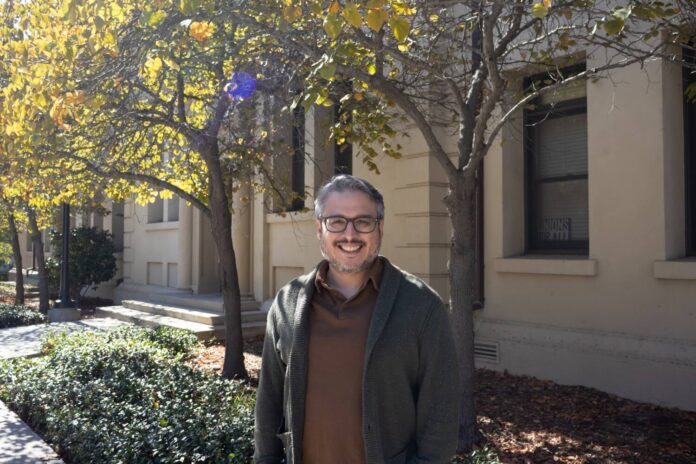
Professor Robert Sanchez, Department Chair of philosophy, helped publish the fourth volume of the Journal of Mexican Philosophy (JMxP) Fall 2026. According to Sanchez, the journal was founded in order to create a central access point for the Mexican philosophical tradition that embraces ideas and styles not typically present in western academia.
Sanchez said what started as an effort to translate texts into an organized anthology with longtime collaborator professor Carlos Sánchez of San Jose University grew into the idea to create an official Journal of Mexican Philosophy. According to Sanchez, the two co-founded the journal and serve as the managing editors.
Sanchez said JMxP welcomes not only linguistic diversity, but also a wide variety of topics and styles of writing. According to Sanchez, each issue of the journal contains an original translation, as well as a contribution from a marginalized voice within the Mexican philosophical tradition. Sanchez said the idea for an academic journal began in 2014, when he convened the first conference of Mexican Philosophy with scholars from both Mexico and the U.S. to further conversations about the newly emerging discipline.
Sanchez said the main goals of the journal are to allow contributors to publish peer-reviewed work on a more reasonable timeline than what is available in academic publishing, and to allow contributors to collaborate with one another in a communal scholarship practice.
According to Sanchez, the publication of the journal coincides with his “Mexican Philosophy, Culture and Society” class, which is in session this semester. Sanchez said both the journal and his class are meant to spark curiosity and combat prejudices about Mexican philosophy and the Spanish language itself.
“Part of the problem is that we confuse our ignorance of those traditions with a justification of remaining ignorant of them,” Sanchez said. “We think there must not be anything, which in turn becomes our reason for not looking for anything.”
According to Aung Myat Htet (junior), a student in Sanchez’s course, Mexican philosophy is a rapidly growing area of research, due in part to Sanchez’s publications and translations in the field.
“Professor Sanchez is one of the prominent pioneers of Mexican philosophy,” Htet said. “He’s written and contributed so much, so he has a very clear understanding of these concepts and he wants to share them.”

According to Fatima Flores (senior), the class helps shed light on a tradition that is often looked down upon or ignored entirely due to cultural stereotypes and anti-immigrant rhetoric.
“Connecting back to this history that hasn’t really been brought to attention is really important, and it’s so beautiful to rediscover these kinds of energies that have been put down before this,” Flores said. “Emphasizing how we have this very rich, intelligent culture is very necessary, especially now.”
Sanchez said the class is important in widening the field of philosophical ideas available at Occidental, just as the JMxP helps open up lines of non-western thought in academia in a way that is free and accessible to all.
“The journal has been this evolution of how to diversify the curriculum and the canon in academic professional philosophy,” Sanchez said. “One of the ideas is to represent the pieces in a way that demonstrates that Mexican philosophy is a coherent, unified tradition that should be taken seriously in the English-speaking world.”
Htet said the class helps him understand a new worldview, while connecting ideas from Mexican philosophy to his own culture.
“One thing I’ve been getting from the class is how philosophy doesn’t really belong to any culture, nation or society,” Htet said. “It’s actually shared within and between human beings in different communities.”
Sanchez said one way the JMxP is combatting the acceptance of western philosophy as the norm is encouraging contributors to write in their own language.
“One of the challenges of academic philosophy is that there’s a prejudice for English,” Sanchez said. “But what that does is hegemonizes how philosophy gets done, because even people in Mexico feel like they have to philosophize in English.”
Flores said the class helps inspire students to consider different ways of thinking, by introducing them to resources which they may not have known about otherwise, such as the JMxP
“For some people, I feel like it’s a way to connect to their culture, or for other POC to understand how these different ideas can bring us together, and for others, it’s a way to understand that their culture isn’t the only one,” Flores said.

According to Htet, one of the ideas from the class that resonated with him was the concept of Nepantla, a Nahuatl word meaning “middle” or “in-between.”
“Nepantla is really trying to capture the idea of liberation, it’s about being flexible, adaptable and free from some stable, singular identity,” Htet said. “Because at the end of the day, I think we’re all in a process of transformation.”
According to Sanchez, keeping the journal running is a difficult endeavor while balancing other responsibilities. However, Sanchez said he is inspired when students connect with the ideas and are able apply them to their lives.
“We have generated so much momentum in the tradition of Mexican philosophy,” Sanchez said. “There’s so many more people working on it. Classes are being taught on it. There really is an explosion of interest — we just need to keep it going.”
Contact Athya Lodhia Paramesh at paramesh@oxy.edu