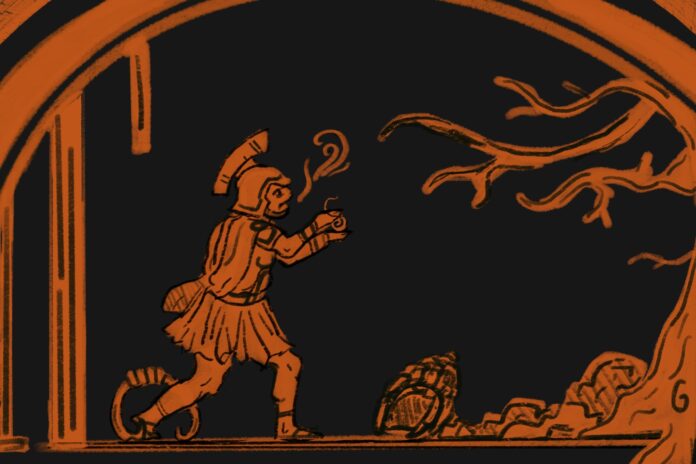
Before I start, I’m aware someone will ask me if I saw it ‘the way it was intended’, in IMAX 70mm. The answer is no, I didn’t, but not for a lack of trying — there is not a single IMAX 70mm location in the entire continent of Asia. So I suppose my review will have to go on without the full experience of Christopher Nolan’s artistic intent.
I watched this film hoping I’d enjoy it despite my own concern — and I did, to an extent. The music, scene composition, props and special effects were amazing. Circe’s scene with the pigs and the Cyclops are feats of costume and prop design. I’d say it is expected for a billion-dollar production, but these days a large budget isn’t always an indicator of greatness. Despite this, the film made no effort to capture the vibrant colors of late Bronze Age armor or clothing. The inaccuracies in plot and costuming were insurmountable and proved to be symptoms of the hollowness of this adaptation.
Nolan’s interpretation of Odysseus’ character is reductive and one-dimensional. Rather than reimagining the renowned Homeric epic, he rewrites its protagonist, effectively placing a modern man in the middle of the Bronze Age. Like in his 2023 film “Oppenheimer,” the Academy Award-winning director simply cannot resist redeeming a violent man through their own suffering.
At the expense of the women and the plot, Nolan injects modern values into the meat of the story. The dogs in this film are, as Emily Wilson mentioned, suitably cute for modern tastes. Circe, the witch who transforms all men who set foot on her island into pigs, lives in a hovel. The aesthetics of this film are all built to cater to a contemporary audience. Circe is originally said to live in a palace, but is shown to inhabit a hut on a hill, dressed in rags in the film. Athena, the goddess of wisdom and strategic warfare, is portrayed as a victim of said war, silent and disapproving. The goddess Calypso, a commentary on the sexist double standards of the gods, is reduced to Odysseus’s therapist. The sirens, Charybdis, Scylla, Helen, Penelope — every woman in Nolan’s “Odyssey” is either an obstacle to be slain, an object of desire or a redemptive vehicle in the titular character’s journey. The suffering of women is used to emphasize Odysseus’s suffering. Their pain decorates his journey of redemption.
It does no good to strip away the power, influence and anger from these women.
Penelope’s characterization in particular irks me to no end. After seeing Nolan’s “Odyssey,” I watched “The Return” (2024), an adaptation of the second half of the epic, starring Ralph Fiennes and Juliette Binoche. One thing that stood out to me was the difference in their monologues. Binoche’s Penelope delivers an impassioned cry to Odysseus after his return and slaughter of the suitors. Her words center on herself, her struggles alongside those of the kingdom. In her speech it is not the king’s two bodies, but the queen’s.
Anne Hathaway’s Penelope makes a speech to Telemachus. The point in the story where the speech is made is different, but her speech lands more as a generalized plea describing the plight of the modern woman. This Penelope is not her own person; she doesn’t center herself (as most people do). Instead, Penelope is an avatar for the executive woman facing discrimination. Again, she is reduced to an idea. She isn’t a character; she’s a theme.
Her husband is not characterized much better. I struggled to feel the intelligence of Matt Damon’s Odysseus. He spends his journey so enveloped in his guilt that we barely see echoes of the wit and acumen of his original character. Where is the tension in this man? Where is the dichotomy? I asked myself: how did Nolan allow Odysseus — a man with the pride of a king, the cunning of a god, the helplessness of a beggar — to slip through his fingers? Even the image of the beached Trojan Horse invoked a stronger sense of complexity than the epic’s protagonist. Given the richness of the source material, it was nearly inconceivable to me that the final experience of these characters would be so diluted.
Nolan is so concerned with writing a redemptive journey for his guilt-ridden toy soldier that he writes fictions into the source material to support his own narrative. The hallowed halls in the palace of Homer’s “Odyssey” are filled with adaptations from days past and likely future. In a room of suitors, Nolan believes he already has Penelope’s hand, while failing to even straighten his bowstring.
Even so, he leaves the door ajar. With the success of this film in cinemas and the intense discourse and analysis, Nolan is bringing the classics back into the homes of the people. Even I couldn’t resist the urge to revisit the original “Odyssey” after this film. No adaptation is perfect. While I feel strongly about Nolan’s directorial choices, I still respect his filmmaking abilities, his box office success and his cultural impact. Like it or not, this adaptation will make waves in public perception of the classics.
Contact Levi Lee at leev@oxy.edu