

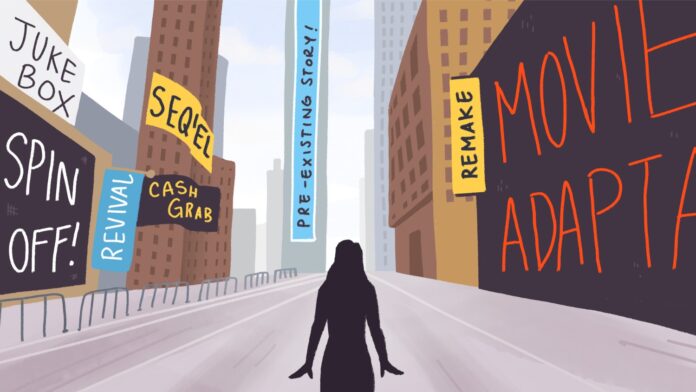
As both an audience member and writer of original musical theater, I have recently been disappointed to see a lack of originality in Broadway musicals. Although it’s fun to see the occasional movie-adaptation musical where the already-familiar characters are bolder and better than ever, I worry what the future of Broadway looks like if we fully lean into the trend of reusing old material.
Audiences have been falling in love with new musicals since the moment Broadway was established, but what happens to Broadway when we stop creating new material for these musicals? What happens when you go to buy tickets for a Broadway show and realize you are already familiar with every story being told? Do musicals start losing their luster if you already know who to root for, how the story will end or how the songs will go?
Throughout the 21st century, Broadway tickets have become increasingly less affordable for the average consumer. Because of this, audiences are less willing to risk major investments on productions they are unsure about. When the ticket price for the average Broadway show is more than $100, it is hard to justify spending that kind of money on something you know nothing about. So, audiences have begun to look for shows they are already familiar with or have received high critical acclaim.
A major trend on Broadway is musicals based on some kind of prior source material. This typically presents itself as media adaptations from books and movies, but it can look like anything from a jukebox musical of songs an audience already knows (“Moulin Rouge”), to a musical based on real people or events (“Hamilton”). As audience interest skews towards these musicals, Broadway investors become primarily interested in those types of shows.
Between 2000 and 2019, no more than two of the nominees each year for the Best Musical Tony Award were original musicals. In those nearly two decades, original musicals only acquired 30 percent of the wins. In 2010, every nominated musical for the award was a jukebox musical. In 2013, every nominee was a movie adaptation. Even this past year, only one nominee for the award was an entirely original musical.
These statistics are important because Tony Award recognition has been shown to have major impacts on the potential longevity of a musical’s run on Broadway. Nominees for the Best Musical award are “nearly 60 percent less likely to immediately close than Broadway musicals that are not nominated.” Additionally, musicals who win the award have their production’s likelihood of remaining open tripled.
Without the support of prior source material, original musicals are in need of award recognition to build an audience that sustains their productions. However, despite the often limited recognition and restricted opportunities available to original musicals, award nominations in recent years have shown that audiences do seem to enjoy and appreciate original Broadway musicals when presented.
In 2025, the original musical “Maybe Happy Ending” won the Tony for Best Musical against one movie adaptation, two real-life inspired productions and one jukebox musical. Audiences around the world loved “Maybe Happy Ending” enough that the show is not only still on Broadway, but also just began a North American tour.
Last year, one of the 2026 Tony nominees for Best Musical was an original musical called “Two Strangers Carry a Cake Across New York.” I was lucky enough to see “Two Strangers” on Broadway with its original cast and was blown away by the way it incorporated incredibly fun, upbeat moments into a deep and unique story. The musical’s original voice, paired with the incredible performances of its two-person cast, warranted at least a nomination for Best Musical, if not a win.
There is, of course, nothing wrong with shows based on prior source material and many feature very unique and creative stories. It is partially because I am a fan of them that I believe we need fewer productions of these varieties on Broadway.
Although the thought seems counter-intuitive, when we have an over-saturation of one specific market, we stop seeing the value in each of the individual options placed in front of us. If every musical on Broadway is some type of media adaptation, the idea of an adaptation-based musical becomes far less novel and interesting for the audience.
Additionally, an even larger issue is created when we begin denying space for original works in favor of musicals based on familiar concepts.
Broadway has always been a place where artists push boundaries and introduce audiences to new ideas. So much original work is being made that deserves the chance to find its audience. It is important to provide support for original Broadway productions so aspiring artists like myself and my peers can continue creating and sharing unique stories through musical theater.
There are countless ways to revitalize source material, but if we don’t expand beyond this, we lose opportunities to bring new voices to the forefront of musical theater and create musicals that will inspire the next generation of Broadway productions.
Next time you want to buy tickets for a Broadway musical, or even a local one, consider supporting a piece of new work and subsequently showing the Broadway industry that original musical theater is not only profitable for them, but important to the audiences it is being created for.
Contact Sadie Maguire at smaguire@oxy.edu



Very interesting and intriguing! Happy to hear more on this topic.