

There’s an old maxim that says, “you only truly understand something once you’ve had to teach it to someone else.”
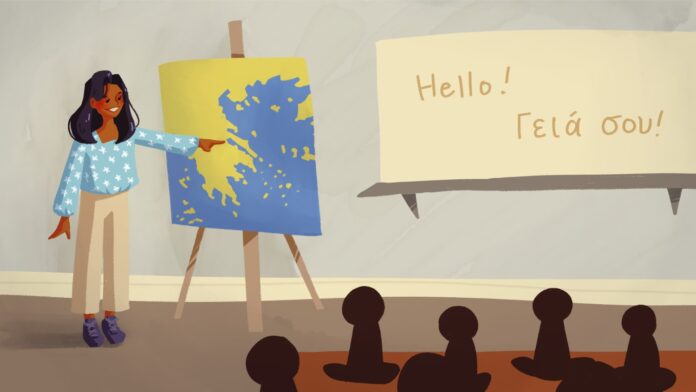
I’ve spoken English my whole life, and have dedicated time at Oxy to learning Ancient Greek, but after teaching English courses at a refugee organization in Greece through the Justice Summer Internship Program, I realized how little I understood about language until now. To say that I taught English is only half the story — the more crucial half is that I learned countless lessons about the cultures, religions and languages of my students through our time together. Our students were primarily from the SWANA region, bringing with them a tapestry of languages and cultural histories.
While most of the time we did not have a language in common with one another, my students and I were able to find new ways to communicate. Many of them were well-versed in translation technology out of necessity, and we are entering an era in which language learning can feel pointless in the face of such immediate and accessible digital resources, like Google Translate. Still, language is far more than a 1:1 translation. There is great value in imperfectly formed, but well-intentioned attempts to communicate.
One of the greatest joys, and challenges, of the program was teaching the teen class. After seeing one of my students diligently copy down the alphabet, I realized that he could not read or write in his native language. Some of the only words we had in common were places on a map. We traced the journey of his migration, from his homeland of Afghanistan to Turkey, later France and his eventual arrival in Greece.
I realized I needed to learn the pronunciation of Turkish words in order to be able to repeat them to him, since I couldn’t just show him a translation on my phone. He would kindly correct my pronunciation, and I would help him say the word in English. Back and forth we would go, giving and taking words from one another in equal measure. Even when we have translation technology at our disposal, there is a human element to learning languages that cannot be conveyed through a screen. Teaching became a reciprocal endeavor, rather than a hierarchical exchange.
There is a distinct vulnerability in seeking to learn a new language. One has to constantly undergo the experience of being wrong, and needing to be corrected. This was particularly challenging for our adult students, one of whom did not seem at all interested in my help at first. Every time I would approach her desk to help with the day’s worksheet, she’d turn away. As someone coming from a place of immense privilege occupying a position of authority, I realized that it was necessary for me to show a degree of vulnerability in return.
I got used to introducing myself and asking questions in Greek, as many of the adult students had learned the language in order to assimilate. The student who was hesitant at first began to trust me because it was clear I was making an effort to step into her language. This cultivated a new level of respect and opened up a friendship that would last the rest of the summer. If a student did not know how to ask for help in English, I would try to learn how to offer assistance in their native language.
There were many times when I questioned my abilities and preparedness for the role. Even though I’ve wanted to be a teacher since I was young, I could not have predicted the difficulties of navigating a classroom without being able to communicate easily. I could have let my self-doubt prevent me from trying to speak so many new languages, but thanks to encouragement and inspiration from my students, I learned that making an effort and growing through mistakes was much more meaningful than striving for perfection.
The most powerful part of the experience was seeing the connections forged between students both during and after class, despite the geographic and political differences between their countries of origin. Thanks to a worldwide emergence of far-right anti-immigration policy, leaders are emboldened to spread Trump’s rampant anti-migrant rhetoric. My experiences this summer made me realize how crucial language is in preserving homelands and cultural understandings shattered by conflict and devastation. As important as it was to teach our students English, asking them to teach us words from their languages helped foster a sense of mutual understanding and care for one another’s cultures.
If we all understood one another perfectly, there would be no need for language at all. Speaking is our internal world made external, an offering to another person that allows them a view into our perspective. There can be deep misunderstandings even among those who speak the same language, because we have forgotten how to listen to one another. The exchange of teaching and learning new languages with students from all over the world reminded me of how central speaking is to our humanity. Building up our vocabularies little by little, revisiting languages we’ve neglected since high school and dedicating ourselves to further study of various languages may one day prove crucial to our ability to help someone else. No matter what gets lost in translation, there is so much more to be found.
Contact Athya Lodhia Paramesh at paramesh@oxy.edu



Amazing article and hits all the right notes and brings out the importance of communication however different our worlds may be.
The way Athya handled the complexity of teaching and learning is truly remarkable.
Thank you Athya you did it again. 🙌🏽