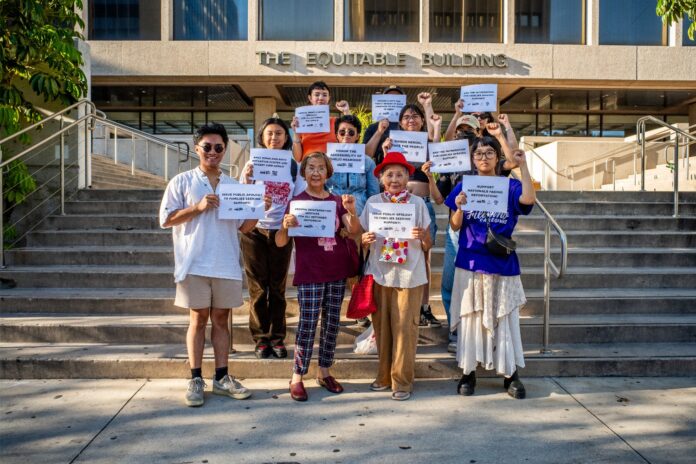
Anakbayan Eagle Rock, GABRIELA Eagle Rock and Anakbayan Inland Empire launched the Free Kuya Jonathan campaign in June to support Jonathan Canete, a 46-year-old caregiver from Cebu, Philippines, who was detained by U.S. Immigration and Customs Enforcement near downtown LA June 10. Canete has since been held at Adelanto’s Desert View annex for three months.
Anakbayan is a national alliance of Filipino youth and students organizing in the National Democratic movement for the liberation of the Filipino people. The alliance has chapters across LA, including Anakbayan Eagle Rock and Anakbayan Inland Empire, near Adelanto. GABRIELA Eagle Rock, an anti-imperialist organization fighting for the rights of Filipino women, children and LGBTQ+ people organizes across Eagle Rock and Northeast LA. Both groups are part of BAYAN, a multisectoral alliance of progressive Filipino organizations fighting for National Democracy in the Philippines. Eagle Rock has long served as a hub for the Filipino community as it migrated outward from Historic Filipinotown.
Dominique Zamora, an organizer with the campaign, said the effort began by connecting Canete with legal support and fundraising to cover basic necessities inside the detention center, such as commissary purchases, phone access and additional food.
“The Free Kuya Jonathan campaign is an effort to support Jonathan Canete, the son of Tita Gloria,” Zamora said. “We’ve been supporting him in navigating the detention system and fighting for his freedom.”
The campaign’s goals extend beyond Canete’s case, Zamora said. Organizers see his freedom as tied to a broader fight against migrant exploitation, U.S. imperialism and the for-profit detention system.
“At the beginning it was very much just helping him survive the conditions inside the detention center,” Zamora said. “From the very beginning, we’ve been reaching out to the Philippine consulate since Jonathan is a national of the Philippines. Ever since, the consulate has basically ignored our requests.”
During an early visit to the consulate office, Zamora said, staff called police on Gloria Canete Anderson, Jonathan’s mother, and other mothers who had come seeking support.
“The consulate called the police on Gloria and other mothers who went there seeking support, saying, ‘You’re intimidating us, you’re antagonizing us, so we’re going to call the police on you’ — which is crazy,” Zamora said.
Canete Anderson said she was surprised by the way the group of mothers was confronted.
“We are the ones being charged with intimidating them,” Canete Anderson said. “A security guard came in and told us to get out. I said, ‘No, I’m not getting out of this door, because we Filipino people are paying for this room.'”
About six people were ultimately escorted out by additional officers, Canete Anderson said. Canete Anderson said she has relied on community support ever since to keep visiting her son.
“I could not move because I have nothing,” Canete Anderson said. “Adelanto was so far, about two hours away, and it was so hot. It’s the support of the community that I was relying on. Without them, I could not visit my son.”
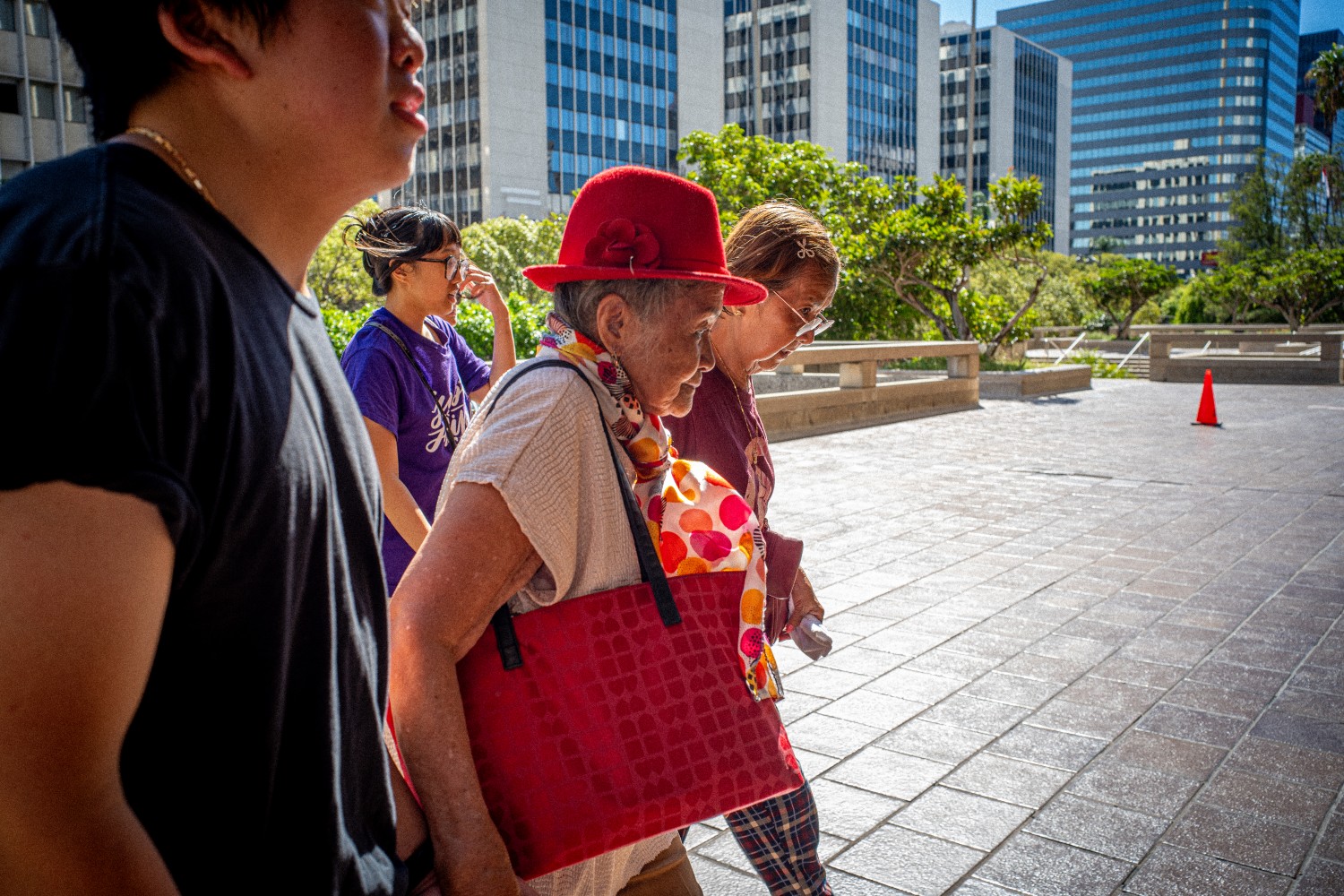
According to Canete Anderson, the experience has been especially difficult for her son, who has two outstanding nonviolent charges but has not been convicted or found guilty of any crime.
“It’s like you are a criminal — you don’t have any conviction,” Canete Anderson said. “Adelanto is hard to survive, especially for my son, because he’s such a carefree person. He never experienced that kind of treatment.”
The food inside rarely includes rice, a staple of Filipino cuisine, Canete Anderson said. According to Canete Anderson, her son’s stress is such that he calls her no fewer than five times a day seeking updates.
Zamora said the campaign’s goals now extend beyond securing Canete’s release altogether.
“There are so many migrants currently suffering these inhumane conditions in Adelanto,” Zamora said. “One of the goals of the campaign is to shut down Adelanto, shut down Desert View annex for good.”
Zamora said the campaign is also pressuring the consulate to expand services for Filipino migrants broadly. According to Zamora, as of Aug. 31, an immigration court had issued a deportation order for Canete after a judge denied his request for voluntary departure the day before. Consulate staff told the campaign the timing of his removal was entirely ICE’s decision.
“Now it’s in ICE’s hands to decide when he’ll leave, what flight he’ll get on,” Zamora said. “It’s completely up to them.”
Zamora said the Philippine government has standing as a sovereign nation to intervene on behalf of its citizens, but it has chosen not to.
According to Zamora, the campaign remains focused on ensuring Canete’s safe return, including pressuring the consulate to confirm he will be booked on a flight from Manila to Cebu, rather than left in the capital, where his family does not live. Organizers have assembled a suitcase of supplies for Canete to take with him.
Zamora said the campaign is raising awareness for a second Filipino migrant detained at Adelanto, who was picked up by ICE while traveling from Chicago to LA after his visa expired.
“There are at least two other Filipino migrants in Desert View annex,” Zamora said.
Leia Albornoz (sophomore), a student at Occidental and a Filipino organizer, joined the campaign after learning about conditions inside Adelanto, which she said is the largest ICE detention center on the West Coast.
“There are articles online about worms in the water,” Albornoz said. “Detainees earn about a dollar an hour when they work. The conditions are horrible — the mental health is horrible. It’s recently been reported that people are committing suicide there.”
Albornoz said Eagle Rock’s Filipino population drew her to organizations like Anakbayan Eagle Rock, a chapter of a larger organization fighting for the National Democratic Revolution in the Philippines.
“We’re fighting for the National Democratic Revolution across the ocean, in our homeland, but we also do a lot of grassroots organizing with local Filipinos,” Albornoz said.
Canete Anderson said her son’s isolation at Adelanto deepened when he found himself the only Filipino detainee in his cell.
“There were about 60 people in his cell, and he was the only Filipino,” Canete Anderson said. “It was sad, because he had nobody to talk to.”
According to Canete Anderson, her son has since befriended a Chinese detainee who speaks English, and Canete’s mood improved once the other Filipino migrant arrived at the same facility.
According to Zamora, detainees are charged for phone calls, food and other supplies and earn as little as $1 an hour if they are assigned work. Canete Anderson said money sent to detainees is also subject to steep handling fees — a percentage-based cut taken by the facility’s transfer system — that scale down as the amount sent increases.
“If you send $50, the handling fee is 16 percent,” Zamora said. “If you’re richer and send $100, it drops to 10 percent.”
Zamora said the fight doesn’t end with Canete’s case.
“The only way we’ll end this unjust system is through mass movement — people coming together, standing up and saying, ‘We won’t stand for this,'” Zamora said.
Contact Samhita Krishnan at krishnan@oxy.edu