It was December 2015. My sisters and I gathered on our olive green couch, anxiously waiting for a performance wehad anticipated for months. One Direction, our favorite band, was about to take the stage on “The X Factor” one last time before their indefinite hiatus. After their performance, the four gathered in an emotional group hug, then it hit me — they were really saying goodbye. We were devastated that this would be the last time seeing them perform, mourning the split of our favorite band that made the years of our preteen awkwardness feel like the best years of our lives. But nothing would compare to the guttural sadness and shock we would feel nine years later.
Maybe I shouldn’t feel so surprised. Some of the best One Direction songs are laced with goodbyes and discussions of change — it’s one of the many reasons I felt connected to them. In “Walking in the Wind” they sing, “Goodbyes are bittersweet but it’s not the end, I’ll see your face again,” and in “Night Changes” they commiserate, “We’re only getting older baby, and I’ve been thinking about it lately, does it ever drive you crazy just how fast the night changes?” In their last single, “History,” they belt, “So don’t let me go, so don’t let me go, we can live forever.”
One Direction fans were used to hearing them sing about goodbyes, but never actually feeling like that would materialize. My sisters and I had been waiting for the day they would get back together and fantasized about going to their reunion show when we were in our late 30s. One Direction’s discography was the soundtrack of our lives.
Then, everything changed.
I sat on the floor of my room in San Francisco Oct. 16, when my dad burst through the door to tell me the news. My heart dropped to my stomach — Liam Payne had died.
“There’s no way,” I thought to myself. I opened my phone and reloaded my Instagram feed as tears began to cloud my vision. Shock hit every cell in my body. I sat there, in my childhood bedroom that was filled with One Direction memories, unable to move or wrap my head around the news. For once, all those goodbye songs felt real.
In some ways, this feeling isn’t new. Everyone has had a celebrity death that has felt personal, that makes you wish you just had a bad dream — this one is mine. When a celebrity dies, the personal connections, images and nostalgia that were associated with them are suddenly packed into a cloud of grief. How do you grieve for someone you’ve never met? I’m still trying to figure it out.
My memories of One Direction, some of the happiest moments of my childhood, are inseparable from Payne.His passing feels like my childhood is being ripped away from me. As I mourn him, I mourn for the 12-year-old “Directioner” in me who came home from school reciting One Direction lyrics as if they were my second language. They were the first artists my sisters and I ever loved, and during my preteen years, they were often the reason I got out of bed —my dad played “Steal My Girl” in our room to wake us up in the morning when we were going to be late for school.
When I’ve listened to One Direction’s music since Payne’s death, it hasn’t been the same. I hear his voice in my favorite songs and feel a rush of sadness take over me as I realize he is gone. His death reminds me that I’m no longer the nonchalant tween who sang along to “Best Song Ever” with my sister in front of our stuffed animals. The grief I’m feeling, in part, is the grief of growing up. I am now older — I know what it’s like to go through change, to miss people, to want to slow down time.
But when I think about One Direction, the sadness I feel is also met with immense amounts of joy. I think about my sisters, our mismatched interests converging towards our shared passion of watching them belt “No Control” with James Corden; our late night watch parties adoring their concert films, gripping a pint of ice cream while screaming their lyrics. I think about how we filled our bedroom walls and camera rolls with pictures of them and played One Direction when we couldn’t agree on what music to listen to on our drive to school.
There’s sadness in saying goodbye to my childhood and being apart from my sisters, but I know that I’ve gained more than I’ve lost.
My sisters and I may never fulfill our childhood dream of seeing One Direction at a reunion concert in our late 30s, but they will always be a fundamental part of our lives — I picture the three of us screaming the bridge to “Stockholm Syndrome” at one of our karaoke nights, watching old videos of them together when we need a pick-me-up and dancing to their songs at our weddings.
I listen to One Direction as I’m walking through the Quad when I need something to brighten my day, and in my dorm room when I want to be reminded of home. Instead of listening to their music for the catchy choruses and perfect harmonies, I now seek comfort in the verses that reassure me that everything will be okay. I hear their voices and goodbyes feel a little bit easier, because I know I’m not in it alone. I need their music now more than ever, especially as I’m getting older and change feels like a constant shadow following me everywhere I go. I know their songs will get me through this goodbye like they have countless other times. But I’ll never really let Payne or One Direction go, because in my memories they will live forever.
Donald Trump has been reelected president of the United States — and now, Joe Biden has entered his lame duck era. In the pages of the New York Times and Washington Post, eminent thinkers will ponder the ramifications of Trump’s second term and will shower praise on the Biden administration’s accomplishments. Unfortunately, I am neither an eminent thinker nor a writer at the New York Times, so it is not really my place to write such a retrospective — nor, in my view, is it proper to praise the administration.
During the Biden presidency, a so-called “new centrism” emerged as the politically dominant ideology — one that challenged the “free-market ethos” that made taboo ideas such as subsidies, protectionism and harsh restrictions on immigration. This new centrism moved beyond the so-called “neoliberal” era of the past 40–50 years — which thinkers like Oren Cass (on the right) and Matt Stoller (on the left) indict as prioritizing complex mathematical models that yielded benefits for free trade and lower barriers to immigration over intangibles like coherent communities and manufacturing prowess.
Yet, the analytical capacities of these so-called “post-neoliberals” are often found lacking. New York Times columnist David Leonhardt, in “Ours Was the Shining Future,” places part of the blame for the end of the “golden age” of the New Deal Era and the subsequent rise of neoliberalism on the rise of immigration post-1965. This is a tempting narrative — it allows one to blame foreigners for structural problems endemic to an economy undergoing massive technological shifts — but unfortunately for its hawkers, it is also wrong. The best empirical evidence we have about the effects of immigration — sudden or long-term — on native-born workers’ wages suggests that they are slightly positive, if anything, since immigrants and native-born workers are more often complements than substitutes.
If the post-neoliberals’ analysis in the realm of immigration was bad enough, the quality of economic analysis when it comes to trade is downright nonsensical. Cass’s group, American Compass, proposed a global tariff, starting at a rate of 10% and ratcheting upwards 5% per year while the country runs a trade deficit — in an attestation to the post-neoliberals’ influence, Trump all but adopted this proposal during his presidential campaign. This tariff plan is, for lack of a better word, disastrous.
The reason the United States runs a trade deficit has nothing to do with the composition of industries and everything to do with our institutional stability. The balance of trade and currency exchange rates are intimately linked together — the dollar, as the global reserve currency, is a highly sought-after commodity; foreigners obtain dollars by exporting goods and services to the U.S. When a tariff is implemented, Americans purchase fewer goods from abroad, meaning foreigners obtain fewer dollars. As a result, the price of the dollar goes up abroad, and exports from America become more expensive. The net effect of a tariff on the balance of trade is approximately zero — with a side effect of more expensive imports, of course.
However, despite these glaring incapabilities in their reasoning, the Biden administration all but adopted their policies in name. In 2019, Biden opposed Trump’s tariffs on the basis of their negative effects on consumers — then as soon as he took office, he not only kept Trump’s tariffs on various Chinese goods, but also expanded import tariffs on crucial infrastructure such as solar photovoltaic panels and doubled down on the disastrous Made in America standard (which drives up the cost of federal procurement with little benefit).The story that Biden’s defenders tell to justify these actions is one of national security— that in maintaining and implementing these tariffs, the U.S. will maintain its industrial base and competitive edge in the technology of the future.
Certainly, there have been a number of accomplishments under Biden that fall under the banner of post-neoliberalism. The CHIPS Act and Inflation Reduction Act have partially yielded large increases in manufacturing construction — bolstered by fear of China, both the Republican and Democratic parties are especially willing to lavish subsidies on “strategic” domestic industries to protect them from national security risk.
This wave of policy emphasizing domestic industry comes at the same time that support for immigration has cratered in recent years — the share of Americans saying immigration should be decreased has regressed to the levels of the mid-1990s. Faced with this wave of anti-immigration sentiment, the best the administration had to offer were tepid words of support for immigrants’ dignity, while maintaining the current excessively restrictive immigration system. Meanwhile, the few programs that the administration implemented to facilitate easier immigration, such as the parole program for Cubans, Haitians, Nicaraguans and Venezuelans (CHNV), were severely curtailed or canceled outright.
The Biden administration, egged on by this new post-neoliberal intellectual trend, finalized the inward turn Donald Trump started. In pursuing a backward-looking dogma that believes muscular industrial might is the sole measure of domestic well-being, the administration turned its back on the historic source of our strength — our openness to trade and immigration.
As Adam Posen, president of the Peterson Institute for International Economics, warned in 2021, this will ultimately prove to be America’s undoing. Rather than strengthening America, the Biden administration will ultimately prove to be its downfall.
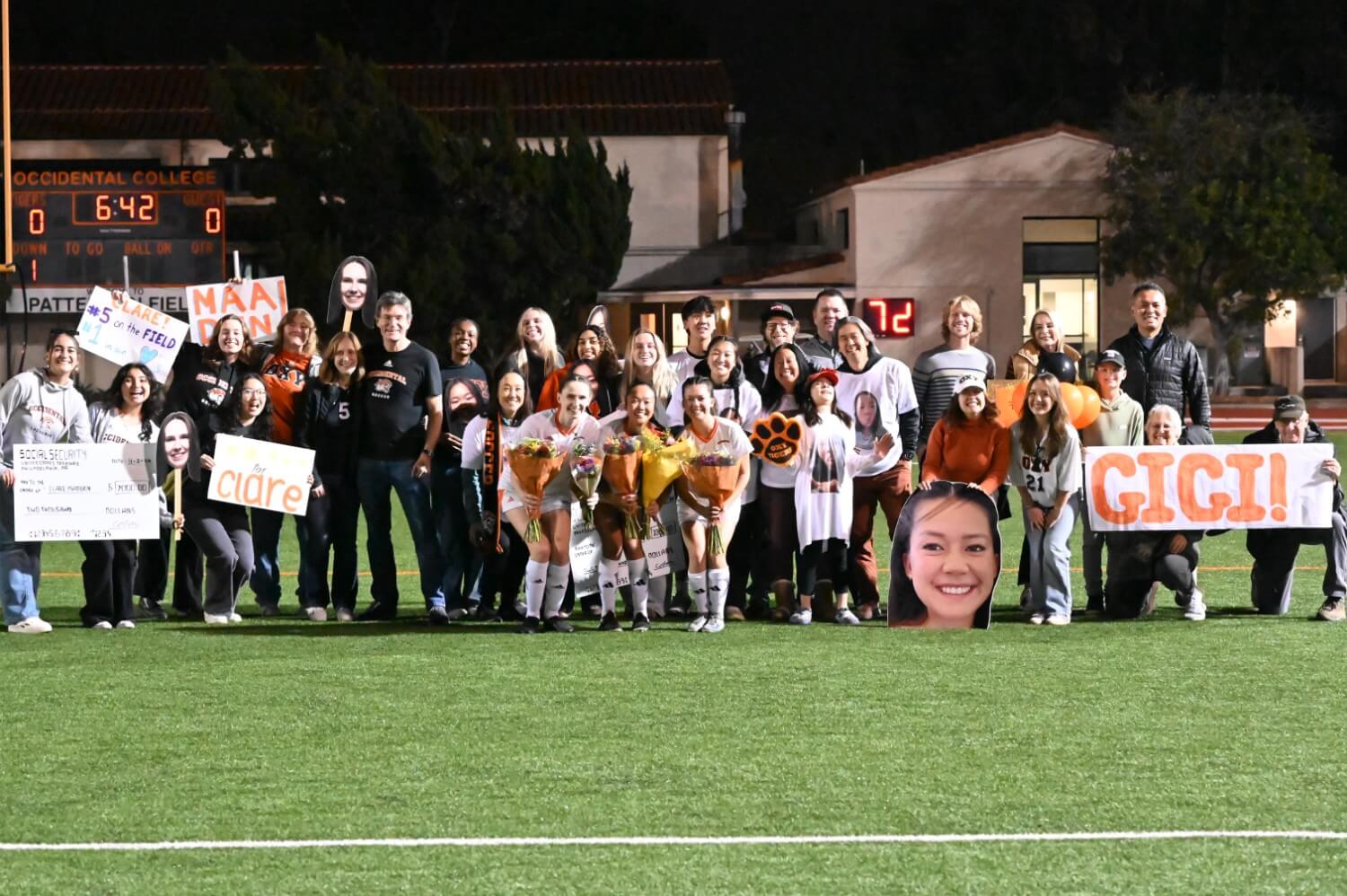
The Occidental women’s soccer team had a rainy senior night game Nov. 2 against Redlands. This year’s roster had three seniors: Anna Fukushima, Clare Madden and Gisele (Gigi) Yamamoto. According to Fukushima, Madden and Yamamoto, the three seniors have had a long soccer career going back years before they came to Occidental.
Fukushima said she was recruited to play for Occidental fall of her senior year of high school. However, she did not actually play at Occidental until she was a sophomore since her first year was online due to COVID-19.
Madden said she transferred to Occidental Fall 2021 for her sophomore year after taking a gap year. She talked to the Occidental women’s soccer coach Colm McFeely during COVID-19 and joined the team as a walk-on.
Yamamoto said she began playing soccer in a coed recreational league in the second or third grade.
“My family is Brazilian, and my dad played in Brazil. I’ve been around soccer essentially since the day I was born,” Yamamoto said.
Fukushima said that for their Senior Night game, the non-senior team members decorated the locker room and made posters for them.
“Every senior night, the team gets together, and they do a lot to make you feel super special,” Fukushima said.
According to Yamamoto, the underclassmen on the team wrote letters to each of the seniors paired with photos commemorating their time.
“There’s always a sentimental gift,” Yamamoto said. “It was just really, really sweet.”
According to Madden, the three seniors got to walk out with their family members and friends when their names were announced before the game.
Courtesy of and photos by Julietta Seirmarco
Yamamoto said her parents, sister, grandparents, aunt, uncle, cousin and boyfriend all came to see her play and that it was nice to share her senior night experience with them.
“[They have] always have been my biggest supporters no matter what, no matter if it was the best game of my life or the worst,” Yamamoto said. “I think having them all there to support me and to wrap up this experience felt really special, and it just felt very full circle.”
Fukushima said one of the most important parts of being on the team that she will look back on and remember is the relationships she formed with her teammates.
“It’s the little things — going to dinner with my teammates after practice and spending an hour just sitting around talking about nothing […] the bus rides home from games or just little team bonding events are the things that will stand out to me when I look back five or 10 years from now,” Fukushima said.
Looking back at her four years of being on the team, Madden said her favorite memories were the team’s Halloween practices. According to Madden, she and Fukushima were dressed as grandmas for this year’s Halloween practice.
“It was our last game of the season. We needed a win to go to postseason, and I ended up scoring the game-winning goal. It was a super fun […] and very rewarding experience,” Yamamoto said.
According to Fukushima, it can be physically and mentally challenging to balance academics and athletics.
“I go to soccer, and I forget about all of the issues I’m having with academics — or when I go to my classes and take a test, I have to forget about what’s going on with my athletics,” Fukushima said. “Balancing both of those things has been somewhat difficult.”
Madden said it was often hard grappling with the ups and downs she faced throughout her soccer career.
“Maybe you don’t end up peaking or being the best playing, but I definitely feel that there’s still development of character and leadership and off-the-field things,” Madden said.
Fukushima, Madden and Yamamoto said they want to continue playing soccer.
Fukushima said she plans to come back for the alumni games and continue playing with old friends.
Courtesy of and photos by Julietta Seirmarco
“I think that soccer has been such a big part of my life that I really can’t see myself not playing. But definitely taking a step back and playing pick up leagues or joining a Sunday league with some of my friends from home is something that I’ll do,” Fukushima said.
Yamamoto said she will also use her extra time to focus on some of her other hobbies, like boxing, running and ice skating.
“Playing soccer at Oxy has been a huge part of my identity here, and I feel really grateful for the friends and for the connections that I’ve made as part of this program,” Yamamoto said. “I remember being a freshman on my very first day, standing in front of the training room with all of our masks in a circle introducing ourselves for the very first time. I can’t believe I’m a senior and we’re passing on the team to the next generation.”
Occidental has two rugby teams: Occidental Men’s Rugby (also known as the Black Shirts) and Occidental Rugby Club. This semester, the two teams have competed against a variety of schools, many of which have student bodies much larger than Occidental’s. For both teams, the fall season is crucial for developing incoming players and preparing them for higher-stakes games in the spring.
One of the presidents of Occidental Rugby Club, Cleo Welch (senior) said the fall semester is generally a more developmental period because new players are learning the game.
“The fall is mainly just building up, introducing rugby to the rookies — but we have a couple of big tournaments that we played in, including one in San Diego,” Welch said.
According to Welch, rugby is not exclusively about athleticism; it is about finding a place on the field that matches each player’s strengths.
Welch said the team prides itself on its inclusivity, welcoming players of all sizes, skills and experience levels.
“The really exciting thing about rugby is that there’s a position for every different person,” Welch said. “If you’re not as fast but really strong, there’s a position for that and if you’re smaller but faster, there’s a position for that. There’s a lot of positions in between.”
According to Sarah Titcombe (senior), a field captain for Occidental Rugby Club, since the sport can be complex and physically demanding, the Occidental Rugby Club has specific strategies to help new players.
“We have a position called rookie wranglers, and those are people who are in charge of making people who are new to the team feel that they have a place but also learn skills, even if they join the team later in the season,” Titcombe said.
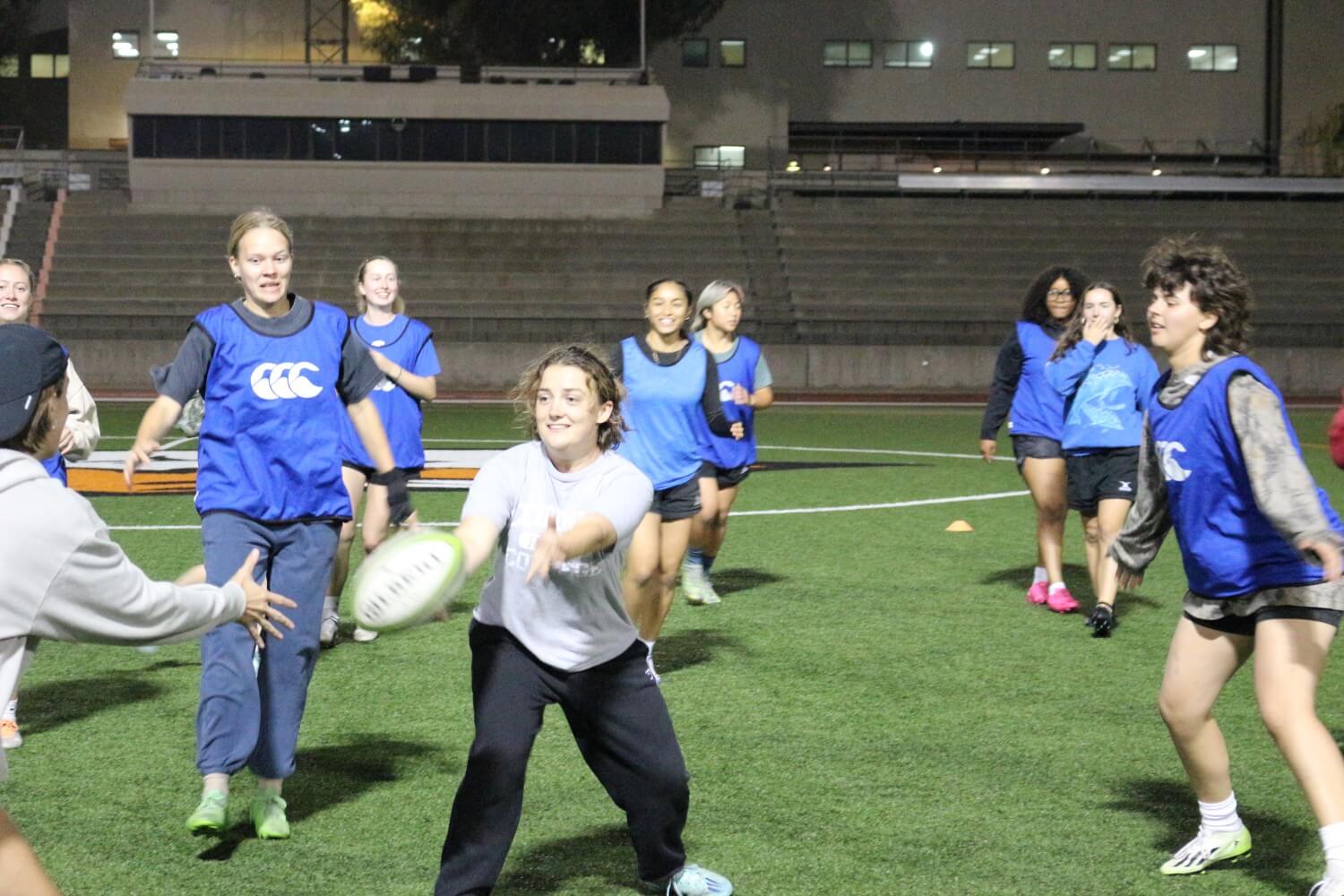
Women’s rugby during practice on Patterson field at Occidental College in Los Angeles, CA. Nov. 6, 2024. Aung Myat Htet/The Occidental
According to Welch, starting rugby can be hard, but the longer someone plays, the easier it becomes.
“It’s tricky in the beginning, to catch up with a lot of the rules because of the way that the game operates,” Welch said. “But we try to make it a gradual introduction to the sport, keeping it light and fun and having people get to know each other.”
Despite rugby’s reputation as a physically intense sport, Occidental Men’s Rugby President Dylan Hastings (senior) said the team places safety first, focusing on proper technique and structured training to reduce injury risks. The club makes sure all players understand that rugby’s physical demands come with a commitment to safety and respect on the field, Hastings said.
“Will you wake up sore as hell on Sunday? Yes, you will,” Hastings said. “But every time I go out on the field, even if there are guys bigger than me, I feel very safe.”
Tim Shumaker (junior), the equipment manager for Occidental Men’s Rugby, said that for many players, rugby’s appeal goes beyond the physicality — it is the sense of community and belonging that keeps them engaged.
Shumaker said Occidental Men’s Rugby views itself as more than just a sports team — it is a space where members connect and support each other, which is something that team members value.
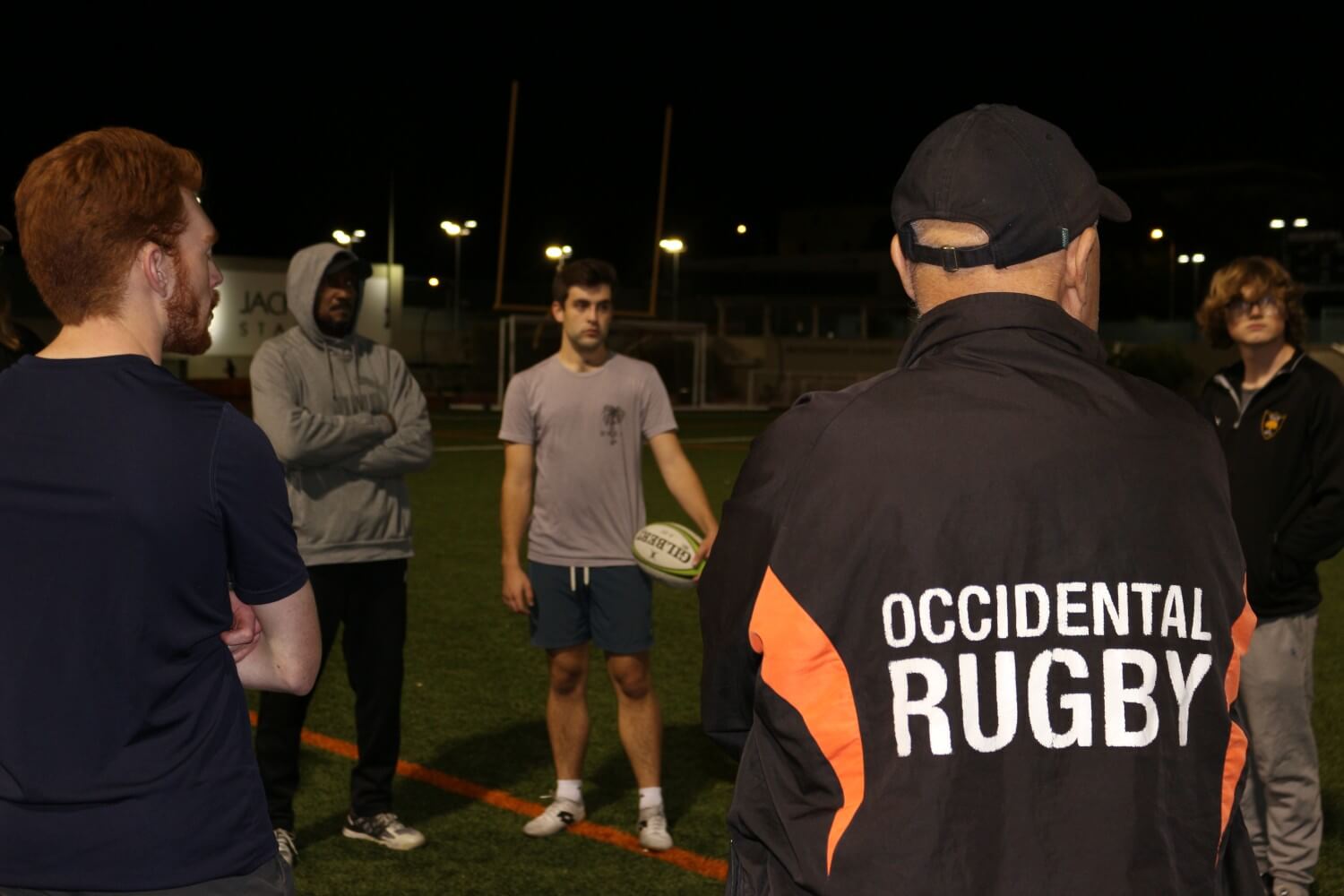
Men’s rugby during practice on Patterson field at Occidental College in Los Angeles, CA. Nov. 6, 2024. Aung Myat Htet/The Occidental
According to Hastings, this spirit of camaraderie extends beyond the team’s own roster. A unique aspect of rugby, he said, is the tradition of hosting the opposing team after each match regardless of the game’s intensity or final score.
“I think the community of the sport is what drew me to it the most,” Hastings said. “I say it’s a rugby club and it is, but I always market the club as a social club and we also happen to play rugby.”
According to Hannah Leiberman (sophomore), the hosting tradition creates an opportunity for players from both teams to come together, unwind and share in the experience that rugby offers.
“What stands out about rugby to me is the relationship between teams. There’s a whole lot of respect that I think you don’t see in a lot of other sports,” Lieberman said.
Hastings said there is a similar type of relationship between teams for Occidental Men’s Rugby as well.
“You’ll play 80 minutes of beating each other up and then after the match you have a social,” Hastings said. “If we had a game here, we’d host the other team at one of our houses, and everybody would come over and hang out. That’s part of the community of rugby.”
As Occidental Men’s Rugby prepares for the spring season, Hastings said that while winning matches is great, the primary goal is for students to enjoy themselves and foster bonds within the team.
“I would love to see them win, but at the end of the day, if you don’t win, it’s not the end of the world,” Hastings said. “I just want to see at least 15 — hopefully one day, 23 — people out there having fun on the field. That’s ultimately all that I want.”
Titcombe said she has a clear message for anyone who wants to give rugby a shot at Occidental.
“We totally get rugby is not for everyone, not everyone enjoys it, but it can be for anyone,” Titcombe said.
The Occidental Theater department held their fall production of “Poor Clare” for four days, Nov. 7-10,in Keck Theatre. The play is set in Assisi, Italy in 1211 and follows a noblewoman named Clare as her worldview shifts after meeting a man named Francis. Written by Chiara Atik, “Poor Clare” is a modern take on the true stories of St. Clare of Assisi and St. Francis of Assisi.
Aidhan Astrachan (senior), who played Francis, said “Poor Clare” is an interesting play because of its characters’ modern language and behaviors despite being a period piece. He said this helps the audience connect with the characters and demonstrates how many issues that existed in the 13th century are still being faced today.
“It shows us that no matter what happens, as humans, we’re still dealing with the same [stuff],”Astrachan said. “I think it’s very relevant, especially in this country with everything that is going on, and I think it’s important to laugh even when things are awful.”
Astrachan is a theater major and said he plans to become an actor after he graduates from Occidental. Astrachan said “Poor Clare” is a kind of play that he has not seen the college put on yet, which led him to audition.
“It was one of the first scripts I’d read for an Oxy play where I thought, ‘I would actually say that in real life,’” Astrachan said. “I connected with Francis in a way that I hadn’t with other characters I’ve played before.”
Lilia Cárdenas (first year) played the titular role of Clare. They said that in the play, Clare is someone who is very happy with her life and position in society.
“Her character changes a lot, but the one thing that doesn’t change is her goodness,” Cárdenas said. “Her definition of good changes, but she is always striving to be good.”
“Poor Clare” rehearsal at Occidental College in Los Angeles, CA. Nov. 6, 2024. Talia Goddard/The Occidental
Cárdenas said they did not expect much when auditioning for the play,as they believe that the college theater world is hard to succeed in. Theater is special to them, so Cárdenas said they were excited to be able to have this experience during their first year at Occidental.
“I enjoy theater more than most things in the world, and there’s something that happens on a stage that I don’t think can be replicated anywhere else,” Cárdenas said.
Athya Paramesh (first year) said she decided to audition for the play because of its messages around social justice and the way the script uses comedy to draw attention to larger social issues.
“Something that has really struck me throughout the process is that I feel really empowered to make change in a way that’s unrelated to the show itself,” Paramesh said. “It’s a really inspiring show that asks a lot of the people who are a part of it and who are coming to see it.”
Paramesh said the show was impactful to her personal life and that she carries its message with her beyond the stage.
“I’ve never had a play resonate with me so much outside of the theater,” Paramesh said. “I’ve taken it into my classes, into activism and other realms of my life where theater has not played a role before. It’s a play that will stay with me after the curtain closes on Sunday.”
According to Ella Gibbs (senior), the cast formed an incredible bond with one another over the nine weeks of rehearsal.
“I’m very happy that our cast is so kind and loving,” Gibbs said. “We’ve been having so much fun together which makes the rehearsal process more enjoyable. It’s something that I look forward to doing every night.”
Cárdenas said the bond with their fellow castmates was something that was refreshing to have as a first year.
“I’ve never met a more devoted cast that wants to be there and loves each other and is so willing to support each other through everything,” Cárdenas said. “That energy transfers really well on stage, because all our relationships are genuine.”
Final bows at the “Poor Clare” rehearsal at Occidental College in Los Angeles, CA. Nov. 6, 2024. Talia Goddard/The Occidental
According to Paramesh, “Poor Clare” is a special play because it is direct with its themes but stillforces the audience to think after the curtains have closed.
“It’s not a show where you’ll leave and wonder what the purpose of certain things was, but there’s still room for interpretation,” Paramesh said.
The play ends with a monologue from Clare, and Cárdenas said the most rewarding part of playing the role was getting the audience to feel emotional.
“After the lights dim on the final monologue, I get up and I look into the crowd,” Cárdenas said. “If I’ve done my job correctly, I get to see tears streaming down everyone’s cheeks.”
Gibbs said the story and message of “Poor Clare” is something that every audience member can learn from and carry with them in their daily lives.
“It’s really a story about self discovery,” Gibbs said. “Clare really goes on a journey of understanding her own privilege, and once she steps out of her bubble, she begins to see what has been around her this whole time.”
The climbing community here at Occidental is going up, down, sideways and all over the wall. While students do climb on their own in their free time, the college also has an official club for the activity, the Oxy Bouldering and Climbing Club.
Club President Alice Amdur (senior) said she started climbing in high school. Despite not having as much time for the sport in college, she said she still makes an effort to climb regularly. Amdur said she has been part of the college’s climbing club since it officially formed three years ago.According to Amdur, the club’s activity has taken a dive this year because of frequent leadership changes and the cost-intensive nature of the sport.
Amdur said the club aims to introduce climbing to more students and gain the funding necessary to make the sport more accessible by doing things like providing gear at the Student Leadership, Involvement & Community Engagement (SLICE) desk. Amdur said another one of the club’s major goals is to connect more climbers here at the college, as she herself struggled to find fellow climbers during her first year at Occidental.
“It took me a while to even realize that there were so many climbers at Oxy, because they find their climber friends and then they go climbing and that’s kind of it,” Amdur said. “But there are so many people who are interested in it and who have been climbing for a long time.”
Amdur said that despite how active Occidental’s climbers are, she thinks that the club no longer plays a significant role in the broader community.
“There’s a lot of really well-established climbing groups at Oxy and meeting those people and becoming part of that group is maybe the quicker way to get into climbing right now,” Amdur said.
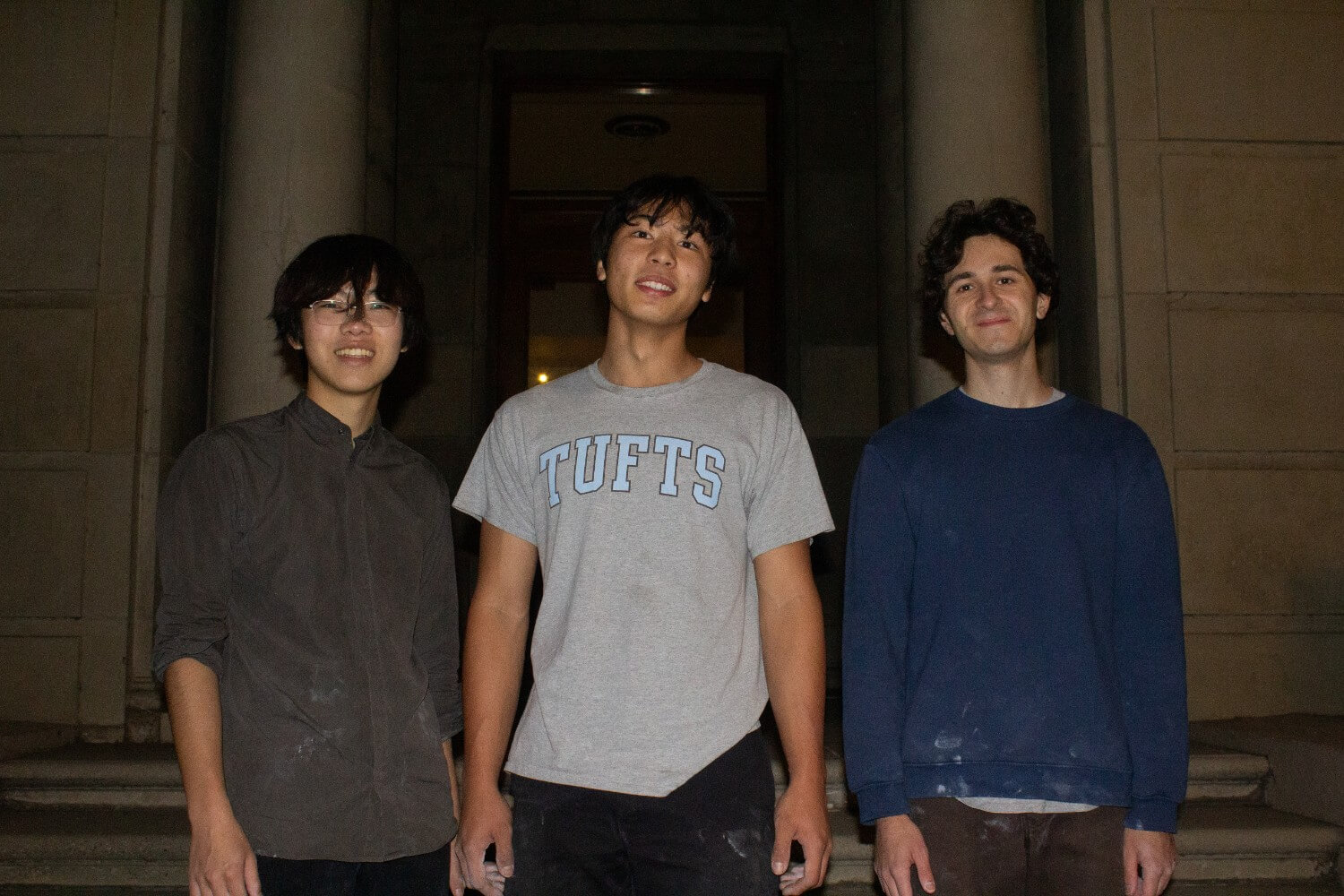
Climbers Ken Suzuki (first year), Ryan Tang (sophomore) and Gianluca Crescenzo (senior) at Occidental College in Los Angeles, CA. Nov. 1, 2024. Marty Valdez/The Occidental
One climber not affiliated with the club is Gianluca Crescenzo (senior), who said he got back into climbing after some friends invited him to climb with them. Crescenzo said he has since been making regular trips to the Hangar 18 Arcadia gym throughout the week, as well as bouldering outdoors at least once a week.
Kyle Eric Smith (first year) said he started bouldering two years ago and that he is not familiar with the college’s official climbing club. Smith said that part of climbing’s popularity is due to the collaborative aspect of the sport.
“Everybody’s helping each other with their problems, and everybody’s just open,” Smith said.
Kyle Eric Smith at Occidental College in Los Angeles, CA. Oct. 29, 2024. Marty Valdez/The Occidental
Ryan Tang (sophomore) is another climber at Occidental who said that despite joining the college’s official club at Involvement Fair, he has never gone climbing with the group. Tang said he likes the sport because it makes exercising fun.
“It’s kind of a gamified sport, you know, there’s levels of progression and it keeps you engaged,” Tang said. “It’s very clear to see your progress, and that’s not exactly true of other sports.”
According to Amdur, another reason climbing is so popular is because the community is so welcoming and encouraging.
“Even when I climbed competitively, it didn’t ruin it for me because I would collaborate with my competitors. They would help me out, they would give me advice and cheer me on and I would do the same. So it wasn’t a super hostile competitive atmosphere, but more of a very collaborative one,” Amdur said.
The Bulletin of the Atomic Scientists released their latest report Jan. 23 on the potentially world-ending dangers of nuclear escalation. The doomsday clock, which serves as an analogy for how close humanity is to extinction, was set at 90 seconds to midnight. This is closer than it has ever been, even closer to midnight than it was at the height of the Cold War. The Bulletin cited nuclear proliferation in states like North Korea and, most pressingly, the escalation of the conflict in Ukraine as major contributing factors to the decision. Since the beginning of the war, risk analysts have warned that the nuclear risk generated by an armed proxy conflict between the two most powerful nuclear states in the world outstrips even the Cuban Missile crisis in severity. Still, despite this constant barrage of terrifying statements from politicians and political scientists, people really do not seem all that concerned.
Experts warn that the greatest risk generated by the conflict is not that Russia will suddenly choose to attack the West with nuclear weapons. Rather, they fear that miscalculations and strategic miscommunications may cause an otherwise manageable situation to spin out of control with devastating consequences. Such miscalculations are not just a theoretical possibility — they almost led to global nuclear war at least two times during the Cold War and were only narrowly averted by the level-headedness of low-ranking officers like Stanislav Petrov. Analysts stress that we cannot count on such extraordinary individuals being present the next time unchecked tensions or faulty technology lead to a miscalculation.
When I ask people around me whether this is something that bothers them, the response I usually get is either that it doesn’t or that they prefer not to think about it. To an extent, this is completely understandable. Nuclear bombs, as potentially horrifying as they are, have only ever been used twice on humans, and since 1980 no atmospheric nuclear tests have been conducted anywhere on Earth. While the threat of nuclear war may not have gone away, for all intents and purposes the image of the mushroom cloud and nuclear devastation is now associated in popular consciousness with the bygone era of the Cold War.
Another possible cause of the lack of discourse surrounding the nuclear threat may be that people simply have other things to worry about. Recent polls show that other issues, such as the economy, immigration and reproductive rights, mean far more to Americans than nuclear disarmament. This makes sense; if you’re struggling to afford your next meal, worrying about the potential risk of a world-ending conflict may not be the most productive use of your time.
Still, despite how difficult it can seem to take action, history shows us that it can be done. During the Cold War, the threat of nuclear war was far more present in public consciousness than it is today — pro-disarmament protests were widespread throughout the world, and millions marched against nuclear proliferation. Considering the fact that nuclear war is arguably more likely today than it was in the 80s, it seems strange that we are not seeing a similar movement.
One reason for this difference may be how ubiquitous depictions of nuclear war were in the popular media of the Cold War. Movies like “Threads,” “Dr. Strangelove” and “The Day After” were major cultural touchstones of their time, helping to educate people about how bad such a war would be. Famously, after watching “The Day After” President Ronald Reagan wrote in his diary that it left him “greatly depressed.” The president, who until that point had been a hawkish supporter of nuclear proliferation, stated years later that watching the film played a major role in shifting his viewpoints to favor disarmament with the USSR.
Nuclear war is less salient in popular culture today, but I believe that we might be starting to see a shift in this trend. In March 2024, American journalist Annie Jacobsen published her non-fiction novel “Nuclear War: A Scenario.” The book, which received rave reviews from critics, is unflinching in its description of the unprecedented horrors that a nuclear war would bring. Jacobsen describes in visceral detail how even a single bomb could kill millions, vaporizing some instantly and leaving others to die slow and painful deaths from radiation poisoning or severe burns. Over the course of a decade, Jacobsen consulted dozens of experts in order to paint the most realistic picture possible of how a slight miscalculation could lead to the end of the world.
Despite the book’s grim content, this is a positive development. Authors like Jacobson help us conceptualize the threats we are facing and understand the urgency of demanding action from our political leaders. Due to the book’s success, it is now in the process of being adapted into a major motion picture by “Dune” director Dennis Villeneuve. If Villeneuve’s film is a success, my hope is that it could be a call to action and bring discussions about nuclear issues back into the forefront of public discourse, just like “Threads” and “The Day After” did in the 1980s.
Art shapes people, and people spark action. If in the long term, we want to live in a world free of the threat of nuclear holocaust, then we need to write more about nuclear bombs.
In Occidental women’s swim and dive’s first SCIAC meet of the season, captain Sarah Radle (senior) placed first in the 100 freestyle, 200 freestyle and 200 individual medley. Although the women’s team lost to Caltech by a score of 129-161, Sarah said the team’s energy remains positive.
“No matter what race you’re swimming, someone will be behind drilling and cheering you on, especially at the big meets where it really matters,” Radle said.
In Fall 2023, Radle studied abroad in Prague and was unable to compete in the swimand dive season. Radle also said she suffered from an achilles injury while abroad.
“We had a bit of a rough patch last year when I was gone,” Radle said.
Women’s swim and dive coach Haley Meryl said that when several team members are studying abroad, the fall season can be more difficult competitively.
“It was nice when Sarah and the other folks abroad returned,” Meryl said.
Meryl said Radle is one of the most competitive swimmers on the team, a quality she believes is a crucial form of leadership.
Since coming back, Radle said that she and her co-captains Caroline Agostini (senior) and Candace Farling (senior) have worked to foster an inclusive environment and create a closer team dynamic.
Agostini saidshe admires Radle’s resilience as a leader and her ability to take on competition, which drives Radle to always show up and score points for the team.
“I think a lot of people see competitiveness as a con, but for her, it drives her and it motivates her not only to get out of bed in the morning, but to be the best version of herself,” Agostini said.
Looking ahead to the rest of the season, Radle said it does not matter to her exactly how she performs, as long as she puts forth her maximum effort.
“From this meet, my biggest takeaway and learning point is that I’m a lot more in shape than I thought I was,” Radle said. “It makes me very hopeful for the rest of the season.”
Joshua Lo
Joshua Lo (senior) next to Gilman fountain at Occidental College in Los Angeles, CA. Nov. 6, 2024. Aung Myat Htet/The Occidental
Occidental cross country runner Joshua Lo (senior) placed 42nd in the men’s SCIAC Championships 8K with a time of 27:08.01, averaging a pace of 5:21 per mile.
Lo said that although this course was more difficult than others due to its hills, he managed to run one of his fastest times of the season.
“A lot of my teammates went out pretty fast, so I just tried to stick with them at the beginning,” Lo said.
Lo said the team has gotten smaller this year but remains a tight-knit group of runners with a strong support system.
“There were a lot of people who came out to cheer. People from the track team came out, so having them there was super helpful,” Lo said.
According to teammate Jack Elfenbaum (sophomore), Lo promotes the team’s social dynamic, encouraging his teammates to engage in bonding activities outside of practice.
“He tries to get us all to do stuff together, which I think is something we need, and it helps make the team our team,” Elfenbaum said.
Elfenbaum said that Lo handles academic and athletic responsibilities in a similar way.
“He’s applying for graduate school, and he handles that really well,” Elfenbaum said. “He always knows what to do under pressure, and I think that translates to cross country.”
After four years of running at Occidental, Lo said he has integrated the routine of running into his daily life.
“I’ve started running more for sure. In freshman year, I was probably running 40 miles a week, and now I’m running close to 60 or 70,” Lo said.
Lo said there is one race left in the season, the West Region Championships, and his goal is to run a new personal record.
“I don’t think my goals have changed, but I’ll go there and try to have a good race and have fun since it is the last race of the season,” Lo said.
Contact Amelia Gehlhaus at gehlhaus@oxy.edu and Ellie von Brachel at vonbrachel@oxy.edu
The neighborhoods around Occidental College offer excellent running experiences for those willing to find them. The beautiful weather, scenery and landmarks make Northeast LAa prime spot for running. Upon arriving at Occidental, I wanted a way to explore and experience the local neighborhoods more closely than just passing along York, Eagle Rock or Colorado Boulevard. In search of gorgeous views and pleasant places to run, I’ve compiled the following guide to help anyone looking to begin their running journey or discover new routes accessible from campus.
Note: All mileage is based on starting at the corner of Avenue49 and Range View Avenue, near Berkus Hall, in ascending mileage order.
Meridian Street is highly recommended for beginners or those hesitant about running in the surrounding neighborhoods. It’s a great choice due to itsproximity to campus and being mostly flat. At the right time of day, it is quiet enough to run in the street, and there are only stop signs until Figueroa Street which prevents unnecessary stopping.
Vice President of Oxy Run Club Burch Sainsbury-Carter (sophomore) said running on Meridian is usually a good experience.
“I love running in the neighborhood — the houses are cute with their decorations, the people are so friendly,” Sainsbury-Carter said. “There’s people walking around with their dogs, and I’ve never felt unsafe.”
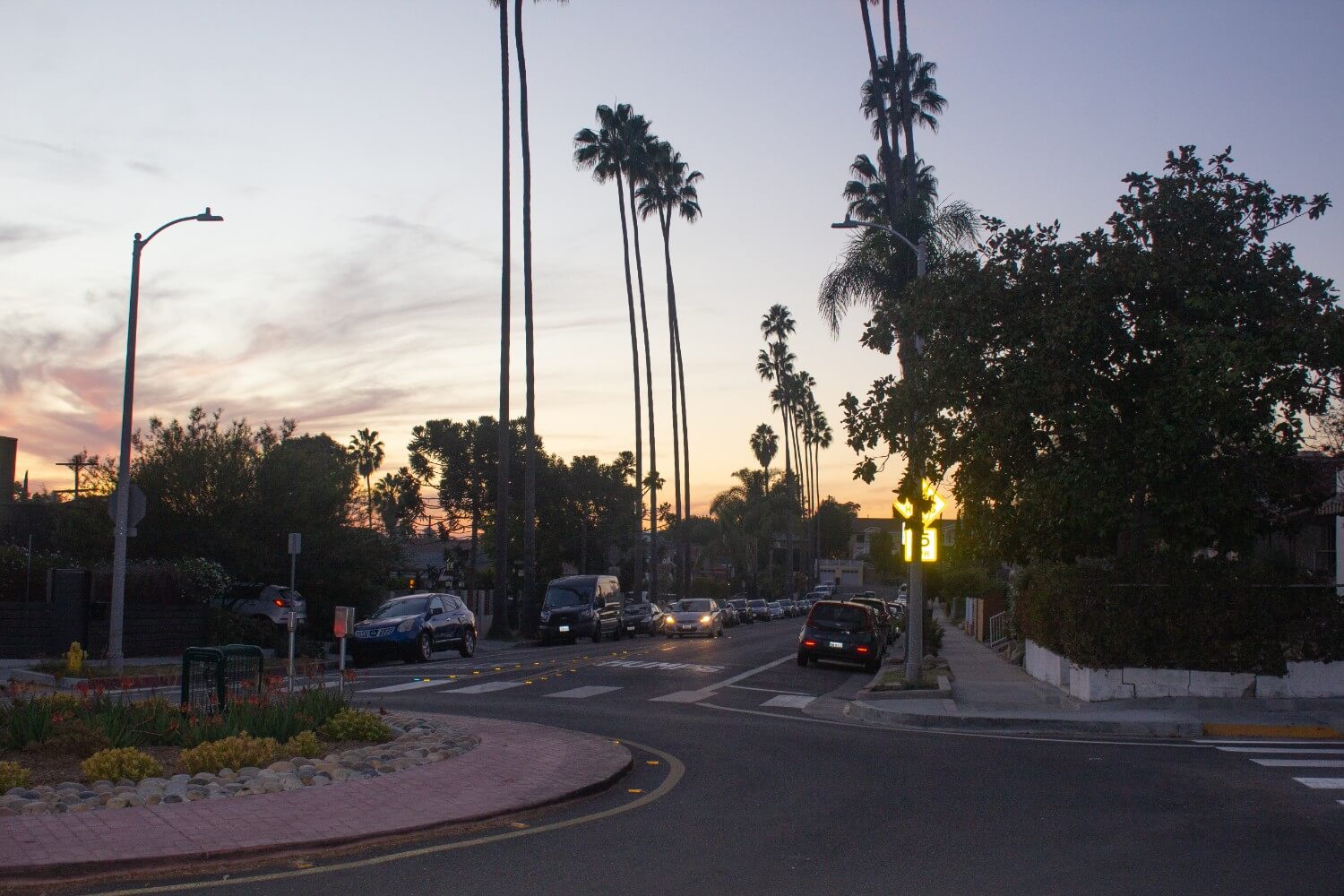
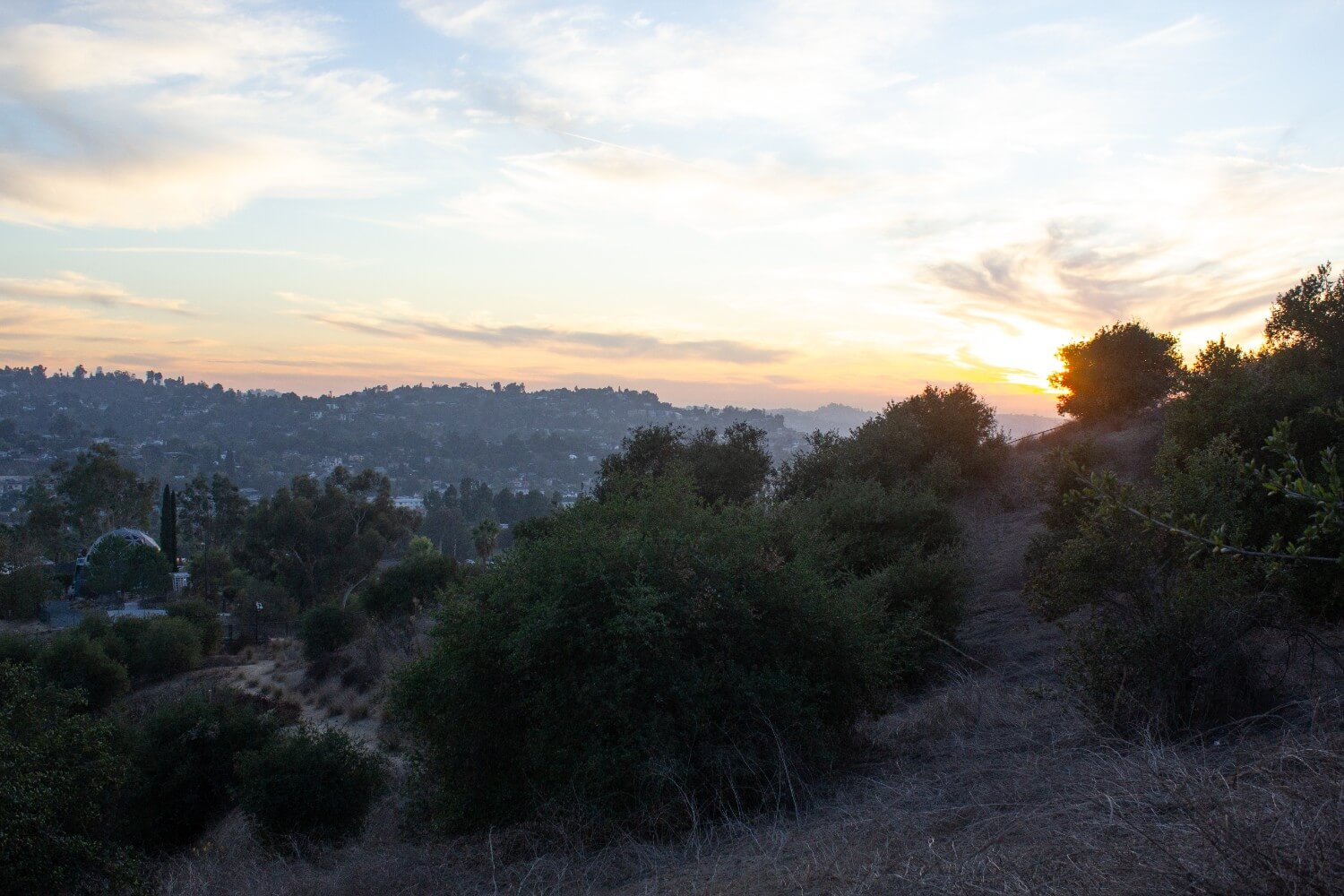
For a picturesque conclusion to your route, plan your run to be heading backon Meridian Street at sunset. At this time of day, the palm tree-lined street between Avenue 50 and Avenue 49 is reminiscent of an LA postcard.
Meridian Street during sunset in Los Angeles, CA. Nov. 10, 2024. Marty Valdez/The Occidental
Looking to add a little mileage and switch it up from an out-and-back run to a loop? The loop around Eagle Rock on Meridian Street, Figueroa Street and Yosemite Drive is a great choice. Once again, most of the run is flat, which makes it more accessible than the other runs on this list.
Along the way, check out the Eagle Rock, visible at the corner of Figueroa Street and Yosemite Drive. The Eagle Rock neighborhood was named after this rock formation, and at the right time of day, a shadow is cast on the rock that resembles an eagle in flight.
As you near the end of this route, you have two options depending on your goals.
Fiji Trail connecting with Townsend Avenue in Los Angeles, CA. Nov. 10, 2024. Marty Valdez/The Occidental
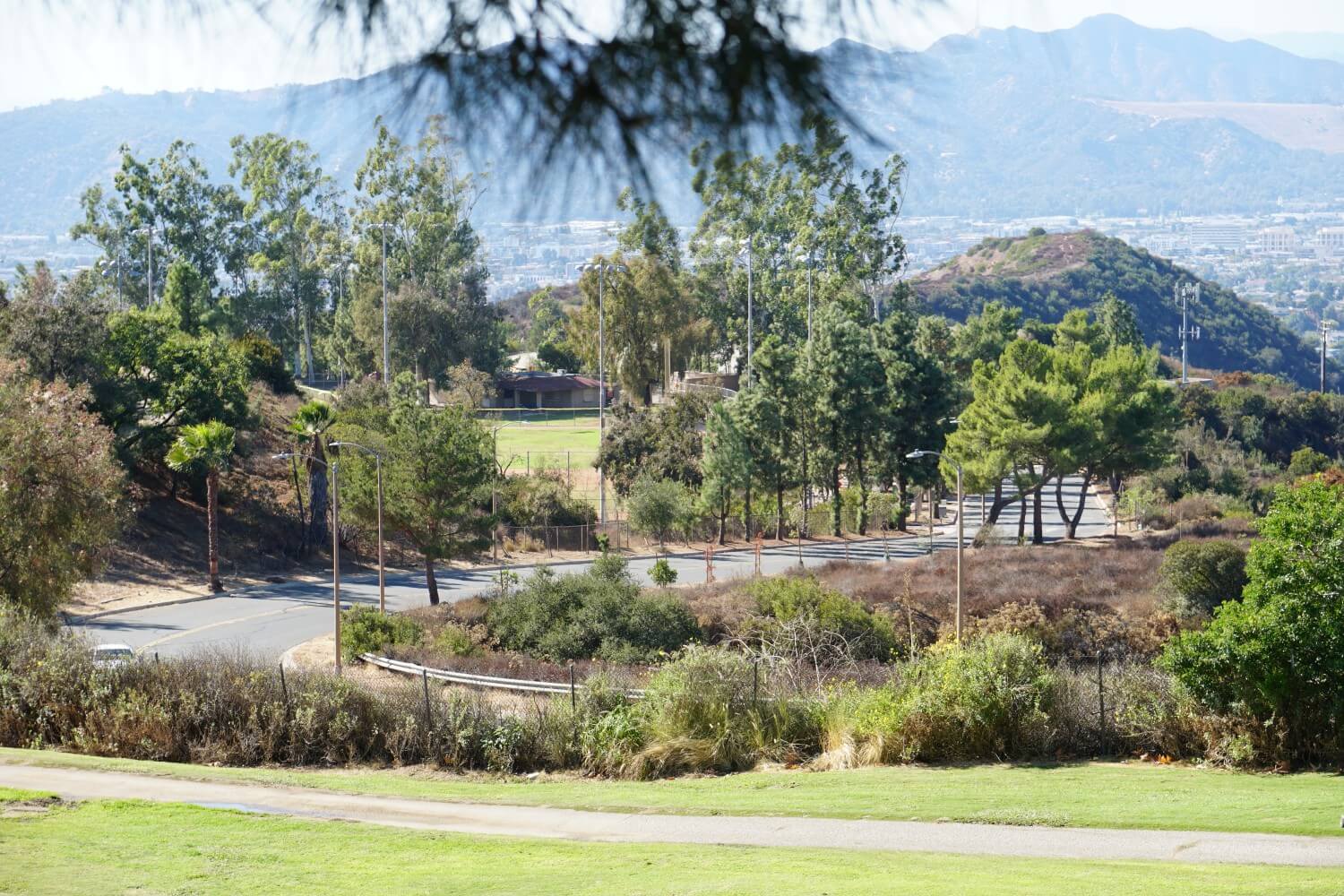
The first option is to run up Townsend Avenue, which is about 150 feet of elevation gain and finishes at the top of Mount Fiji. To the north, sections of the Scholl Canyon Fire Road are visible on the ridge directly above the Ventura Freeway. To the south, you’ll see a hill dotted with trails, known as Ernest E. Debs Regional Park.
Feeling tired and don’t want to run uphill? Take the second option and head back to Occidental via the Yosemite Recreation Center, where an adjacent green space offers a nice spot to do homework on the weekends.
Cross-country and track athlete Will Stark (senior) said he uses nearby roads like Yosemite Drive for warming up before track and field meets.
“There’s a small little trail that goes by Eagle Rock High School,” Stark said. “If you go down there and go right on Yosemite, there’s not many traffic lights so you don’t have to stop as much. It’s great if you just want to do a short run.”
Arroyo Seco 5+ Miles (8km+)
Archway at the Arroyo Seco river in Los Angeles, CA. Nov. 3, 2024. Theodore Wilton/The Occidental
The Arroyo Seco has been an important part of transportation in the LA region for thousands of years. Like many other highways in California, the 110 Freeway was built on Indigenous roadways. Today, the various paths along the Arroyo are a refuge for pedestrians looking to escape the endless stream of cars on the streets. There are several trails and paths along the Arroyo that vary in length and surface including pavement, dirt and loose gravel.
At first, the run to the Arroyo from Occidental feels intimate and sheltered because of the narrowness of Meridian Street and the close proximity of the houses to one another. Then, upon arriving on York Boulevard, the scenery opens up to multi-lane traffic, strip malls and fast-food restaurants. As one approaches the bridge on York Boulevard over the Arroyo Seco, the views expand further to include the surrounding mountains and the 110 Freeway. Each progression in the route reveals a new layer of the landscape, offering unexpected contrasts that make the run feel like a journey through distinct regions connected within one city.
Turn downhill towards the Arroyo Seco Stables, and you’ll find yourself at the entrance to the Arroyo. At this point, the runner has severaloptions. For a loop back to Occidental, head south on the Arroyo Seco Bike Path until Hermon Park, then run back on Avenue 60.
According to Sainsbury-Carter, running on the Arroyo Seco Bike Path is a welcomed change from running next to cars.
“It feels like I’m in concrete LA, [there’s] amazing vibes,” Sainsbury-Carter said. “It’s meant for running and biking, so there’s no distractions while running.”
Looking for a long run? Follow the Arroyo north for long enough and you can reach the Rose Bowl in Pasadena. The paved 3-mile loop around the Rose Bowl is frequented by cyclists, runners and walkers who can be an extra source of motivation during a long run.
Occidental cross country runner Sam Nussbaum (sophomore) said the team has runs on the trails around the Arroyo Seco because it helps prevent injuries.
“Running on dirt is definitely nicer,”Nussbaum said. “Running on concrete and asphalt every day beats your legs up a lot more. So we get injured a lot less because we do most of our running on soft surfaces.”
Ernest E. Debs Regional Park offers the most immersive experience in nature on the list, with numerous trails to explore. The fastest way to reach the top of the park is just over 5 miles, making it the closest spot from Occidental to get a sweeping view of downtown.
Once you arrive at the park from Avenue 52, the uphill climb begins immediately. As your legs tire, distract yourself by looking to the right as you rise above the trees toward the beautiful Verdugo and San Gabriel mountains. Down below the trail is a giant metal dragonflyin someone’s front yard. Don’t forget — there is a reason to be going through this. After a small short flat section, the climb continues and the surrounding neighborhood becomes more visible. At a certain point, the trail will start to bend left, revealing a beautiful view of Downtown LA. Wilshire Grand Center (with the Korea Air logo), LACity Hall and theU.S. Bank Towers are all prominent in the skyline from this vantage point.
View near Hilltop View in Los Angeles, CA. Nov. 3, 2024. Theodore Wilton/The Occidental
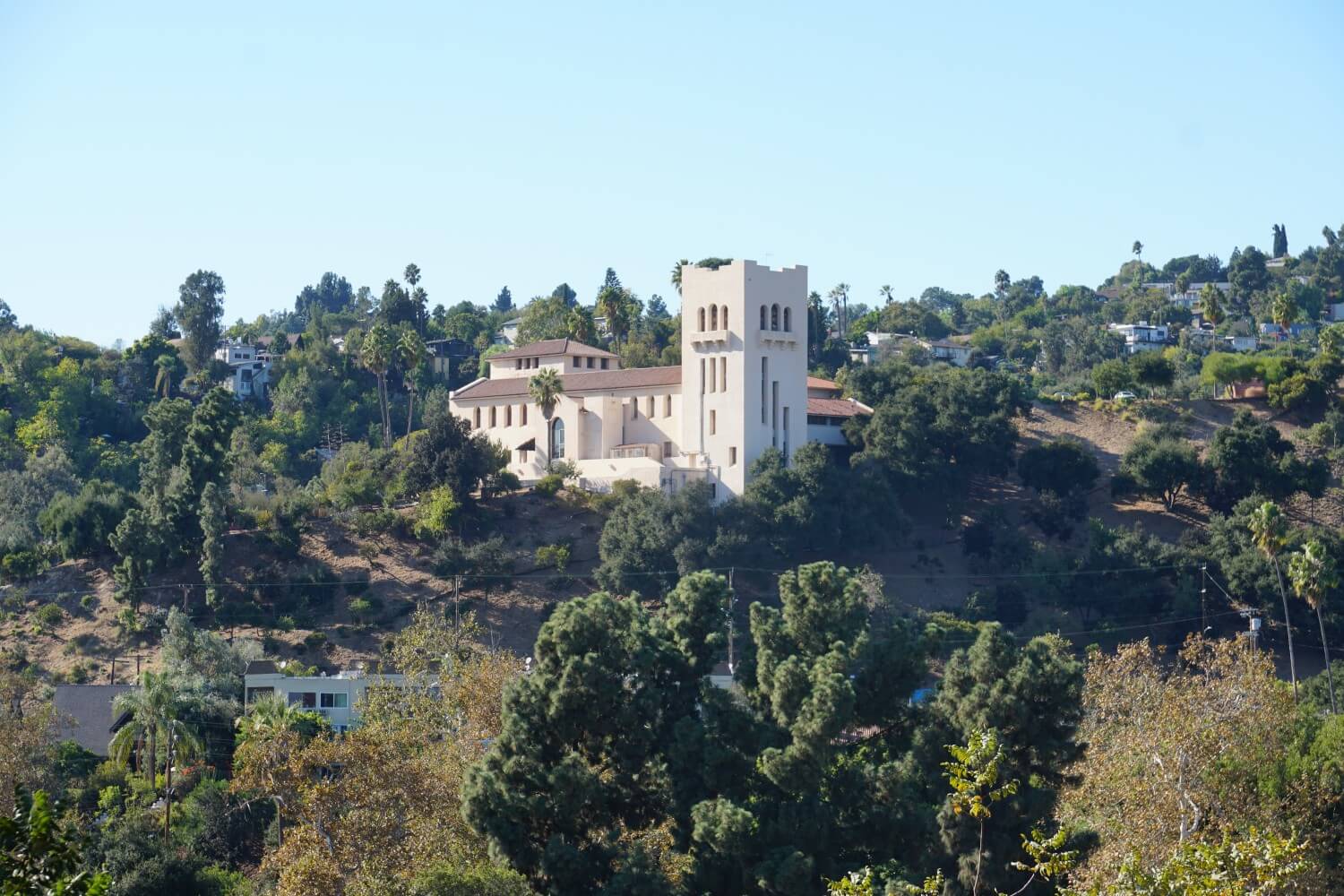
Take a second to admire the view and look for interesting elements in the landscape. One thing to look for is the original Southwest Museum building, located on the side of Mount Washington to the west. Founded by Charles Fletcher Lummis in 1907, it holds the distinction of being LA’s oldest museum and was designated a “national treasure” in 2015. Although the museum has since closed and its collections have relocated to a facility in Burbank, it is temporarily open as a setting for the world premiere of Beth Piatote’s play, Antíkoni, produced by Native Voices.
Southwest Museum in Los Angeles, CA. Nov. 3, 2024. Theodore Wilton/The Occidental
For those wanting to avoid going uphill, Sainsbury-Carter said he does a similar route along Avenue 50.
“I like going down this road [Avenue 50] and then if you keep going past Figueroa, you end up at the Arroyo Seco,” Sainsbury-Carter said. “Turn right back around, and it’s a total of four miles.”
Mount Washington 5-8 Miles (8-13km)
Avenue 42 at the base of Mount Washington in Los Angeles, CA. Nov. 3, 2024. Theodore Wilton/The Occidental
Mount Washington is a playground for runners who are willing to endure its climbs and descents. There are a variety of routes in and around Mount Washington, and for runners who like to explore, it is perhaps the best place close to Occidental.
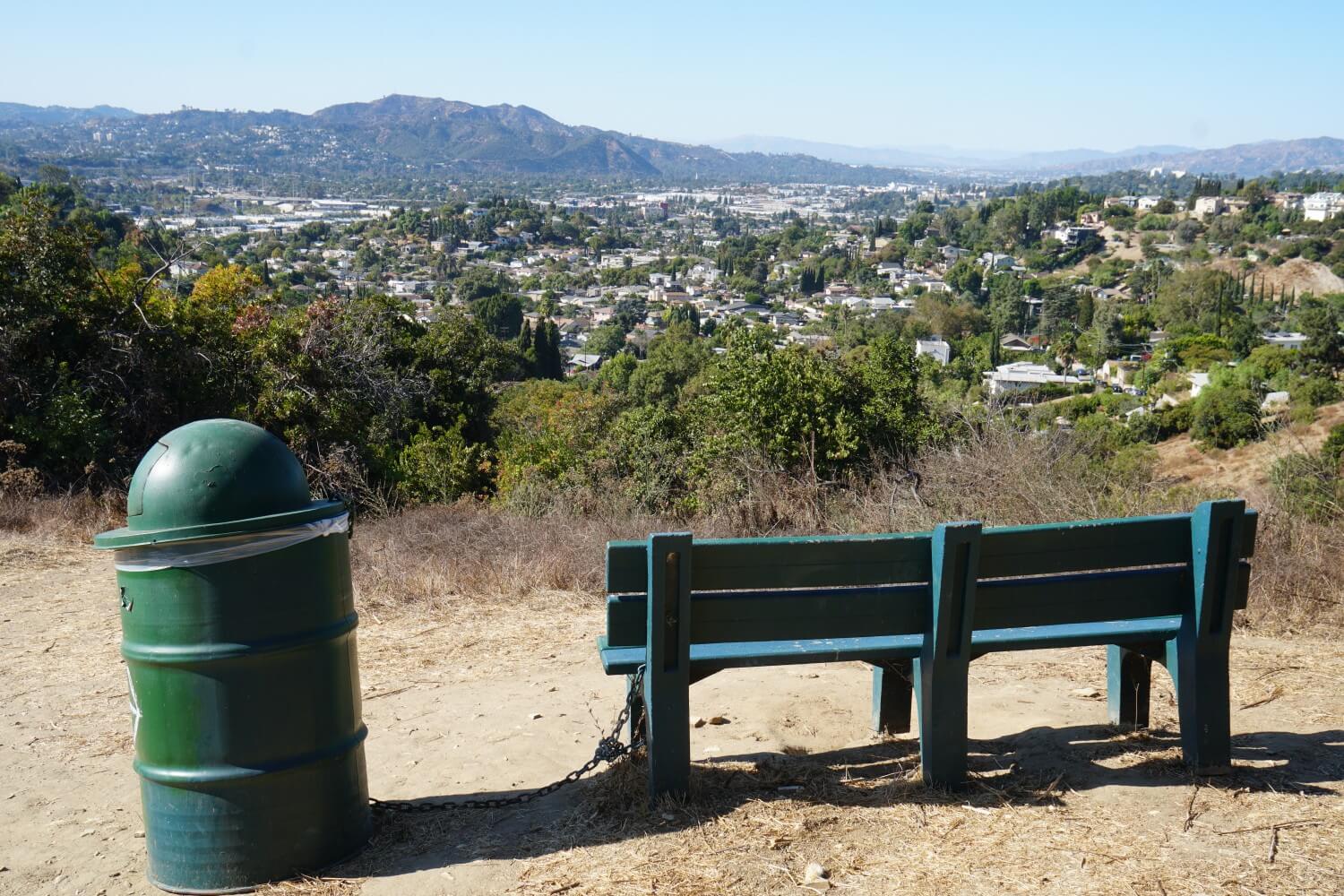
Bench and trash can at Elyria Canyon Park in Los Angeles, CA. Nov. 3, 2024. Theodore Wilton/The Occidental
For first-timers in Mount Washington, I would recommend running up San Rafael Avenue. It is one of the closest routes to Occidental and is more gradual than the other routes provided. After making it up the hill, continue running past Mount Washington Elementary School until you reach Elyria Canyon Park. There, you’ll find benches where you can rest your legs after the effort they’ve just endured. There is also a hidden path on San Rafael between Mayo Street and Terrace 49. It is very steep, so be cautious while on it.
For steeper and shorter routes up Mount Washington, try running up Museum Drive or West Avenue 45. Museum Drive will take you past the entrance of the previously mentioned Southwest Museum and through a trail in Moon Canyon Park.
The narrow roads and winding paths of Mount Washington make it feel like another world compared to the wide, flat streets that dominate the rest of the city. The roads can quickly curve and shift direction, flowing up and down to match the demands of the hillside. There’s also variety in the scenery — in an instant, the surroundings change from tree-covered to open, with views of the distant mountains. The beauty of the surroundings makes each climb feel like less of a struggle and more of a reward, reminding you why the effort is worth it.
Looking for a longer run without having to run uphill? Complete the Mount Washington loop on Avenue 50, Figueroa Street, Cypress Avenue and Eagle Rock Boulevard. Along the route is the Rio de Los Angeles State Park, which is a great place to take a break and maybe even catch a part of a local soccer game. It has water fountains and bathrooms that are especially appreciated on long runs.
Located in the center of El Sereno, Elephant Hill has 360-degree views of LA and a diverse range of native plants.
Getting there will be familiar if you’ve completed the Arroyo Seco Loop mentioned above. After turning right from Avenue 60 onto Collins Avenue, the scenery shifts from a wide, exposed street to a sheltered sidewalk with a grassy median and plenty of trees. The hills on each side of the avenue make it feel like a peaceful passage tucked away from the busy streets nearby. Turn left at Pullman Street, and the hill will start before the park does.
When you arrive at Elephant Hill, take note of the scenery which changes dramatically throughout the year. In the fall, the hillside takes on a golden, dry appearance as grasses and foliage fade; while in the spring, it becomes lush with blooming flowers and other flora. At the peak of Elephant Hill, the sprawling, seemingly endless nature of LA becomes apparent. The views to the east reveal a flat expanse of neighborhoods stretching toward the San Gabriel Mountains, highlighting the vastness of the city’s landscape.
In recent years, the nonprofit Save Elephant Hill has worked to organize and educate the public on the social and environmental impacts of illegal off-roading and dumping, two issues that have plagued the park for years. In 2023, the group received $150,000 dollars as part of a larger $1.2 million grant by the California State Parks Off-Highway Motor Vehicle Recreation Division to restore and protect urban parklands. For those interested in learning more about the park’s native plants, Save Elephant Hill regularly hosts in-person educational sessions at Elephant Hill.
Be warned — this route is over 11 miles and has over 1,000 feet of climbing. However, for those willing to brave the long climb up to the golf course, the views will be panoramicand your sense of accomplishment will likely be even bigger.
The first part of the route is a little ugly, because it requires passing by the interchange of Route 2 and State Route 134 on Harvey Drive. The tunnel going under the 134 Freeway is especially discouraging for pedestrians, because you are engulfed in concrete and the sound of cars in all directions.
After the interchange, the scenery becomes more enjoyable, going through the heart of Glenoaks Canyon. Its ridges offer shade and protection for runners at the right time of day, and the quiet neighborhood has a number of parks that can be utilized for breaks. My first time completing this run, I accidentally ran into Lower Scholl Canyon Park, where I was met with a parking lot with rows full of black SUVs. It almost felt like a scene from a movie, as if some kind of high-stakes gathering were about to unfold amidst the park’s peaceful surroundings.
View of Glenoaks Boulevard from the Scholl Canyon Golf Course in Los Angeles, CA. Nov. 3, 2024. Theodore Wilton/The Occidental
At a certain point, the sidewalk ends and there is a sign that reads “Welcome to Scholl Canyon Golf-Tennis Club.” Now, there is only a hill separating you and the final destination. As the road winds upwards, the left side of the road will gradually open up to views of Rancho San Rafael and Chevy Chase, two neighborhoods that weave and twist with the hills. The climb is fairly gradual with an average grade of 4.6% and can go by quickly withthe right playlist — the song “Giving Me” by Jazzy is a personal motivator of mine.Car drivers are often shocked to see someone running up to the course, so be on the lookout for their facial expressions as another distraction from the inevitable pain.
Once you reach the top, take a second to appreciate the elevated views and what you have accomplished. Reaching the top isn’t just about the view — although it’s a great reason to do this run — it’s a testament to the journey that brought you here. As your legs pushed against the steady incline, you likely found a rhythm that resulted in a newfound appreciation for the road beneath you.
This route is listed last because it is the only one I’d recommend driving to; the trail is best enjoyed at a quicker pace, which can be tough after a long uphill run. While it’s possible to reach the Fire Road from Occidental on foot, running four miles including the trek up Sleepy Hollow Drive makes for a tiring warm-up. If you decide to drive, there is usually available parking at the top of Valle Vista Drive, just steps away from the trailhead.
If you’ve ever been to the campus’ Jack Kemp Stadium or driven up Eagle Rock Boulevard, you’ve likely seen this trail without even realizing it. Scholl Canyon Fire Road runs along the ridge above the 134 Freeway and Scholl Canyon.
This trail feels as if you are on top of the city, and the steep ridges on either side add to that feeling. Fire Road is undulating with steep ups and downs that follow each other quickly. The entire ridge is exposed to the sun with little shade or tree cover, so go closer to sunrise or sunset if possible. To the south, there are big views of LA, including the Eagle Rock, Occidental and of course, the Ventura Freeway. As you get further along, views of downtown Glendale will become visible until you are able to see all of the neighboring city.
Backside of Fiji Mountain in Los Angeles, CA. Nov. 10, 2024. Marty Valdez/The Occidental
Running through these neighborhoods, both in solitude and with friends, has turned each route into more than just exercise. With every mile, I’ve discovered new layers of the community — its history, vibrant landscapes and hidden corners. Exploring on foot has given me a stronger sense of place, making each stride feel connected to the rhythm of the area around Occidental. So lace up, get outside and see where the streets and trails around Occidental can take you.
This past September, Assistant Dean of Students at Emmons Devon Sakamoto and Health Promotion Specialist Laura Fettig applied for and received a $300,000 grant from the Substance Abuse and Mental Health Services of America (SAMHSA) that will be distributed evenly over the next three years. Fettig said this grant will allow Emmons to expand its training, wellness services and overall campus involvement in supporting mental health.
“It’s not just about the clinical support that we offer. It’s really about engaging the entire campus in [suicide] prevention,” Fettig said. “[Occidental’s] Health Promotion Program is really meant to be looking at ways we can build skills and educate students.”
Sakamoto said mental health support and suicide prevention is an important part of Emmons services and that this grant will allow them to expand mental health training to the rest of the campus.
“We will gain more coverage for students in need to be identified and supported,” Sakamoto said.
Sakamoto said that while this grant does not provide enough money to add new full-time staff to the Emmons team, it does provide the opportunity to bring in additional help for special situations.
“If we need to bring in a therapist to deal with a specific issue or of a certain identity, then we can contract with an outside therapist for that specialized help,” Sakamoto said.
Fettig said that the training made possible by this grant will be beneficial to the entire campus and support students on a higher level. She said that everyone who interacts with students — including professors, athletic coaches, RA’s and Student Leadership, Involvement, & Community Engagement (SLICE) staff — is in a position to identify when a student is not doing well or needs support.
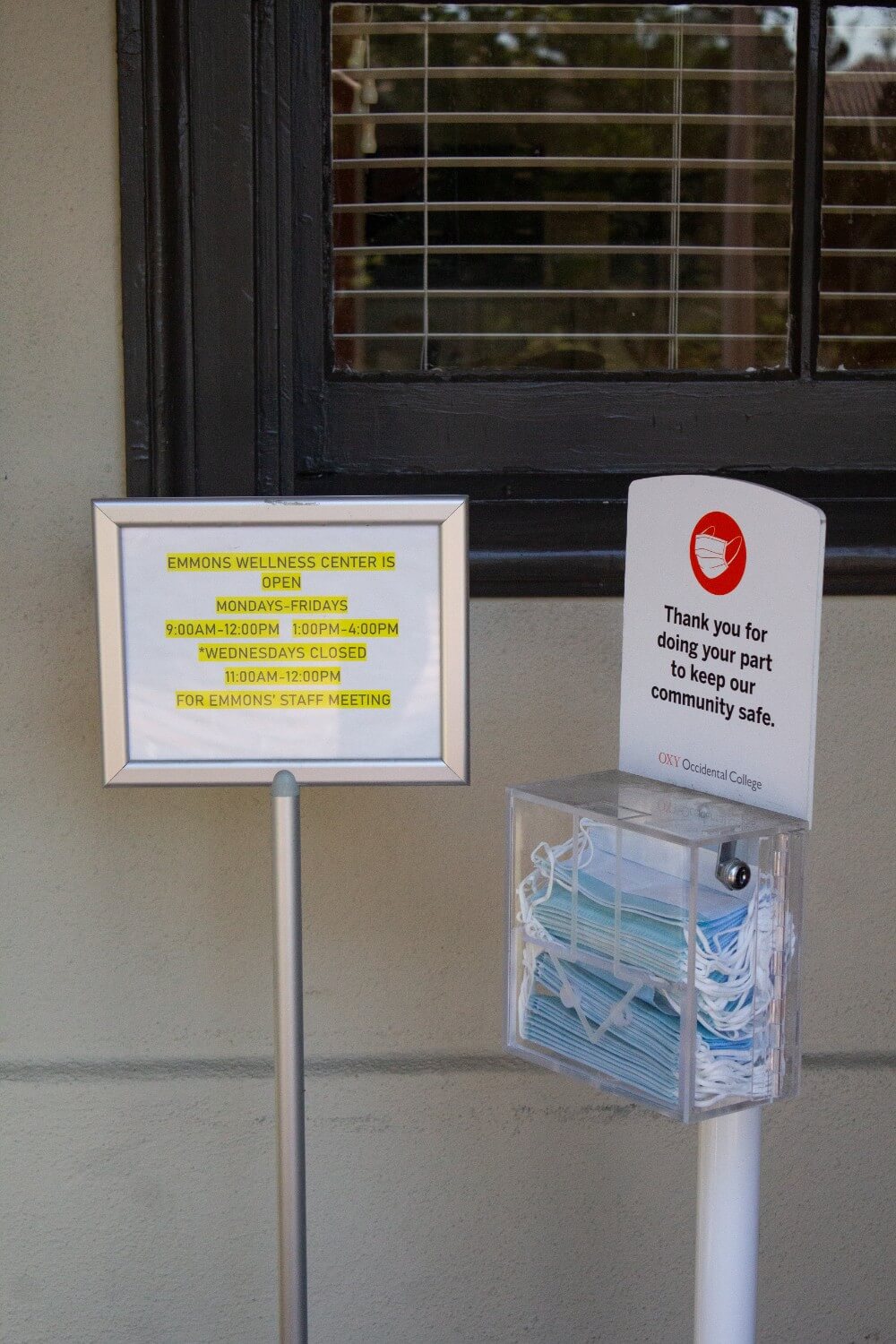
Masks and sign in front of Emmons Wellness Center at Occidental College in Los Angeles, CA. Oct. 23, 2024. Marty Valdez/The Occidental
“To be able to notice signs that students are not doing well, understand resources, understand how to engage with students and make sure that they’re getting connected to the support that they need is important,” Fettig said.
Fettig said a large component of this grant will be used to make Occidental a JED Campus, a program from The Jed Foundation that provides colleges and universities with expert emotional support and guidance for students to protect their mental health and prevent suicide.
“[The Jed Foundation] is going to offer technical assistance and data collection support,” Fettig said. “We get to work with them to assess the gaps, and they have a specific framework that they use that kind of looks at all these different areas.”
Fettig said another part of being a JED Campus is the implementation of a survey called the Happy Minds Survey. She said that this survey, created by the JED Foundation exclusively for JED Campuses, will help Emmons staff better understand the state of mental health, substance abuse and level of need on campus.
“We will get funding as a part of JED campus to implement this survey at Oxy,” Fettig said. “This will help us assess where Oxy students are at.”
Matt Gragg, director of the Counseling Center at the University of Redlands, said via email that the JED Campus program has helped his campus improve its mental health support and wellbeing outreach, which has also led to decreased stigma around mental health and an increase in students attending counseling.
“According to a recent Healthy Minds Survey on our campus, an increased number of students reported that they agreed with the statement, ‘I lead a purposeful and meaningful life,'” Gragg said.
Fettig said a portion of this grant will also be used to support clubs on campus and get them involved in mental health support initiatives.
“Student groups will be able to apply for small grants for funding toward doing activities and programming that help enhance student well-being or mental health in some way,” Fettig said.
Sakamoto said this grant is filling a need they have seen on campus — improved and expanded mental health support for all of Occidental’s students that is not exclusive to Emmons’ resources.
“[It’s] more than just a benefit [to] Emmons — it’s a benefit for [the] campus in general,” Sakamoto said. “A lot of the preventative health promotion, harm reduction and keeping people healthy is everybody’s responsibility on campus […] we’re all making these decisions on how to keep the campus healthy together.”