Home Blog Page 50

Critical Theories of Antisemitism speaker series presents ‘Gendered Objects of Genocide in Museum Collections’

As part of Occidental’s Critical Theories of Antisemitism speaker series, “Gendered Objects of Genocide in Museum Collections” was held Jan. 27 in Choi Auditorium. The event was co-hosted by Dorota Glowacka, a professor of humanities at the University of King’s College, and Lorena Sekwan Fontaine, an associate professor and head of the Department of Indigenous Studies at the University of Manitoba. More than 50 individuals attended the event.

Assistant Professor of Critical Theory & Social Justice (CTSJ) Ben Ratskoff said he hoped to bring speakers who could share their experience with partnered comparative research with the community.

“I wanted to invite people who are working critically and comparatively on genocide and present some of the cutting-edge research that connects Holocaust memory to things that we’re talking about in North America,” Ratskoff said.

Fontaine, a Cree and Anishinaabe member of the Sagkeeng First Nation, focused on Canada’s residential schools. Glowacka, a descendant of Holocaust survivors, centered her research on the Holocaust.

The event was held on Holocaust Remembrance Day and explored how non-dominant views of genocide are remembered and recorded. Glowacka and Fontaine said these perspectives, particularly those of women, are important to examine in genocide remembrance and research.

According to Fontaine, she conducted research by drawing not only from personal experiences and histories, but also from stories shared by donors of the items shown to students during the event.

“The goal was for us to write a paper about settler colonial genocide in North America and the Holocaust, speaking to them as instances of genocidal violence in both places,” Fontaine said.

Glowacka said they expanded their research to include a feminist perspective.

“The history of the genocide has been told from the point of view of a male survivor, and that’s the majority of the stories to this day,” Glowacka said. “One aspect is to tell the stories that are told not necessarily from that perspective. [It] is important to me both because of historical justice but also because I think that history is incomplete without these stories.”

The event began with an examination of residential schools and Holocaust photographs. As the talk progressed, both professors presented various photographs of uniforms and other items. Glowacka showed several altered female Holocaust uniforms, including a bra and sanitary pad. Fontaine showed pictures of children in residential schools and a pair of moccasins.

“[The uniforms and photographs] led to different conversations about how clothing could be used as a way to also express cultural resistance and survive in these different areas,” Fontaine said. “[These conversations] occurred in my community, and so it became more of a personal story to talk about how my family was able to overcome some of the impacts of residential schools by reintegrating ceremonies into our family.”
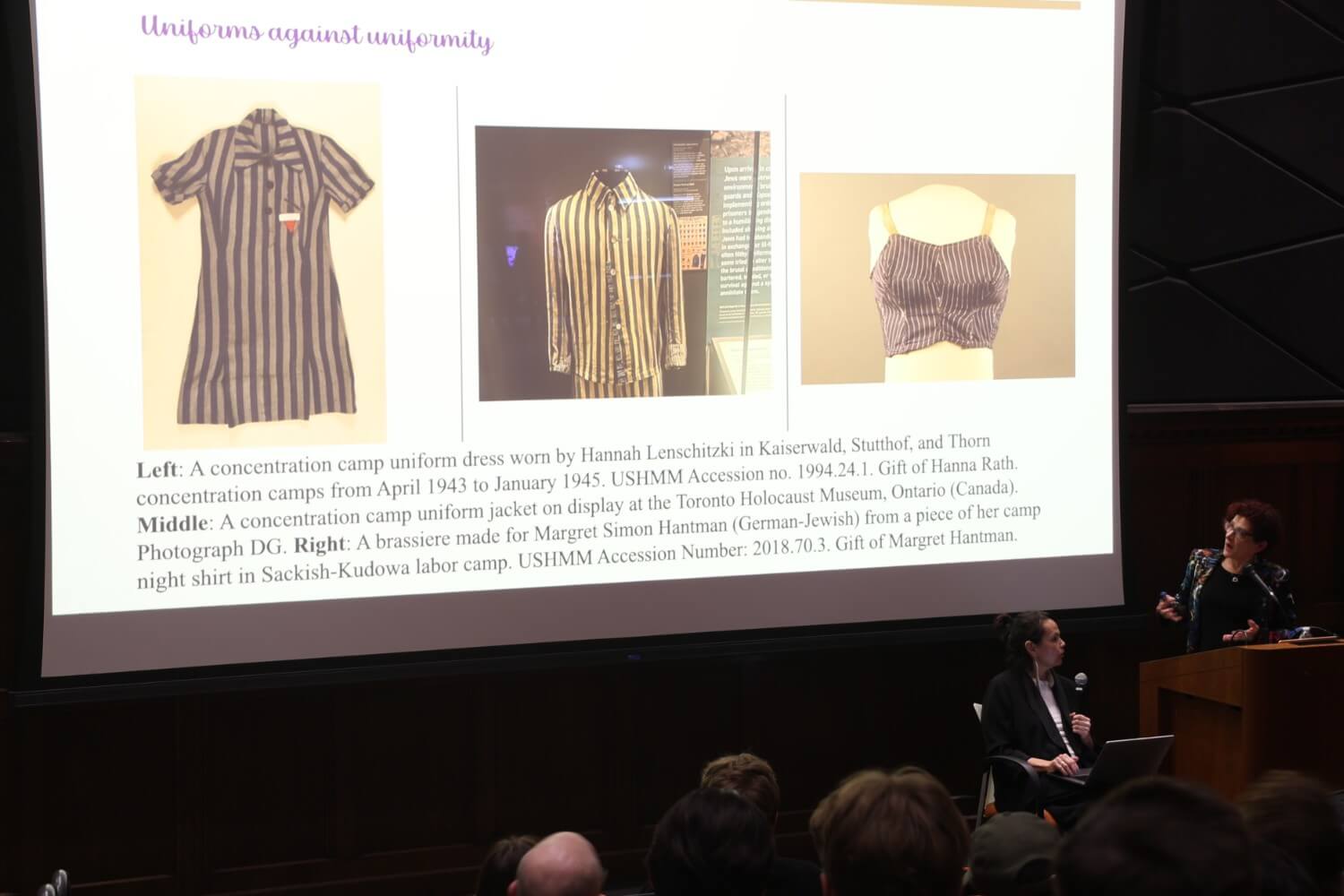
Lorena Sekwan Fontaine and Dorota Glowacka during their “Gendered Objects of Genocide in Museum Collections” talk in Choi Auditorium at Occidental College in Los Angeles, CA. Jan. 27, 2025. Amy Wong/The Occidental

Glowacka said their inclusion of more intimate items was a deliberate effort to break the silence surrounding them.

“I think that only by talking about them and not perpetuating the silence can we normalize these stories,” Glowacka said. “[There are] aspects of human lives that have been shamed to the detriment of people who have been affected by them.”

Glowacka and Fontaine ended the event by discussing memory carriers. Glowacka presented a cookbook collected from a concentration camp, and Fontaine showed a water drum.

“It sparks the importance of talking about the reparation of the objects that are crucial towards reconciliation with the genocidal oath and restoring cultural integrity,” Fontaine said.

Ratskoff said he appreciated the insights he gained from the event.

“You kind of thought that maybe they were going to be talking about this comparison between Indigenous genocide and the Holocaust,” Ratskoff said. “It ended up not actually doing that, [the talk] was actually about how their own work and their own projects inspired each other to ask different kinds of research questions.”
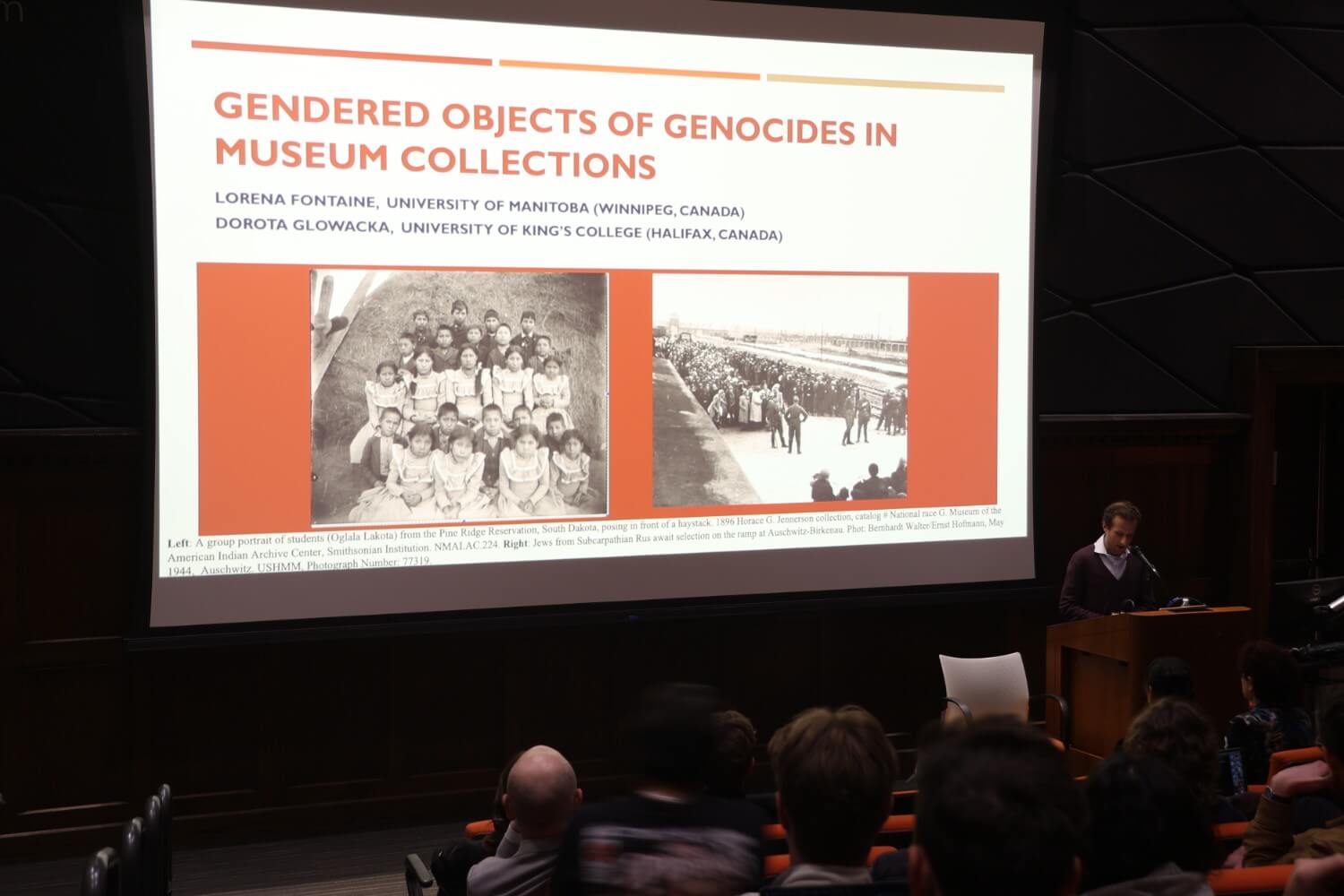
Critical Theory & Social Justice professor Ben Ratskoff introducing the “Gendered Objects of Genocide in Museum Collections” event in Choi Auditorium at Occidental College in Los Angeles, CA. Jan. 27, 2025. Amy Wong/The Occidental

Safiya Zavala Sweet (junior) said one of the most impactful moments of the talk came when the discussion focused on unmarked graves.

“I thought that was really heartbreaking, but it was beautiful how they were able to transform grief [in a way] that uplifted Indigenous people and spread awareness,” Sweet said.

Contact Levi Lee at leev@oxy.edu

Loading

Eaton Fire prompts athlete evacuation, impacts winter training

Caroline Agostini (senior), a recently elected captain of the swim team, was out to eat at a Korean barbecue restaurant with 30 other swim team members, including the other five captains, Jan. 7.

As the Eaton fire raged on nearby, Agostini said she and the team wondered — what would it take for morning practice to get cancelled?

According to Agostini, in a group chat with co-captains Sarah Radle, Carter Park, Matthew Spruance, Joshua Biggs, Nicholas Cantrell, and Candace Farling (all seniors) it was decided that every member of the swim and dive team should prepare a go-bag, in the event that they had to leave campus due to the fires.

Courtesy of Caroline Agostini

According to Agostini, her and others were awoken by an Apple alert Jan. 8, advising that the area around Occidental was considered hazardous. Using the same group chat, swim and dive captains decided to make plans for evacuation immediately, and in 15 minutes the team assembled. On their way out of Newcomb hall around 7:15 a.m., Agostini said they spotted a familiar face.

“Tom Stritikus was at the front door of Newcomb saying ‘Have fun guys!’ as we were getting in our cars ready to leave,” Agostini said.

An email from the Occidental mailing system was sent out to all students and faculty at 7:30 a.m., advising everyone to evacuate campus. By that time, the swim and dive team (and other students who were still on campus and needed a place to go) were already en route to Park’s house in Irvine.

“We decided to use my house as a central point to figure out everything and go from there […] we opened up a notes document to figure out who could house people in the SoCal area,” Park said.

Swim and dive athletes’ lodging was mainly split between the residences of Biggs and Park, with some students opting to stay in hotels. During this time, Park said that he felt that communication with administration was scattered, making their decision to stay off campus easier.

“The feedback from administration was not that helpful, there was mixed communication in [following] emails on whether or not campus was open” Park said. They [continued] to recommend people to evacuate, but it was not mandatory.”

With all the confusion and chaos, Agostini said she was worried about her performance in upcoming meets having missed several days of practice.

“These few weeks are crucial […] winter training can make or break the season,” Agostini said. “We can get up [to practice] at 6 a.m. for 10 weeks straight in the fall, but it won’t matter unless you’re there for winter training […] going down to nothing is absolutely a detriment to our season.”

Nicky Clotfelter (junior), a player on the men’s basketball team, also said he made the decision to evacuate Jan. 8. Anahit Aladzhanyan, head coach of the women’s basketball team, confirmed via email that the men’s and women’s basketball teams both evacuated Jan. 8.

“My roommate woke me up to start packing,” Clotfelter said. “We called some coaches before making the decision to leave campus […] I’m from San Diego so we took six of my teammates in a few cars down there. Sophomores went to Reece Ballard’s house in the LA area, other students stayed with family wherever they could find.”

Nicky Clotfelter (junior) outside the Tiger Cooler at Occidental College in Los Angeles, CA. Jan. 29, 2025. Ben Petteruti/The Occidental

According to Clotfelter, men’s basketball missed three games as well as practice sessions, which is set to have a huge impact on their schedule moving forward.

“Usually our SCIAC schedule is Wednesday and Saturday games,” Clotfelter said.
“Because of rescheduling, we now have to play on Mondays, Wednesdays, and Saturdays. We played our first game on Monday [Jan. 13] with basically no preparation.”

According to Assistant Athletic Director for Communications Joe Perrino, six events were rescheduled in total; three men’s basketball games, two women’s basketball games and a swim and dive meet which was originally scheduled to take place at Occidental.

“Coaches were really good about [communicating with other schools to get games rescheduled],” Perrino said. “We were really making sure that conditions were safe for the athletes and that they wouldn’t get stuck in a bad situation being here. The smoke came down over here, and it was sitting very ominously above the whole region.”

Courtesy of Joseph Perrino

Despite the hardship and turmoil, Agostini said the experience provided an opportunity for further team connection and support.

“Winter training in particular is a time where we’ll all living and practicing together, so I call it summer camp,” Agostini said. “There was a huge push in everyone bonding together […] A freshman came up to me and said ‘I really got to know some of my fellow swimmers because we had to go through that stress together.'”

According to Clotfelter, a unique bonding experience was also created in his house by taking home four first-years that he did not know very well.

“They [the first-years] got to know me, my family and my parents,” Clotfelter said. “We’ve had a crazy season so far with injuries, so this was a great time for us to all come together. I feel like we all responded very well. The president [Tom Stritikus] was also in communication with my mom, thanking her for taking care of members of the team.”

Contact Ben Petteruti at petteruti@oxy.edu

Loading

Opinion: What Democrats can learn from Ruben Gallego’s Senate victory in 2024

On the night of Nov. 5, 2024, my co-organizers and I were at our favorite restaurant celebrating the nearing culmination of the past months’ efforts. Tossing back my third Aperol spritz, I decided that I was going to ignore the Times’ election updates and instead opt to learn the fate of the nation the next morning. Since mid-July, I had been in Tempe, Arizona, working overtime in an effort to send the state and its 11 electoral votes into the hands of the Harris-Walz ticket on that very night.

The rest of America sat on edge, awaiting election results from seven states in particular that were likely to determine the winner of the presidential election. A great ideological chasm separated the candidates, ensuring that animosities would fill the air in the following days, months or years, regardless of the victor.

We know how this one goes. Donald Trump swept all seven swing states, winning Pennsylvania, Michigan, Wisconsin, North Carolina, Georgia, Nevada and regrettably Arizona. Trump won his largest swing state margin in Arizona, winning 5.5 percent more of the vote than Harris. Puzzlingly, at the same time, Democratic senate candidate Ruben Gallego was able to comfortably win in a state which had gone to Democrats in only two presidential elections since 1948. Not only that, but he won his race by the largest margin out of any swing state senate race in 2024. And he did it all with a reputation as a progressive! All of this begs the question: How did he do it?

Having spent months immersing myself in the culture and landscape of politics in the Grand Canyon State, I needed to know why the party that I had been on the payroll of was able to perform so differently in two statewide elections. As a part of my conclusive paper on my experience with Occidental’s Campaign Semester program, I looked into the strategy differences between the Gallego and Harris campaigns. What I found helps shed light on why these contradictory election results managed to coexist. Perhaps more importantly, it gives a path to victory to a Democratic party reeling from a catastrophic loss.

If you know your Arizona politics, you might reflexively point to the poor candidate quality represented by Republican senate candidate Kari Lake. I’m not going to say that she wasn’t a bad candidate, but I also don’t think that alone tanked her performance. She had modeled her own political persona in the image (or maybe the shadow) of Trump’s, which should have given her a boost in a state that he won or at least helped her do better than run nearly 8 percentage points behind her close political ally. But that’s for another article.

As for Gallego’s campaign, he focused largely on appealing to the significant Latino population of the state. What made him stand out from his party was that he understood Arizonan views on immigration better than many other Democrats. He knew that many Latino people in Arizona considered the situation at the border to be a mess. He didn’t assume that Latinos would automatically vote for Democrats because of Trump’s history with “the wall” and his racism towards Latino people. He knew that he had to promise stability and solutions to get their votes. Notably, one of his most-viewed Youtube videos is a Spanish-language ad expressing his support for fortifying the border.

Gallego knew that high inflation made people (especially Latinos) feel inadequate and incapable of supporting their families. Breaking from typical Democratic messaging lines of “jobs jobs jobs” and “look at our record,” he took a family-centered approach. He actively engaged with the community, frequently hosting and making appearances at boxing match watch parties, Mexican rodeos and carne asada cookouts. Understanding the popular disdain for politics and politicians, he met people where they stood, rather than forcing them to come to him.

His focus on the opinions of Latino voters in the election year proved to be effective. According to ABC’s exit polls of Arizona, Gallego won 64% of Latinos and 58% of Latinas, compared to 55% of Latinos and 54% of Latinas for Harris. At the same time, he was able to pull 10% of Republicans and 48% of Independents to vote for him, while Harris only got 7% and 44% respectively.

The Harris campaign, on the other hand, came to a fork in the road and took the path on the right. She boasted about her endorsements by the Cheneys, revealed she owned a Glock and generally did anything she could to appear preferable to moderates and conservatives. In the process, she alienated the progressive and the working class of the party, and made it harder for the party’s core to be excited about voting for her. People didn’t show up for Harris because her campaign didn’t motivate them to. Nevertheless, I applaud her for being able to turn a Biden campaign headed for disaster into a highly competitive ticket.

The Harris campaign did its best to run towards the political center in a valiant effort to pick up the voters that were supposedly there. But instead, it fell straight into the ideological chasm between the candidates.

There are many things that the Democrats can learn from this election, but atop the list must be never to abandon its core. Second to that must be to campaign like Gallego did: get local, get on the ground, don’t take people for granted, don’t dilute your message. Simplifying your approach, telling people what they want to hear and listening to your constituents first can help separate you from the chaff to come through being a true servant to the people, rather than a career politician.

Democratic heavyweight Chuck Schumer famously said in 2016 that Hillary Clinton would pick up two socially moderate suburbanites for each blue-collar worker that voted for Trump. This sounds awfully similar to the strategy of the Harris campaign. Simply put, the Democratic party cannot afford to continue to make the same mistakes election after election. The way forward has never been clearer. A rehabilitation of the Democratic party must take place in the next four years: a diverse, progressive, working-class and bold party of the people must replace the uninspiring rendition spawned in fear of Trumpist extremism.

Contact Oliver Lee at olee3@oxy.edu

Loading

New intramural sports invite students to bond over athletics

Occidental’s Intramural Sports League Commissioner Nasratullah Elham (senior) said he plans to make intramural sports activities mainstream. According to Elham, intramural sports are sports for students to participate in, regardless of their skill level or how much experience they have.

“If you’re just somebody who likes to play soccer, and you’ve barely played soccer in your life, intramural is your [go-to],” Elham said.

In the past, basketball and soccer were the only intramural sports offered. For this semester, volleyball and flag football are new additions, and Elham said Spikeball is also being considered based on students’ interest.

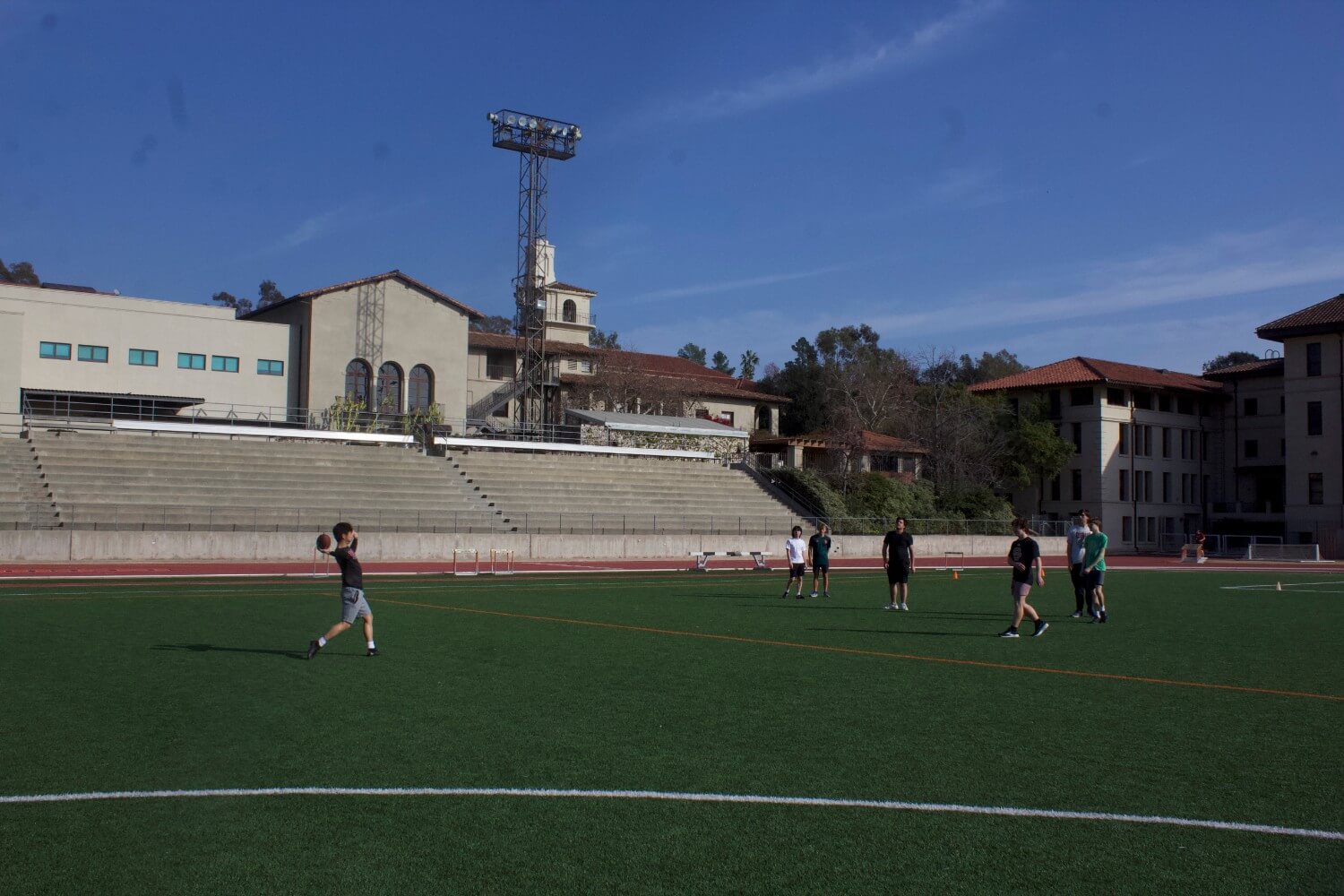
Underclassmen team practicing before a game on Patterson Field at Occidental College in Los Angeles, CA. Feb. 2, 2025. Marty Valdez/The Occidental

According to Elham, he wants to include intramurals at Occidental because he enjoys seeing students come together, build community and make friendships.

“On a surface sort of level, my job basically includes any sports that I’m given the responsibility to organize, and then organizing those on the websites, registering teams [and] making sure that the things we need are there,” Elham said. “But on a personal level, I feel the responsibility to have more people come out, and I think that’s what makes me, in my opinion, a good commissioner for the role.”

According to Elham, he hopes intramural sports can be improved by more budgetary support from Occidental’s athletic department. Currently, flag football and volleyball are each given five weeks of playtime, while basketball and soccer are given 10 weeks each.

“A lot of students would say that 10 weeks overall is not enough, and I think that’s fair, because a semester is longer than 10 weeks,” Elham said.

Yunyoung “Yuni” Chun (sophomore) and Aidan Saeed (junior) have already signed up for the newly added intramural sports.

According to Chun, she signed up for intramural volleyball. She played volleyball all four years of high school, mostly as a libero and defensive specialist.

Chun said she was searching for colleges that had an intramural volleyball team. When she came to Occidental, she said she was slightly disappointed that she did not have a place to play volleyball.

“I was really connected to my team,” Chun said. “And that was always something that I looked forward to.”

Chun said she is excited to have more opportunities to exercise and move around, especially because she believes it is difficult to exercise at Occidental.

“I think people kind of underestimate how the fun of playing the sport can make you motivated to get outside and exercise and do healthy things for yourself,” Chun said. “It’s definitely a good thing for colleges to bring intramural sports and make them accessible and have a bunch of different options.”

Chun said she wants to try out the setter position for this semester’s intramural volleyball.

Saeed, who also runs for Occidental’s track team, has been involved in intramural sports at Occidental since his first year, from basketball to soccer. He said he plans on competing in flag football this semester. Like Chun, he played basketball all four years of high school.

“I didn’t want to play basketball for the actual school, but I still wanted to enjoy competitive basketball,” Saeed said.

According to Saeed, what he really looks forward to when it comes to intramurals is relaxing and having fun.

“Sports has always been kind of a let-go of everything else,” Saeed said. “Just being able to get on the basketball court and exercise for hours — it doesn’t even feel like exercise.”

To increase students’ interest in sports and getting them more involved with intramurals, Saeed said he wishes Occidental would offer one-unit courses that teach students how to play sports. Saeed said this could additionally help students realize whether they truly enjoy the sport or not.

“I think a class would make people exercise more, as well as draw more attention to intramural[s] for people to come play,” Saeed said.

According to Saeed, he wanted to play football in high school but was worried about getting severe injuries such as chronic traumatic encephalopathy (CTE)— a common brain disease among football players caused by constant head impacts.

“I never wanted to play a physical sport where it’s just about hitting each other,” Saeed said. “But flag football allows us to have the fun parts of football without the contact of it.”

Saeed said anyone interested or even thinking about joining intramural sports should go for it.

“There’s nothing wrong with putting yourself out there,” Saeed said. “If you’re worried about it, Elham’s a great commissioner. You can talk to him, or they can obviously reach out to me as well.”

According to Saeed, through playing intramural sports, students have the opportunity to build connections and meet people that they wouldn’t typically see around campus as much. Saeed said intramural sports are also very beneficial to students who have played sports throughout most of their high school career and are struggling to let go of that in college.

“I have friends who played basketball in high school, and they’re not necessarily happy with the way their high school basketball careers ended,” Saeed said.”So for them to be able to play [intramural basketball], it’s like they get a new chance.”

Contact Weiran Li at vli2@oxy.edu

Loading

As college settles allegations of antisemitism, Occidental protests continue with allegations of a vandalized memorial and misdirection of a school event

*This article mentions sexual violence.

As the Israeli war on Hamas in Gaza persists, protests continue on Occidental’s campus. Just as President Tom Stritikus settled complaints about antisemitism on campus, a memorial to Palestinian victims on the Academic Quad was vandalized and allegations arose of SJP protestors deliberately misdirecting attendees of a campus event.

Occidental enters into voluntary resolution agreement with ADL and Brandeis Center 

President Stritikus announced Nov. 26 that Occidental entered into a voluntary resolution agreement Nov. 22 with the Anti-Defamation League (ADL) and Louis D. Brandeis Center for Human Rights Under Law (Brandeis Center), settling a complaint the groups filed with the U.S. Education Department’s Office for Civil Rights that alleged Occidental had violated Title VI of the Civil Rights Act by allowing antisemitism on campus.

One Jewish student, who asked to remain anonymous fearing social ostracization for their beliefs, said the resolution is a step in the right direction.

“It is nice to know that someone is standing up for me and other Jewish students on campus,” the student said. “With the protests and the encampments and everything, it was really tough last year to be a Jewish student on campus.”

The student said that signs such as the one that read, “When people are occupied, resistance is justified” were used at the protests last Spring semester, which they interpreted as justification for Hamas’ Oct. 7 attack on Israel. This rhetoric, the student said, struck them as an instance of antisemitism.

According to the resolution, Occidental agreed to train all students about Title VI and the college’s Discrimination, Harassment and Retaliation Policy, update demonstration guidelines and refer to the International Holocaust Remembrance Alliance (IHRA) definition and examples of antisemitism when reviewing complaints of potential antisemitic harassment or discrimination, among other points.

The resolution states that Occidental will consider the IHRA definition of antisemitism when investigating harassment or discrimination, but this does not preclude other definitions of antisemitism from also being considered. 

According to the IHRA’s website, examples of antisemitism include denying Jewish people their right to self-determination by claiming that the existence of a State of Israel is a racist endeavor. 

In his New Yorker article “The Problem with Defining Antisemitism,” journalist Eyal Press wrote, “Within the Palestine-solidarity movement, there is a widespread belief that defenders of Israel have used the IHRA definition to censor speech and silence legitimate criticism.”

Another Jewish student who spoke with The Occidental anonymously said they would like to have seen additional definitions of antisemitism included in the resolution. 

Independent journalist Arvind Dilawar, in an article published in The Progressive Magazine, wrote that the U.S. Education Department’s Office for Civil Rights received 515 complaints alleging discrimination on the basis of shared ancestry between October 2023 and September 2024.

Brandeis Center President Alyza Lewin told The Occidental that one of the greatest challenges universities face today is recognizing the full spectrum of how antisemitism manifests on campuses.

“Universities need to be able to recognize when what’s taking place on campus is actually the vilification of Jews, as opposed to a good-faith political debate,” Lewin said.

One of the students said that they would like to see more speakers on campus who are Zionists. The student said that although the resolution is a step in the right direction, the damage has been done.

“I know people that don’t feel safe being outwardly Jewish on campus. I know people that have transferred because of the environment, or people aren’t coming to Oxy because of the protests,” the student said. “They see these things and they say, ‘You know what, my voice isn’t accepted here, I won’t come here.’”

According to Lewin, Jewish students at Occidental and other colleges have been equated with evil for identifying as members of a people indigenous to the land of Israel.

“At a minimum, stop shunning people on the basis of who they are,” Lewin said. “The whole point of this is that nobody on campus should be shunned or marginalized or excluded or harassed or demonized on the basis of who they are, on the basis of their identity.”

Palestinian memorial on Quad vandalized 

A memorial for Palestinians killed in Israel’s war on Hamas in Gaza was vandalized over the weekend of Nov. 23, according to Occidental Students for Justice in Palestine (Oxy SJP) and Occidental Jewish Voice for Peace (Oxy JVP) spokesperson Tobias Lodish (sophomore). 

The memorial consisted of around 100 fliers hanging from the coast live oak trees on the Academic Quad. The fliers were laminated pieces of paper, each with the image and biography of a Palestinian killed in the Israel-Hamas War. They were stripped from the trees before the intended removal date of Nov. 25, according to Lodish.

Occidental’s Director of Communications Rachael Warecki said via email that the college is conducting an ongoing investigation into the vandalism. 

According to Warecki, Oxy SJP and Oxy JVP worked with the College Events Advisory Committee to ensure that the memorial complied with the college’s event policies.

Lodish said via text that the hours of work put into honoring the memories of these martyrs were carelessly and violently undone and that the martyrs deserve the destruction of the memorial to be thoroughly investigated. 

“They deserve for the perpetrators to be brought to justice in accordance with school precedent,” Lodish said via text. “They deserve real recognition.”

Film screening attendees misdirected

Attendees were directed away from a Nov. 22 screening and panel discussion of “Screams Before Silence” — a film depicting sexual violence during Hamas’ Oct. 7 attack on Israel — to a “Transnational Feminist Solidarities” panel, according to “Screams Before Silence” panelist Heidi Basch-Harod. 

In an article published in The Times of Israel, Basch-Harod wrote that students supporting the “Transnational Feminist Solidarities” panel purposefully redirected attendees to their event. 

“The subtext, that coming together in solidarity to witness the experience of Jewish women and sexual violence in the midst of war was not considered a discussion of transnational feminism, did not escape me,” Basch-Harod wrote.

Lodish said via text that the groups are considering a legal response to Basch-Harod’s allegations, which they believe are intended to justify low attendance at the screening. 

“These clearly unhinged allegations are not only absurd, but are defamatory and we are weighing a legal response,” Lodish said via text. “Our Transnational Feminist Solidarities Panel was an attempt to provide a platform for dialogue and education, not an act of censorship.” 

Professor of Gender, Women & Sexuality Studies Caroline Heldman, who organized the series of feminist film showings that included “Screams Before Silence,” said via email she was deeply saddened by the actions of some students to prevent others from attending the screening of the film, which was also organized by a diverse group of transnational feminists. Heldman said via email that she has harshly condemned the killing of civilians in Gaza on TV, supported Oxy SJP for many years and used her media platform to excoriate college administrators for mistreating student protesters. 

According to Heldman, a short film that centers on the pain of Palestinians, “Daughters of Abraham,” was played first at the “Screams Before Silence” screening. 

Heldman said via email that the screening could have been a great learning moment.

“Oxy is a vibrant, diverse intellectual community, and if one holds a position that requires them to silence rather than engage others in the community, it runs counter to our educational mission and unnecessarily divides our community,” Heldman said via email. “I met with SJP students prior to the screening, invited them to be panelists and promised to distribute a sheet expressing their concerns with the film ‘Screams Before Silence,’ but I never heard back.”

Contact James Miller at jmiller4@oxy.edu

Loading

New Faculty Connections Dining Program offers a ‘neutral space’ for building community

The Marketplace and Tiger Cooler teem with students, whether in line for pasta made to order or hovering over the conveyor belt of bagels popping from the toaster. What is not often in sight is the college’s faculty — that is, until President Tom Stritikus recently announced the implementation of the Faculty Connections Dining Program. This program, announced via email Oct. 31, allows students to invite a faculty member to a meal paid for by the Office of the President up to three times per semester.

“The program was inspired by a request that came from faculty at a faculty listening session,” Stritikus said. “Faculty spoke about the importance of connecting with students and how a program like this might be beneficial.”

After the idea phase of the program, Stritikus said Vice President and Chief Operating Officer Amos Himmelstein teamed up with Campus Dining to put it into action.

“I was excited by the idea, because I have seen the impact our faculty have on our students and how powerful that relationship is at Oxy, as our faculty do an incredible job mentoring our students,” Stritikus said.

Resident Senior Instructor of Chemistry Anne Yu said that before the program, she would normally have lunch, ice cream or boba with students off-campus because the food on campus was too expensive.

“A lot of the students I end up eating with are students that were in my class, so I get to catch up with them and see what they’re taking, what they’re interested in, what their goals are,” Yu said. “Because I teach a lot of first and second years, I can see how they grow and progress.”

Campus Dining Asst. VP of Hospitality and Auxiliary Services Erik Russell said he worked with Director of Operations Judy Runyon to create the Faculty Connections Dining Program. When checking out, Russell said students tell the cashier that their professor is dining with them as part of the program, fill out a form and turn the form back into a cashier. The cashier then files this form as part of their daily cash reconciliation, billing the Office of the President for the faculty meal, according to Russell.

“In hospitality, everything we do is relational,” Russell said. “Food is a communal experience, and it builds relationships.”

Assistant Vice President of Hospitality and Auxiliary Services Erik Russell at Occidental College in Los Angeles, CA. Nov. 7, 2024. Aung Myat Htet/The Occidental

Russell said this program is an avenue for students looking to build community and further relationships with faculty outside of the classroom.

“When students graduate, what’s the first thing they and their families do after commencement? They go have meals. That is what we’re trying to tap into, that sense of community — of sitting down, of sharing a meal with somebody,” Russell said. “It’s a much more personal connection with somebody over a meal than sitting with a faculty member during office hours.”

Yu said she had her first Faculty Connection Dining Program meal on campus with a student the week after it was announced.

“Being able to get together over food is like [having] a neutral space that we’re already familiar and comfortable with,” Yu said.

When she goes into the Marketplace, Yu said she gets the sense of invading a student space.

“In my previous job, we were able to go to the dining hall twice a week for meals […] and that’s really where the community was built,” Yu said. “What I miss about that is I would end up meeting my students’ friends and students that were different majors and non-STEM majors. I got to know a large swath of the college that I would not have known otherwise. The students were completely comfortable just sitting down and eating with anyone.”

Yu said that while it might initially seem awkward to interact in these student-dominated spaces, she encourages the community to make it more normal.

“We are going to have to start publicizing [the program] more and talking it up. I think the culture of the college is that the students aren’t used to talking to their professors outside of class,” Yu said. “There’s a sense of ‘us and them.’”

Beyond getting to know students’ interests, Yu said that a Media Arts & Culture (MAC) lunch event centered around Occidental’s anti-Asian text message scandal in 2022 brought her attention to the lack of connection between students and faculty.

“Two alumni came back, and they said, ‘If this had happened while we were here, we would not have felt comfortable going to our professors to talk about it,’” Yu said. “The fact that they would not have told us really was profoundly disturbing to me.”

Yu said she finds comfort in sharing meals with community members during trying times, such as after the results of the 2024 election.

“Everyone was crying, but it was also comforting that we could talk about it and be there together,” Yu said. “We go through things together.”

Contact Mollie Barnes at mbarnes@oxy.edu

Loading

CD-14 residents react to Ysabel Jurado’s City Council election victory

After representing the district since 2020, Kevin de León conceded to Ysabel Jurado in the race for City Councilmember of LA’s City Council District 14. According to the LA County Registrar, by Nov. 11, Jurado received 57.13% of the vote, while de León received the remaining 42.87%. In a district that includes the communities of Boyle Heights, University Hills and Skid Row, residents voiced their thoughts on Jurado’s victory and her potential impact on issues such as housing, the environment and resource allocation.

University Hills resident Jamal Muwwakkil said he voted for Jurado in the election after disapproving of de León’s personal attacks against Jurado.

“[Jurado is] saying the right things and engaging with a lot of issues that are very important to the people,” Muwwakkil said.

Dr. Jamaal Muwwakkil at the CD-14 candidate forum in Boyle Heights, CA. Oct. 9, 2024. Talia Goddard/The Occidental

Muwwakkil said he believed de León still had a negative reputation after a 2022 scandal, in which an audio recording leaked of fellow councilmembers making racist remarks during a conversation de León was a part of. Muwwakkil said that he felt the people around him were more enthusiastic about Jurado than de León.

“There’s something to be said for a change and newness,” Muwwakkil said.

Omeatl Tonahtiuh, a resident of the district, said he did not vote in the CD-14 election because he is not a US citizen but that most people he knew cast their votes for Jurado. He said he was more impressed with Jurado’s debate performance at the CD-14 Candidate Forum than de León’s.

“He was just really mean to her,” Tonahtiuh said. “[Jurado] presented everything very professionally and tried to defend herself in a professional manner. She had the dignity to be a little more mature about it, versus attacking him personally.”

Omeatl Tonahtuih at the CD-14 candidate forum in Boyle Heights, CA. Oct. 9, 2024. Talia Goddard/The Occidental

Muwwakkil, who was also present at the forum, said that though he eventually voted for her because he disapproved of de León’s rhetoric, he did not feel strongly in favor of Jurado. He said he would have liked to see Jurado discuss her policy positions more at the forum instead of issuing broad platitudes that appeal to liberal voters and rebuttals to de León’s solutions on issues, such as housing insecurity.

Tonahtiuh said that environmental issues in his neighborhood of Boyle Heights are something he hopes Jurado tackles while she is in office.

“I just hope that people take an environmental perspective on things and really look at the environmental impact of Boyle Heights being in the midst of all these freeways,” Tonahtiuh said. “[I want there to be] an effort towards a healthier environment for our future.”

Liliflor Flores owns an art studio in Boyle Heights. She said that she saw Jurado’s victory as a bright spot in an otherwise difficult election week.

“I think she will be a really good person to really stand up against the powers that be, to be able to articulate the needs of the community,” Flores said.

Liliflor Flores at the CD-14 candidate forum in Boyle Heights, CA. Oct. 9, 2024. Talia Goddard/The Occidental

Flores said she is opposed to Executive Directive 1. The directive expedites the building of affordable housing, but some have raised concerns over the displacement of already-existing tenants when their houses are torn down to build affordable housing. Flores said she expects that Jurado will also oppose the directive — a position Jurado has not confirmed — due to her background as a tenant’s rights lawyer.

“That’s what she does,” Flores said. “She fights for her renters’ rights.”

Muwwakkil said he thought there were benefits to de León’s experience with holding public office, including with issues such as the upcoming Olympics.

“There will be some decisions that need to be made about resource allocation and funding and support that I’d love to have our district well-suited for. More experience gives us the opportunity to better position ourselves in that context,” Muwwakkil said. “It’s a risk to take a chance on a new person in such a relevant time.”

Flores said she knew Jurado has never previously held a public office but that she was not concerned about Jurado’s level of experience. Flores said she believed Jurado will fight for the community she represents.

“I do feel that she’s definitely going to come into some challenges, like any other politician,” Flores said. “But I think she definitely has the passion and the fire to really make some things happen and to really represent the voice of the people in the community.”

Contact Ruby Gower at gower@oxy.edu

Loading

‘The saddest I’ve ever seen campus’: students react to the presidential election

After months of buildup to the election, The Associated Press called the 2024 presidential election for former President Donald Trump at 2:34 a.m. Nov. 6. Students woke up Wednesday morning to headlines announcing the historic decision. In the days that followed, reactions across campus varied.

In a Nov. 5 email to the student body, President Tom Stritikus wrote that regardless of the election’s outcome, the administration planned to continue their commitment to Occidental’s “bedrock principles of inclusion and belonging.”

Ixchel Hernandez (sophomore) at Occidental College in Los Angeles, CA. Nov. 6, 2024. Marty Valdez/The Occidental

Ixchel Hernandez (sophomore) — Hometown: Chicago, IL

Hernandez said she felt disturbed and mortified on Nov. 6, the day following the election. She said she feels particularly let down by the majority of Latino voters who cast their ballots for Trump.

“As a Latina, it is embarrassing for me to see my community support a racist, a homophobe [and] a convicted felon,” Hernandez said. “It’s beyond imaginable that people can just put these things aside.”

Hernandez said she is most afraid that there will be bans on abortions, increased deportation of immigrants and added obstacles for immigrants seeking asylum or citizenship. She said as a student, she is also concerned that Trump’s presidency will impact FAFSA and the general accessibility to education for her and her peers.

“Now that the Republicans have both the Senate and [most likely] the House, Trump basically has the green light to do and enforce whatever policy he thinks is fit for the country,” Hernandez said.

Daniel Muñoz (first year) at Occidental College in Los Angeles, CA. Nov. 6, 2024. Marty Valdez/The Occidental

Daniel Muñoz (first year) — Hometown: Fullerton, CA

Muñoz said he assumed Harris would win because he was surrounded by a large amount of her supporters at Occidental. Because he was not anticipating Trump’s win, Muñoz said he is still figuring out how to react.

“I really didn’t realize how many new people are supporting [Trump] now, especially young people,” Muñoz said.

Muñoz said he chose not to vote because he does not see his values being well represented by either the Democratic or Republican Party.

“Looking forward to the future, I want a family, I want to get a house and these are things I didn’t feel confident about [happening] with the Biden-Harris [administration],” Muñoz said.

Muñoz said that while he sees his values better represented by the Republican party, he did not like the idea of Trump having his vote either.

“If I had to choose, gun-to-head, I would vote Republican,” Muñoz said. “But because of Trump and because of the corruption and [his] presentation of [the Republican] party, I was like ‘I can’t get behind this, I can’t support this.’”

Dash Atwood (junior) — Hometown: Bethlehem, PA

Atwood said that after four years of Trump in office, he was shocked that America would make the mistake of reelecting him. He said that in the days following the election, he noticed a sense of collective disappointment around campus.

“Walking around on Wednesday morning was probably the saddest I’ve ever seen campus,” Atwood said. “Every person I walked by just looked so upset.”

Atwood said it hurt more knowing that his home state of Pennsylvania was so crucial in Trump’s victory. He said he fears for what American democracy will look like after four more years of Trump in office.

“The checks and balances in the American government are kind of ruined now that the Supreme Court is stacked with Trump loyalists,” said Atwood. “The Supreme Court just removed a lot of limits on executive power, so it seems like we’ve started our descent on the slippery slope towards authoritarianism.”

Charlotte Guajardo (first year) at Occidental College in Los Angeles, CA. Nov. 7, 2024. Marty Valdez/The Occidental

Charlotte Guajardo (first year) — Hometown: Atlanta, GA

Guajardo said she flew home to cast her vote for Harris in person, because she did not trust the absentee ballot system.

“Being from California, your vote doesn’t feel like it counts as much, but in Georgia, it [feels] like such a crucial thing,” Guajardo said. “The fact that [Georgia] still went red, it kind of feels like my vote was wasted.”

Guajardo said she felt confused and fearful when Trump won Georgia.

“Everyone thought Georgia was going to turn blue, especially people in Georgia,” Guajardo said. “So it was a really confusing moment when all of us watched it go red.”

Guajardo said she is concerned for the rights of her friends and family members who are transgender, as well as those who have immigrated from Mexico.

Gabriela Gomes (first year) — from Porto, Portugal

Gomes said that despite not being eligible to vote in the U.S., she was excited to experience an election for the first time as a U.S. resident.

“The U.S. often sets trends for international politics, so in 2020, I was watching U.S. elections even though I wasn’t here,” Gomes said.

Gomes said she worries Trump’s presidency might fuel far-right trends in many European countries, including Portugal. As an international student, Gomes said Trump’s win could present some unique obstacles during the next four years.

“One of the main things that Trump talks about is migration,” said Gomes. “I’m relying on an F-1 visa, so I’m a bit scared that Trump could impose restrictions on [renewing] my visa because international students need to do that every two years.”

Gomes said she is also concerned that the cost of healthcare will increase and that she will not have the same resources as domestic students to cope with this change.

“If there’s more restrictions imposed to healthcare and access to it, I could [be] more easily affected,” Gomes said. “I don’t have this safe economic haven that some people here have.”

Grace Optekar (junior) at Occidental College in Los Angeles, CA. Nov. 7, 2024. Marty Valdez/The Occidental

Grace Optekar (junior) — Hometown: Milwaukee, WI

Optekar said she was embarrassed and disappointed for Wisconsin to have been a state that solidified Trump’s win. She said she anticipated Harris to take the majority this election, particularly because Biden won Wisconsin in 2020.

“We had a convicted felon versus a woman, and we’re seeing the convicted felon win,” Optekar said. “We now have somebody who will be in office who has said out loud that he would like to be a dictator for the [first] day.”

Optekar said her biggest concerns following the election have to do with reproductive rights, human rights and the longevity of American democracy.

Max Cowan (first year) at Occidental College in Los Angeles, CA. Nov. 6, 2024. Marty Valdez/The Occidental

Max Cowan (first year) — Hometown: Albuquerque, NM

Cowan said he is feeling depressed and let down about Trump’s win. He said he is thinking about how this election resembles the 2016 election, but also how reactions to it differ.

“2016 felt like a fluke because of the Electoral College, but this year he also got the popular vote,” Cowan said. “Even with the same result as 2016, I feel way more hopeless [this year].”

Cowan said that Trump’s win feels much more personal than it did in 2016.

“It’s such a letdown knowing that, being able to vote this year, people my age are responsible for his win,” Cowan said. “Whereas in 2016, it felt like my peers and I were detached because we were just observing as children.”

Cowan said he worries about how Trump’s presidency will affect certain people across the country.

“I don’t think [Trump being in office] will impact me much because I’m an upper-class, straight, white male,” Cowan said. “But I think that other people are going to get hurt a lot.”

Contact Estel Garrido-Spencer at garridospenc@oxy.edu

Loading

2024 EADA report shows Occidental’s strides toward athletic budget equity

The Occidental first reported on Occidental’s athletic budget in 2019, before the COVID-19 pandemic impacted college sports programs nationwide. According to the 2024 EADA survey, Occidental spent $3 million on athletics in the 2023-24 academic year and generated $4.9 million in revenue. This data is collected annually by the U.S. Dept. of Education’s Office of Postsecondary Education and is publicly available on its Equity in Athletics Data Analysis webpage. The 1994 Equity in Athletics Disclosure Act (EADA) requires universities to disclose intercollegiate athletics participation rates and expenditures to the Committee on Education and Labor.

Anahit Aladzhanyan ’07 is the Associate Athletic Director for Budget & Finance and the Senior Woman Administrator, the highest-ranking female involved in the management of the institution’s intercollegiate athletics program. She also serves as the head coach of the Women’s Basketball team.

“[Budgeting] is a complex and meticulous process and we have checks and balances in place. Budgeting for the department is one of my main responsibilities, as is completing the EADA report annually to the government,” Aladzhanyan said via email.

Director of Athletics Shanda Ness said via email that equity is one of the main considerations for Aladzhanyan when creating the budget.

“Equity is important to Oxy Athletics and the budget is no exception […] sport and gender equity are top of mind for her and play a part in all decisions made about the athletics budget allocation,” Ness said via email.

According to the 2024 survey, the average annual institutional salary for head coaches of men’s teams was $1,442 more than that of women’s teams. For assistant coaches, the average men’s team assistant coach was paid $1,852 less than the average women’s team assistant coach.

Alumni Gymnasium at Occidental College in Los Angeles, CA. Nov. 10, 2024. Marty Valdez/The Occidental

According to Aladzhanyan, team budgets are constructed based on the needs of each program. 

“Travel for competition, gear, officials, recruiting and coaches’ salaries are just a few examples of what we allocate for in the operating budget,” Aladzhanyan said via email.

Aladzhnayan said via email that these factors fluctuate year-to-year. 

“Many factors go into allocating budgets, such as roster size, number of contests, number of home games vs. road games, location of road games and type of transportation needed, number of officials and cost of officials, needs and cost of equipment by sport,” Aladzhanyan said via email.

As a member of the Swim and Dive team at Occidental, Callum McDonald (sophomore) said he benefits from practice equipment and clothing provided by the college.

“Everyone gets equipment. We get fins, paddles and kickboards — it allows everyone to have an equal experience at practice. Not only that, but we get practice suits and Tech suits which are normally really expensive. This year we got Power Towers and a new reaction time machine,” McDonald said.

Callum McDonald (sophomore) at Occidental College in Los Angeles, CA. Nov. 8, 2024. Marty Valdez/The Occidental

McDonald said that swim and dive is in a notable position given its coed nature, even though it is listed as two different genders on the EADA survey.

“We all get the same stuff — suits, clothing, it’s not different based on the men’s or women’s teams. Women’s tech suits in general tend to be more expensive because they cover a larger portion of the body,” McDonald said.

According to Aladzhanyan, while the college may spend less than its SCIAC peers, there are several other important factors necessary to consider, such as the size of the college’s endowment.

“In terms of SCIAC schools, we are at the lower end of the overall budget received from the college. However, we have the ability to fundraise and this helps us close the gap in some areas. Each college has its own set of considerations. One key consideration is the size of the college’s endowment and how much the school is willing, and able, to tap into that endowment for operational needs,” Aladzhanyan said via email.

According to McDonald, the athlete recruiting process is somewhat impacted by the college’s lower-end budget in comparison to other schools in the SCIAC conference.

“Both team building and recruitment are things we may need to allocate more funding to. The swim team in particular is in a dire spot right now, we don’t have a lot of people on the team, which makes team building and recruitment very important […] We need to focus on strengthening our numbers,” McDonald said.

Contact Ben Petteruti at petteruti@oxy.edu

Loading

Opinion: There is no unconditional love

For the Merriam-Webster dictionary, “unconditional” is defined as “not conditional or limited.”

For my mother, unconditional love is not the absence of conditions, but the weight of constant presence.

My mother knows the art of split-screen living.

She consistently sends messages like ‘Where are you?’ and ‘Remember to eat and take your medicine regularly.’ Her phone remains face-up and notifications-on to answer regardless of when or where she is — during client meetings or at 3 a.m., even when she has to get up at 6 a.m. for work. Our lives blur at the edges — my tears become her sleepless nights, my success is her victory and my failure is her wound.

Through this invisible tether, I become familiar with the guilt of my delayed replies, knowing that somewhere, she is waiting.

Stanford University Davis-Brack Professor Hazel Rose Markus and University of Michigan Robert B. Zajonc Collegiate Professor of Psychology Shinobu Kityama state that Eastern cultures tend to perceive the self as fundamentally interconnected, and this self-construal can influence “cognition, emotion and motivation.” My mother and I understand this interdependency in our shared emotional monism despite being 8,157 miles apart.

This singularity is intensified in her relationship with my father. They don’t have best friends, they told me, because they have one another. They do activities together and come home to each other. My parents share everything and hold no secrets because the concept of privacy between them seems foreign.

This is a fusion in which two individuals are so intertwined that they become indistinguishable. My parents call this unconditional love.

Unconditional love is unchanging, as its presence is without the consideration of another entity; it exists as itself, independent of changing circumstances. Similarly, the participants in a union would seek to move and exist as a singular — two made into one. ​​This idea is perpetuated through media like Hallmark romance movies, in which the ending is usually the joining of a man and woman in a romantic relationship after troubles.

But philosopher Gillian Rose writes in her memoir “Love’s Work” that “exceptional, edgeless love effaces the risk of relation.”

According to Rose, a genuine relation requires differentiation, precisely because loving involves labor. Only in recognizing the other person as an other, therefore recognizing yourself as an individual, can you grow and develop, she said.

This is where the conditionality of love lies — in existing as yourself and in the limitation of yourself within a union.

Understandably, there is less risk in existing as one entity, instead of as separate entities. But eliminating risk threatens the possibility of true love and freedom. Paradoxically, allowing otherness and acknowledging the space for separation makes genuine recognition possible.

However, this does not mean that love is based upon rigid qualities of the other person.

In a 2003 article, Professor of Political Theory at the University of Leeds Derek Edyvane argues that because people and their values evolve, it is implausible that love is solely contingent upon unchanging properties.

Within the continuum of time in which relationships and humans operate, the very unchanging nature of unconditional love would deny the ever-evolving character of relationships.

In fact, love involves valuing of the relationship itself — the make-up of different individuals, not just individual qualities. Focusing on the relationship provides a stable foundation that can withstand changing individual characteristics.

In this case, is not about perceiving love as dependent on specific qualities, but the recognition of otherness and boundaries as a whole — where one ends and another begins. Thus, there exists a void between an individual and another, and accepting this void is essential to building an authentic connection.

True perception needs distance. One loves by seeing something exactly as it is, neither more nor less. Authentic love, therefore, requires separation at the same time the connection is maintained. This tension is why love requires, and is, labor — there is work involved in looking beyond what you wish to see.

While I understand the different conceptualization of love and relationships between my mother and me, I have chosen a different kind of labor of love. This is not a rejection of her or how she expresses love; I see her fears, her anxiety, her love and care. Both of our forms of love require their own kind of labor: hers in a constant presence and mine in distance.

Now, I check in frequently with her, although she understands my silence not as a rejection of our connection, but a matter of personal schedule. In this way, we have accepted our conditionality that lies in the differences between us.

As Rose says, “Acknowledgement of conditionality is the only unconditionality of human love.”

The ability to recognize love in all of its contradictions and maintain it is henceforth what I posit as conditional love.

Contact Val Nguyen at vnguyen4@oxy.edu

Loading