Home Blog

Oxy JVP and SJP stage encampment for divestment ahead of Board of Trustees meeting

Occidental’s Jewish Voices for Peace (Oxy JVP) and Students for Justice in Palestine (Oxy SJP) set up an encampment on the Academic Quad around 9 a.m. Friday, April 24. With about 40 tents, the participants are prepared to continue the encampment until Monday, when the Board of Trustees will meet.

Athya Paramesh (sophomore) spoke to The Occidental as a spokesperson for Oxy JVP and is not planning to participate in the encampment. According to Paramesh, one of the reasons for the encampment is to demonstrate to the Board of Trustees that their Divestment Proposal, which was submitted April 22, should be voted on during Monday’s meeting.

“The plan is to continue building support throughout the weekend in order for there to be a big showing at the Board of Trustees event, which is happening on the 27th,” Paramesh said. “They technically do not have to address the divestment proposal in their upcoming meeting on Monday, because the comment period is 45 days.”

College administrators sent a statement to The Occidental Friday evening which stated that some of the actions taking place at the encampment, “[…] violate the College’s Student Code of Conduct and content and viewpoint neutral Time, Place, and Manner policies which are in place to ensure the well-being of the entire campus community.”

The statement says that throughout the day, campus safety officers and college staff engaged in peaceful discussions with individuals to communicate these policies and how the college would hold students accountable.

“A recently submitted divestment proposal has been cited as the purpose for this encampment. […] there is an established process for such proposals, which includes a 45-day comment period for the Occidental community,” the statement says. “That comment period was initiated today, and the Board of Trustees will evaluate the proposal in accordance with policy stipulations.” 

Paramesh said that the encampment is also meant to repoliticize the campus and put Palestine at the forefront of everyone’s minds.

“There is student, faculty and community members’ support for the divestment proposal, and it’s something that the whole community rallies around. Therefore, it’s something that should be voted on, and should definitely be in the agenda for the meeting,” Paramesh said. 

A protest sign amongst tents at the Occidental Jewish Voices for Peace (JVP) encampment on the Academic Quad at Occidental College in Los Angeles, CA. April 24, 2026. Jane Hutton/The Occidental

According to a participant in the encampment, Student A, the divestment proposal requests divestment from weapons manufacturing companies, from the prison industrial complex and from ICE detention centers.

In an email sent Friday morning, President Tom Stritikus stated that the actions taken by the protestors, such as concealing their identities, violate the student code of conduct. “[…] we believe that many are not part of our Occidental community,” the email states.

“Since the first encampment at Occidental two years ago, the school has steadily constructed a cage of policies which essentially make policy compliant protest impossible,” Student A said. “It’s impossible to protest within that cage of policies.” 

According to Paramesh, there are off-campus community members participating in the encampment, but it is mainly a student-led effort.

“The administration is very quick to use the issue of community partners on campus as a reason for why the encampment should be stopped,” Paramesh said. “But as we know well, there are always plenty of community members on campus anyway, because it is an open campus.” 

Paramesh said that the wearing of masks in the encampment is partly due to the college administration’s increased targeting of individual students with conduct charges over the past year.

“The anonymity is meant to equalize everyone, and because some people are more at risk, this is meant to ensure that everyone who participates feels safe to be present in any way possible,” Paramesh said. 

In the email from President Stritikus, he stated that the encampment presents “a substantial disruption of planned campus activities.” 

Occidental’s Pride event took place on the Academic Quad Friday afternoon and included food, music and live performances. 

Paramesh said that the encampment was not purposefully trying to disrupt the Pride event in any way.

“The organization became aware of the Pride event pretty late into the planning process,” Paramesh said. “Queer liberation and Palestinian liberation are also something that are very intertwined, so we see the missions of both events as being compatible with one another.” 

Paramesh said that the encampment has already helped engage people who have not been involved in past protest actions on campus. 

“It’s one thing to do a rally, and then disperse. It’s another thing to make the student presence felt throughout multiple days and nights,” Paramesh said. “They are having professors coming for teach-ins, they’re having cultural events, and community bonding activities, in addition to having meals together, and these are just some ways we hope to draw people in.” 

Another participant in the encampment, Student B, said the encampment should be considered in terms of the larger push for divestment across colleges in California.

“The encampment is not just to occupy space, but for education,” Student B said. 

According to Paramesh, members of campus safety and administration have addressed the protestors multiple times, citing the college’s Speech, Dissent and Demonstration policy, and have threatened to call LAPD. 

“The optics of calling police on students who are not being confrontational […] is something that would have really negative repercussions for the college,” Paramesh said. “[Protestors are] prepared for any outcome that could happen, especially after the sort of brutal treatment of students during the inauguration protest.”

Multiple admissions tours passed by the Academic Quad on Friday. 

“At a time when they’re really struggling with enrollment and trying to do their best at admissions events, I think it’s in their best interest to keep in mind how it would look to have forceful repression against peaceful protestors,” Paramesh said. 

Paramesh said the protestors prioritize their flexibility. According to Paramesh, the main components of the encampment took 30 minutes to set up.

“The fact that they were able to put everything up so fast means that they can take it down just as fast, and adapt, and regroup, and come back together,” Paramesh said. 

Art Peck (‘77), the chair of the Board of Trustees, sent an email Friday afternoon saying that the investment proposal policy was formally submitted to the Board of Trustees Wednesday, after going through the college’s approved proposal submission process

“The Investment Committee will evaluate the proposal against the established criteria, the Executive Committee will review that analysis along with community input, and the full Board will ultimately consider the matter in light of its fiduciary, legal and moral responsibilities to the College and its students,” the email states.

In the email, Peck said he encourages the community to make their voices heard through the open comment period

“ […] I will admit to some genuine perplexity about the purpose of actions that appear to disregard a process shaped by this community and now actively in motion,” the email states. “At the same time, I want to be clear that the Board will engage this proposal seriously and in good faith, as we do with all matters of this kind.”

Paramesh said that engaging in good faith is not the same thing as responding in a timely manner, and that the escalation of warfare globally has increased the urgency of this situation. 

“I think while it’s a very strategic thing to go through the internal processes of the institution, that is not enough. There has to be […] some sort of very visible call to action that people can participate in,” Paramesh said. “Otherwise, it’s reduced to a piece of paper that’s voted on by a group of people that nobody on this campus really has any familiarity with.” 
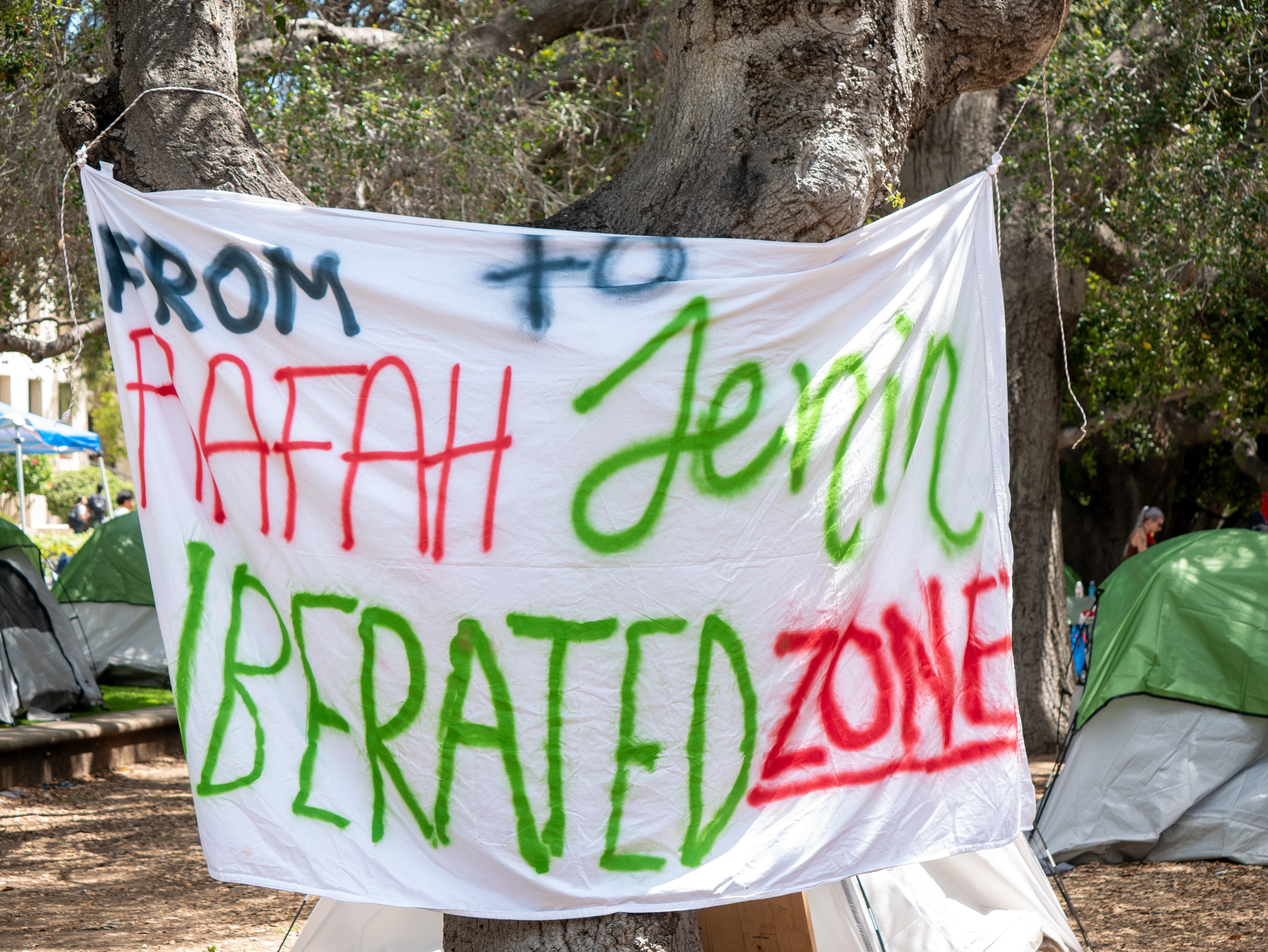
A protest sign amongst tents at the Occidental Jewish Voices for Peace (JVP) encampment on the Academic Quad at Occidental College in Los Angeles, CA. April 24, 2026. Jane Hutton/The Occidental

Paramesh said that the choice to stage an encampment was meant to ensure that there continue to be students on campus who know how to organize one and mobilize people when the need arises. 

“When the students who will be seniors next year graduate, there will be no one left on campus who was present during the [2024 AGC] occupation and original encampment,” Paramesh said. 

Professor Alexander Day from the history department sent out an email to faculty members on Friday afternoon encouraging professors to come observe the encampment and talk to their students. 

“Hopefully the college finds a just and peaceful resolution,” Day said in the email. 

According to Paramesh, the best case scenario for Oxy JVP and Oxy SJP is the Board of Trustees having the divestment proposal on the agenda on Monday and voting to divest from the companies mentioned in the proposal.

“There would be no need for escalation further than that, because that’s meeting the demand of the encampment,” Paramesh said. “It would mean that we’ve achieved one of the goals that people have been striving for over the last two years.”

However, Paramesh said, that does not mean the fight for Palestinian liberation on the college campus would be over. 

“The struggles of the people in Palestine are very interconnected with those of people here in terms of ICE raids. It’s very interconnected with the war in Iran, and the escalation of attacks in Lebanon.
 Fighting for Palestine, and Palestinian liberation is part of larger movements across the world, and I think that is just something to be proud of and something to be excited about,” Paramesh said.

Contact Ava LaLonde at lalonde@oxy.edu 

Loading

Controlling the uncontrollable: athletes’ superstitions and rituals

Men’s tennis player Benjamin Burrows (senior) said competitive sports are inherently mental. Burrows said he and many other athletes partake in rituals or have particular superstitions that help them focus during critical moments in their respective sports.

“Some people, maybe who are not athletes, might think that a lot of these routines are weird, and it’s OK that they’re weird,” Burrows said. “It’s more that the consistency gives athletes peace of mind and it helps them perform better. It doesn’t really matter what the ritual is, it’s doing it consistently — that’s what helps.”

Sydney Acol

Lacrosse defender Sydney Acol (senior) said she always gets to the locker room an hour and 15 minutes early on game days. Acol said this routine gives her the time and space to get into the right mindset.

“It’s all just become part of my routine for game day,” Acol said. “I’m used to doing it every single game, so if I forget it, it might not feel the same way when I am getting into the zone. It is like warming up and getting your muscles activated.”

Acol said some of her superstitions and rituals formed during high school lacrosse. Acol said she follows similar routines and still uses the same gear for game days.

“One kind of superstition [is] that I wear the exact same stuff that I have [had] since high school,” Acol said. “I wear the same sports bra, the same spandex and the same hair tie. It’s kind of crazy, but it works for me.”

Part of Acol’s pre-game routine involves her teammates. Acol said Tirzah Rivera (sophomore) or Olivia Okamoto (senior) always braid her hair. However, Acol said sometimes she has to change plans.

“One time, Tirzah was sick. She wasn’t there to braid my hair before the game, and Olivia was in the trainers. I found someone else to do it, but I still want to get all of my routines or pre-game rituals done, even if it takes a little change,” Acol said.

Reagan Rosenthal

Softball outfielder Reagan Rosenthal (first year) said she has many superstitions she relies on during competition.

“I believe in literally resetting yourself and resetting your mind,” Rosenthal said. “This is why softball and baseball are two special sports, because you’re forced to confront your problems. When you go up to bat, and it’s literally just you and the pitcher, and you have to face your problem – [the pitcher].”

To help with the pressure involved in softball, Rosenthal said she takes every opportunity to reset during games.

Softball Regan Rosenthal (first year) on the Academic Quad at Occidental College in Los Angeles, CA. April 2, 2026. Maile Brucklacher/The Occidental

“If I chew gum in a game and I am chewing it for an inning and I didn’t like how that inning went for me, I spit out the gum and start [chewing] a new piece,” Rosenthal said. “It is like a restarting point.”

Rosenthal said she uses some of her superstitions to calm herself in other aspects of her life.

“When it comes to preparing myself for an exam or something else, I’ll find myself shaking off the bad vibes,” Rosenthal said. “That is something that I [also] do when I’m on second base or when I’m running. I have to shake my hands to get ready. I’ll catch myself doing that before I walk in for an exam or something like that.”

Benjamin Burrows

Burrows said he started playing tennis at 14 years old, and trained at IMG Academy in Florida, where he learned about nutrition. Burrows said his preparations for matches always start the night before when he eats a healthy meal from Panera, but that some of his superstitions get a little more specific.

“Bouncing [the ball] between serves is not only [something I do] in matches, but it’s something that I incorporate during practice,” Burrows said. “The whole idea is it doesn’t matter if it’s an easy point and there’s no pressure, or if it’s a match point and it’s to clinch and you have all that pressure. If you’re doing the same routines over and over again, that eases your anxiety.”

Tennis player Benjamin Burrows (senior) outside Rush Gymnasium at Occidental College in Los Angeles, CA. April 2, 2026. Maile Brucklacher/The Occidental

In addition to bouncing the ball before serving, Burrows said he does not walk on the white lines in between points, and he always puts his shoes on in the same order. Sometimes superstitions can get in the way of an athlete’s performance, Burrows said, but he is intentional about remaining focused during practice and matches.

“You really want to focus on the things that matter, and if you’re distracted by anything else, that doesn’t help,” Burrows said. “I think routine just puts you at ease. It primes and prepares your brain.”

Burrows said even though some of his superstitions may seem odd, everything counts during a match.

“Tennis is a sport where so much is uncontrollable, whether it’s the sun, the wind, the opponent,” Burrows said. “The margins are so slim, so if I can get a one or two percent difference in a tight match just by doing consistent routines over and adding up all my superstitions, however weird they are, and they give me a one or two percent edge, I’ll definitely take each percent.”

Contact Nora Youngelson at youngelson@oxy.edu

Loading

Women’s tennis finds rhythm after early-season struggles

The Occidental women’s tennis team has been on a winning streak, recording three consecutive 7-0 sweeps. The team shut out Whittier March 27 and has a 5-8 record going into conference play. In the SCIAC conference, the top four seeds make the playoffs, and Occidental is currently seeded fifth.

Head coach Stephen Perkins said there was no single adjustment that shifted the team’s success.

“It’s been steady improvement throughout the whole season,” Perkins said. “Things that the players have been working on back since January are starting to come together.”

According to Perkins, injuries have been an issue all season, but the team has recently been able to rise to the occasion.

“People have had to step up, and the team’s done a good job being resilient […] trying to [take it] one day at a time and focus on the process, improving and controlling the things we can,” Perkins said.

Assistant coach Jesse Kreger said the team has overcome and adjusted to problems created by injuries.

“Our players have battled through [injuries] and have shown a lot of willingness to learn and get better,” Kreger said. “We have grown as a team, and the last week of matches has shown what we’re capable of.”

Nicole Anderson (senior) said the turning point for the team was their win against UC Santa Cruz March 8.

“We ended up beating them 4–3 — it got us out of this rut,” Anderson said. “It provided more confidence for all the players [and proved] that anything can happen with good effort and energy.”

Tennis player Nicole Anderson (senior) at the McKinnon Family Tennis Center at Occidental College in Los Angeles, CA. April. 3, 2026. Sophia Au/The Occidental

The team has found success in both singles and doubles in the past three matches. Multiple performances led to 6-0, 6-0 wins from second to sixth singles. In her last two matches, Greta Nagy (sophomore), in the singles one spot, landed herself in tight three-set tie breaks but secured the last point for Occidental in her wins.

Kreger said it is challenging to win any match 6-0, 6-0, and that the team’s improvement embodies these achievements.

“It’s easy to lose focus [or] drop a game, and our players have not only gotten better technically, but their mindset has grown as well,” Kreger said.

Anderson said Nagy’s three-set tie-break against Whittier was entertaining.

“It’s [thrilling] because you don’t know what’s going to happen, anything could change in a tiebreaker,” Anderson said. “All my teammates, alongside our opponents, were on the edge of our seats.”

Perkins said it’s difficult for Nagy to consistently perform in the number one singles spot.

“It’s challenging to be the last person on court with everyone watching [you] playing a close match,” Perkins said. “[Nagy] showed good perseverance, staying mentally focused in those matches against top opponents and pulling out wins.”

According to Nagy’s doubles partner Ellise Jay (sophomore), Nagy’s ability on the court stands out.

“She’s a strong doubles partner and player in general,” Jay said. “Her serve is terrifying — I’m so glad I’m not on the receiving end of that.”

Kreger said Jay’s improvement has not gone unnoticed.

“Ellise was playing six last year, now she’s jumped into the number two spot,” Kreger said. “That’s a huge jump, and she’s been playing some really good tennis.”

Courtesy of Ellise Jay

Jay said Occidental athletics resources have supported her recent wins.

“It’s positivity,” Jay said. “We have a mental coach on campus that we’ve started to meet with. She brings up positive talk or remembering positive things that people have told you, and bringing that onto the court and making sure you stay grounded.”

Kreger said the key to the latest victories in singles has been mental strength.

“Tennis is a difficult sport mentally because you get down on yourself,” Kreger said. “[Elise and Nicole] have made good progress in being able to fight through [mental difficulties] and come back and always believe in themselves and fight for every point.”

Perkins said every singles player’s contribution is essential to each match.

“Everyone’s important, top to bottom,” said Perkins. “Each point counts the same, whether it’s number six singles or number one singles; it all has the same level of importance in a dual match. People think of tennis as an individual sport, but [at] the college level [it] is a team sport, and everyone plays an important role in that.”

All doubles teams clinched wins in their last three matches, Perkins said, which has contributed to the team’s winning streak.

“We’ve worked [a lot this season] on doubles, doubles strategy, being aggressive and playing to win as opposed to not playing to lose,” Perkins said. “The teams are doing a better job of that, which has been a reason for the recent wins.”

Jay said the team needs to improve against high-level opponents to make the SCIAC playoffs.

“We have Claremont [April 18], they’re number one in our conference,” Jay said. “I’m looking forward to seeing how it’s going to play out.”

Contact Liz Hermosillo at ehermosillo@oxy.edu

Loading

‘We-before-me’: student managers star in supporting roles

Occidental sports teams have done well this year, with several teams reaching their respective SCIAC conference tournaments and others with seasons still in full swing. Every sports program at Occidental has both players and coaches, but many also have student managers, who play important roles across several teams.

For Occidental’s baseball team, student manager responsibilities have varied, according to head coach Luke Wetmore. Wetmore said student managers for the team have often been tasked with running charts  keeping track of important statistics and game events.

“If they’re running a chart, it allows me to see more,” Wetmore said. “I don’t have my head buried in a clipboard, and I can see a little bit more and communicate a little bit more effectively and efficiently because I’m not having to write stuff down.”

According to men’s basketball assistant coach Dominic Maynes, their current student manager, Naya Woods (sophomore), takes on various responsibilities for the team. Maynes said Woods often controls the shot clock and keeps track of statistics during games and practices.

“She’s supporting us as a staff and also supporting the program and anything that it needs,” Maynes said. “She’s with us on game days, sitting on the bench right there with us. She supports us by taking stats — with those stats, we get live feedback in the moment.”

According to lacrosse head coach Sierra “CC” Slack ’18, their current student manager, Emily Gutstein (junior), was a player on the team before she moved into the student manager role due to injury.

“She’s been our manager for the last two years,” Slack said. “She does a ton of things that are visible, but also a lot of behind-the-scenes work for us.”

Slack said Gutstein is a very valuable part of the lacrosse program, having integrated with the team as a player before becoming a student manager.

“She’s not an outsider coming in to do random things,” Slack said.

Malcolm Munnich (junior), who was a player on the baseball team before becoming a student manager, said the decision to become a student manager was an easy one.

“I played my freshman year on the [baseball] team, and then got cut at the end of fall my sophomore year,” Munnich said. “When [Coach Wetmore] cut me, he was immediately like, ‘If you want to stick around, we’d love to have you in the program — we just don’t see an option for you to play.’ It was an easy decision for me.”

Baseball manager Malcolm Munnich (junior) on the Samuelson Pavilion at Occidental College in Los Angeles, CA. April. 1, 2026. Sophia Au/The Occidental

Munnich said as a student manager, he maintained close relationships with the team.

“I felt like a player 95 percent of the time,” Munnich said. “That was influenced by the fact that I’d played there before, but [also] you’re just there every day. You’re in the locker room, you’re at team gatherings, so it just felt like being a teammate.”

Alex Tseng (sophomore) said he was drawn to a student manager role out of a desire to engage with volleyball at Occidental.

“I’ve been playing volleyball for the past eight years or so, and we don’t have any sort of men’s team,” Tseng said. “I love being surrounded by the sport.”

Alex Tseng (sophomore) on the Mary Norton Clapp Library Patio at Occidental College in Los Angeles, CA. April. 1, 2026. Sophia Au/The Occidental

Tseng said he has worked alongside the women’s volleyball team doing everything from setting up nets to helping coordinate practices.

“There was one practice last week where I was able to ‘coach’ a certain team in a scrimmage, and it was really cool to be in that group […] talking about strategy,” Tseng said.

Wetmore said baseball student managers have often served as another set of eyes when coaching staff is stretched thin.

“We call them student managers not necessarily from an instruction standpoint, but from the way that they approach it [and] the way they look at the game,” Wetmore said. “We’re trying to [teach] them to see the game like a coach so they can support us and bring up the stuff that they see.”

Munnich is back on the baseball team as a player this year, but said his experience as a student manager allowed him to see the game in a new light.

“It was really cool, being able to see the process more, and observe what was working [and] what wasn’t working for people from a more objective point,” Munnich said. “That allowed me, when I came back, to think about [what] I was doing [as a player].”

Wetmore said it takes a special kind of person to accept a role as a student manager for a sport they’re hoping to play in college.

“It really is that ‘we-before-me’ [mentality] — ‘if this is what’s best for the program, how do I best support the program?‘” Wetmore said.

Contact Julian Levy at jlevy@oxy.edu

Loading

Falling ‘Head Over Heels’ in love with the spring musical

Occidental College’s theater department is bringing to the stage “Head Over Heels,” a musical comedy consisting of songs by the 1980s female rock band, the Go-Go’s. With performances on April 17–19, April 24–26 and May 16, the musical follows the story of a royal family on an adventure to save their kingdom.

According to Drey Chan (sophomore), a member of the ensemble, they have reached a point where they are excited to share the final product and all the work they have put in.

“Yesterday, we just did an act one stumble through and it was super cool to see it, ” Chan said. “I feel like now we’ve reached a point where we’re all singing while dancing, and it’s just really beautiful to see it all put together.”

Chan said that, for the ensemble, the process of rehearsing the play centered around creating their individual characters.

“Our director told the chorus members to come up with their own character,” Chan said. “Just because we don’t have lines, that doesn’t mean we don’t have our own character-like arc.”

Courtesy of Drey Chan (sophomore)

Chan said their rehearsals helped create a community and explore the ways in which they can embody their roles in the play.

“I remember this one rehearsal session where they just played different types of music and we moved in the space,” Chan said. “I think that helped us explore what we could do with each other and how we can express different things through the movement of our bodies.”

According to Chan, the ensemble plays around with the embodiment of animals in the performance, anything from snakes, sheep or birds.

“We’re touching on puppetry for the snake, ” Chan said. “The director said, ‘You’re not playing you, you are the snake, so you direct your gaze to your snake. How you move doesn’t matter — it’s how the snake moves that matters.’”

According to Day Rhizal (senior), who plays a lead role, the rehearsals fostered a curious and energetic group of people who worked together to complete the piece.

“It became very clear to me that the energy of this show was lighthearted, hopeful, and curious,” Rhizal said. “From then on, I tried my best to show up every day excited and open to whatever people were bringing into the room.”

Rhizal said the fast-paced energy of the show taught them to enjoy the chaos and run with it throughout the show.

“Part of the fun of this show is how rapid-fire and sort of explosive it is at any given moment,” Rhizal said. “It was a challenge for me at first to feel there was enough space to fully explore every emotion or event being felt on stage, but learning to enjoy the chaos was important for me.”

According to Chan, the magical world of the play is relevant to our reality as it comments on various themes.

“It’s set in a magical world, but it’s super applicable to our world now and all the characters go through some sort of change,” Chan said. “Step into this world with us, challenge your ideas or the preconceived notions that you have.”

Courtesy of Drey Chan (sophomore)

According to Lee Chaloemtiarana (junior), who acts in one of the lead roles, “Head over Heels” comments on queer identity and perceptive image in a subversive way, not in the way of hate, but through discovery.

“I hope people see the image of a society in which existing outside of a gender binary or being queer is a universally accepted truth,” Chaloemtiarana said. “Basilius, while a villain, never misgenders Pythio [(they/them)] once corrected [the first time]. He may be evil, but he’s not transphobic.”

According to Rhizal, “Head Over Heels” joyously speaks to the growth of people in changing circumstances with a comedic undertone.

“This musical is truly a celebration of love and acceptance,” Rhizal said. “Over the course of the show, every character grows into new, beautiful versions of themselves, largely through a rejection of inflexibility and stasis. So much of this show is really fun and silly, and of course, I want the audience to feel uplifted and joyous while watching it.”

Contact Cole Banks at cbanks@oxy.edu

Loading

Occidental’s student diversity shines during graduation celebrations

The week prior to Commencement, graduates have the opportunity to take part in cultural graduation ceremonies, according to the 2026 Celebration Schedule on the Intercultural Community Center (ICC) website. These ceremonies are dedicated to honoring graduates’ unique and diverse experiences and excellence.

The eight cultural graduation ceremonies are held at the Academic Quad, Cannon Plaza and the Intercultural Community Center (ICC). The ICC partners with the campus cultural organizations to organize Asian, Pacific Islander, and Desi American Graduation, Black Graduation, First-Generation Graduation, Indigenous Graduation, Latiné Graduation, Lavender Graduation, Multi-Graduation and Middle Eastern and North African Graduation.

According to the ICC’s description of the events, “Cultural Graduation Celebrations are an opportunity for smaller groups to come together and acknowledge students’ accomplishments […] These smaller events provide more intimate settings for students to share these personal milestones with their communities.”

According to the speaker at the 2023 and 2024 Lavender Graduation Celebrations and Arts and Humanities Librarian Erin Sulla, the cultural graduation ceremonies remind seniors they have a supportive network of faculty and staff at the college to come back to even after graduation.

“Cultural graduations are a wonderful example of this ongoing dedication to all Oxy students, regardless of identity or background,” Sulla said via email. “These graduations provide a space for seniors and their support networks to celebrate all their accomplishments and their lived experiences.”

BSA co-president Zuriyah Smith (senior) on the Marketplace patio at Occidental College in Los Angeles, CA. April 3, 2026. Maile Brucklacher/The Occidental

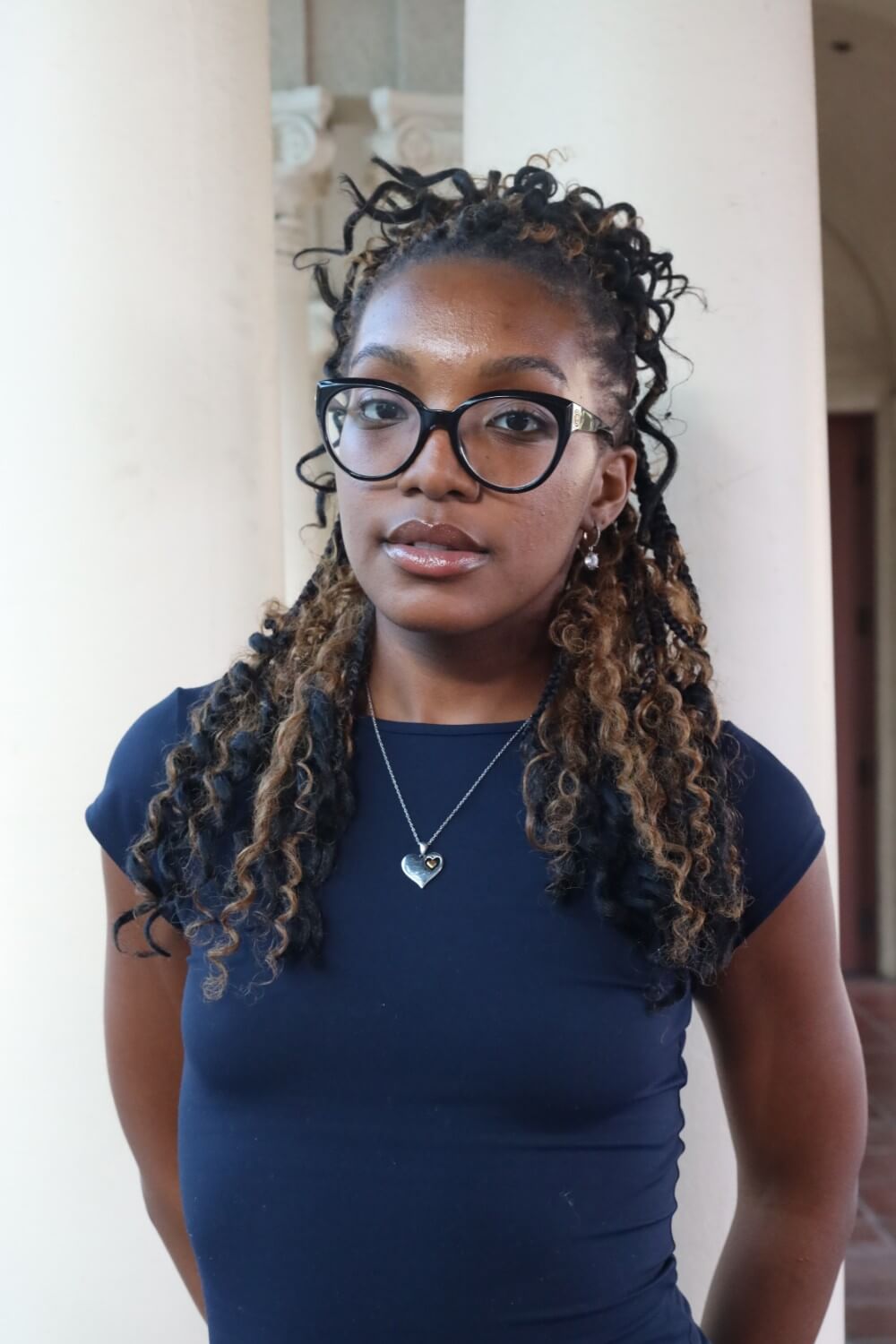
Co-president of Black Student Alliance (BSA) Zuriyah Smith (senior) said she hopes to speak at the 2026 Black Graduation ceremony.

“I would talk about what it means to be a Black student leader at Oxy, to have highlighted our Black culture and the Black experience at a PWI (Predominantly White Institution),” Smith said. “I would talk about why my Blackness is important to me, and why I think the Black culture deserves to be highlighted, and how grateful and happy I am to see myself and my Black peers take this next step into our futures and how I’m looking forward to that.”

Co-president of the Latine Student Union (LSU) Hailee Silva (senior) will be attending the Multicultural, the Latine and the First-generation Graduation Ceremonies and said if she were to speak at one of them, she would discuss her experience as a mixed-race student at Occidental.

“If I were to speak at either, I think definitely showing my side of being Mexican and Filipino and showing the blend of different cultures and then also bringing up my time here as a Latina, especially in a Predominantly White Institution [would be the focus],” Silva said.

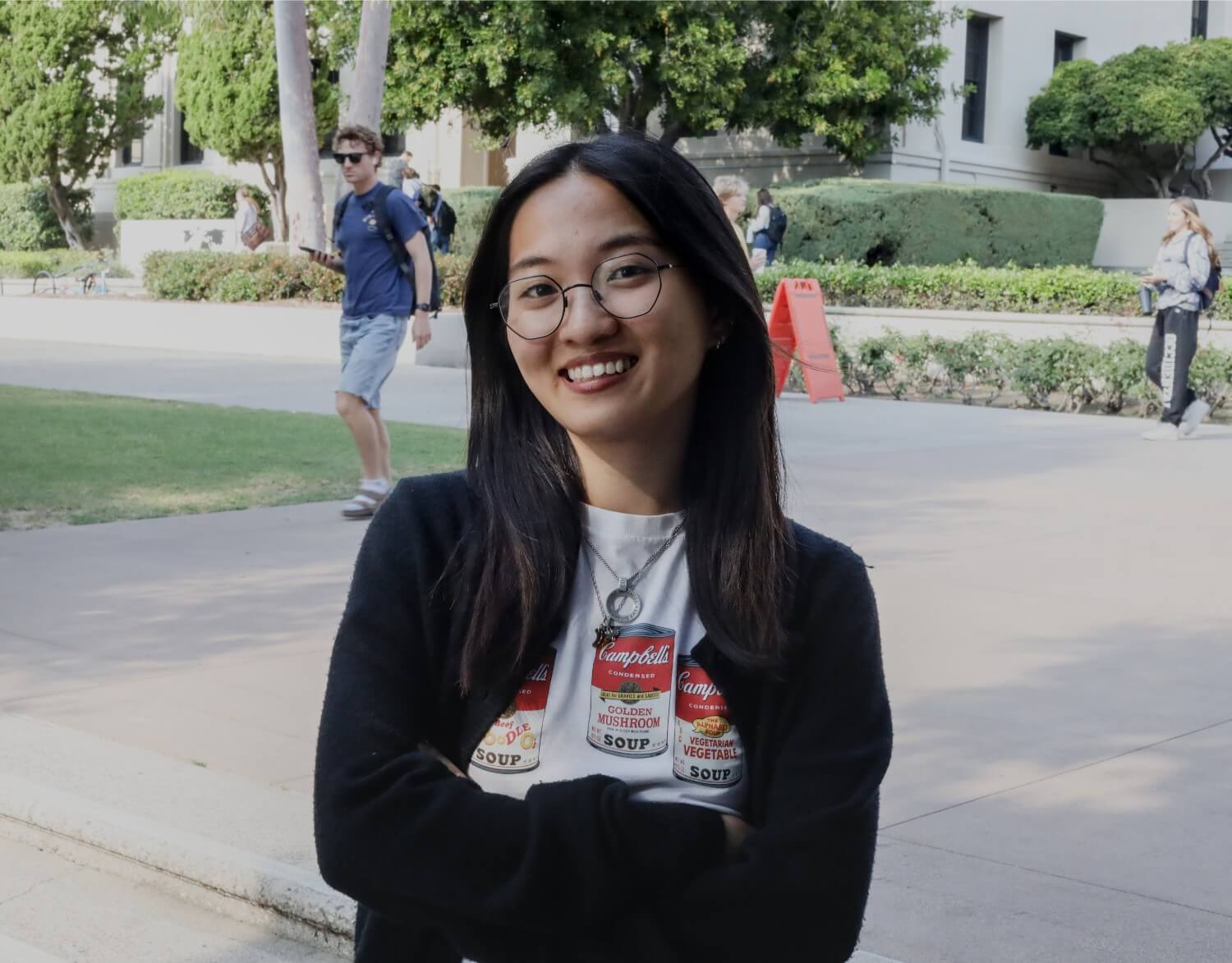
Co-president of Asian, Pacific Islander, and Desi American Association (APIDAA) Nirmala Rusli said Cultural Graduation is one of the few ways the Occidental administration has supported the APIDDA community.

“We [sometimes feel] very blindsided by the school and we just [don’t] really feel supported by the institution that allegedly wants to promote diversity,” Rusli said. “But then with Cultural Graduation, it’s like ‘OK, this is where you’ll support us.’”

APIDDA co-president Nirmala Rusli (senior) on the Academic Quad at Occidental College in Los Angeles, CA. April 2, 2026. Maile Brucklacher/The Occidental

Smith said it should not take graduating to celebrate and showcase students’ culture and identity, and that we should always be celebrating diversity across campus.

“There should be more opportunities for us to be highlighted as cultures, across the diaspora, whether it’s ethnic or identity, something that you identify as,” Smith said.

Despite these feelings, Rusli said Cultural Graduations nonetheless bring a positive environment for graduating seniors to be with friends when their time at Occidental has come to an end.

“The faculty and students that speak at those ceremonies [are] very uplifting and the vibes are always just so positive, and people are just happy to be there,” Rusli said. “I think it’s hard to find spaces where genuinely everyone is happy to be there, so that’s probably my favorite part.”

Contact Arlo Gallati at gallati@oxy.edu

Loading

A spotlight for storytellers: Occidental Children’s Theater takes center stage

The Occidental Children’s Theater is a theater troupe in its 31st year of performing fairytale-inspired shows and hosting camps for local kids. The cast is made up of six actors, all current or former Occidental students.

Visiting Professor of Theater and Performance Studies James Angell is the artistic director and founder of the Children’s Theater. Angell said his inspiration for creating the troupe came from a previous summer theater program at Occidental that was started in 1960, and became focused on performing for children in 1995.

“My idea was [that] you don’t have any sets, you don’t have any costumes,” Angell said. “All you have is a quarter staff and a sash, and you make everything that way.”

Angell said the original idea for the Children’s Theater was an experiment, and he didn’t know if it would succeed.

“I figured, in my hubris, that if it didn’t work out, I’d just write a play,” Angell said. “So that’s how it started […] and it worked really well. We’ve built on that over the years. The one really important ingredient that we added was Nick Erickson, who was teaching at CalArts at the time […] he was really instrumental in creating the physical performance style that we’ve adopted.”

Connor Leebardt ’25 is a current participant in the Children’s Theater. Leebardt said the troupe shoulders a number of responsibilities in their programming.

“There’s two sides to the Children’s Theater,” Leebardt said. “In the actual performance itself, we perform three folk tales and one custom mashup folktale, usually with a modern movie or something […] There’s [also] the second half, which is the Summer Institute of Fun. [It’s] a four-week summer camp program, teaching kids ages 8 to 13.”

Angell said the cast’s interaction with children in the audience is integral to the Children’s Theater’s performances.

“If you’re talking to an 8 or 9 year old in the audience, and you ask them a question, they’re going to answer, and you’re not in control,” Angell said. “When there’s an extended kind of back and forth that is completely unexpected, and my actors are dealing with it and engaging with it, it makes the audience happy […] and it really makes me happy. It’s those kinds of things, the unexpected, that really is wonderful.”

Courtesy of Connor Leebardt

According to Leebardt, the devising process is a joint experience between the participants, the director and everyone else involved.

“There is a lot of collaboration, a lot of synergy,” Leebardt said. “The first few months are a very collaborative experimental process where we’re just trying to see what’s feasible to put on as a story […] everyone is contributing all the time, and it’s a very open space. You’re allowed to make mistakes, and if something doesn’t work, then you try something else.”

Leebardt said despite the amount of work the Children’s Theater requires, they still enjoy the ordeal.

“We have the Thursday, Friday, [and] Saturday performances, and then the actual weekdays of teaching the kids,” Leebardt said. “On those Thursdays and Fridays, you have both the whole show in the morning and then you immediately get ready to teach all of that [and] put on a different show. It gets grueling, but it’s very fulfilling work throughout the whole process.”

Leebardt said being a part of the Children’s Theater has helped their mindset and acting skills, as well as being a good opportunity to try a different style of performance.

“It’s all about the devising process and working together and having fun,” Leebardt said. “We have a clown come in sometimes and teach us some clowning principles, and something that’s stuck with me […] is the three tenets: ‘It doesn’t have to make sense. It doesn’t have to be good. But it must be fun.’”

Courtesy of Connor Leebardt

Megan Johnson ’19 is the stage manager for the Children’s Theater. Johnson said the troupe forms close connections as they devise together.

“It gets really tight-knit, which I know everyone says about every rehearsal process,” Johnson said. “But this is so physical. You’re so reliant on the other people in the cast to support each other, to keep each other safe. It really feels like you’re part of a team.”

According to Johnson, the Children’s Theater is an effective form of community outreach and representation for the college.

“I wish that more of the direct Oxy community knew about [the Children’s Theater], but this is something that from the beginning has been for the larger community that really does bring in people who have never been to Oxy before,” Johnson said. “This feels like one of those programs that is actually for the community and not just for Oxy.”

Johnson said having dedicated performances for children is fulfilling for the whole cast.

“There’s something really rewarding about performing for children and creating something for kids,” Johnson said. “For a lot of kids, it’s their first theater experience that they’ve ever had. To give them something that’s at their level and that they get so excited to see [is] really rewarding.”

Contact Angus Kapstein Parkhill at parkhill@oxy.edu

Loading

Joey Valence & Brae and student openers bring high-energy to SpringFest

Occidental’s annual SpringFest concert featured headliner Joey Valence & Brae, with student openers Aitan Milman (sophomore) and Hannah Fortvne (senior), April 4 at Remsen Bird Hillside Theater. The event was hosted by KOXY, Occidental’s student-run radio station.

Milman, one of the opening acts, said he loved the spirit of the crowd and the other performers.

According to Milman, he heard Fortvne’s first set while getting ready for his own performance backstage. Milman said he heard her second set, as well as the headlining performance, as a member of the crowd.

“Joey Valence & Brae brought a lot of energy,” Milman said. “They were hyped.”

Milman said he loved the chance to perform at Occidental’s biggest musical event.

“It felt really cool performing at SpringFest,” Milman said. “To be able to perform on that stage, with that platform, in front of Oxy.”

Aitan Milman’s (sophomore) opening set for Springfest at Occidental College in Los Angeles, CA. April 4, 2026. Amy Wong/The Occidental

Milman said he has been making music his whole life and began pursuing it seriously in high school. According to Milman, he released his first song when he turned 15 and Occidental’s strong music department motivated him to attend the college.

“One of the main reasons I chose Oxy was the program they had with the music production major,” Milman said. “It was exactly what I was looking for.”

Molly Malin, an event director for SpringFest at KOXY, said it is the biggest event KOXY puts on every year.

“I worked on booking starting in August,” Malin said. “We got our artists, and then we put the show together, which means working with other campus groups to get our venue settled, get student openers ready, connect with our community and promote it.”

According to Malin, choosing a headlining artist involves thinking of who will bring out the crowd’s energy, even if not all students are familiar with the artist.

“’What’s a high-energy, festival-type act that we could bring?’” Malin said. “So that even if people don’t know them, they would get up and dance to this kind of music. That was my vision when I picked Joey Valence & Brae.”

Hannah Fortvne’s (senior) opening set for Springfest at Occidental College in Los Angeles, CA. April 4, 2026. Amy Wong/The Occidental

Maddie Thorpe (senior), promotions director at KOXY, said envisioning a specific look for SpringFest’s promotional materials, including posters and social media materials, involved taking inspiration from Joey Valence & Brae’s branding.

“They have a lot of ’90s style, which we were inspired by,” Thorpe said. “We were trying to do a ’90s basement type of poster, and then our graphic designer Ruby [King] made it more beachy, which I think is really cool.”

According to Thorpe, promotional materials are designed to appeal to all students regardless of their familiarity with the headlining act.

“We wanted to just make it seem like a very fun party with the whole campus community,” Thorpe said.

Malin said her position involves communicating with the headliners’ manager, photographers and safety teams in preparation for the event.

“I’ve been chatting with [Joey Valence & Brae’s] manager and making sure they’re ready to hit the ground,” Malin said prior to the event. “It seems like they’re very excited to be at Oxy.”

According to Malin, student openers are selected to complement the headliner.

“They’re well-loved by Oxy students,” Malin said. “They’re going to bring that same upbeat energy.”

Brae (JVB) performing for Springfest at Occidental College in Los Angeles, CA. April 4, 2026. Amy Wong/The Occidental

According to Milman, it has been easy to organically meet artistic collaborators at Occidental.

“I met a lot of people through classes and through being able to perform at Oxy,” Milman said. “It’s all about reaching out to the right people and knowing who to talk to in different situations.”

Milman said he practices for performances by running through his set the week before, but ensures he does not overthink the process.

“I’m always gonna get nervous before I perform, but as soon as I step on the stage, I snap into a different zone,” Milman said. “I just let it happen.”

Milman said his favorite part of performing is the connection he forms with the crowd, especially when they are excited for his music. At SpringFest, Milman performed both previously released and unreleased songs to cheers from the crowd.

“When the crowd is singing your songs, it’s definitely one of the best feelings,” Milman said. “Or doing call and response, getting the reactions from the crowd, especially when I’m playing new music.”

Contact Diana Trutia at trutia@oxy.edu

Loading

Lessons Learned: Everything changes and nothing remains still

When I was little, I had extremely strict rules and expectations for my future: be a computer engineer like my father, start a nonprofit by 25 and absolutely no dating or vacations until I had completed a PhD in the fanciest-sounding STEM discipline. If I met my high school self today, younger me would be puzzled by the woman in front of her — a tattoo-covered literature major with no post-grad job lined up who will soon move to San Francisco to join her boyfriend.

I was full of light from the prospect of reinventing myself during my first months at Occidental. Charting out everything I planned to accomplish during my four short years was intoxicating. Take the hardest classes. Join every club. Participate in every program. Win all the awards.

On the outside, I was the picture-perfect daughter on a merit scholarship with multiple leadership positions on campus. However, internally, I was conflicted because I still wasn’t content with who I was. Being in a new environment with new people was shifting my mindset, and I was confused and frustrated with myself because I was becoming such a different person than the one I recognized in the mirror.

Admittedly, I sometimes enjoyed late-night talks with friends more than time-blocking my schedule for the following day. I no longer felt guilty not getting perfect marks on exams if I needed extra sleep the night before instead of pushing myself to my limit. I didn’t even feel the need to forgive myself for hanging out with the cute senior biology major multiple days in a row instead of giving up my lunch hour to apply for internships. Who was I?

I slowly realized I wasn’t mad at who I was becoming because I recognized I was growing into a healthier, more well-balanced person; I was frustrated that I was even changing at all. I was married to a version of myself that was validated by unsustainable expectations of the past. I had adapted so well to all the external changes of moving to a new state and starting college, but none of that meant anything if I wasn’t ready to accept the change within myself.

I recently got a new tattoo, which would have been unthinkable to my freshman self because accepting personal change haunted me, no matter how positive. In fact, it was my third one. I have also gotten ten new ear piercings since starting college and have dyed and cut my hair more times than I can count. As I was hunched over the bathroom sink, bleaching my eyebrows last week, I thought that I was so cool for being proud of my body modifications and how I now crave more of them — more permanent change.

It then dawned on me that I view my internal growth like I do my crazy external body modifications. Somewhere along the way, I welcomed change within myself and growth with open arms.

Like a heavily-tattooed person getting the “itch” for their next piece, I now yearn for new beginnings because I’m excited to meet the person I grow into. Just like every tattoo on my body, I will always carry with me all the past images and versions of myself. They might fade and get blurry over time, and I may like some more than others, but all the different pieces work together to make me complete, and I shouldn’t be scared to add another one.

My newest tattoo reads, “πάντα χωρεῖ καὶ οὐδὲν μένει” — Everything changes and nothing remains still. I had been planning this tattoo for almost a year, as I knew I wanted a piece to commemorate my time in the Comparative Studies in Literature and Culture department. It accompanies an image of a large wave that wraps around my upper arm, symbolizing both the death and dawn of a character in one of my favorite books, “Finnegans Wake.” Like Anna Liva Plurabelle changing forms and pouring into the vast ocean, I am about to embark on the journey of finding home in the ever-changing adventure of life and becoming myself after college.

My time in college gave me so much more than a piece of paper in a diploma cover saying I read books and can translate Chinese and Greek literature. It allowed me not only to grow into myself but also to learn how to love who I become. The people I’ve met taught me to appreciate the person I was in the past, but also to be excited for the next version of myself.

As my deeply-admired professor, Sydney Mitsunaga-Whitten, once said to me, “To live is to love and leave.” In order to fully appreciate my time at Occidental and the person I have grown into, I must leave it behind to open myself to the new. I have to be brave enough to know I will never be the same person again. I must gracefully step into the water to be swept up by waves, because I know that only through change will I continue remaking myself and completely become who I am.

Contact Anna Beatty at beatty@oxy.edu

Loading

A namesake illuminates California’s homelessness crisis

Meeting Jimbo Miller

Two James Millers sat together on a curb outside of the Third Avenue Charitable Organization (TACO), a homeless services organization in downtown San Diego, June 2, 2025.

One of them, Jimmy Miller, 21, had rambled six blocks from Times of San Diego — the fledgling local newsroom based just north of downtown where he interned on the housing and homelessness beats — to the organization in search of a two-stall mobile shower.

The nonprofit distributes daily meals, charges devices, holds mail for 1,400 of San Diego County’s roughly 10,000 homeless people — and offers free showers in a converted horse trailer.

Lorena Galligan, the organization’s director, parked the hygiene Airstream trailer in a filthy parking lot where drug addicts tied belts around their biceps. The lot is adjacent to TACO’s offices on the second floor of a church’s administrative wing, which oversee a tidy courtyard where food is served.

Outside that courtyard, Jimmy met Jimbo Miller, 65, and interviewed him for about 10 minutes about being homeless.

Jimbo said in a gruff voice that he was from Cabazon, CA — a rural desert community along Interstate 10 between Riverside and Palm Springs.

After his wife, Kathy, died, he had been homeless “on and off forever, man.”

He now stayed in a shelter downtown run by one of the largest homeless services organizations in San Diego, Father Joe’s Villages, which sheltered more than 11,000 different people in 2025. In the past, Jimbo had worked as a day laborer, cleaning construction sites in El Cajon, a town of 100,000 east of San Diego.

But Jimbo had trouble finding laboring work close to his shelter downtown.

“There’s nothing I can do,” Jimbo said of his unsuccessful job search.

Plus, Jimbo was having trouble registering for a Social Security appointment, which meant he wasn’t receiving the benefits he was entitled to.

In the interview, Jimbo was easygoing and laconic — but also bumbling and incoherent. He mentioned a court-ordered stay at a shelter in Riverside County that turned out to be a now-defunct drug treatment center. When discussing how hard it was to register for Social Security benefits, he blew a raspberry and grew upset, although not irate — which would’ve been a rational response, too.

In many ways, Jimmy was to blame for some of Jimbo’s ambiguity. Listening to the interview 10 months after the fact, the silences between questions seemed drawn out, as if the interviewer was grieving. Jimmy realized he hadn’t asked the right follow-up questions, or really any at all. When he had probed, he’d focused on Jimbo’s experiences navigating the regional network of homeless services, like the soup kitchen and the shelter. It’s not a bad line of inquiry, but it dodged the real story: that two people with the same name — the same starting point for the self — could live such different lives.

I’ll drop the bit and admit I’m Jimmy. But I’m also not the Jimmy who met Jimbo last summer. When he met Jimbo, that Jimmy was speechless because homelessness became personal in an instant.

Jimbo’s bright blue eyes and his obfuscations about substance use and unstable family life didn’t remind me of my own story, but I recognized them as running themes in my own family.

Now, I’m not sure that linking Jimbo to all the James Millers, so to speak, that I know, is right.

I only spoke to Jimbo for 10 minutes. While he hinted at a few possible reasons that he was homeless during our interview, I didn’t know for sure that he was an addict or that he had family problems. Those were projections of mine, which came from the stories of financial dependence and homelessness that resonated the most for me — but they weren’t necessarily true for Jimbo.

For instance, when I asked Jimbo if he had kids, he said he did.

“I haven’t talked to them in a long time,” Jimbo said. I took his answer to mean that he had been in some sort of family dispute. His disgruntled tone supported my interpretation — but our brief conversation hardly outlined the complex life I’m sure he’d lived.

The night I met Jimbo, I made a rare entry into my journal about him. I jotted down Jimbo’s lack of family and that his “teeth had rotted and he spoke with the grandfatherly drawl of a man who is old and tired. But he was only my dad’s age.” I sketched in Jimbo’s story by working him into my family story — both my dad and grandfather are James Millers. But this move of mine overdrew Jimbo, whom I hardly got to know.

When I re-listened to my interview with Jimbo in April 2026, I realized that my interest in his possible family problems or a substance use disorder — aspects of his story I found captivating, in part, because they were just out of reach — had led me away from a glaring component of his homelessness: the paucity of work near his shelter.

According to Jimbo, an average day for him involves going to different soup kitchens downtown and then going to “try and find some work.” In addition to his day laboring gigs in El Cajon, Jimbo said he had previously bussed tables at a hotel downtown.

But at the time we spoke, Jimbo’s mercurial personal life seemed like a more obvious source of his homelessness than his trouble finding work did, or his lack of permanent housing.

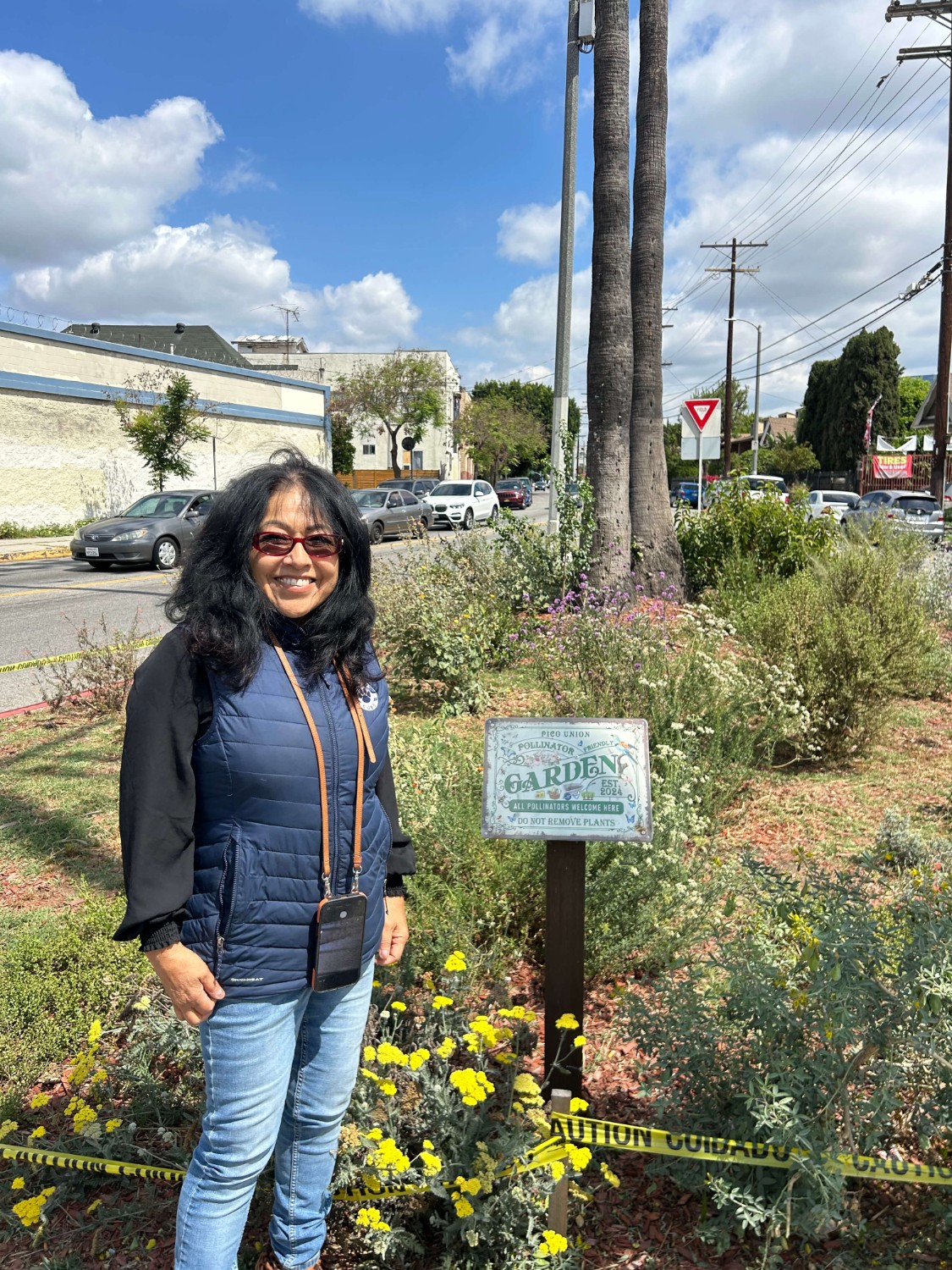
Community organizer Aurora Corona ’77 in front of a native plant community garden she helped create in Los Angeles’ Pico Union neighborhood. April 2, 2026. James Miller/The Occidental

Homelessness in LA’s urban core

Occidental alum Aurora Corona ’77 is a community activist who has served on the neighborhood council in Pico Union, the neighborhood just west of downtown Los Angeles where she grew up.

An art history major, Corona caught the travel bug while studying abroad in Florence, Italy. After graduation, her career at American Airlines allowed her to live abroad in New Zealand, Venezuela and Argentina.

Corona organizes biking safety and poetry events at local schools. She spearheads neighborhood revitalization events, such as a native plant garden in a street median and a trash pick-up in February — attended by Los Angeles Mayor Karen Bass — at MacArthur park in Westlake.

When Corona moved home after 9/11, she said she became a Spanish linguist for law enforcement — which involved wiretapping cartel communications.

Now, addicts abound on the streets in her community.

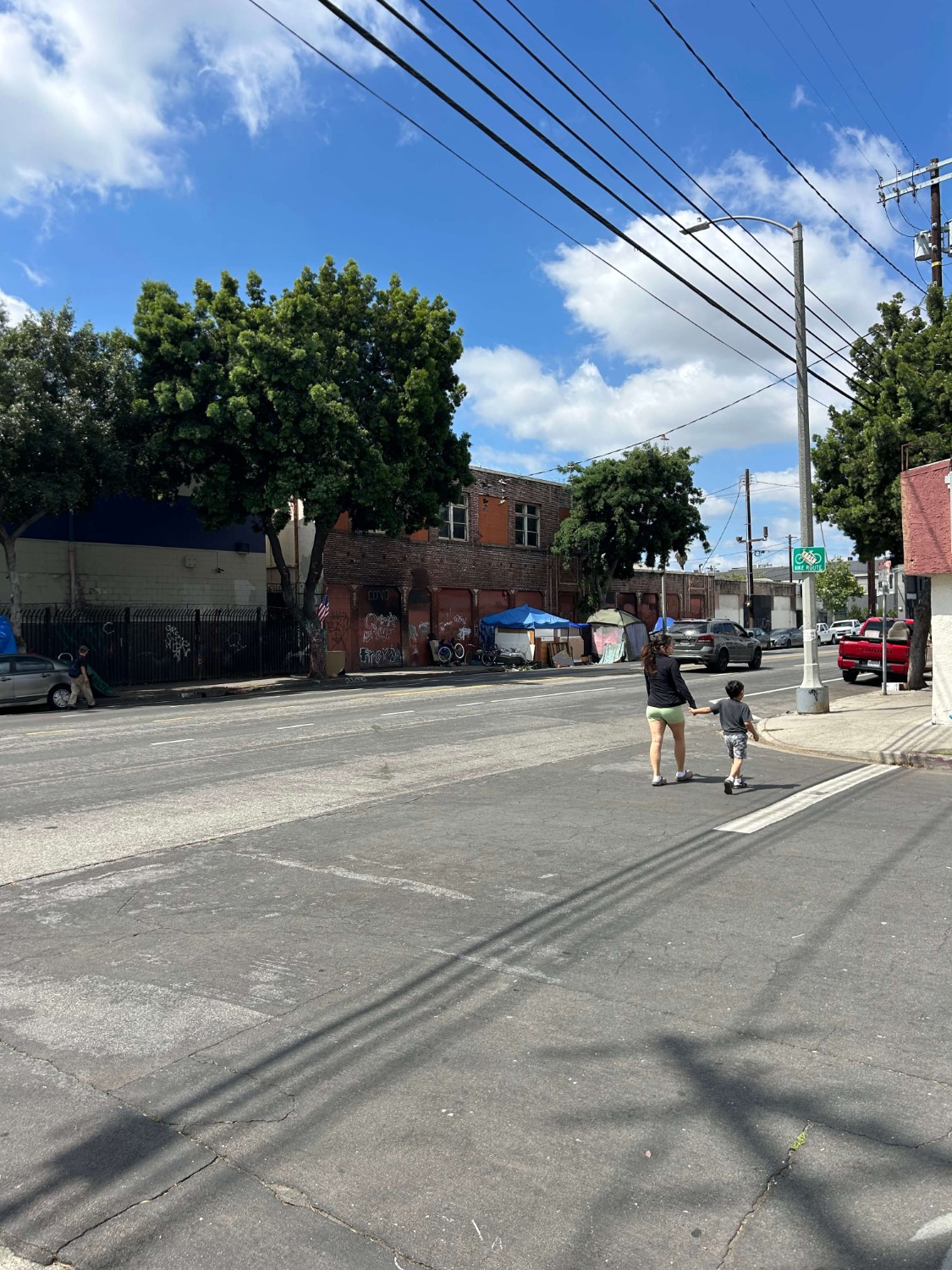
According to Corona, Pico Union has had gangs since the 1980s, but now there is a drug dealer on her block, and two nearby homeless encampments littered with bicycle parts that she said are stolen.

MacArthur Park — where Corona led a clean up in February — is an open-air drug marketplace where gangs sell drugs out of tents in the homeless encampments, the US Attorney’s Office claimed in a March 5 press release about the indictment of 12 members of LA’s largest street gang.

A larger-than-life statue of Prometheus in the park was revised by LA artists S.C. Mero and Wild Life in early 2024, when the guerrilla van Goghs put a giant meth pipe in the mythological figure’s left hand.

In early 2025, the city enclosed sidewalks around the park, displacing street vendors selling illicit and legitimate goods, according to LA Taco. Per The LA Local, Westlake has a sizable Latin American immigrant population, and one quarter of its workers are not U.S. citizens.

Corona said that until the 2000s, MacArthur Park was mostly known for drunks, not drug users.

“You could still go there, you could still shop there,” Corona said of the park two decades ago.

Drugs have since become more prevalent in the park.

“Nobody wants to go there. Everybody’s afraid to go down there at night, or even during the day,” Corona said of MacArthur Park today.

According to Corona, the profligate drug use in MacArthur Park and the gangs that have infiltrated the encampments have made it difficult for social service providers to reach addicts who might want to get clean.

Per the LA County Dept. of Public Health, approximately 20 to 35 percent of homeless people have a substance use disorder, a statistic supported by data from department programs.

During the 2024-25 fiscal year, 41.7 percent of people admitted to a publicly-funded substance use disorder treatment center in LA county — 14,938 individuals — were homeless. That number is 20.7 percent of the 72,195 people who were homeless county-wide in early 2025, according to the LA region’s most recent annual point-in-time count.

According to the Los Angeles Homeless Services Authority (LAHSA), in 2025, the homeless population in LA proper was 43,695, of which nearly 27,000 were without shelter.

According to the Mayor’s office, homelessness declined for the second year in a row in 2025, and the unsheltered homeless population has decreased 17.5 percent since Mayor Bass took office in late 2022.

Corona said that to shrink the population of unsheltered addicts in MacArthur Park and her neighborhood, the city needs to expand CIRCLE, a program that dispatches unarmed response teams to non-emergency situations involving homeless people.

CIRCLE operates in south-central LA and a swathe of the city from Hollywood to Lincoln Heights that includes Westlake, but not Pico Union.

Corona also said that homeless people who are granted temporary housing through Inside Safe — the mayor’s signature anti-homelessness program — should be connected with jobs.

“Once you get people in the homes, what do you do with them? How can we sustain people just [by] paying for them?” Corona said. “They’ve got to be given an incentive to work, an incentive to get jobs. Give them some pride and find out what their talents are.”

According to Cal Matters Homelessness Reporter Marisa Kendall, Inside Safe transfers encampment inhabitants to hotels or motels until they can find permanent housing — at an average nightly cost of $121 per bed.

Inside Safe has faced criticism for its high recidivism rate. As the LA Times reported April 5, 40 percent of participants in the program that has cost more than $323 million are once again homeless.

According to a dashboard of Inside Safe’s outcomes and finances published in November 2025 by LA Controller Kenneth Meija’s office, of the program’s 5,808 beneficiaries, 24.6 percent are now housed and 29.6 percent are in interim housing — mainly motels. More than 45 percent of Inside Safe participants have exited the program, and for the most part, they’re back on the streets.

A former LAHSA employee spoke to me about homelessness in LA — anonymously, to avoid professional reprisals. The employee criticized Bass’ Inside Safe as a temporary solution to homelessness. They said that when funding for the program runs out, formerly homeless individuals in temporary housing will likely be released back to the streets.

That day is right around the corner, they said. The city of LA faces a $1 billion budget shortfall, the county is moving their funds from LAHSA to a new homelessness agency due to fraud concerns and Republican leadership in Congress jeopardizes federal funds for housing and urban development.

According to the employee, California doesn’t have just a homelessness problem. It has a housing shortage, inaccessible medical care and growing poverty. They said the root issue is that the city lacks enough housing.

Seasoned journalists and progressive stalwarts seem to agree. In a rejoinder to a moderate conservative’s book about homelessness in San Francisco, Occidental’s E.P. Clapp Distinguished Professor of Politics Peter Dreier pinned the growth of homelessness nationwide in the 1980s on “the combination of closing the nation’s mental hospitals (without providing the promised funding for community-based treatment settings) and the Reagan administration’s cuts in federal funding for low-income housing.”

A homeless encampment near Aurora Corona’s home in Pico Union in Los Angeles, CA. April 2, 2026. James Miller/The Occidental

Former LA Times Senior Editor Mitchell Landsberg and staff writer Gale Holland chronicled the history of LA’s homeless in a feature of epic proportions published last year. They write that the average cost of a home in LA today costs six times what it did in the early 1970s — and that’s accounting for inflation. From 1975 to 1979 — before Reagan — prices doubled.

In their feature, Landsberg and Holland write that there are poor people, drug users and those who need treatment for mental illness in every U.S. city — but those cities don’t have “this many people without homes.”

According to Dreier’s article, “when more low-rent housing was available, including many rooming houses since lost to gentrification, even people on society’s margins could afford a roof over their heads.”

Whether cheap boarding houses were lost to gentrification or less clear market forces is debatable — what is for certain is that they just weren’t hovels keeping the infirm and the debauched out of sight. According to an LA Times article from 2024, the single-room occupancy hotels on Skid Row that now reek of feces were acceptable havens in the early 2000s.

Homelessness is a catch-all at the confluence of many issues, as Landsberg and Holland acknowledge in their article, writing that “the poverty, lack of support system, childhood trauma, domestic abuse, financial and legal problems that sent people into homelessness in the first place won’t just vanish in new housing. But it removes the chaos of living on the street.”

When I met Jimbo last summer, I wanted a simple explanation for why he was homeless, so I lent him a story I knew. Now it’s clear to me that there are many reasons he ended up outside the soup kitchen on Third Avenue, including that his housing and work opportunities were determined not by human need, but by profit. That force explains his malaise, but maybe not entirely.

I changed my thinking about why Jimbo’s homeless, but the reason his story matters in the first place remains the same: he’s family. During our interview, I saw my father in another life, or my grandfather or me.

It took meeting someone with my name to see myself in a homeless person, to see the people I love on every sidewalk, in every median, doubled over with needles in their arms, smoking from glass pipes, sleeping in their cars or on the beach or on a bench or on the bus. And even when I don’t see someone I love, I know I’m seeing a son, or a father.

Contact James Miller at jmiller4@oxy.edu

Loading