

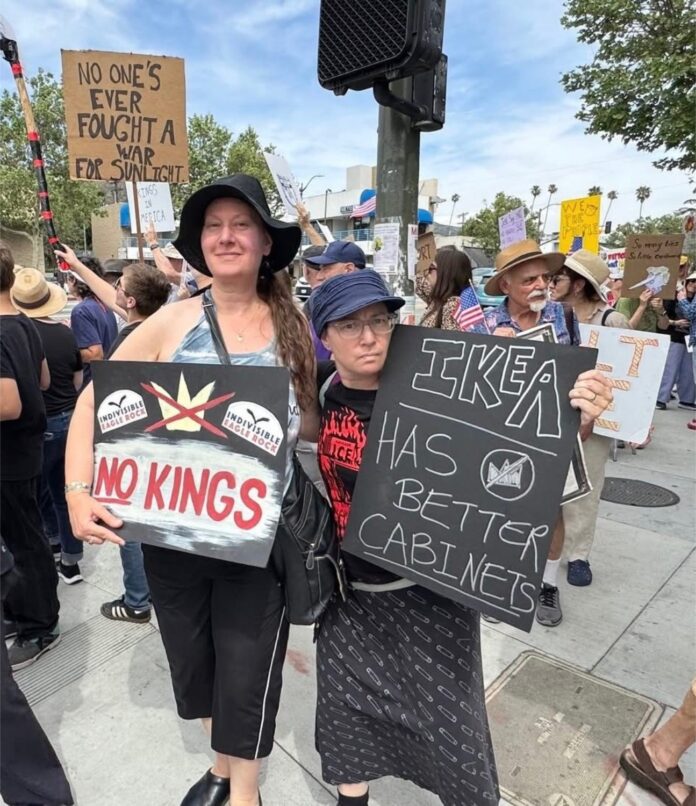
Demonstrators across the nation took to the streets for the third round of No Kings Protests March 28. With over 3,300 registered No Kings events taking place, an estimated eight million attendees mobilized in the US.
Katy Hickman and Janice Markham, co-facilitators of the Indivisible Eagle Rock Hope Squad, organized an unofficial Eagle Rock No Kings Rally on Eagle Rock and Colorado Boulevards. Markham said she did not think the Eagle Rock rally would see high attendance, as the group was unable to officially register with No Kings, but decided to go ahead with the event and scheduled it after the Pasadena and Glendale rallies to encourage attendance. Markham said she spread word of the protest through Mobilize, an organizing app, resulting in 250-300 attendees.
“There were many people who were grateful that we had an Eagle Rock site for No Kings,” Hickman said. “It was easier for some older people to not have to travel as far […] The whole point of that was to organize locally.”
According to Hickman, the Indivisible Eagle Rock Hope Squad formed after Indivisible Eagle Rock merged with the NELA Hope Squad. Indivisible, a progressive grassroots organizing movement with 2,500 registered groups across the nation, is one of the lead organizers behind the No Kings movement, along with 50501 and MoveOn.
Jane Demian, a long-time activist from Eagle Rock, said she attended both the downtown LA and Pasadena protests. Demian said downtown was an electric environment, estimating that over 100,000 people and various activist groups participated.
“[At] Pershing Square, they’re marching and chanting, and people in Gloria Millennium Park are handing out flyers and they’re talking about signing up for stuff,” Demian said. “There was a lot of stuff about immigration protection and pro-Palestinian issues. Anybody who does anything was there.”
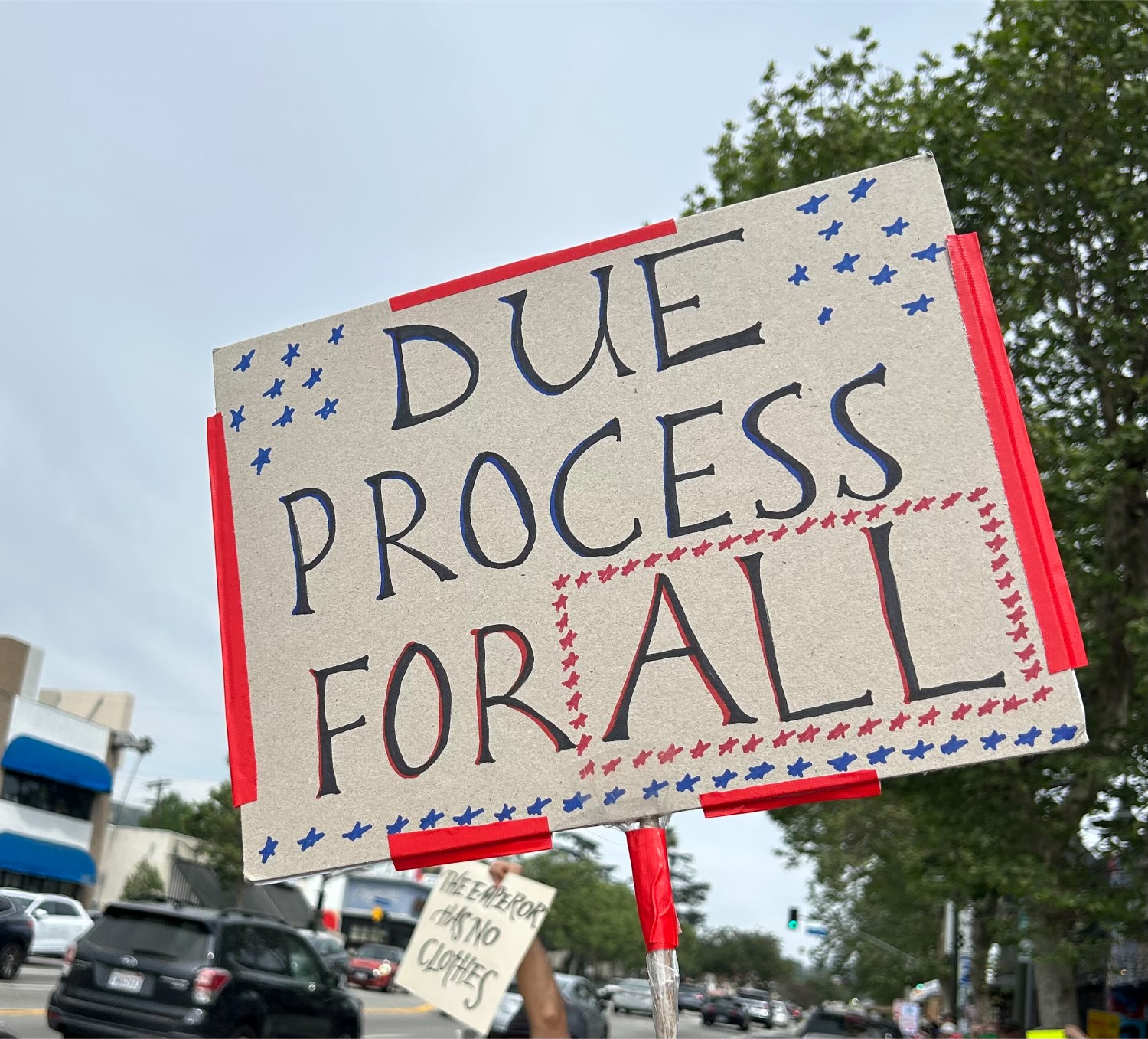
Demian said the fact that every round of ‘No Kings’ Protests has drawn out larger and larger numbers of people gives her hope that people will continue to mobilize. Demian said the scale of these protests — from five million people last June to seven million in October to the eight million March 28 — demonstrates their impact.
“I think the reason why these protests are getting bigger — and they’re also worldwide now — is because of this factor of the most powerful person in the world exhibiting dictatorship qualities,“ Demian said. “People are waking up, and they’re understanding what Trump wants to do.”
According to Demian, protesting can be a tactic to resist injustice by building networks of like-minded activists who then collaborate to influence change, comparing No Kings to the Vietnam Anti-War Movement.
“It’s a way to get people more involved,” Demian said. “When you show up at a protest, you meet other people. You exchange phone numbers, you hand out flyers, you tell people to show up at a meeting. That’s really what the protest is for. It’s not [the] end all be all.”
According to Demian, the various protests she attended had very different atmospheres: the Eagle Rock rally was very family-friendly, the Pasadena protest seemed to lack diversity and downtown LA was packed with people from all walks of life. At least 75 people were arrested at the downtown LA protest for refusing to disperse or assaulting law enforcement. Demian said she does not see the No Kings protests as a means of disruption, and that the protests were organized legally with permits to avoid inciting escalation from the federal government.
Hickman said the purpose of these gatherings is to provide a focus for people to rally around, creating energy to be carried over into everyday activism. While people may view the movement as emotional but incoherent, Hickman said taking any form of action is what gives grassroots movements political strength.
“I think we need to get away from heroes, from giant expectations of a big change after something,” Hickman said. “It’s trench warfare. It’s just every little battle — a little bit more, a little bit more — and staying in it.”
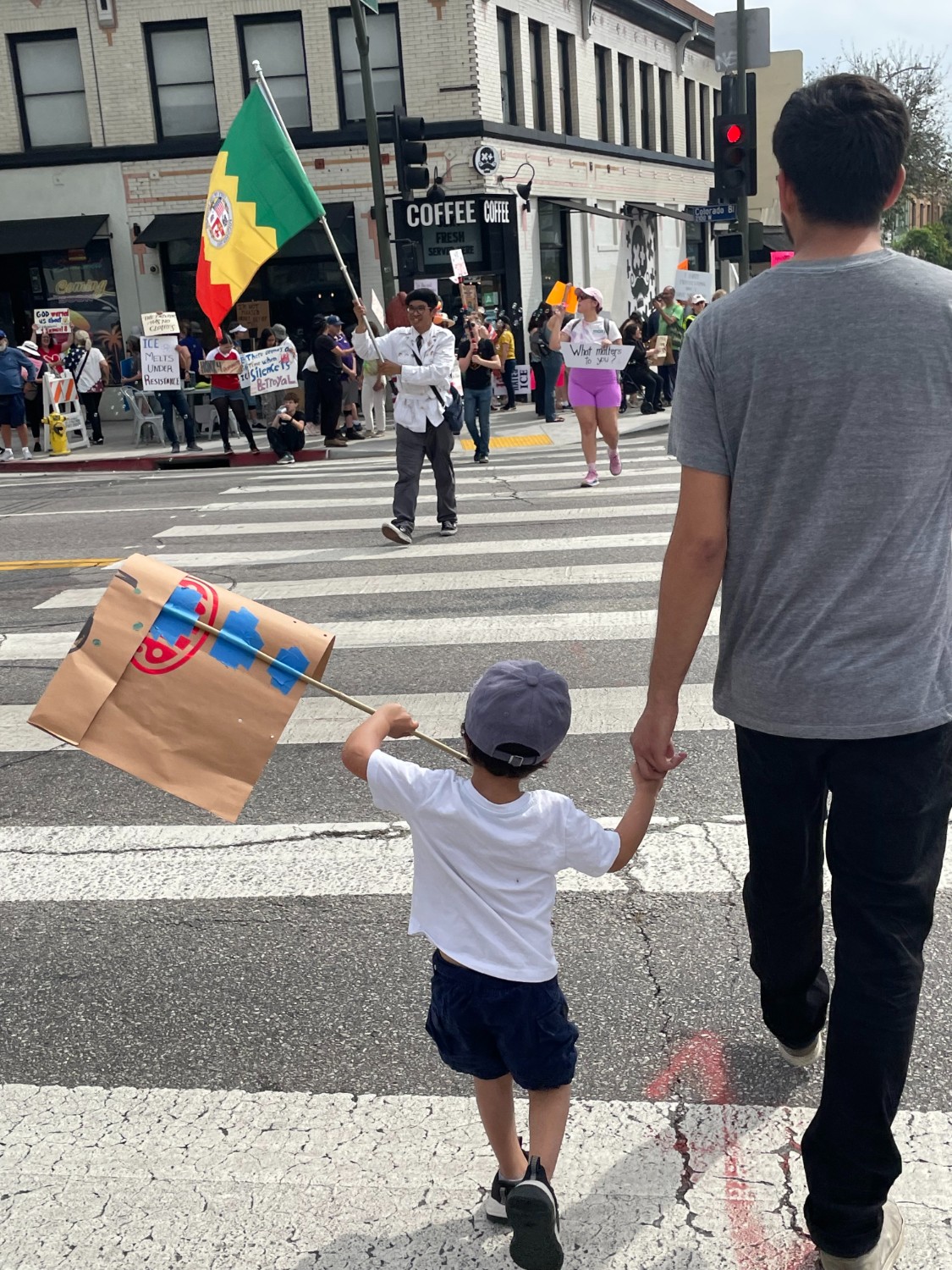
Hickman said she has seen the protests inspire more people to get involved with the Indivisible Eagle Rock Hope Squad: the group gained around 20 active members after the Jan. 10 protests and ten members have joined since the March 28 rally. Markham said the Eagle Rock Hope Squad tries to play to their members’ strengths by offering people a range of ways to get involved.
“There are people who are like, ‘I’d rather stick needles in my eyes than pick up a phone and phone bank,’” Markham said. “‘That’s not my thing, right?’ How about postcard writing? Maybe you’re more comfortable with face-to-face talking to people or find out about ballot measures or help with going to Trader Joe’s and get some food for the group for mutual aid.”
According to Demian, the movement’s next steps involve a nationwide work stoppage planned for May 1. According to the group’s interest form, they are also involved in bridge actions, canvassing, phone and text banking, content creation, mutual aid, climate work and community defense. Hickman said the Indivisible Eagle Rock Hope Squad will meet next at Eagle Rock City Hall April 11 and hopes to maintain the current momentum through the upcoming midterm elections.
“Every single thing by itself is so shocking: the deportations, the data centers and detention centers […] That’s a terrible thing that we’ve gotten to in our country,” Hickman said. “There’s so much, overwhelming to take on, but we’ve just got to do that. Every time I get overwhelmed, I’m like, ‘well, what’s the next thing?’”
Contact Naisha John at njohn@oxy.edu



Thank you for covering this story!