Home Blog Page 49

Occidental Library collects hundreds of books for Children’s Books for Altadena

Between Jan. 21 and Jan. 24, the Mary Norton Clapp Library collected used and new donations for Children’s Books for Altadena. According to First-year, Transfer, & Student Success Librarian Samantha Hilton, the library was one of ten locations collecting books — other locations included Vroman’s Bookstore, Chevalier’s Books, Book Soup, The Last Bookstore, Bob Baker Marionette Theater, Arcana Books, Annabelle’s Book Club, Secret Headquarters and Other Books, Comics and Zines.

Hilton said that between all donation locations, thousands of K–12 books were donated and that at Occidental specifically, she lost track of how many books were donated after 400.

“I knew there was an appetite for being able to do a book drive […] but nothing that was on this scale,” Hilton said. “It was a little bit overwhelming, in good and bad ways.”

Carmela Beyer is the founder and sole organizer of Children’s Books for Altadena. Beyer said that following the initial devastation of the recent LA fires, she felt the need to do something to help her community. She said she created Children’s Books for Altadena intending to support teachers, local bookstores and businesses, as well as gifting books to students who had already lost so much.

“Children’s Books for Altadena came from [an] undying call to serve my community that I think was instilled inside me from my family, growing up around educators and becoming one myself,” Beyer said. “I think I’ve always had this need to help others, to show up for others and especially for children.”

According to Beyer, Children’s Books for Altadena started as a GoFundMe to help rebuild classroom libraries and replenish curriculum supplies, workbooks and book collections for teachers and students, specifically those from the five burned-down Pasadena Unified School District (PUSD) schools.

“I published the social media and the GoFundMe from my parents’ dining room table. I run everything out of my childhood bedroom,” Beyer said.

Beyer said she noticed a lot of people wanting to do more than just give monetary donations.

“I kept hearing people saying exactly how I felt when I started this, which was this need to physically do something,” Beyer said. “The book drive was [also] so I could help other people that want to help fulfill that need inside them [and] help support local small independent bookstores.”

While Occidental did not match the local business location Beyer was initially requesting, Hilton said she thought it was a perfect fit. She said she had seen the @CBforAltadena Instagram post asking for local places to collect donations and reached out as a neighborhood-adjacent place that wanted to do something.

“Oxy does a good job of volunteering and staying connected,” Hilton said. “A book drive makes sense for a library. It’s something we can do.”

Student Success Librarian Samantha Hilton in her office in the Mary Norton Clapp Library at Occidental College in Los Angeles, CA. Jan. 28, 2025. Graham Jewett/The Occidental

Sarah Pickle, the college librarian and director of the Academic Commons, said that while they had only initially put out one collection box, they ended up with at least eight overflowing boxes within the first day. Pickle said she, Hilton and Christin Boomhower, the acquisitions specialist, helped transport the books from Occidental to Beyer’s downtown storage location. According to Hilton, they took a total of five carloads.

“We were expecting a couple of boxes, but it ended up being hundreds of books,” Boomhower said. “Every time we came back and checked, there were more […] It was really great to see the support.”

Donors were encouraged to bring their favorite children’s books. Hilton said she saw several copies of Wings of Fire, the Hunger Games trilogy, Magic Treehouse, Percy Jackson and The American Girl Doll books.

Pickle said she thought this prompt was a great way to bring another element of humanity to the drive.

“Everyone seemed to pass by and have [personal] experiences,” Pickle said. “I saw Goodnight Moon and thought of all the times that I read that to my daughter.”

According to Hilton, one of the reasons Occidental was able to collect so many books was because of sub-drives collecting donations, one of which was ran by Administrative & Advising Assistant Angela Vawter, a PTA board member at Mount Washington Elementary.

Vawter said that after seeing Hilton’s email about the drive, she reached out to the principal of Mount Washington Elementary and put a collection box outside the front school office. Vawter said she was able to collect two full boxes and two heavy bags of books, which she dropped off at the Occidental library.

“Just knowing the books were being collected to help rebuild school, classroom and home libraries left us with a really good feeling,” Vawter said. “The effort and coordination of the book drive led by Sam and the library staff just further solidifies the place and space Oxy holds within the community here on the Eastside.”

According to Hilton, neither Occidental nor Children’s Books for Altadena is collecting more books at the moment. Beyer said she is currently in the process of organizing and distributing the books that were donated. She said that if people want to help, she welcomes volunteers and encourages them to reach out to cbforaltadena@gmail.com with the subject “VOLUNTEER” and mention their hours available in their email.

“I think for children who have lost everything, holding a beautiful, touching, important book that has helped others and inspired others — and even just comforted others — is what I want to prioritize,” Beyer said. “I want these books to feel like a gift, not a donation.”

Contact Ava Anderson at aanderson5@oxy.edu

Loading

Student-run Touchdown Thrift plans to reduce waste year-round

Touchdown Thrift, a student-owned thrift store on campus, opened their doors Jan. 24 with nearly all of their inventory coming directly from the Occidental community. Located in what used to be the concessions stand for Kemp Stadium, Touchdown Thrift is a collaboration between Oxy Ecossentials, the ECON 201 Sustainability Lab and the Office of Sustainability.

According to Associate Professor of Economics Bevin Ashenmiller, who teaches the ECON 201 course, the project had been in the works for a long time.

“This is a dream that Isa and I have both separately had for many years,” Ashenmiller said.

Isa Merel ‘23, Occidental’s Assistant Sustainability Coordinator, said she has also been involved in the project since the beginning.

“Right when I started as a staff member, which was August 2023, one of my tasks was to reduce waste during [dorm] move out,” Merel said. “My first thought was, ‘If that’s our goal, we need to have an option for items to flow in and flow out,’ and a thrift store that could be open year-round made the most sense.”

Assistant Sustainability Coordinator Isa Merel and Toby Wepman (first year) outside Touchdown Thrift near Jack Kemp Stadium at Occidental College in Los Angeles, CA. Jan. 30, 2025. Isabel Marin/The Occidental

According to Annabelle Ewing (junior), one of Touchdown Thrift’s co-founders, Oxy Ecossentials had already been running Green Move Out, a program where students can donate any unwanted or unused items at the end of the spring semester instead of throwing them out. Green Move Out holds an annual Fall Move-In Thrift Sale where many of the items that students donated the past spring are put on sale for the community.

“Before the thrift store opened, Ecossentials was [holding] move-in sales, but they had to donate so much of it, and so much of that we had to throw away,” Ewing said.

According to Stella Cammack (sophomore), another co-founder of Touchdown Thrift, the collaborators on the project worked to open Touchdown Thrift with this in mind.

“We were really successful in getting people into the space and getting some excitement about the new thrift store,” said Cammack.

Assistant Director of Sustainability Alisson Linder said on the day of the opening sale, Touchdown Thrift processed 265 transactions.

“On the first day it was open to the wider student body, over 10 percent of students chose to shop there,” Linder said.

According to Ashenmiller, even with this early success, there is still more to come. She said this period for the store is a baseline semester.

“It’s a heavy lift to get started, and then we’ll have a report and a proposal for next year,” Ashenmiller said. “Then we’ll be able to be like, ‘In the spring, this is how many people came, and this is how much money we made, and this is how much we diverted and these are how many donations we got.’”

Touchdown Thrift Co-Founder Jesse Principe (sophomore) said that for the students running Touchdown Thrift, the success has fueled ambitions for future projects which, while still in the planning phase, are objectives they see as attainable.

“Everything’s still up in the air and still planning, but we really want to host workshops teaching people repair techniques,” Principe said. “We want to be able to have [an] e-waste collection and [a] textile recycling collection so that these things that so-often [go] into landfills [don’t].”

Jesse Principe (sophomore), Stella Cammack (sophomore) and Annabel Ewing (junior) outside Touchdown Thrift near Kemp Stadium at Occidental College in Los Angeles, CA. Jan. 30, 2025. Isabel Marin/The Occidental

According to Cammack, the team has been vocal about the broader impact they wish to achieve on campus moving forward. Cammack said in addition to diverting waste, they want to change the way the Occidental community thinks about consumption in general.

“Even if we don’t change people’s minds about overconsumption, [we want to] just bring attention to the fact of how much waste we create as a campus,” Cammack said.

Linder said she agrees with this idea of impacting the community as a whole.

“The point is [the store] has that behavioral change on the front end, but also the opportunity for scalability on the back end because [people are] learning how it works,” Linder said.

Ewing said the best way to get involved is by joining Ecossentials.

“That’s the most successful way to get into the loop of being in the shifts and also the more inner workings of it,” Ewing said.

According to Ashenmiller, the power of student involvement on Occidental’s campus is a strong force.

“My experience at Oxy is that the best things that we do around the environment are always started by student creativity,” Ashenmiller said.

Principe said the store will be open regularly beginning Jan. 27, from 11 a.m. to 6 p.m. Monday through Friday and 11 a.m. to 3 p.m. Saturdays.

Contact Toby Wepman at wepman@oxy.edu

Loading

‘Start bashing your problems away’: Oxy and LAKO Boxing Clubs join forces

Twice a month on Wednesday afternoons, members of Oxy Boxing Club can be found at LAKO Boxing Club on Eagle Rock Boulevard, punching to upbeat music. According to club president, Timothy Shumaker (junior), the group has existed for years without a consistent place to train or reliable equipment to use. That changed at the end of last semester, he said, when ASOC granted them $1,400 in funding to finance a series of 12 classes at LAKO.

“[Oxy Boxing Club] was left without an advisor and it was going to die, so I became president and started looking for ways to get more involvement and make it convenient for people,” Shumaker said. “Working with LAKO was kind of a breakthrough, because they’re so close [to campus].”

Shumaker said that since the partnership began, Oxy Boxing Club has seen a rise in membership, particularly from beginners. At the most recent training session, he said the club had around 20 members join, with more anticipated to come for future sessions. Because of the high quantity of beginners, Shumaker said he is working to make the club as inclusive as possible.

“Part of the reason that I want to make it more accessible and [all]-skill-level-friendly is so that anyone who’s even a little bit interested can have the convenience to be able to join,” Shumaker said. “I want to be a leader that everyone is comfortable around.”

Just two years ago in 2023, the club had no female members. Shumaker said he thinks at least half the group is female identifying now, and it is important to him that the environment of the club is open to everyone.

Club member Sawyer Bornstein (first year) said he had over 10 years of martial arts experience before joining but had never tried boxing. He said that while having prior experience might help out some, it is not necessary to succeed in the club.

“I’ve seen people come in, not knowing how to stand or anything, and then other members of the club being like ‘Hey, make sure to put your foot here, put your hands up [like this],’” Bornstein said. “Everyone really helps each other out. It’s a great environment.”

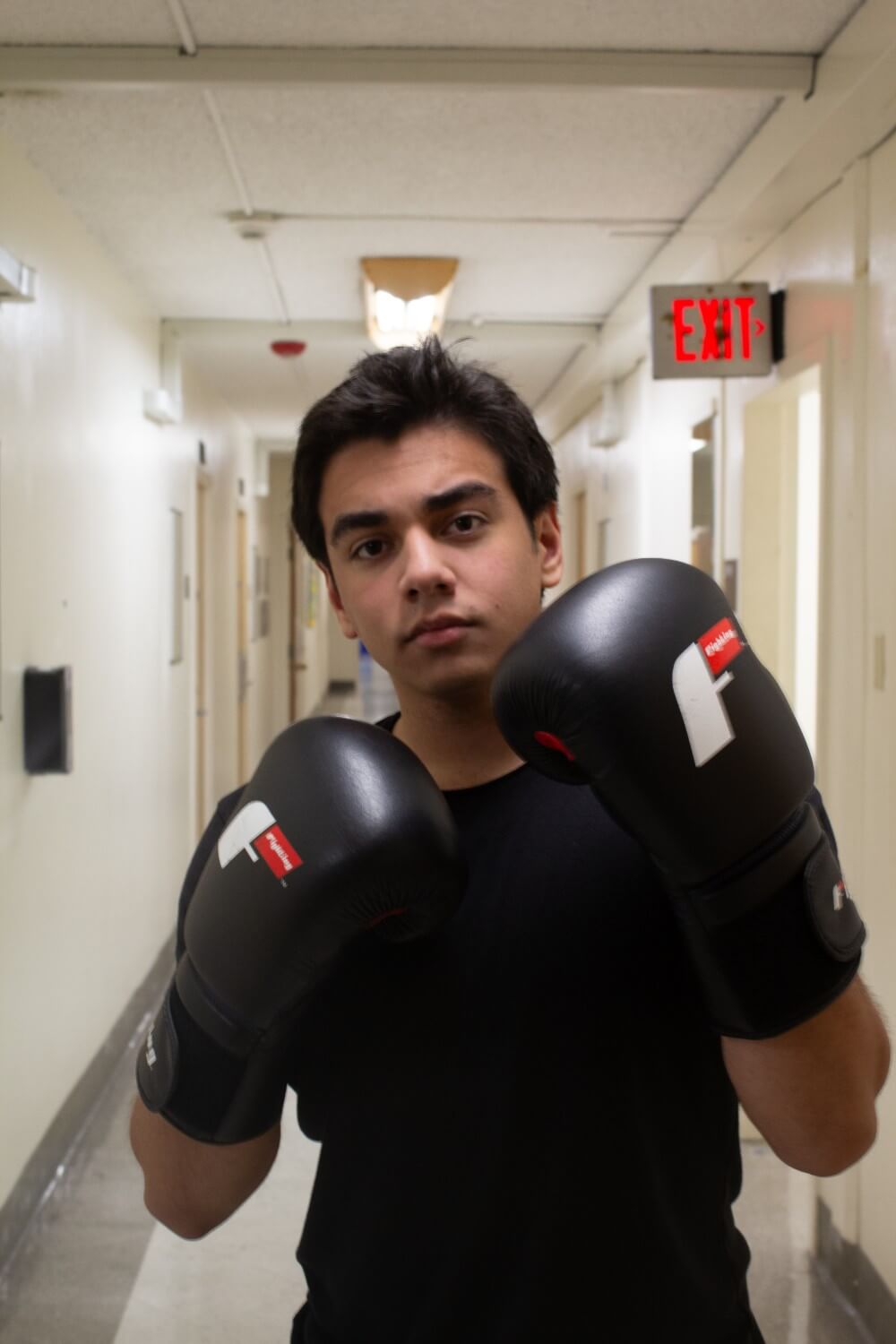
Gerard Suner (first year) in Stewart-Cleland Hall at Occidental College in Los Angeles, CA. Feb. 1, 2025. Marty Valdez/The Occidental

Club member Gerard Suner (first year) said that although though he was intimidated at first, he has found his time with the group to be highly rewarding. He said that since joining, he has increased mental clarity and plenty of new friends.

“Boxing brings a whole bunch of people together, even though it’s a small community,” Suner said. “It’s very nice to go workout with other people and start bashing your problems away.”

Part of the reason Suner said he enjoys training with the club is because of their coach at LAKO, Justin Van-Hairston.

“He’s an amazing coach, one of the best coaches I’ve ever seen,” Suner said. “He doesn’t put you down, but he will make sure that you continue to push through. He’s genuinely one of the most motivating people I’ve ever seen.”

Shumaker said Van-Hairston is an enthusiastic presence who always trains with a smile on his face. Van-Hairston has further supported the club, Shumaker said, by facilitating the donation of over $500 worth of boxing equipment, including gloves and wraps which members can keep.

“I know how it is being a college student,” Van-Hairston said. “So even the classes I made free, gloves I made free, wraps I made free — they really don’t have to pay for anything.”

Van-Hairston said he hopes to continue to coach the club in the future, particularly as some members become more interested in competing. He said the club’s ability to continue training at LAKO will depend on if they are able to get continued funding from ASOC — which he hopes they will provide after hearing positive feedback from students.

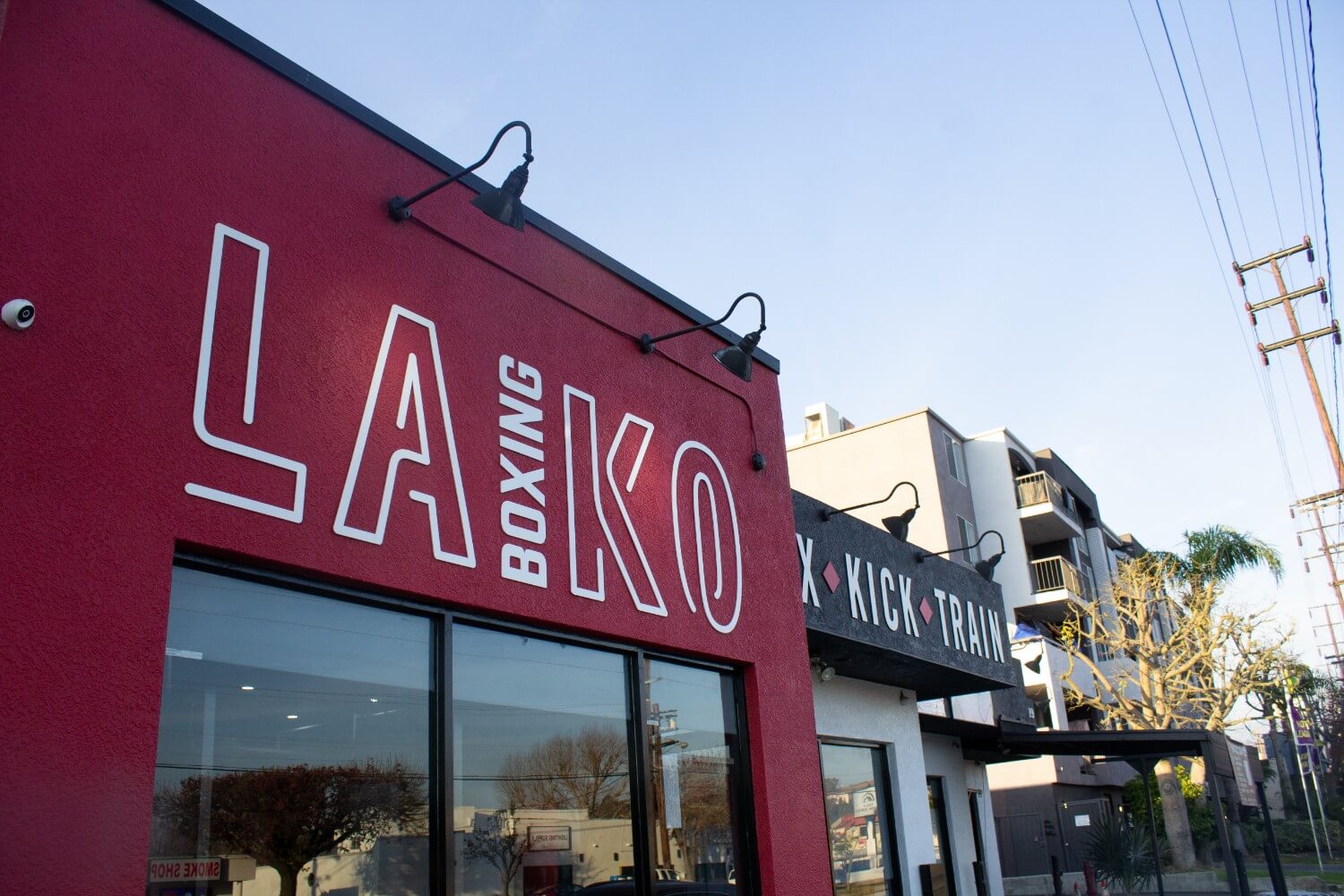
LAKO on Eagle Rock Boulevard in Los Angeles, CA. Feb. 1, 2025. Marty Valdez/The Occidental

Van-Hairston said, as a coach, it is important to him that the energy during trainings is both positive and serious.

“You can’t half-ass boxing,” Van-Hairston said. “You can get hurt, you can die. Boxing has to be something you really want to do, and then you have to get good at it, and then it becomes fun.”

In the coming months, Shumaker said the club has plans to organize a fundraiser for punching bags and other gear that students can utilize on campus to train between classes. He said the club will continue to be open to new members and that he recommends joining as a way to build physical fitness and community at the same time.

“For anyone considering joining, just know that all skill levels are welcome, there’s equipment provided and free trainings,” Shumaker said. “We encourage anyone who’s interested to come.”

Contact Estel Garrido-Spencer at garridospenc@oxy.edu

Loading

Athletes Connor Grant and Paige Yasukochi find success through consistency and community

Connor Grant

In the Cal Lutheran swim and dive meet Jan. 25, Connor Grant (first year) won both of his individual events, the 500 and 1,000 meter freestyle, by nine seconds. These wins add to a string of victorious meets for Grant.

Grant’s head coach Haley Meryl said that she attributes Grant’s success to his consistency and ability to take feedback. According to Meryl, athletes do not need to be spectacular everyday, they just have to be consistent everyday and then they will be ready when it matters. This is something that she said Grant excels in.

“He is super consistent,” Meryl said “Which in any sport is important, but especially swimming, [because] it’s a monotonous sport in itself.”

Meryl said Grant’s willingness and ability to consistently push himself inspires and motivates his teammates to do the same.

Grant said that to get ready for a meet, he always makes sure to eat enough the night before. Additionally, he said he prepares using the same warm-up routine for every meet, ensuring he is ready when it is his turn to perform. According to Grant, a lot of his early collegiate success can be attributed to his teammates and the environment that they create.

“While this is an individual competition, practice is the complete opposite,” Grant said. “Training with the right group of people in their best area, it makes you better. It’s definitely a team sport.”

According to Grant, this communal spirit helped him improve in areas where he is not as naturally skilled. Grant said he is hoping to continue his improvement, and as his first collegiate season begins to wrap up, he is focusing his energy on preparing for the SCIAC championship Feb. 19 to 22.

Paige Yasukochi

Paige Yasukochi (junior) led her women’s basketball team to a tense overtime win against Redlands Jan. 25. Yasukochi put up 22 points, one block and one steal as her and her team battled their way to a hard-fought victory. Yasukochi scored two of the first three baskets, which helped Occidental secure a six-point lead at the start of the first quarter.

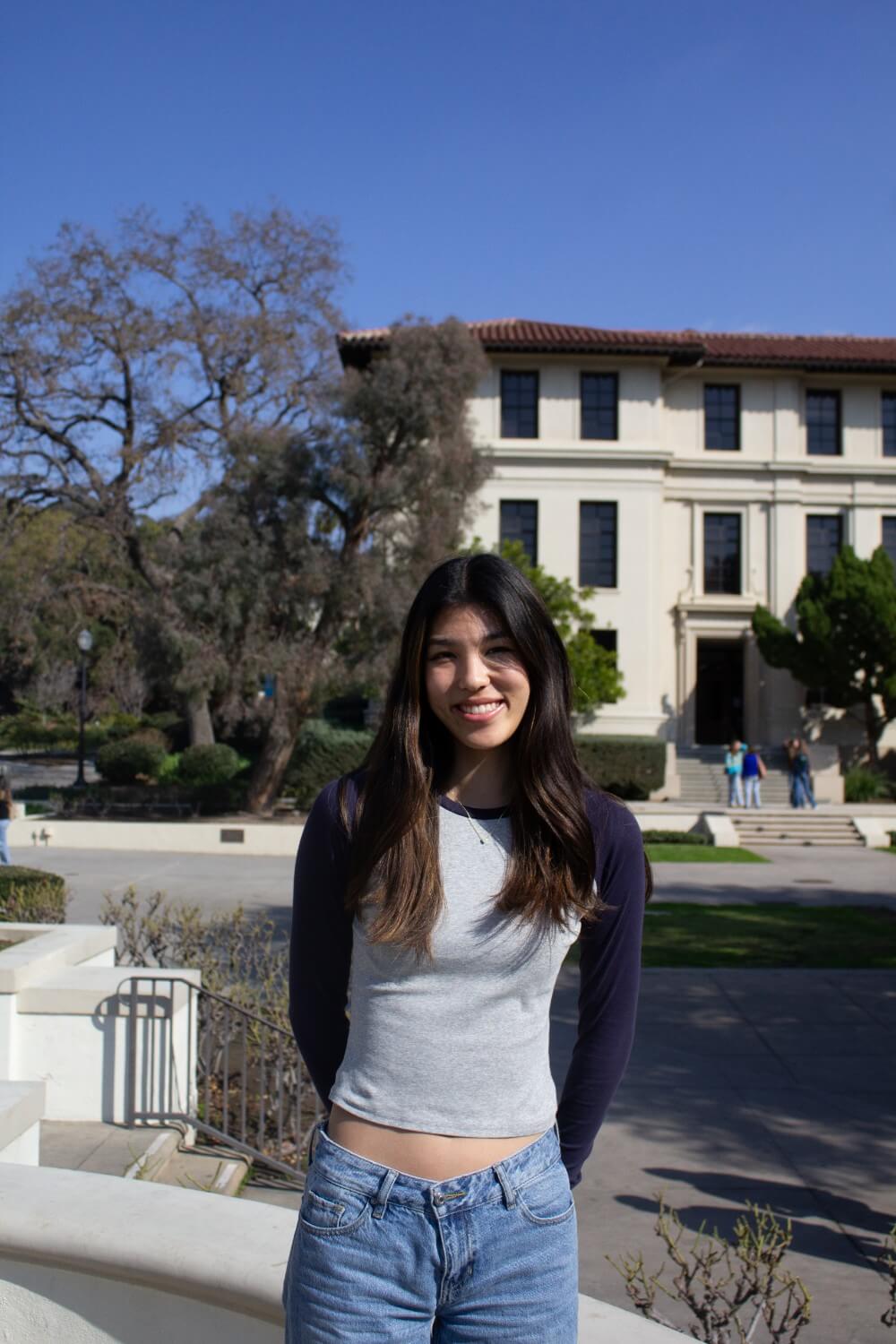
Paige Yasukochi (junior) on the Academic Quad at Occidental College in Los Angeles, CA. Jan. 28, 2025. Marty Valdez/The Occidental

Yasukochi said she is hoping to help her team get to the postseason this year — to do that they would have to be one of the top five teams in the conference. They are currently seeded fourth. According to Yasukochi, this year they have a very good chance of making the playoffs, and she is looking forward to pursuing that goal.

Yasukochi said she knows that to be the best athlete she can be, she needs to have a proper pre-game routine. She said she likes to prepare for a game by taking a nap, having a Gatorade and putting up a few solo warm-up shots before the team warm-up begins.

Yasukochi’s teammate Ainsley Shelsta said that every day in practice, Yasukochi gives it her all and consistently puts in extra hours and extra shots. According to Shelsta, Yasukochi is an amazing teammate.

“She’s very calm, cool and collected all the time,” Shelsta said. “She is never [going to] get really upset. She is never [going to] get too high, too low. If things are going great, she’s just chill, she’s Paige and if things are not going the best, she’s still just Paige.”

Shelsta said this consistency allows Yasukochi to be a good role model for her teammates.

“We just look at Paige, and she’s calm, she has faith and she just keeps grinding,” Shelsta said.

According to both Yasukochi and Shelsta, being on the basketball team has helped them flourish academically and athletically. According to Shelsta, the basketball team is a very close-knit team. Shelsta said having teammates is like having a built-in friend group.

“My teammates are my best friends,” Shelsta said. “Paige is one of my closest friends.”

Yasukochi said she believes that having such a close bond with her team has helped her push herself both on and off the court. She said having good teammates helps when she is having a hard time or when she needs some extra motivation.

“They really just make me a better person in all those aspects,” Yasukochi said. “They always push me to do better.”

The basketball team is currently 6-4 in conference play and 11-7 overall, with six conference games remaining. They are looking to notch another win in their record with their next game against Chapman Feb. 5.

Contact Noah Emmitt at emmitt@oxy.edu

Loading

Opinion: Student training is uninspired and outdated — Oxy should take a different approach

For anyone who is blissfully unaware of the Vector LMS, Higher Education Student Edition website, let me just say that you should enjoy your luck while it lasts.

Why? Because it means you somehow escaped a harbinger of misery meant to be a well-intentioned symbol of 67% of American colleges’ commitment to diversity and inclusion (as reported by the Goldwater Institute). While the idea of educating students on discrimination and understanding others better is good, Oxy handles this in a way that completely undermines the purpose of the training.

And since this is the case, I’ll just go over all the pitfalls that were missed in the process.

1) Information is only as good as how it’s presented.

With serious topics, it can be a natural instinct for educators to try and make them more palatable by any means necessary. While I do understand that certain topics are harder to discuss than others, cringey videos with unrealistic scenarios won’t help anyone fully comprehend the dangers of alcohol or how to talk to a friend about their mental health.

One of my biggest issues with these lessons is that they always fail to acknowledge the complexity of the topics they’re supposed to cover. Real life is messy, and even if we do all the right things, there’s no guarantee that everything will end with smiles on our faces. Knowing this, do we see the issue with the curriculum projecting that anytime someone we care about has a problem, there will always be a magic sentence or action that can change everything?

Questionable acting aside, why is it that the person in need of help always relents and accepts your aid should you happen to say the “right” thing? Even if you say the suggested words, there’s no guarantee someone will open up to you or that you’ll find a solution together — especially if you’re unfamiliar with someone. Weirdly enough, the scenarios in the trainings always involve close friends or family, but never classmates or other acquaintances.

2) What’s understood doesn’t need to be said.

You would think that a college that boasts about having such a diverse student body would be aware of the challenges some students face. Since said students are stuck doing these trainings, probably not as much as they’d like us to think.

I say this because as a Black woman in America, I find it highly absurd that I need a kindergarten walkthrough on what discrimination is, especially when having already faced it. As unfortunate as it is, a lot of minority students are well aware of what their country thinks of them before they reach their teenage years.

Oxy needs to put more of its efforts into making this school a genuine safe space for those who need it. If Oxy truly cares about promoting diversity and alleviating discrimination, more meaningful steps need to be taken to make it happen. There’s a variety of affinity groups, social justice clubs and well-meaning students on campus. Give them a real opportunity to help this place align with Occidental’s vision. The time we’re all required to spend on these trainings could be better spent on student outreach and implementing things we want to see. Not only would it be more impactful, but it would bring the desired results of training to life without the boredom.

3) If your plan of action gives any “woke is bad” person a field day…it’s not a good plan.

Yes, I fully recognize that the “anti-woke” movement often comes from a place of bigotry and people parroting ancient politicians. However, if we consider “wokeness” in the proper context, which is to be aware of social issues, then we still have gone overboard with these trainings. It’s bad enough that they are mandated assignments over break (and weren’t mentioned in any enrollment info), but when such important topics are treated as nothing more than homework assignments, you’re not truly helping students realize why these topics matter. There’s no empathy or genuine understanding that can come from these soulless assignments; it’s just a job.

Cultivating a welcoming learning environment for students is an ongoing process. It’s never going to be a one-and-done kind of thing because you have to observe what works, what doesn’t and talk to students and faculty to make things better. However, with constant training assignments and lectures about the same set of topics, it feels like Oxy is attempting to take a shortcut past a lot of the work that goes into creating the happy campus it wants.

Contact Kamaria Williams at kwilliams4@oxy.edu

Loading

Opinion: Authoritarianism thrives on inaction — Democrats need urgent resistance

The world watched as Donald Trump took the oath of office Jan. 20, marking his return to the presidency. The inauguration, held on Martin Luther King Jr. Day, was laden with irony. Dr. King, a steadfast advocate for justice over mere order, once warned against “the white moderate, who is more devoted to ‘order’ than to justice; who prefers a negative peace which is the absence of tension to a positive peace which is the presence of justice.” Yet, in their commitment to a peaceful transfer of power, the Democratic Party appeared to embody this critique, prioritizing decorum and democratic norms over substantive resistance to a candidate who had repeatedly undermined those very principles.

Despite relentlessly condemning Trump as a fascist and an existential threat to democracy, Joe Biden all but gift-wrapped the reins of power for his return, even sitting down for tea on inauguration morning — an almost surreal display of civility in the face of authoritarianism. While this adherence to tradition may appear noble on the surface, it also underscores a recurring issue within the Democratic Party: prioritizing procedural order over the pursuit of substantive justice. Biden’s presidency, in many ways, mirrored King’s critique of the white moderate — favoring stability, bipartisanship and institutional continuity over transformational change.

The reimplementation of Schedule F by President Trump exemplifies the stakes of this failure. By reclassifying federal employees as at-will workers, Trump is purging career civil servants and replacing them with political loyalists, undermining governmental integrity. The acting attorney general moved Monday to fire over a dozen Justice Department officials involved in Trump’s criminal investigations, stating they could not be trusted to “faithfully implement the President’s agenda.” These purges, carried out with brazen disregard for the rule of law, exemplify exactly the disregard this new administration has for democratic norms.

Biden’s effort to reestablish democratic norms is commendable in theory, but can you reestablish those norms when you are handing power to someone who has actively and previously broken them? When Biden describes Trump as a fascist, someone who disrespects democracy and endangers its institutions, how can his administration’s unflinching adherence to tradition be interpreted as anything other than enabling? Examples of Trump’s norm-breaking — from inciting the Jan 6. insurrection to weaponizing immigration enforcement and attacking civil servants — are numerous.

To meet such an unprecedented threat with only symbolic gestures of good faith is to misunderstand the nature of the crisis. When democratic norms are handed over to a president who openly disregards them, such rituals ring hollow. The Democrats’ strategy of standing for democracy while refusing to confront systemic injustices — or even adequately defend those same democratic norms — has left the party vulnerable and unprepared.

To reclaim political momentum and effectively counter Trump’s authoritarian playbook, the Democratic Party must abandon its reliance on institutional decorum and adopt a more aggressive, results-driven approach. The era of passive resistance is over — Democrats must wield power with the same urgency that Trump and his allies use to dismantle it. This means not only defending institutions but reshaping them to be more resilient, proactive and accountable to the people they serve. The party must embody Dr. King’s vision of justice as an active force, not just the maintenance of order.

Fortunately, there are signs of resistance within the Democratic Party. Trump’s recent attempt to impose a sweeping federal freeze on grants and loans was met with swift backlash, forcing him to rescind the order. House Minority Leader Hakeem Jeffries quickly mobilized Democrats, organizing an emergency strategy session and outlining a three-pronged approach — legislation, litigation and aggressive messaging — to counter Trump’s executive overreach. While this represents a small victory, it underscores the need for Democrats to remain proactive rather than reactive, using every available tool to push back against authoritarian maneuvers before they take root.

Democrats must reclaim the language of populism — not just as an anti-Trump stance, but as a movement for economic justice that directly confronts corporate exploitation, wealth hoarding and institutional inefficiencies. This requires a shift from technocratic policymaking to an emotionally resonant, movement-driven approach that frames economic reform as a battle against entrenched elites who profit from instability and division.

The GOP has successfully used alternative media ecosystems, social platforms and algorithmic manipulation to spread its narratives. Rather than dismissing these tactics as fringe extremism, Democrats must modernize their own messaging infrastructure, leveraging digital platforms to disrupt the GOP’s dominance in online political discourse and right-wing disinformation. A Democratic Party that is not only defending institutions but actively reconstructing them — politically, economically and technologically — will be far better equipped to meet the ongoing challenge of Trumpism and authoritarian resurgence.

Most importantly, Democrats must recognize that Trump has rewritten the rules of American politics, and they can no longer assume the old playbook will work. No more deference to outdated norms, no more assuming institutions will self-correct and no more half-measures in the face of existential threats to democracy. The Democratic Party stands at a crossroads. It can either double down on proceduralism and watch as democracy erodes, or it can seize this moment to redefine itself as a party willing to fight — unapologetically, strategically and with the full force of its power — to ensure that justice, not just order, prevails.

Contact Tejas Varma at varmat@oxy.edu

Loading

Lessons Learned: (Re)making home at Occidental

I was in Spain in the fall, and now I am here, both again and for the first time. While Occidental could hardly be called stagnant, it is steady. The squirrels still beg for food on the quad, the Newcomb bathrooms still smell. I am a bit averse to the romantic idea that I’ve changed while everything else has stayed the same (because I’m sure everyone and everything here has changed too), but there is a sense that I must return to the person I was while I was here. I think the uncomfortable part is realizing that, in a way, I’m in my first year again. Or maybe every return home is an attempt to fit yourself back into a space that has once more become strange to you, or you to it.

My time in Salamanca, Spain was a wonderfully uncomfortable few months. I can’t pretend that living in a beautiful town in Europe was any kind of hardship, but I can say that I had many personal adjustments to make during the experience, which was to be expected and even welcomed. By the end of the semester, I was immeasurably grateful for the memories I made, the friends I met, the slower, more intentional life I was fortunate enough to lead. But I won’t pontificate here about the aspects that made studying abroad, without question, worth the effort.

In truth, as the final weeks approached, I was eager to return home. The discomfort of living in unfamiliarity had grown tiring, and I missed — well, everything and everyone. I should caveat this by saying I live about 45 minutes away from Occidental, so I’ve never been away from home for longer than a couple of weeks.

And eventually, home I came! I was content and full and cozy as time passed over winter break, and I took in the faces of people who I had grown accustomed to seeing over FaceTime and ate the foods I had grown used to going without.

Now, we’re finally back — “we” being me and some of my closest friends who also embarked on their semesters abroad in the fall — and it’s joyful if not peculiar to be returning to our usual routines of overstimulating meals in the MP, studying in the library or watching movies in our dorm rooms.

Despite it all, I can’t shake a feeling of discomfort not so dissimilar to the one I felt in Spain.

I wrote an email about my anxieties of studying abroad in the airport in August. In it, I said I was worried that I was mistakenly subscribing to an idea perpetuated in the media that, as a young person, I needed to go, alone, somewhere far and foreign in order to become myself or to grow. As a person with Spanish and Mexican ancestry, I also had complicated feelings about going specifically to Spain to learn Spanish. It was both a return to a place where I have genetic roots but also a journey to the homeland of a people that conquered others I am descended from. I’ve reconciled with my choice of country and my choice to go abroad in general, even if it was inspired by a privileged dream of a travel-based coming-of-age story.

I’m now under the impression that growth takes place not while existing within the newness but more often when you take the newness back with you, absorbing it into yourself and morphing into an amalgamation of your experiences.

I think the uncomfortable part is reconciling everything you’ve learned and seen. It leaves you a bit unbalanced or uncertain. When I wave to someone I haven’t seen in months, am I waving as the person who they last saw almost a year ago or as someone else? Am I naive or egocentric to assume that a few months in a new country could even result in tangible changes in myself that could be perceivable to anyone else?

Before I left for Spain, I would have said that Occidental, despite the difficulties that do exist in being a student here, felt like home. I was sure of my place here, and it had taken time to get to that headspace. Now, although many of the comforting and lovely things from my sophomore year still exist as part of my experience — my job, my friends, my major, my roommate — the idea of it being “home” doesn’t ring entirely true. Maybe it’s because I now know I can make a home for myself somewhere else. Does that mean, then, that home is something I carry within me? Something that I bring to a place, not something that a place provides to me?

Not to bring up Nietzsche — as a CSLC major and CTSJ minor, I’m a bit obliged to mention at least one theorist — but I’m inclined to think about the idea of the eternal return of the same. The event of coming to a place and feeling uncomfortable and uncertain is bound to repeat itself throughout the course of my life. I must make home again and again. It is odd, to say the least, to make home in a place that once was home before, but it’s not impossible. And a disconcerting experience, much like the choice to go abroad in the first place, is to be welcomed. There’s so much “becoming” to be had both now and in the future, and I am simultaneously reluctant and lucky that I have the opportunity to “become” yet again at Occidental.

Contact Ava LaLonde at lalonde@oxy.edu

Loading

Eagle Rock businesses mobilize to help fire victims

In the aftermath of the wildfires that swept through LA in January, staff at Eagle Rock’s local businesses collected and distributed donations for those impacted by the fires, turning their workplaces – which were themselves affected by the fires – into emergency relief centers.

Amanda Salazar is the Director of Programming at Vidiots, a joint video store and movie theater. Salazar said the movie theater had to close down for four days as a result of the fire and that they began their programming as soon as they reopened.

Amanda Salazar at Vidiots in Los Angeles, CA. Feb. 1, 2025. Marty Valdez/The Occidental

Salazar said Vidiots partnered with Bob Baker Marionette Theater to bring a puppeteer and magician to the store and Humanitas, a nonprofit that aims to support film and television writers.

“[Humanitas] received a donation of hundreds of stuffed animal toys,” Salazar said. “They asked us if we could set up tables to give kids beautiful new stuffed animals.”

Salazar said that Vidiots screened 25 free movies—alongside free popcorn and drinks—over two weeks. Salazar said the movies were not only for the fire victims but for the whole community. According to Salazar, the screened movies included “Pee-wee’s Big Adventure” and “Perfect Days,” a zen Japanese drama about a public toilet cleaner who finds joy in the world around him.

“I think [it was an] opportunity and offering to be together and to be in a space where we were gathered to feel a collective hug of care,” Salazar said. “Movies can offer that care to us.”

Joshua Company is the manager at Skaf’s on York, a local Lebanese restaurant. Company said he was one of the first people in Eagle Rock to set up a donation center at his workplace.

Company said he resolved to do whatever he could to help out after the fires broke out because of his own personal connection to the Altadena community.

“I grew up here playing soccer in Altadena, so I have a lot of friends who live out there,” Company said. “I felt that I needed to do something to help out, as a human.”

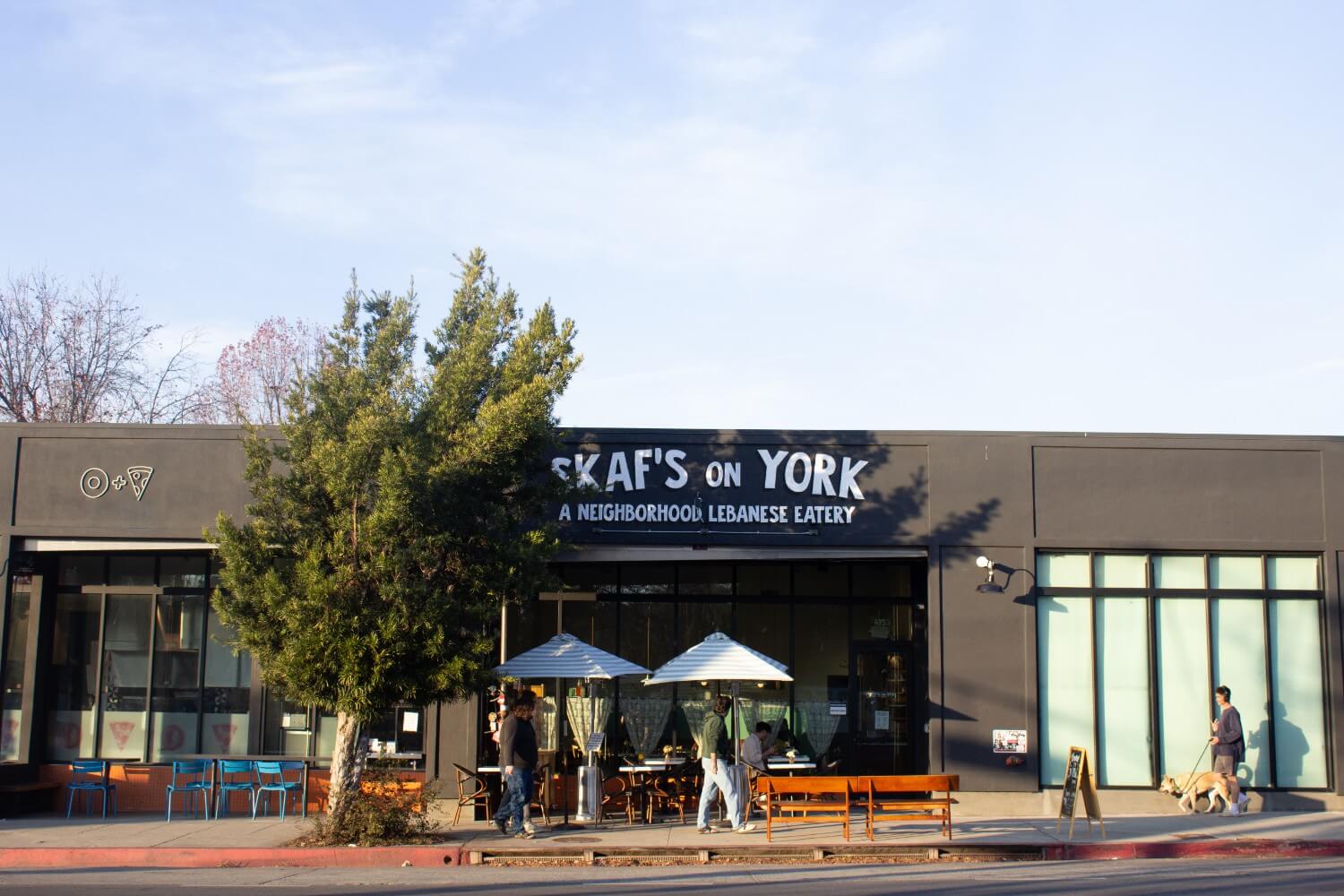
Skaf’s On York on York Boulevard in Los Angeles, CA. Feb. 1, 2025. Marty Valdez/The Occidental

According to Company, staff at Skaf’s focused on collecting emergency relief material such as food, clothing, hygiene products and other necessities, which were then donated to distribution centers around LA.

“During that time we had strangers drive by asking if they [could] help us take some of the goods over to the donation centers, which was amazing,” Company said. “We met people, we met new friends along that path.”

Sous chef at Queen St. Raw Bar and Grill Jennifer Velazquez said she started a donation program at her workplace, which aimed to distribute aid both to people who lost their homes in the fires as well as those helping with the cleanup of affected areas.

“A lot of the people risking their health to clean up after the fires belong to the undocumented community. We wanted to show our appreciation for them, so we ended up raising over $27,000 for the National Day Laborer Organizing Network,” Velazquez said. “It’s volunteer work, and they’re showing up to do it because they love and care for their community. That’s powerful.”

Velazquez said she and her coworkers at Queen St. felt let down by the way the authorities managed the fires but felt very proud of the way the local community responded.

“I’m from LA and people always claim that we don’t have a strong community here, that everyone is superficial and that no one really cares for each other. But with this program, everyone was jumping in to take action,” Velazquez said. “We do have a community, and it’s willing to help you out no matter what walk of life you’re from.”

Mask Bloc LA partnering with Vidiots to distribute masks to the NELA community in Los Angeles, CA. Feb. 1, 2025. Marty Valdez/The Occidental

Company said the outpouring of support from the local community had been almost immediate, as many people who had never been to the restaurant before came by to drop off materials to support fire victims.

“It was overwhelming at first because we hadn’t expected that level of support — but it was amazing,” Company said. “It just goes to show how willing the community here is to help each other out when things really get down to it.”

Contact Adam Pildal at pildal@oxy.edu.

Loading

Administration provides housing and financial aid in response to Eaton fire, damage assessment and response ongoing

Jan. 8, Occidental’s senior administrative leadership, headed by President Tom Stritikus, decided to close the campus for five days, a cautious measure in response to the nearby Eaton Fire. According to the California Department of Forestry and Fire Protection, the Eaton fire has been 100 percent contained as of Jan. 31.

Vice President and Chief Operating Officer of the college Amos Himmelstein said the decision was made partly because the administration did not want people connected to the school to commute around LA. He said the administration also wanted the campus to be fully prepared and clean for a safe start to the Spring semester. Additionally, he said the decision was easier to make because the campus was not in session, meaning a delay in course progression would not be an issue.

According to Himmelstein, the fires did cause some residual physical damage to campus, but this damage was minimal.

“It was really the debris that we were cleaning up,” Himmelstein said. “[A] couple of fallen trees, some other plants that were just blown around and some roof tiles.”

Himmelstein said the college contacted Servpro, a third-party cleanup company, for temporary support in campus restoration.

“There was just a lot of the campus to cover in a short period of time,” Himmelstein said. “We just wanted to make sure all surfaces were clean, that there wasn’t any ash around and that kind of stuff, so we called them in to do that.”

According to Himmelstein, the fires have been disastrous for some college employees.

“About a dozen folks lost their homes, and another dozen or so employees have been impacted [so] that they can’t be back in their house yet,” Himmelstein said.

In response, Himmelstein said the college has provided temporary housing to unhoused employees.

Himmelstein also said the administration started its own Emergency Relief Fund, which sent timely financial aid to those in the Occidental community affected by the fire.

“There were disbursements made the Monday following the fires,” Himmelstein said. “We moved pretty quickly on that.”

According to Himmelstein, the Emergency Relief Fund comprises donations and funds set aside in the normal operating budget in case of emergencies.

Director of Communications for the college Rachael Warecki said via email that, as of Jan. 24, the Emergency Relief Fund has raised over $100,000. Of this total, Warecki said over $80,000 has been given to faculty and staff.

Nora Kahn, the general counsel for the school, said via email that for employee financial relief, different departments in the administration collaborated to send different levels of money to those in need based on the extent of damages suffered.

“Human Resources and the Business Office really pulled this program together with incredible efficiency to bring our staff some relief,” Kahn said via email.

Lupe Salmeron, the controller at the college’s Business Office, said via email that the fund also gave dining hall meal credits to employees and their families.

During the closure, Himmelstein said the Emergency Response Team, which is responsible for handling campus emergencies, met regularly, sometimes twice daily, to discuss logistics and protocol in case the fire spread.

According to Himmelstein, the Emergency Response Team is now holding meetings to assess and improve current protocol for future emergencies and fires.

“[We discussed] what things we need to tighten up, what areas we need to improve on, what worked well, what may not have worked as well for an emergency response,” Himmelstein said. “That is ongoing.”

In particular, Himmelstein said the Emergency Response Team is working on an evacuation plan should fires break out during a campus session.

Interim Vice President for Student Affairs and Dean of Students Vivian Santiago said the school’s communications department played a key role in the response.

“Communication is critically important during any emergency and our colleagues in [the Office of Marketing and Communications] were very mindful of their important role to provide timely and accurate information to our campus community,” Santiago said.

Assistant Dean of Students for Emmons Wellness Center Devon Sakamoto said via email that the Emergency Response Team has also developed health guidelines for the campus, which are based on the LA County and California public health departments’ recommendations.

Sakamoto also said that some faculty have taken on individual initiatives to help the community recover.

“Lizzy Denny, Director of Project SAFE, has organized a hygiene product drive to benefit those impacted by the fires,” Sakamoto said.

In an email sent Jan. 13, President Tom Stritkus said he felt encouraged by the campus’s unity in the face of catastrophe.

“I’ve heard heartbreaking stories from those in our community who’ve lost so much, but I’ve been heartened by your desire to support one another,” Stritikus said via email.

Stritikus also said that the campus was never under official evacuation orders and that the academic schedule was set to run as planned.

Himmelstein said he thought the administration responded well but also that for those significantly affected, the college is willing to offer support to mitigate long-term impacts.

“We really feel for those who are majorly impacted,” Himmelstein said. “That is going to be a long haul for those folks, so even though we’ve pivoted towards the semester, we still have to really be mindful of the people who lost their homes or are displaced.”

He said that although the campus is back to normal, responding to the fires requires continuous support.

“It’s not over in that respect,” Himmelstein said. “I think that’s an important message that they don’t think that, ‘Oh, we’ve moved on now, and everything’s fine.’ For them, it’s not fine.”

Contact Noah Kim at nkim4@oxy.edu and Bennett Michaels at bmichaels@oxy.edu

Loading

‘Know Your Rights’ session provides Occidental community information on immigrant rights amidst ICE raids in LA

The “Know Your Rights” live session Jan. 29 provided students, employees and families information on understanding immigrant rights under the new presidential administration. The session, sponsored by the Office of the President, included three expert panelists from the LA area — Executive Director of the Coalition for Humane Immigrant Rights (CHIRLA) Angelica Salas ’93, President of and General Counsel to the Mexican American Legal Defense and Educational Fund (MALDEF) Thomas Saenz, and Executive Director of Gateway Cities Council of Governments Hector De La Torre ’89. Throughout the event, the speakers frequently alternated between English and Spanish.

The panelists talked about various ways in which immigrants can combat the fear that Trump is trying to push throughout the nation. Salas, Saenz and De La Torre focused on Trump’s recent executive orders, attempts to end birthright citizenship and the closing down of refugee entrance into the United States.

According to the panelists, the act of resisting all pressure and fear imposed by U.S. Immigration and Customs Enforcement (ICE) officials is crucial. Panelists said that regardless of someone’s citizenship, just being in the U.S., especially residing here for several years, makes them eligible for certain rights, such as the First Amendment, right to due process and right to an attorney after being detained.

According to Saenz, the Department of Homeland Security’s new directives, which strip schools and other locations such as churches and healthcare facilities of their sanctuary status, are particularly harmful for immigrants. Saenz said that every child has the right to attend K-12 grade without obstruction. While there is no right to attend higher education institutions, when students pay for tuition, Saez said, they have a contract instituted where they have the right to receive what they paid for.

Panelist Thomas Saenz at the “Know Your Rights” live session in Choi Auditorium at Occidental College in Los Angeles, CA. Jan. 29, 2024. Talia Goddard/The Occidental

Panelists also brought awareness to the rights that immigrants hold whilst encountering ICE, including the right to not open the door of one’s home for ICE without a warrant and the importance of an administrative warrant over a judicial one. They emphasized the right to remain silent and the right to not provide a signature for any form to reduce the chances of undocumented immigrants being coerced into signing voluntary departure forms.

“They lie all the time, from their uniforms to their forms, they lie all the time,” Salas said.

According to the panelists, ICE uses several intimidation and scare tactics to attempt to detain immigrants in public places and relies on collaboration with law enforcement officials to create a disadvantage for undocumented immigrants.

Salas said there are numerous resources available for immigrants, however, such as CHIRLA, which gives immigrants access to an immigrant assistance referral line and legal assistance.

“Every time that any government branch tries to say that immigrants do not have rights, we prove that they do,” Salas said.

Panelists Thomas Saenz, Angelica Salas and Hector De La Torre at the “Know Your Rights” live session in Choi Auditorium at Occidental College in Los Angeles, CA. Jan. 29, 2024. Talia Goddard/The Occidental

Hannah Lieberman (sophomore) said she resonated with the panelists’ emphasis on being brave in the face of law enforcement agencies.

“I found it particularly interesting that [Saenz], one of the speakers, put the responsibility [on the college] to be brave in this moment and to say to ICE officials and anyone trying to come on this campus, ‘This is not your place,’” Lieberman said.

The panelists said that knowing one’s rights is paramount for navigating issues such as what the next steps are for mixed status families in the state of California, what filling out federal aid forms is going to look like and fear of whether or not Trump’s rhetoric will cause private parties to participate in discrimination. The panelists said that a part of knowing an individual’s human, civil and constitutional rights is knowing how to exercise them and that constitutional rights are the same throughout the U.S., regardless of one’s city or country of origin.

Francisco Zamora, a facilities worker, said the session provided valuable information.

“They touched on a lot of important topics, and I think that it is going to help us all know our rights, which I personally did not know about,” Zamora said.

Nataly Mesinas (first year) said the session was clear and informative.

“It was really straightforward; they did not sugarcoat anything, and they mentioned the fear [many people feel] which is so true,” Mesinas said.

Contact Evelyn Almanza at ealmanza@oxy.edu

Loading