Home Blog Page 47

Opinion: Big tech has gone full MAGA — but why?

The date was Jan. 8, 2021. The U.S. was a mere two days removed from one of the most catastrophic events in its 250-year long history, in which pro-Trump protestors stormed the U.S. capitol in an attempt to overturn the 2020 Presidential Election. The event sent shockwaves through the nation, and the name “Donald Trump” was on just about every tongue in America.

Yet in the online sphere, the president was nowhere to be found.

It seems like a fever dream today, but four years ago, it was almost impossible to find any official social media presence for Donald Trump. Following the events of Jan. 6, Facebook, Twitter and Instagram — three of the largest social media platforms on Earth — banned Trump’s accounts. Discussion sites such as Reddit and Discord deleted communities that were centered around him. Even search engines such as Google got involved, removing far-right websites like Parler from their search results. In mere days, the sitting president’s online presence went from nearly unavoidable to practically nonexistent.

Of course, such a reality is no longer the case today. Following Elon Musk’s acquisition of Twitter in 2022, the website has undergone a host of changes that have made it nearly unrecognizable today. In addition to unbanning thousands of accounts (including Trump’s), Musk has fundamentally altered Twitter to ensure that the app represents his vision of “free speech.” Third-party fact checking on the app is gone, site moderation is barely enforced and the company’s trust and safety council has been dissolved. And with Musk, an outspoken supporter of Trump, in control of the website’s algorithm, Twitter has become the epicenter of right-wing content online.

Since Trump’s 2024 Presidential Election win, few of his allies have reaped the spoils of victory quite like Musk. In return for Musk’s colossal donations to Trump’s campaign, the president has essentially gifted Musk a spot in government through the Department of Government Efficiency (DOGE). The DOGE, named after one of Musk’s favorite cryptocurrencies, is a governmental entity headed by Musk that seeks to reduce wasteful spending within government and cut down on regulations that Musk and his team deem to be unnecessary. Musk’s position at DOGE also puts him in control of numerous government contracts — including those with his own companies. It’s a textbook conflict of interest violation, but it affords Musk what is essentially unchecked power, as the world’s richest man now has a direct line to the leader of the free world.

With Musk’s power rivaling that of Trump himself, other Silicon Valley billionaires have begun to take notice and have been attempting to work themselves into his good graces. Tim CookJeff Bezos and Sam Altman each made personal donations of $1 million to Trump’s inauguration. Even Mark Zuckerberg, who spearheaded the removal of Trump from social media years ago, has bent the knee to the new president, vowing to completely rework Meta’s social policy in a manner that mirrors Musk’s alterations to Twitter. It’s no surprise that Zuckerberg has acquiesced to Trump — the president has threatened Zuckerberg with life in prison for supposedly plotting against him — but Zuckerberg’s ideological 180 makes him look like more of a lapdog than a free speech crusader.

The reason behind the tech industry’s pro-Trump pivot is rather obvious — it’s what’s best for business. When Trump was ousted from office in 2020, the American public thought he was finished. The president ended his first term as an outcast, and tech companies simply went along with the popular opinion: wipe Trump off of their platforms and bring his era of influence to an end. With the U.S. — and much of the world — shifting to the right in recent years, tech companies have continued to do what they do best: whatever makes them the most money. And as Musk has determined, the best way to accumulate unchecked power in the United States is to cozy up to Trump, who takes no issue with providing personal favors to business magnates in exchange for their support.

In his farewell address to the nation, President Joe Biden warned of an oligarchy that was taking shape in Washington. The “tech-industrial complex,” as Biden put it, could have disastrous ramifications on the American public. Just five days later, the very same members of this supposed tech oligarchy took their seat right next to Trump’s cabinet picks at his inauguration. The symbolism was palpable.

Ultimately, this recent turn of events has provided a stark reminder to the American people: those at the top of the tech industry stand for nothing but their own preservation. America’s tech giants coalescing to kneel to Trump is certainly shocking — dystopian even — but it’s something that we as a collective must come to expect. The tech giants have made their true position known, so let’s take note.

Contact Mac Ribner at ribner@oxy.edu

Loading

From first game to final season, Lucy Worden and Jacob Hamermesh excel

Lucy Worden

Lucy Worden (junior), who has been playing water sports most of her life, walked on to the women’s water polo team this year after transferring to Occidental. In the team’s first game of the season against Carthage College Jan. 31, Worden scored three goals in the team’s 12-11 win.

“It was our first game of the season,” Worden said. “I think [there were] a lot of nerves building up to it.”

Despite adding seven new members this year, Worden said the team did a good job of controlling play for their first game together.

“It’s really […] cool that we were able to actually make some moves on offense knowing that we’re still kind of a new team,” Worden said.

Worden said that according to her returning teammates, the team has improved significantly compared to previous seasons. She said she has been able to make connections on the team very easily. After joining the team this year, Worden said that from athletics to academics, she’s improved in more ways than one.

“[It] makes you get all your ducks in order for the week,” Worden said.

Worden said water polo is a very team-oriented sport and that her teammates are very supportive of each other. Because of the tight-knit community, it often feels worse when you make a mistake, according to Worden.

“When you mess up, it’s really difficult to let it go,” Worden said. “If I make a mistake, I get really disappointed because I’m like, ‘Damn, I could have done so much better for my team.’”

However, she said no team member actually holds a grudge, especially since it was the first game of the season.

Worden attributes a lot of her success to her first-year coach, Coach Lindsey Garcia. Worden said the team rewatched the game film together, Garcia often pausing it and breaking down plays and strategies.

“[It’s] nice to hear it from somebody who really knows what’s happening,” Worden said. “I’ve never had a coach like this.”

Jacob Hamermesh

Breaking the men’s basketball school record with 13 assists in a Jan. 29 game at Whittier, Jacob Hamermesh (senior) has been putting in the work on and off the court. A 6’5” starting center, Hamermesh broke the standing school record of 11 assists, previously set by his very own coach, Brian Newhall ’83.

“I knew I had a bunch of assists, but I didn’t realize I had that many,” said Hamermesh.

Jacob Hamermesh (senior) at Occidental College in Los Angeles, CA. Feb. 4, 2025. Graham Jewett/The Occidental

Hamermesh said it is his first year starting on the team, but he has been playing his whole life. According to Assistant Coach Kebu Stewart, Hamermesh has been working tremendously hard from the basketball court to the weight room. Stewart said he attributes Hamermesh’s success to his confidence, his desire to win and his passion.

Stewart said that Hamermesh loves basketball, and his dedication to the sport and to his team has been paying off.

“He has all the things that it takes for him to be successful,” Stewart said. “I’m just there to make sure […] that happens for him.”

Hamermesh said he gives credit to his team and that it really was his teammates’ record, not his.

“They were just getting open,” Hamermesh said. “And I was giving them the ball.”

On the court, Hamermesh’s strengths are passing, knowing where his teammates are and making the right plays, Stewart said. Stewart saidHamermesh has a very high IQ and does not do things he cannot do. But according to Stewart, though, basketball is about more than just the game, and Hamermesh was not sure he would play this year.

“I try to teach him about life,” Stewart said. “I told him that you [have to] finish what you start.”

Stewart said the team respects Hamermesh on and off the court, as a player, as a person and as a leader. He said Hamermesh displays his leadership on the court with both words and actions.

“He’s not a guy that’s just a talker,” Stewart said.

Coach Stewart said it has been a pleasure working with a player like Hamermesh and that he deserves the record. Hamermesh has dedicated himself to having a successful season and the hard work has paid off, according to Stewart.

“He’s playing his best basketball of his life right now,” Stewart said. “If you can have 12 Jacob Hammers on a basketball team, you’re gonna be in good shape.”

Contact Amelia Darling at adarling@oxy.edu

Loading

Listening Impact Circles launch with hope of people truly listening

Listening Impact Circles, the first initiative of the Presidential Advisory Group for Community and Dialogue (PAGCD) established last fall by President Tom Stritikus, begin Feb. 12.

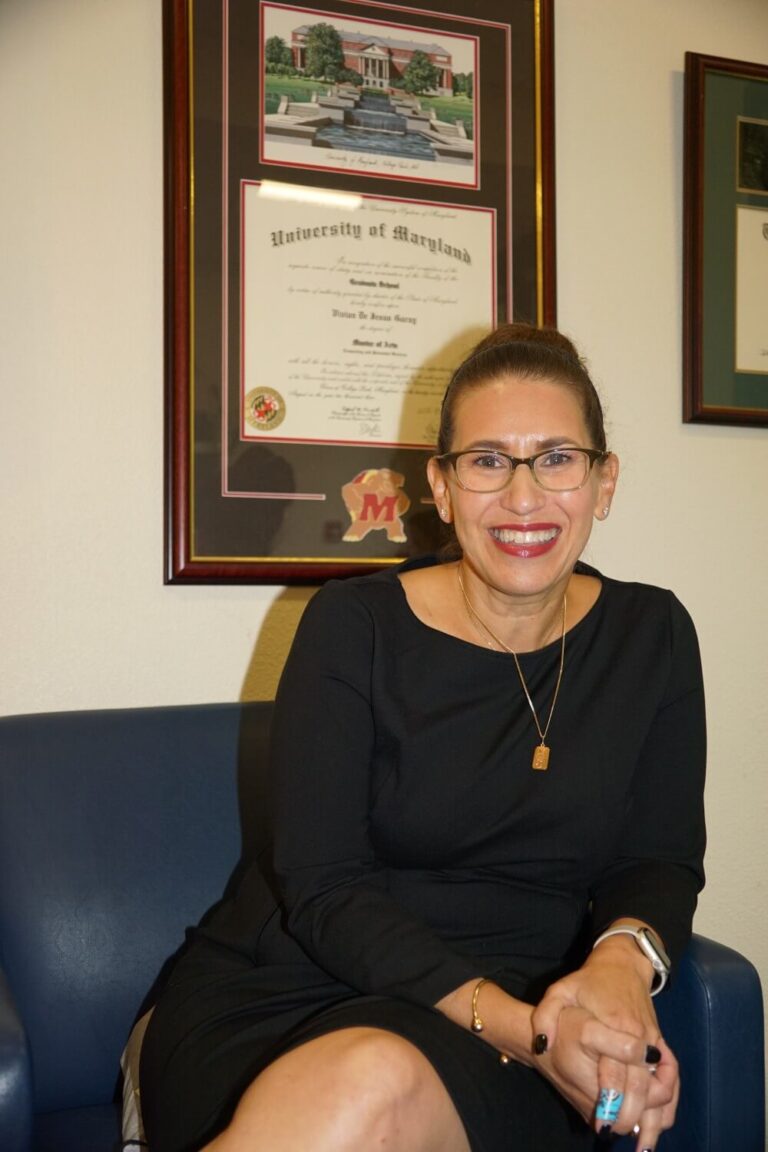
Interim Vice President for Student Affairs and Dean of Students Vivian Garay Santiago said these sessions were proposed to help develop spaces for dialogue and exchange of ideas and will be facilitated by external experts from Emerging Leadership Consultants (ELC), a third-party company that helps organizations create supportive working environments.

“[The goal is] learning how to really listen and talk to one another […] with empathy, and to see the humanity in one another. I think [we want] all of those things [to] kind of permeate,” Santiago said. “I think we are so much in our echo chambers that we’re not accustomed to listening to people. We hear people yelling at each other. We see a lot of this, but I think we are less practiced at really, deeply listening to one another.”

The PAGCD includes faculty, staff and student representatives and is one of the components of Occidental College’s Plan for Building Community and Promoting Dialogue — a proposal that aims to foster a safe environment for constructive discourse between members of the community. It was formed in response to rising tensions on campus from the Israel-Palestine conflict with the concept of restorative practices in mind. The group is co-led by Santiago and Interim Vice President of Academic Affairs and Dean of the College Catherine Leonard.

According to Santiago, the first Listening Impact Circle will feature three different sessions: session one with only faculty and staff, session two with a mixed group of students, faculty and staff and session three with only students.

Santiago said she recognizes that there are still unresolved tensions between students, as well as between students and staff, and that many are sensitive to the topics the Listening Impact Circles will address. Santiago said several students have told her it feels like there is a delicate layer of ice that has not yet been broken.

Santiago also said she recognizes many other programs on campus already hold space for similar types of dialogue but might not center restorative justice in the way the listening circles intend to.

Claire Kosek (senior), a student representative on the PAGCD, said that because Listening Impact Circles offer this restorative practice approach to dialogue, it might encourage students to engage in difficult conversations that they were not comfortable participating in before.

“The best way that our campus can facilitate change on the institutional level is to fund and design programming that allows students to have open dialogue,” Kosek said. “The idea of a listening session is not a novel contribution to campus but rather seeks to bridge the barriers that exist in terms of labor and cost.”

Tobias Lodish (sophomore), a student representative on the PAGCD and a member of Occidental Jewish Voice for Peace (Oxy JVP), said that although he agrees that there is not adequate dialogue among students who hold different opinions — especially on the topic of the Israel-Palestine conflict — it is due to lack of education around the topic and not because of a lack of space to talk about it.

“I don’t think anything bad will come from having these types of conversations,” Lodish said. “I just think […] it may be a misuse of limited time and resources that we have.”

Santiago said the committee seems to see great promise in the Listening Impact Circles and the PAGCD, even though the work is far from over.

“I’m optimistic,” Santiago said. “I’m hopeful that this could be a path forward for us, but it’s up to us collectively.”

Contact Felix Yi at fyi@oxy.edu

Loading

Aleem Hossain’s ‘Weird Short Films’ inspires discussion about technology and the future of filmmaking

Media Arts & Culture (MAC) Professor Aleem Hossain showcased “Three Weird Short Films” Feb. 6 to students, professors and Occidental community members at Choi Auditorium. A Q&A session followed the screening, moderated by Jonathan Wysocki, an award-winning local filmmaker, previous visiting professor at Occidental and long-time peer of Hossain.

Hossain said the short films are recent works, most of which were made during the pandemic as a creative break from larger-scale film projects.

“The through-line of these pieces is a real desire to experiment and work quickly,” Hossain said.

The films spanned a range of subject matter, from robots to astronauts to a pile of discarded VHS tapes. Hossain said that what makes these films “weird” is their experimental, process-based and non-narrative styles.

“I love the fact that these films are hard to categorize and are unusual in terms of what they’re about, how they’re made and how they use the cinematic form,” Hossain said. “I also use weird a little defensively, which is to say, I want to signal to my audience. I want to set their expectations.”

Played together at the screening, the films shared a run time of 20 minutes. Each combined elements of mixed-media photography, animation and AI generation.

Wysocki said he identified experimental and science-fiction qualities across all of the films and a contemplative undertone to Hossain’s work.

“I think that there are things [Hossain] wants to say about who we are now, but connected to who we were in the past, and I think all [these] films do that,” Wysocki said.

Professor Aleem Hossain in Weingart Hall at Occidental College in Los Angeles, CA. Feb. 4, 2025. Marty Valdez/The Occidental

As both creators and educators in the film sphere, Wysocki and Hossain’s conversation about the short films’ content and forms drove the post-screening Q&A. The discussion also focused heavily on Hossain’s most recent work of the collection, “Do Bangladroids Dream of Electric Tagore?” The film premiered last year at Fantastic Fest, the largest genre film festival in the country, and is currently on the festival circuit.

The documentary-style short illustrates a futuristic, dystopian neighborhood of New Jersey where “Bangladroids” populate the streets in varying forms of decay, reciting verses by the Indian-Bengali poet and philosopher Rabindranath Tagore. The film ends with a robot reciting Tagore’s poem “Freedom,” whose verses share familiar echoes to the ongoing debate about the use of AI in creative fields.

During the Q&A, Hossain said he created the film using open AI softwares Midjourney and ElevenLabs to generate animations and voice-overs. The work, Hossain said, was an experiment with AI in filmmaking.

“I consciously made the film not yet comfortable with whether we [as filmmakers] should use these tools at all,” Hossain said.

Hossain said he was open to disagreement regarding his choice to use AI, and voiced his own concerns about the AI debates surrounding the film industry, specifically around intellectual property and labor-related issues.

“I want to be a part of that conversation, right? But there is a risk,” Hossain said.

Alexia Lara (junior) said she had come to the event specifically to see “Bangladroids.”

“[Professor Hossain] had been mentioning these films in class, and I was specifically interested in the AI film because he mentioned that it was entirely made of AI and I just wanted to see what that would look like,” Lara said. “I think, as someone who wants to potentially be in the film industry, I’m also worried about AI.”

Hossain said he felt it was better to try to understand changes surrounding AI than to shun the technology as it advances. Working on “Bangladroids,” Hossain said, helped him gain some footing in AI practices.

“Now, having done it, I don’t have all my questions answered, but I now understand more what the tools can and will be able to do, which I do think puts me in a better position to think about, how do we respond?” Hossain said.

After the screening, Lara said it was interesting to see how a filmmaker could use AI as a tool.

“I think it just kind of put into perspective that [AI is] not necessarily a hindrance towards art but more so another tool, the same way a brush is to an artist,” Lara said.

Wysocki said experimental work is important in a field where feature-length, narrative blockbusters tend to steal the spotlight.

“I had my interpretation [of the films], which I shared with people tonight, but everybody in that room is gonna walk out of here with different ideas about what they thought or felt watching those movies,” Wysocki said.

Hossain said he plans to continue experimenting in his creative endeavors and with his students in the future. Hossain said he is hoping to teach a film class that will reckon with tools like AI.

“It’s like a class where we may all be skeptical,” Hossain said. “But let’s get into the muck, get a little dirty, and if we decide we want to wash off afterwards, that’s fine, but let’s play with it a little bit.”

Contact Molly Malin at mmalin@oxy.edu

Loading

Oxy Live! with Ed Ruscha provides Occidental students with artistic insights

Oxy Live! A Conversation with Ed Ruscha hosted by Paul Holdengräber centered around themes underscoring the artist’s work, which began with a career studying commercial art at Chouinard in LA. According to Arthur G. Coons Professor in the History of Ideas Amy Lyford, Ruscha soon became enmeshed in the burgeoning pop art scene, which investigated contemporary commercialism and the cultural and physical landscape of America.

“I encountered other towns too along the way […] that had kind of memories for me that were somewhat profound,” Ruscha said. “I thought I better make a story about this.”

According to Lyford, Ruscha’s examination of the overlooked world still has value for students of the arts today. Lyford said she hopes Ruscha’s art can inspire students to draw inspiration from the material of the world around them.

“[Ruscha had an] interest in focusing on the places that he lived and worked and recognizing that there could be a meaning and a critical value in looking carefully at things that many people would deem to be banal,” Lyford said.

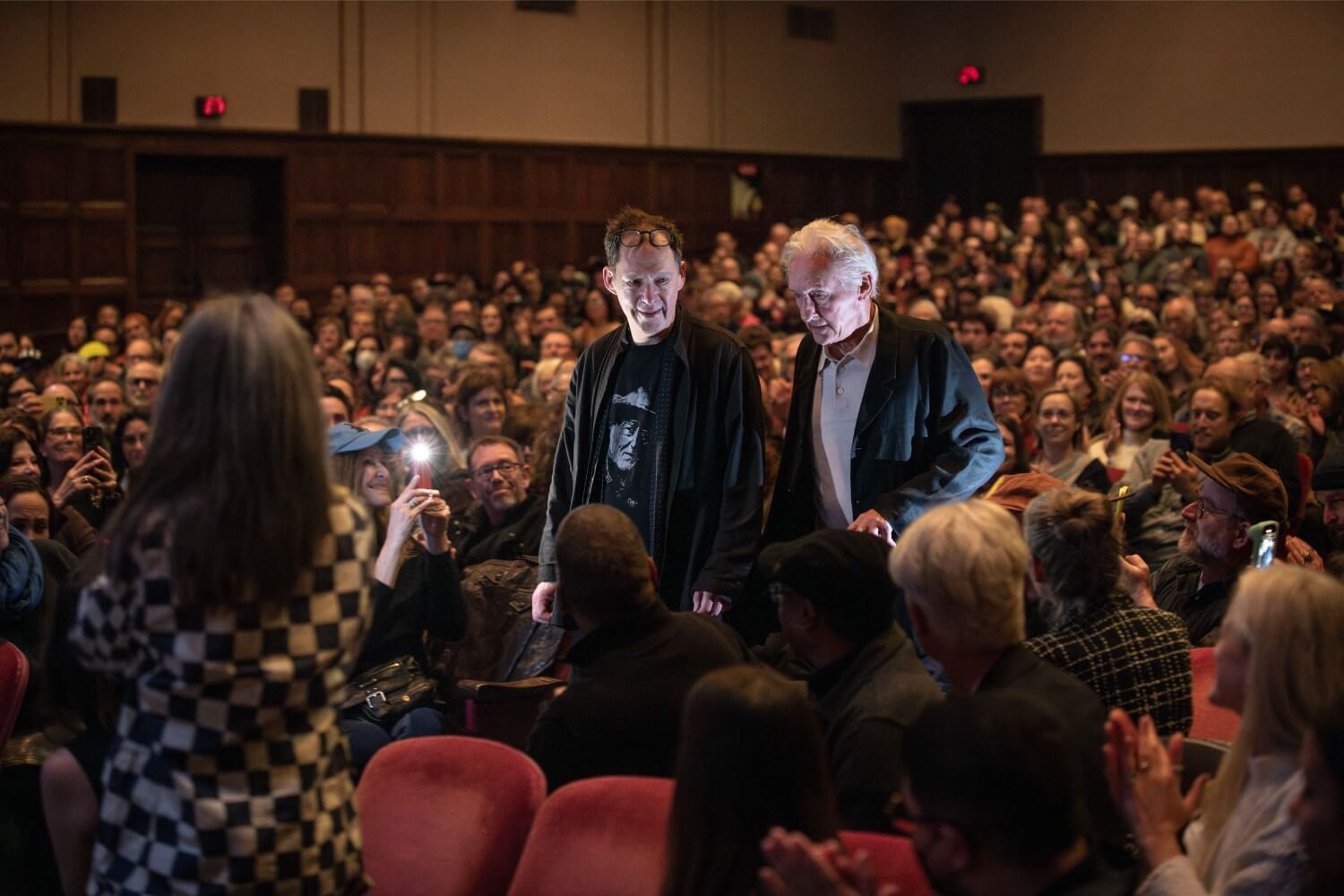
The Feb. 4 event began with an introduction by Ruscha’s grandson, Milo Ruscha (senior), followed by a clip from Holdengräber’s previous interview with director David Lynch in memory of his recent passing, garnering strong applause.

The talk began with both interlocutors sharing personal anecdotes of hitchhiking, Ruscha describing his engagement with the Americana of Route 66. They pivoted to an inquiry on where and how Ruscha draws inspiration, to which he brought up LA’s unique landscape and its idiosyncrasies –– such as a certain pothole on Sepulveda Boulevard.

“It was almost like a friend, you know?” Ruscha said.

Courtesy of Marc Campos

Holdengräber then asked Ruscha to elaborate on how phenomena such as the pothole have inspired the artist. Ruscha said his idea process is erratic and impossible to locate.

“[Ideas] jump on you like rascals,” Ruscha said.

Ruscha described his irritation when this pothole that had fueled his imagination was filled in by city officials. He said he saw this change, smoothing out LA’s peculiarities, as creating a jolting feeling. The two then touched on feeling a nostalgia for the changing city, with Ruscha wondering if all these changes will have rendered his work, firmly rooted in time and place, irrelevant.

“I guess my drawings are going to be obsolete,” Ruscha said.

According to Lyford, LA’s changing landscape can provide its residents with an evolving canvas to work with. Ruscha said he frequently returns to Sunset Boulevard to re-shoot his 25ft-long panoramic photobook, “Every Building on the Sunset Strip,” of which the Occidental Special Collections holds a 1966 original copy.

Despite repeated prompts by Holdengräber in regards to the meaning behind works such as “LA County Museum on Fire,” Ruscha did not elaborate.

“The message behind it; I don’t know,” Ruscha said. “I don’t know what the message is […] There’s not much to say about it. There it is.”

August Brown (first year) said the talk at times felt awkward due to Ruscha’s reserved demeanor. However, Brown said the conversations surrounding themes of learning to appreciate one’s environment for its prosaicness resonated with some students.

“You can see just a ton of [the environment], just in everyday normal life, like what seems to be mundane, or is mundane to some people, but there’s another lens […] it’s enriching,” Brown said.

Holdengräber ascribed Ruscha’s reticence to define his work.

“He wants to make the viewers of his work totally free. He doesn’t want to [define] because to define is to distrust,” Holdengräber said.

Despite feeling frustrated, Holdengräber said he believes this is who Ruscha is and part of what makes him such a compelling artist.

“I don’t think this is a persona,” Holdengräber said. “I think it’s actually the way he feels. I think he really does not know.”

During the conversation, instead of placing fixed meaning to his artworks, Ruscha talked about where he found inspiration for his pieces.

“Don’t overlook [your environment] just because [it has] been forgotten,” Ruscha said.

Holdengräber closed the interview by juxtaposing two Ruscha artworks, “America’s Future?” and “Better Things.” Holdengräber said he did not necessarily want to create a comment, but rather pose a question to the audience of students in regards to America’s future.

“All art comes out of other art, and artists are made up of things that they see out in the world,” Ruscha said.

Contact Harper Burton at hburton@oxy.edu

Loading

‘An act of self-love’: Real Talk Series focuses on Demystifying Grief

“Grief looks different for everyone — your relationship with grief does not have to look like someone else’s.”

Along with coming in with an open mind, this was one of the community agreements participants read at the first event of the Real Talk: Demystifying Grief series, a conversation-based program facilitated by the Office of Equity and Justice.

Andrew Guerrero, the college’s Justice, Equity, Inclusion and Diversity (JEID) education specialist, is leading the series, which will take place four more times throughout the spring semester. Guerrero said the series is inspired by a program they attended at the University of California Irvine, where faculty, staff and students came together in meaningful and vulnerable ways. Guerrero said this semester, they decided to focus on grief.

“We just had the wildfires that impacted a lot of people’s communities,” Guerrero said. “I know so many people who have been impacted, and with everything else going on geopolitically, I think a lot of folks might not have had the opportunity to grieve or to think about what grief is open to.”

Director of Counseling Services at Emmons Wellness Center Alejandro Aguirre said he is co-facilitating the programs to provide clinical support and that part of the series is expanding and unpacking our own perceptions of grief.

“Yes, we can grieve people we lose who are no longer here, but also relationships, belongings, phases of ourselves,” Aguirre said. “Grief can be fluid, and there’s no progression around it, but being able to come together in community can allow us to feel connected when we are going through difficult times.”

Disclaimer and community agreements of “RealTalk Series: Demystifying Grief” in Lower Herrick at Occidental College in Los Angeles, CA. Feb. 4, 2025. Addie Fabel/The Occidental

Participants sit in a circle in Lower Herrick and engage in open conversation, according to Guerrero, with some questions and prompts passed out related to that week’s theme. The first event of the series was titled “Decolonizing Grief,” and upcoming topics include “Ancestral Grief,” “Vicarious Grief,” “Compassion Fatigue” and “Disenfranchised Grief.”

“I felt like ‘Decolonizing Grief’ was important to start with because it gives some foundational context of where we are as a society when we think about grief. Sometimes we think about it as being a linear thing,” Guerrero said.

Marty Valdez* (first year) is an Equity Ambassador for the Intercultural Community Center and assists with the Real Talk series this semester.

“I think it’s just a great space to unwind and think about things in our lives that we don’t often get to think about,” Valdez said via email. “The last talk was about ‘Decolonizing Grief,’ so just being able to learn about other cultures and their traditions and the history of it […] it really is just a space to learn more about yourself and others and connect too.”

Guerrero said the next session on “Ancestral Grief” will focus on generational trauma that may not be fully processed or talked about. The “Vicarious Grief” and the “Compassion Fatigue” sessions, Guerrero said, will include discussions on how people’s trauma and loss are easily consumed in the era of social media.

“We can sometimes become numb with all the information and all the grief that we’re holding,” Guerrero said. “We’re just always impacted by grief from multiple people, by multiple institutions at once, and we can become so desensitized that we don’t get to process.”

Aguirre said, as a clinician, he believes talking about certain topics in community can be healing and facilitate processing.

“I think about grief, depression, anxiety, stress; sometimes some of those things can be well served in group format because they tend to draw strength by isolating us,” Aguirre said.

Valdez said for him, it can be powerful to think about grief.

“It gives one the chance to reflect and pick up things that we often put away in ourselves because the wave of life washes over us,” Valdez said via email. “I was thinking about all the different griefs I had in my life, the last session, and feeling the emotion again, even though it’s negative, makes me feel very human again.”

Guerrero said the program can give people the tools to have hard conversations on a college campus and not to rush to label or antagonize people when something problematic is said.

“It can just mean this person didn’t have the tools or the knowledge to know that was problematic,” Guerrero said. “I think in spaces like this where people are invited to be really vulnerable, it gives people permission to mess up and it gives them permission to learn from those mistakes.”

Valdez said it is a very supportive group.

“I think it’s also another great space for [Black, Indigenous and People of Color] and [Women of Color] to come and build community in a [Predominantly White Institution],” Valdez said via email.

Both Aguirre and Guerrero said they want people to know there is no pressure to be front and center during these conversations. Guerrero said they encourage people to lean into the discomfort, and Aguirre said it can be an act of self-love to enter the space. Valdez said he encourages those who are hesitant to come to try it out.

“The worst thing that can happen is you eat pizza or make a few friends, but who knows, it can be a serious life experience for some to rethink how they think about themselves and the world in terms of one’s emotions,” Valdez said via email.

The next event in the series will focus on “Ancestral Grief” and will take place from 6:30 p.m. to 7:30 p.m. on Feb. 18 in Lower Herrick Chapel.

*Marty Valdez is a photographer for The Occidental.

Contact Ava LaLonde at lalonde@oxy.edu

Loading

Artist of the Week: Crochet artist Syd Neff stitches together community

Syd Neff (senior) said he first picked up the art of crochet in the spring of his first year at Occidental when he was drawn to a bok choy stuffed animal that his hall mate, Talise Snyder (senior), had crocheted. Now, Neff said he is in his second year producing Occidental’s student-run fashion show, where he incorporates his unique crochet skills into the world of design.

“[He] very quickly took [crochet] and ran with it,” Snyder said. “I think one of [his] very first projects [he] made was this awesome bag, which is definitely a larger scale than anything I attempted when I was first learning.”

Snyder said in terms of crochet skills, Neff has learned more complicated techniques and can execute cohesive, larger projects. Neff said he has not only crocheted many more stuffed animals and garments, but has also shared his passion with the community.

“I’ve done crochet commissions, primarily stuffed animals and some hats as well, for almost all of my coworkers in the dining facilities,” Neff said.

Along with personal commissions, Neff said he has also sold his crochet work at the Los Feliz Flea Market, Silverlake Flea, Long Beach Antique Market and several on-campus flea markets.

“I had a lot of bigger days here [at Occidental] than I had at any of the other large city-wide flea markets in terms of the profits and engagement,” Neff said. “Some of the best engagement I’ve ever gotten was from doing the flea markets on campus.”

Despite Neff’s success in selling his crochet pieces, he said the real transaction is the joy it brings him to see people style his garments or to see a child’s reaction to having a crochet stuffed animal.

“For me, it’s really developed more into how I can get my work to be seen by people, and that is fulfilling enough for me,” Neff said.

Crochet pieces by Syd Neff (senior) in Booth Hall at Occidental College in Los Angeles, CA. Feb. 6, 2025. Isabel Marin/The Occidental

Neff said he has found himself going between two realms of crochet art — either creating stuffed animals or crocheting fashion garments and accessories.

“Even if you’ve been doing it for a lifetime, which a lot of people have, you will never run out of new things to learn and new techniques and styles,” Neff said.

Neff said he is trying to create more garment pieces, similar to his crochet feature included in the 2024 student-run Flaneur Fashion Show. Neff said he created a crochet weapon-inspired garment for Chantell Thompson’s (senior) fashion brand, Kusari Gama.

“One of the final looks we did was inspired by Gogo Yubari from Kill Bill,” Neff said, “I had one of my best friends, Jai English [’24], come out on the runway with it, drag it behind her and swing it around. It was the coolest thing ever.”

On the fashion side of crochet, Neff said one of the biggest supporters of his creative work is his friend Shae Campbell (senior), who was inspired by Neff to begin crocheting themself over winter break.

“When I came back, Syd and I would sit and crochet with each other. [He] taught me how to do the magic circle so that I could make hats,” Campbell said.

Campbell said they were amazed by Neff’s ability to make beautiful sculptural pieces.

“[His] talent has no bounds,” Campbell said. “I really think that the way that [he moves] through the world is just inherently artful. [He sees] the beauty in the most mundane things and [transforms] it with [his] creativity.”

As a music production major, Neff said he often places grandiose expectations on himself and his art, feeling the pressure to live up to the standards he sets for himself.

“I was questioning my ability to be a musician and an artist,” Neff said.

Neff said the sense of fulfillment he experienced upon finishing his crochet projects became, during that period, a replacement for the creative outlet he was missing.

“My goal for the future is how can I incorporate crochet into my multidisciplinary goals?” Neff said. How can I incorporate it with music? How can I incorporate it with fashion, with everything I love?”

Neff said that to him, crochet art is not merely a business but also a passion that he has developed an attachment to.

“It’s very labor intensive. It takes a long time,” Neff said. “But it’s a labor of love.”

Contact Amelia Gehlhaus and Ellie von Brachel at gehlhaus@oxy.edu and vonbrachel@oxy.edu

Loading

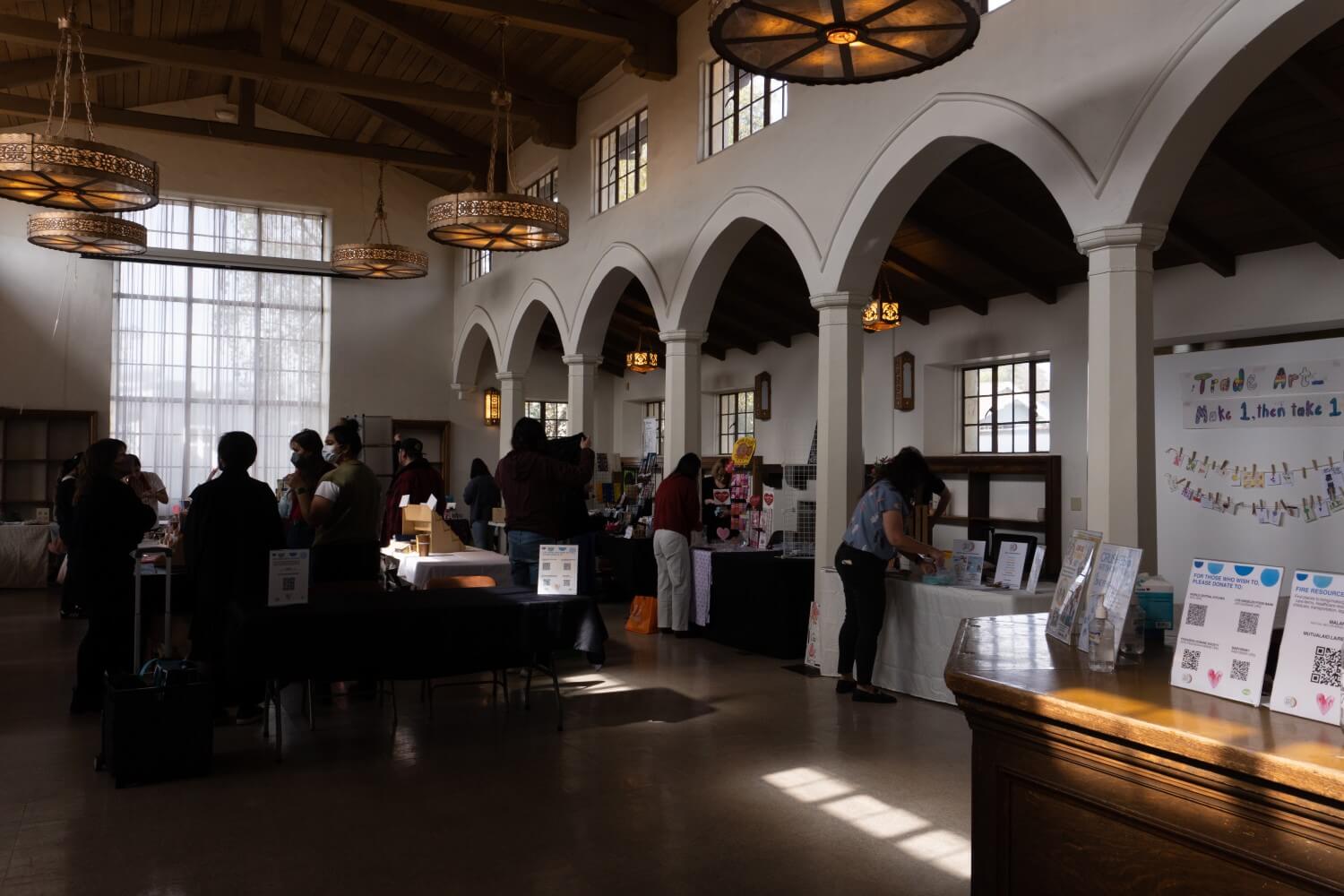
The LA zine community finds love at Crushes Art Show & Zine Fest

Center for the Arts Eagle Rock (CFAER) hosted artists as they displayed laminated, printed, cut and folded mixed-media zines Feb. 8. According to Events Coordinator Melinda Ann Farrell, this is the second year that CFAER has hosted their Crushes Art Show & Zine Fest, which invites artists from around the community to showcase their work.

“It’s open to everybody,” Farrell said. “Zines are just a wonderful vehicle for people to express themselves.”

Miquela Davis, the arts education coordinator at CFAER, said the center experienced emptiness in the post-COVID years, so she wanted to implement more events open to the community. According to Davis, zine festivals have an accessible, DIY feel that encourages everyone to try creating a zine.

Davis said she first thought of the idea for Crushes in 2018 and wanted to give the community a space to hang out and not be alone on Valentine’s Day.

“It celebrates love overall, and bringing that love to your community,” Davis said.

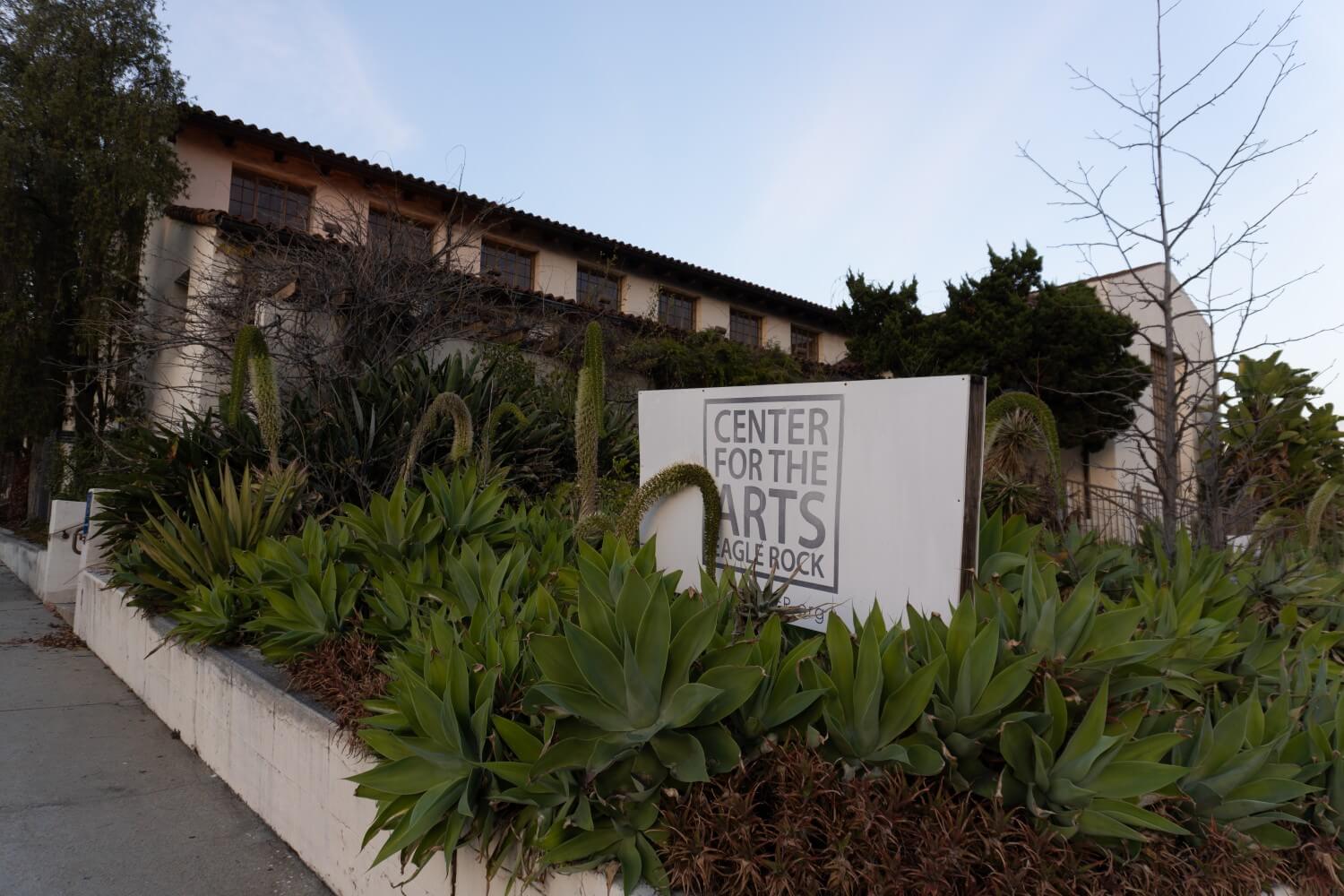
Center for the Arts Eagle Rock in Los Angeles, CA. Feb. 8, 2025. Abigail Montopoli/The Occidental

To become a vendor at the Crushes Art Show & Zine Fest, applicants submitted samples of their artwork to demonstrate how they apply to the show’s conceptual theme of love, according to Davis and Farrell. Davis said the administration makes an effort to fit in as many artists as they can.

Farrell said she wanted the festival to serve as a safe place for people enduring hardship. She said the event donated proceeds and artwork from the festival to mutual aid benefitting those affected by the LA County fires.

“So what can you do? Meaning the universal ‘you’ – us,” Farrell said. “What can we do to help people feel safe and give them joy while [the fires are] happening?”

According to Farrell, community events such as these allow new artists to introduce themselves to the community and build their portfolios.

“It’s an honor having artists come in and share what’s meaningful to them with you,” Farrell said. “And then you in turn are sharing it with the community.”

Zine Fest at the Center for the Arts Eagle Rock in Los Angeles, CA. Feb. 8, 2025. Abigail Montopoli/The Occidental

T Torres, part-time artist and founder of Goopy Banana Co, said their simple illustrations of recurring heart characters resonated with their audience through a theme of connection.

“It’s a reminder that things are finite,” Torres said. “You may not have a lot of time with people, so enjoy it while you can.”

Rebecca Ustrell, mixed media artist and founder of Curious Publishing, exhibited her first solo collection of pieces at the Crushes Festival. According to Ustrell, her solo work focuses on age and loss, whereas her work in Curious Publishing emphasizes empathy, activism and social justice issues.

“If I had two exhibitor spaces, they would probably have two completely separate identities,” Ustrell said.

Ustrell said for the Valentine’s Day theme, she chose to embody self-love rather than romantic love. While she explores more external social justice issues in her work with Curious Publishing, Ustrell said she is able to be more introspective in her personal work.

“I find making zines and my art practice as revisiting myself,” Ustrell said.

Denise McKinney, an artist from Southern California, said she bridges the gap between local history and vintage restaurants in her zine “Eat Me.” McKinney said her zines fit the theme of Valentine’s Day as love centers around food and food centers around love. According to McKinney, feelings around food and love are not exclusively positive or negative.

“You can go out to eat on a date, and then the date’s terrible,” McKinney said. “But you’re going to remember what you ate in the restaurant.”

Stephenson Muret, zine artist and author who goes by John Dishwasher in his artistic practice, collects and redecorates vintage zines in addition to his original creations. A particular Valentine’s-themed vintage zine Muret displayed was “How We Kiss.” Muret said the zine is about the difficulty of navigating nightlife as a queer person.

“If you’re in a nightclub, straight people can kiss on the dance floor, and it’s not a problem, but if you’re queer then it becomes a problem,” Muret said. “This is about being able to express love openly with whomever.”

Rachel Curry is an artist and art educator who displayed her zines at the festival. Curry said she met her wife at the LA Zine Festival and that the zine community has been an open and welcoming space since she started creating and displaying zines in 2013.

“You’re literally putting your heart on the table,” Curry said. “There’s barriers for who can be an artist or what is good art, and zines are all about embracing the imperfection […] As long as you’re making something with your heart, that’s art.”

According to Torres, Instagram remains a popular vehicle for the arts and zine community of LA, providing networking opportunities and growth of their personal brand.

McKinney said that, even in the growing digital age, preserving and appreciating physical art is vital.

“It doesn’t hurt to have a physical copy. You’re holding it in your hands, it’s a different feeling,” McKinney said. “A lot of people never experience that, or they haven’t had the chance to miss that yet, but they will.”

Contact Lucinda Toft at ltoft@oxy.edu.

Loading

Guitar teacher Nils Bryant helps students find their joy in music

Within the hills of Mount Washington sits the studio of local musician and guitar instructor Nils Bryant. Bryant said he has called LA home for the past 17 years since moving from Amsterdam, where he first developed his love for guitar.

Bryant said he was initially attracted to the LA music scene because of the endless opportunities it presented to connect with other musicians and promote his work as an artist. Bryant said while many aspiring artists are pulled in by LA’s promises of fame and grandeur, he was more intrigued by the close-knit community of smaller artists that exists in the city.

“I think a lot of the beauty in music and the real way of connecting is actually on a much smaller, much more local level, and I really quite appreciate LA for that,” Bryant said.

Bryant said he was able to develop his teaching style early on when he was offered his first job immediately after graduating high school.

“I started teaching in high school back home because people realized I could play guitar,” Bryant said, “I was lucky, I went [to] a high school where music was very much a big part of school and extracurriculars […] shortly after high school, the teacher I was with at the time was like, ‘I need a break, you can have my job,” Bryant said.

Bryant said he was only 19 years old at the time and had planned on continuing his studies at a music conservatory. Instead, he took advantage of the opportunity to teach and began his career as an instructor.

“I [taught at] some music schools, but I’ve always been doing private [lessons],” Bryant said. “My first students were just [from] Craigslist and some word of mouth, and that just grew.”

Nils Bryant working on editing his music in his studio in Eagle Rock, CA. Feb. 7, 2025. Marty Valdez/The Occidental

According to Bryant, he offers guitar lessons at his studio to musicians of all levels but finds that his clientele consists mostly of adults searching for a way to get back into playing.

Jules Desmond said he currently takes guitar lessons with Bryant. Desmond said that Bryant possesses unlimited knowledge of every aspect of music, be it theory, production or performance.

“I like him because I was looking for someone who could not only teach guitar technically, but I wanted to learn more about theory as well,” Desmond said.

Desmond said that while taking lessons he has been able to explore numerous genres of music, such as blues, rock and country. Desmond said he admires Bryant’s unstructured approach when teaching and his ability to meet students where they are.

Irene Potter said via text that she is a current guitar student of Bryant’s. Potter said studying with Bryant has allowed her to build her confidence as a guitarist, as he is a very encouraging teacher.

“What I like about his teaching style is that he’s very patient and student-centered,” Potter said via text. “He tailors his teaching to each student’s goals, timelines, abilities and learning styles.”

Bryant said he approaches teaching with a sense of humility and an open mind, eager to learn from his students as much as they learn from him. He said he uses his music as a form of communication that can build and develop bonds between him and those that he works with.

“[Music] is ultimately a language. It’s a way of connecting, and it doesn’t have to be a very specific thing because that only limits you,” Bryant said. “If you’re a bit more open minded and say yes to things, that’s generally quite healthy.”

According to Bryant, because music is such an uncertain field, being a jack of all trades has been his key to finding success. Bryant said he aims to share that versatility with his students.

“It is fairly well known that most musicians are not just musicians, they also do everything else around it,” Bryant said.

Nils Bryant’s guitar collection in his studio in Eagle Rock, CA. Feb. 7, 2025. Marty Valdez/The Occidental

According to Bryant, a musician is most successful when they are well-organized and efficient in areas aside from creating music. Additionally, he said it is most important for them to love the music that they are creating, whether they are pursuing a professional career in music or not.

“Obviously all musicians, ideally what they would do all day long is the music part,” Bryant said, “But for a lot of us that is not necessarily reality.”

Desmond said he has found a sense of peace within the music he creates, even though he does not intend to pursue guitar professionally.

“I’ve always been around music, so it’s that sense of home and peace for me,” Desmond said. “It’s a very personal thing and it allows me to switch off.”

Bryant said he has helped his students find the joy in the process of making music and created an environment in which they want to push themselves out of their comfort zones to hone their skills.

“The more you learn, the more you know that you don’t really know anything. There’s all of these rabbit holes that you keep falling into or things you rediscover,” Bryant said. “It’s a lifelong journey, and it’s not meant to be anything else.”

Contact Amalia Rimmon at rimmon@oxy.edu.

Loading

Opinion: The impending doom of journalism under the Trump administration

Every day, I wake up, check my phone and learn about another one of Donald Trump’s insane decisions as president: banning transgender women from sports, ICE raids, pulling funding from USAID, slashing the budget from the Department of Education, etc. Now, not only will Trump affect the policies that uphold our nation, he will affect how we receive news about it.

Feb. 1, the Pentagon announced a new media rotation program under the Trump administration — meaning news sources such as The New York Times, NBC, Politico and NPR have lost their dedicated media offices in the Pentagon — making space for news organizations such as the New York Post, Breitbart News, One America News and HuffPost. This “rotation” is the first time a president’s administration has had this amount of authority over the press that reports directly to the Pentagon.

Harvard Research made a graphic showing news media across the political spectrum and how left or right politically a specific source may skew. For comparison, sources like The New York Times and NPR skew more left on the scale, while sources like the New York Post and Breitbart News show a strong skew to the right. Politico and NBC lean to the left but are deemed more centrist.

It is rumored that this media rotation has stemmed out of negative portrayal of Trump’s allies, such as Pete Hegseth, who the Senate confirmed as the Defense Secretary just seven days before the decision. His confirmation hearings consisted of weeks of press about his alcohol consumption and misogynistic behavior towards women.

The motivation behind this media rotation is clear: President Trump’s administration is opting for right-leaning news organizations to be the main reporters in the Pentagon so his decisions look more educated and approved and so his followers in the government can look better. All of those people who were undecided about Trump during the 2024 election will not understand the sinister nature of his new policies, because the news we will receive from the Pentagon will all be right-wing. These right-wing sources will further the narrative that Trump has America’s best interests in mind without space for critique.

Trump’s next four years will prove to be detrimental for journalism. Journalism has already had its blatant struggles as the increase of intense polarization separates our nation. Social media has contributed to the spread of false information, and it spreads at a rate far faster than any newspaper could generate new stories. It seems as though the stories people care about right now are the ones that will make them angry, and they get pigeonholed into an algorithm that justifies their fears and doesn’t show them any other side. Trump has a history of fear mongering, and his supporters are showing up for him. But without proper reporting on Trump’s new actions, the dangers of this new administration can be easily overlooked by the public. As the past decade has furthered polarization and fake news, accurate and unbiased reporting on our national government will be more important than ever.

Certain parts of our news industry will have to change in order to ensure journalism remains accessible during this administration. A good start would be removing paywalls entirely. While news sites must make money in order to function, paywalls over important information are the last place they should start in order to do so. While researching why paywalls exist, I came across an article from The Atlantic called Democracy Dies Behind Paywalls, which I could read for a few grafs until — you guessed it — a paywall stopped me from continuing. We will never learn how to build a stronger system if our information has a financial incentive.

The pressure is not entirely on the news companies. The general public must be more cognizant of the media they are consuming and understanding where fallacies lie. With Elon Musk in charge of X (formerly Twitter) and Mark Zuckerberg in charge of Meta (Instagram and Facebook), their support for Trump will inevitably impact social media content — and it already has. NBC wrote how Musk’s control of X has turned it into an echo chamber for Trump supporters, working with the Trump campaign during the election and promoting AI-powered conspiracy theories. There’s responsibility on the consumer to take a critical eye to everything they see online — no matter how much it aligns with one’s views.

News organizations like The New York Times, The Washington Post and CNN will not go away. Trump’s move simply doesn’t give them a desk to report from in the Pentagon. Sure, his move may be symbolic, but it illustrates a larger issue — Trump will not be afraid to take control of the media by any means necessary. And, with billionaires and right-wing media on his side, there’s no clear sign of stopping.

Contact Eliana Joftus at joftus@oxy.edu

Loading