Home Blog Page 45

Not Another Pottery Studio molds ‘a family environment’ for Northeast LA

Kindness, cleanliness and a creative community are the core values of Not Another Pottery Studio (NAPS), owner Lauren Allison said. NAPS, which opened on Eagle Rock Boulevard July 2, 2024, currently offers over 100 glazes and underglazes and supports six to seven different clay types, Allison said. According to Allison, NAPS offers memberships, classes, workshops and paint-your-own pottery classes as well as private and community events.

“I felt like there needed to be a place for people that had a low barrier for entry and was more inclusive for [people] to come do pottery,” Allison said. “I was looking [for] anywhere in the Northeast LA community because it [is] so vibrant.”

Owner of Not Another Pottery Studio Lauren Allison in Los Angeles, CA. Feb. 12, 2025. Addie Fabel/The Occidental

Allison said she opened NAPS after feeling like there was a need in NELA for a community pottery studio. She said she had been looking for a space for about two years until she landed on Eagle Rock. Now, Allison said NAPS offers community days where anyone can come in and try working with clay.

“We move two of the wheels into the windows and anyone [can] come in, any age, any ability,” Allison said. “One of the instructors will sit with them and, in fifteen minutes, get them from a tiny ball of clay to a bowl.”

According to Allison, on these days people can also come and try a hand-building activity, which normally consists of decorating an ornament.

“We really [want] this to be a community space, so we run free community events where people can come in and try things,” Allison said.
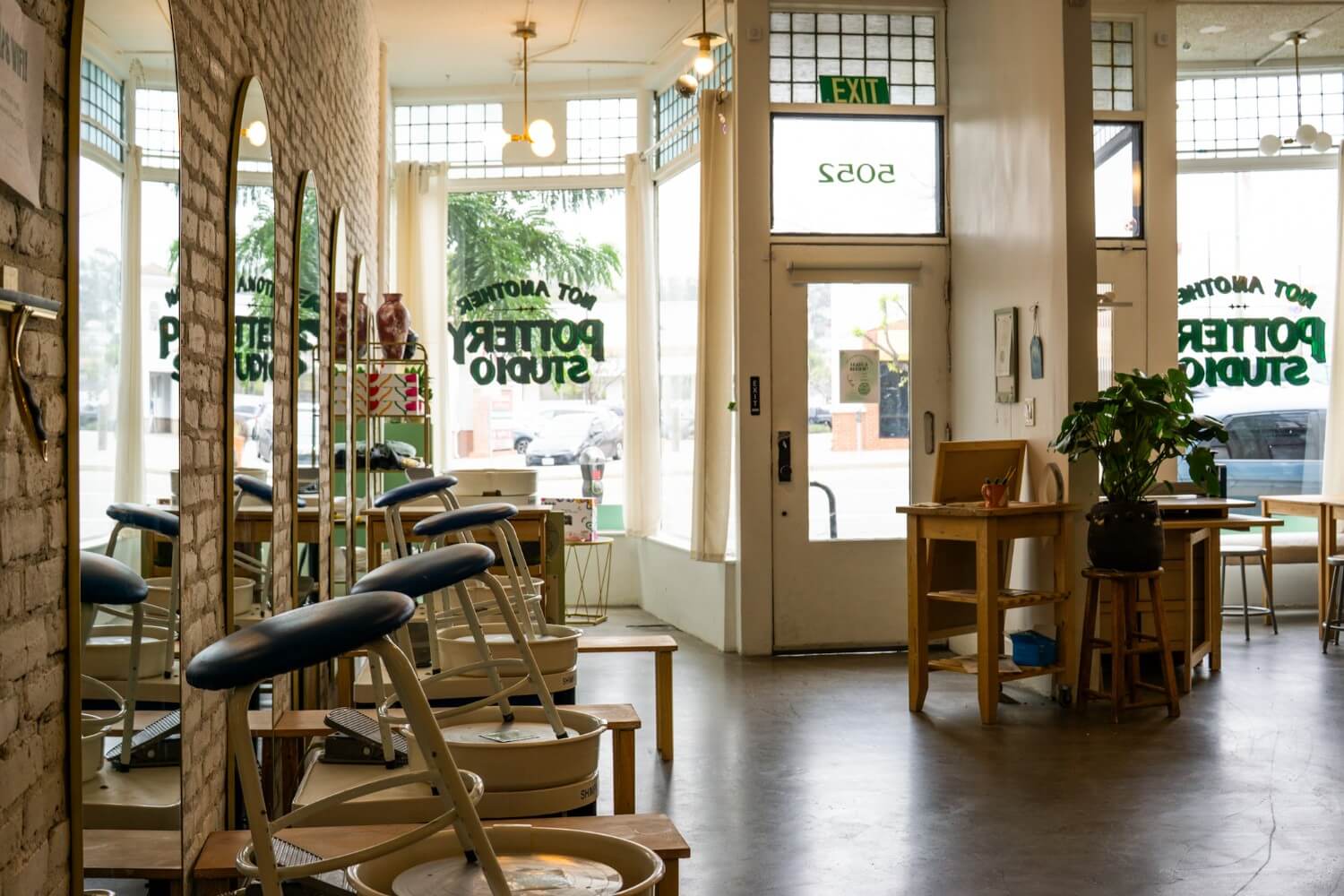
Interior of Not Another Pottery Studio in Los Angeles, CA. Feb. 12, 2025. Addie Fabel/The Occidental

According to Allison, members work on projects and classes occur throughout the week, except Mondays. Mondays, Allison said, are reserved for deep cleaning the studio, as the dust and residue from clay can be dangerous for people’s lungs.

According to Allison, during the recent LA fires, NAPS also opened its doors as a day shelter. Allison said NAPS had both electricity and air filters, which were not running at many places nearby. NAPS was open to the community for four to six hours a day for the first two weeks after the fires, and Allison said they offered a place for people to charge their phones, fill their water, grab a snack, play with clay and — most importantly — have a place to gather.

“Every single spot in here [had] people together. Some of them had lost their homes. Some of them were waiting to find out. Some of them had lost their schools,” Allison said. “They all were able to talk and process together while they built things with their hands.”

According to Allison, 400 pieces were created during these community sanctuary days.
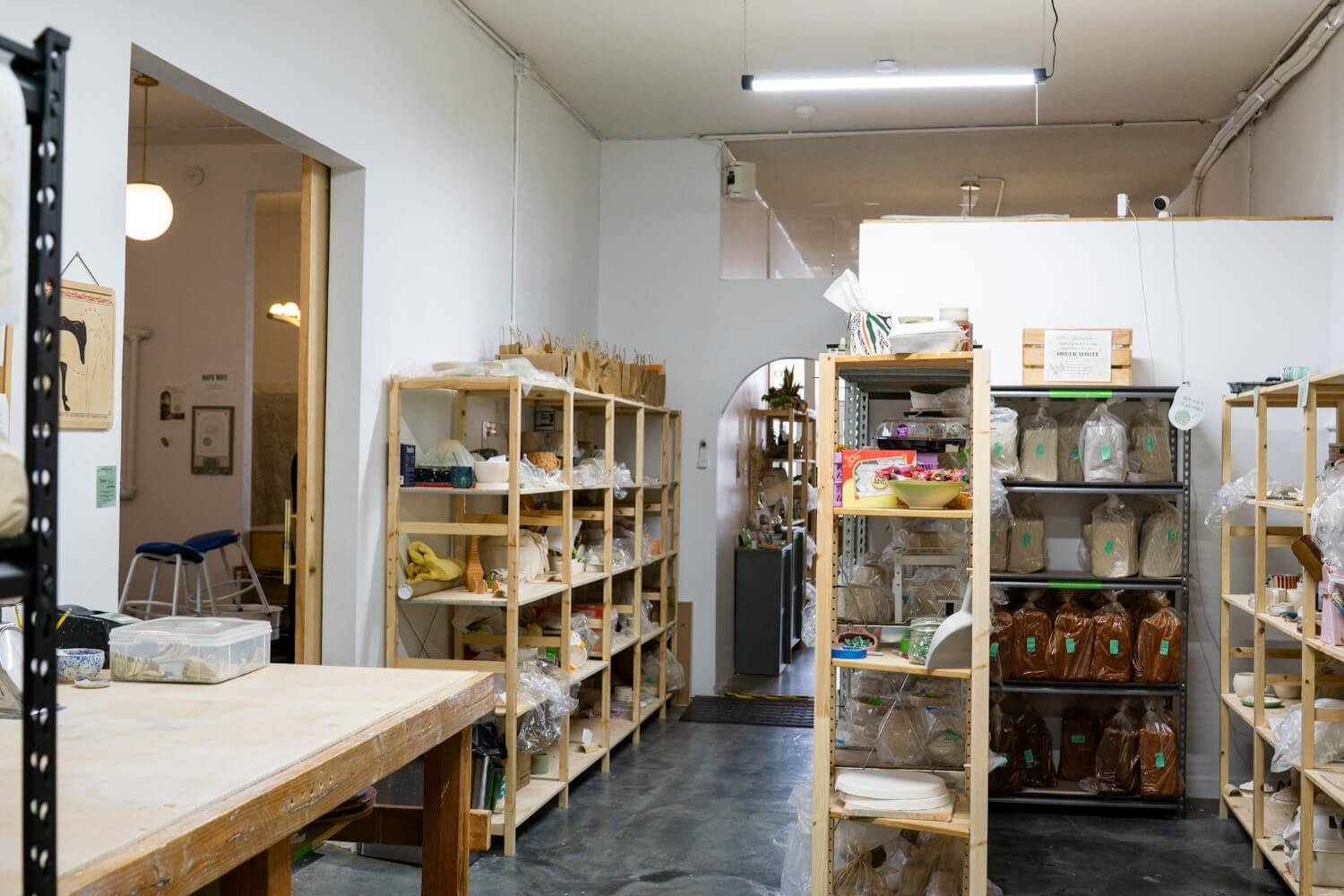
Interior of Not Another Pottery Studio in Los Angeles, CA. Feb. 12, 2025. Addie Fabel/The Occidental

Sal Treviño, a member at NAPS, said he has been a resident of Eagle Rock since 1978. He said he is grateful and honored to be a member, especially because of the community sanctuary days NAPS hosted.

“I always thought that was so selfless of [Allison] and the staff,” Treviño said. “Those fires affected all of us in many ways, but they took the time to help anyone that walked through the door.”

Allison said that beyond community days, NAPS also provides tools and resources aimed at inclusivity and accessibility in the studio. According to Allison, NAPS has several tools to support different body types and needs, including different height wheels and various ceramics tools such as clay openers for people who need help with dexterity. According to Allison, NAPS also has coffee and tea, as well as heat pads, tampons, deodorant and zit patches in the bathroom. Allison said that NAPS offers private classes for kids who need one-on-one support.

“I think it’s really important that creative spaces are inclusive,” Allison said. “We just want it to be a place where people [feel] like they are at home.”

Treviño said he has collaborated with several other members as well as instructors on projects at NAPS.

“Every one of these people [is] so selfless and always open to help me with any questions that I or [another] member may have,” Treviño said. “This is gonna sound [kind of] funny but the staff takes the time to know everyone’s name […] it’s like a family environment.”

According to member Dan Owen, he believes NAPS is one of the least judgmental environments in the art world.

“NAPS, under the direction of Lauren, Mimi and the rest of the team have something fresh,” Owen said. “[It is] tremendously welcoming and while still finding its feet, optimistic and energized.”

Allison said she was inspired by the British television show The Great Pottery Throw Down to begin writing notes of praise and encouragement to leave by people’s pieces.

“It’s amazing the creativity that comes from people. Especially with people who are newer, I would rather someone risk something that didn’t work than [think] someone’s going to be annoyed at [them].” Allison said. “We write these little love notes [to say], ‘That was amazing.’”

Mira Lanz, a studio assistant at NAPS, said NAPS’ values of kindness play out in the studio. She said she accredits this to a tone set by owner Allison.

“This is a hub for you to try something new, build upon your creativity, find community in shared interests and experiences,” Lanz said. “There’s enough tools and glazes for everyone, different clays to try, smiling faces around and good music always playing.”

Contact Ava Anderson at aanderson5@oxy.edu.

Loading

Yellow Paper Burger opens first brick-and-mortar location in Eagle Rock

Yellow Paper Burger, previously a pop-up burger restaurant in Eagle Rock, officially opened its first brick-and-mortar Jan. 4, according to founder Colin Fahrner. Fahrner said the brick-and-mortar opening marks over five years since the company opened as a pop-up restaurant in 2019.

Fahrner said he opened the store as a pop-up in the back of Tony’s Saloon, where he worked at the time. According to Fahrner, soon after he founded Yellow Paper, he and his wife Katie Reid Burnett began to set up their pop-up restaurants at different local businesses, including Walt’s Bar and Golden Gopher. Fahrner said he advertised the appearances via the restaurant’s Instagram account. During the pandemic, Fahrner said they continued to host Yellow Paper events in their backyard in Monterey Park.

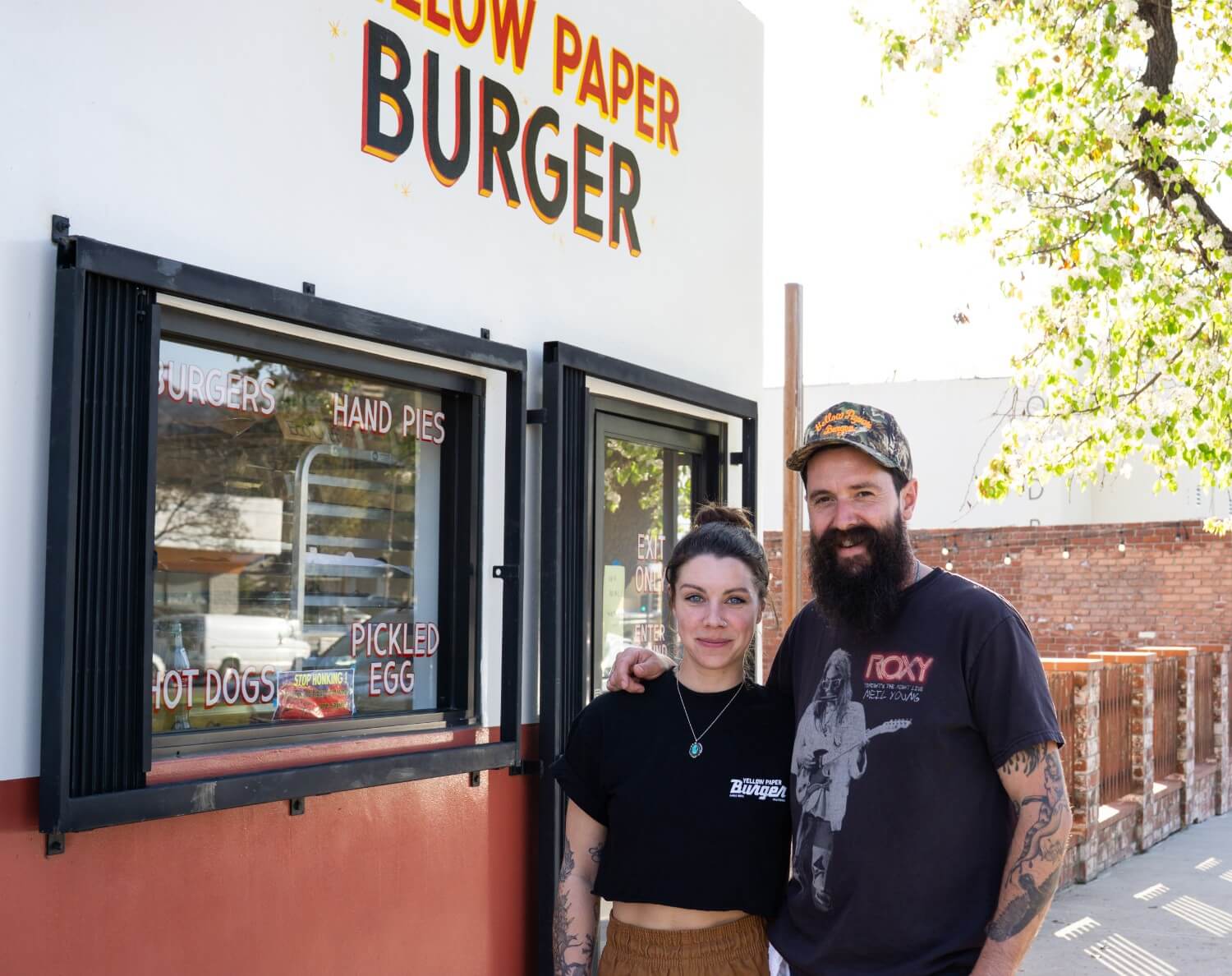
Owners Colin and Katie Fahrner of Yellow Paper Burger in Los Angeles, CA. Feb. 20, 2025. Addie Fabel/The Occidental

“One of the awesome parts about the pop-up is we were able to build our following and get our name out there,” Fahrner said. “We’ve had people who have been coming from the first pop ups who are coming here now, and so we’ve built this really loyal, dedicated following.”

As customers arrive at Yellow Paper Burger’s new location at 1740 Colorado Blvd., they are reminded that the meal will be “Worth the Wait” by a red painted sign on the glass door. On the side of the building is a portrait painted by Jay Howell, the original character designer for the television show Bob’s Burgers, facing outwards to the patio where customers sit.

Customer Ryan Krientz said he and his wife Polly Canella ordered two double-double burgers and an apple hand pie made by Burnett. Krientz said it was their second time eating at the full-time location. Krientz said they first heard about Yellow Paper at the Altadena Beverage and Market and through pop-ups at Walt’s Bar.

“It’s such a nice collective spot to just be outdoors in the fresh air and catch up with people,” Krientz said. “[You can] have some delicious food and support a local business.”

The smash burger comes garnished with cheese, lettuce, onion, tomato, pickles and chopped chilies and wrapped in the namesake yellow parchment paper, according to Fahrner. Before the start of the pop-ups, Fahrner said he documented his favorite LA burgers on Instagram, which eventually inspired him to make his own. Fahrner said he aims to combine the classic burger with current food trends to create a spin on a regular cheeseburger.

“We’re not too pigeonholed in one thing or another totally,” Fahrner said. “We’re making it accessible to everybody.”

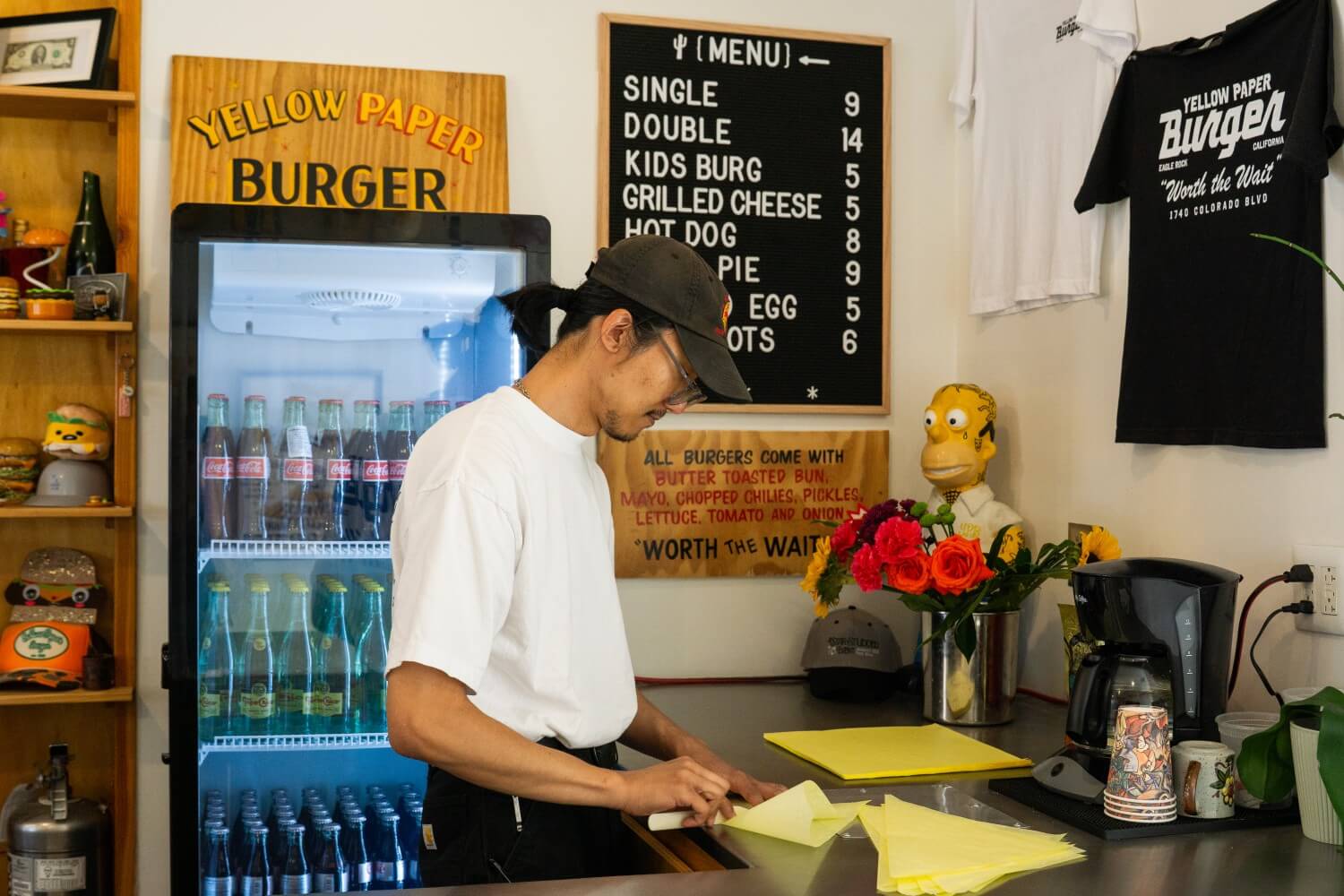
Employee Sae Han of Yellow Paper Burger in Los Angeles, CA. Feb. 20, 2025. Addie Fabel/The Occidental

Fahrner said the complete menu now consists of — in addition to the burgers — the classic dive bar snack of a pickled-egg plate, Burnett’s homemade apple hand pies, tater tots and hot dogs.

“This place used to be a hot dog joint called Meea’s for 10 years,” Fahrner said. “It’s a homage to the neighborhood and to the old spot.”

The business is also expecting to start selling beer and wine in the next month, according to Fahrner. According to Teri Gamble, a Yellow Paper team member and friend of the Fahrners, business has been going well.

“When it’s a weekend, it is just nonstop and it’s just people, people, people, people all day,” Gamble said. “I love it when people come right back in halfway through the meal and order something to go.”

Despite the new location’s heightened popularity, they experienced difficulty as the Eaton and Palisades fires began in the first week of their opening, forcing them to shut down operations for a short time, according to Gamble.

“We did that opening weekend, and then the fire started a week after, so we closed a couple of days that week, but luckily everything’s still here,” Fahrner said.

However, according to Gamble, the business took advantage of the opportunity to serve the community, cooking for first responders in the area.

“To be able to feed people in that kind of an environment was really heartening,” Gamble said. “To be able to really feel like an asset to our community immediately really galvanized us as a team and got us really excited to be here and continue to come in and do this.”

Yellow Paper Burger has become a valuable addition to the Eagle Rock community, according to Krientz.

“To have people in the community who care about the community, building a brick-and-mortar restaurant business — that’s what you want,” Krientz said.

According to Fahrner, the team’s dedication and commitment are what sustain the business in these uncertain times.

“We love what we’re doing, and the challenges are always going to be there, but it just makes us stronger,” he said.

Yellow Paper Burger’s hours are Wednesday through Sunday 1-7 p.m.

Contact Paige Thomas at pthomas2@oxy.edu.

Loading

Grammy-winning artist Cory Henry performs at Thorne Hall, coaches jazz program in masterclass

Grammy-winning jazz musician Cory Henry sat center-stage at Thorne Hall Feb. 15, surrounded by a Stonehenge-esque array of speakers, microphones, keyboards and drums. In a few moments, he would put on a one-man show of gospel, funk and jazz songs to a crowd of Occidental and Eagle Rock locals gathered in the auditorium.

His performance was scheduled as a part of a concert series hosted by Occidental College called the Hume Fellows Concert, named after Bill Hume ’50 M’52, who was the director of Thorne Hall for nearly 20 years during the 1950s, ’60s and ’70s.

As part of the Hume Fellowship, Henry also gave a performance masterclass earlier in the day to a group of Occidental students. During the masterclass held at Bird Studio, Henry coached students as they played to refine their skills.

Visiting Assistant Professor of Music Alexander Zhu said that when looking for artists to bring in for the event, the school searches for currently active candidates who are producing popular, high-quality work.

“We were looking for an artist who’s really relevant at this time and at the top of their game,” Zhu said.

According to Zhu, landing Henry for the event, a process that had been in the works for around half a year, was a win for the program.

“I’m particularly excited that our visiting guest artist, Cory Henry, who’s already a star in the jazz and funk world, literally won a Grammy last week,” Zhu said.

Zhu said the event was especially tailored to music students, who can gain inspiration from working so closely with a professional artist.

“A big part of the Hume residency is there’s a teaching component,” Zhu said.

Zhu, who earned his Bachelor’s in Music from the New England Conservatory, said working with a Grammy-winning artist is a special and rare opportunity for students, regardless of how robust their jazz program is.

“Even at a huge university or music conservatory, it’s not very common to have a masterclass with a Grammy winner,” Zhu said. “So for our students here at Occidental, it’s an incredible opportunity.”

According to Music Professor and Director of Choral and Vocal Activities Desiree La Vertu, the Hume Fellowship, which is not limited to artists in music but invites artists in theater as well, has recently picked back up after a hiatus due to COVID restrictions. According to Zhu, past performers have included bassist Esperanza Spalding, opera singer Frederica von Stade and violinist Hilary Hahn.

Alessandra Nefedenkova (sophomore), who is a music production and computer science double major and a member of the jazz ensemble, said she was eager to learn about Henry’s creative process.

“I am very much interested in hearing about his process for improvisation and how the music flows for him,” Nefedenkova said.

From her own listening, Nefedenkova said she finds Henry’s style lively and upbeat.

“He feels so energetic, and he projects his energy onto the listener,” Nefedenkova said.

Nefedenkova, who grew up with classical music, said that for her, jazz is unique in how much artistic license one is allowed, which is why she enjoys playing.

“With jazz, it’s a completely different field where you have a simple chord progression that you can do so much with and communicate with other people,” Nefedenkova said.

According to Nefedenkova, who plays the saxophone, the jazz program at Occidental exposed her to a diverse array of styles, which spurred her development as a musician. Nefedenkova said the difference from her high school’s program was vast.

“It was a very big switch because everyone is so talented,” Nefedenkova said. “[It] just immediately opened up so many more opportunities for me, in terms of playing with a group, but also having people want to play with different styles, different genres, different groups, different grooves.”

A deciding factor in her choice to attend Occidental, Nefedenkova said, was the quality of the jazz program and the opportunities it provides due to its metropolitan location.

“I wanted to pursue jazz, and Occidental is located in LA,” Nefedenkova said.

Cory Henry in Thorne Hall at Occidental College in Los Angeles, CA. Feb. 15, 2025. Graham Jewett/The Occidental

Henry, who started playing the keyboard at age 2, said he wants to give more masterclasses and teaching exercises going forward in his career.

“I feel like it’s my responsibility now a little bit to a certain degree to help people that have questions and want to make it to the next level,” Henry said.

Henry said playing at his church was formative in his musical development.

“Growing up in church taught me as a musician how to play for the people early, because if you couldn’t move the church [and] you wasn’t doing what was good in the church, no matter how young you was, they was like ‘get off,'” Henry said. “I wanted to stay on.”

A lifelong musician, Henry said as he has matured in his life, so have his tastes and relationship with music.

“We played jazz in church and rap grooves and all the different stuff,” Henry said. “It was loose. Music was just fun and happy, and now, it’s a little bit more serious and spiritual and meditational.”

Henry said his approach to musical creation is the same regardless of who he’s working with — whether it be Grammy-winning singer Rosalía or Occidental’s chamber jazz groups — because he believes in the power of music.

“Whenever you serve the music, it don’t matter who it’s for,” Henry said.

Henry said his music is first a personal endeavor, which touches the deepest parts of himself as a human being.

“Me and music have a great relationship,” Henry said. “I love music, and music loves me.”

Contact Noah Kim at nkim4@oxy.edu

Loading

Artist of the Week: Student band Spirit Foul returns to music scene

After members Lily Pesikoff (junior) and Soren Covell (junior) studied abroad last semester, the band Spirit Foul returned to the Occidental music scene Feb. 8 at Tic Tac Toe Pizza.

Drummer and vocalist Pesikoff said Spirit Foul started because she and Eli Kramer (senior) were in several of the same music production classes and wanted to create a band together. Pesikoff said she and Kramer knew Nate Pittroff (junior) and asked him to join the band as a guitarist and vocalist.

“We knew Nate and asked if he wanted to come and jam with us,” Pesikoff said. “The day of our first practice Soren was sitting at a table with Nate. We said we were looking for a bass player, and Soren said he played bass. And so Soren just showed up to our very first practice.”

Pesikoff and Covell said Spirit Foul’s music style is modern indie rock.

“[Our music] is whatever you want it to be. It’s indie rock at its core, but it’s also lit rock,” Covell said. “One thing that makes us really awesome is that we all have different music tastes.”

Courtesy of Addie Fabel

During the Spring 2024 semester, Spirit Foul performed at the Programming Board’s annual SpringFest. Pesikoff said the band took a hiatus until the Tic Tac Toe show because Pesikoff and Covell were studying abroad in Vienna and Prague, respectively.

Pesikoff said she released her first solo song while abroad, but was worried about reentering the Occidental music scene upon her return to campus in the spring.

“We were all really excited to play with each other again, so practicing for the show [at Tic Tac Toe] was easy,” Pesikoff said. “[The crowd] was so heartwarming. To tell college students one of their first Saturday nights back to spend their evening supporting us and have them actually show up was so nice. It’s like, you could be anywhere in the world and you’re here.”

Covell said he is happy the band is back together, and that he took a break from music while in Prague because he was burnt out and wanted to rediscover creative inspiration.

“Going abroad helped me get back into my flow. I’m happy [the band] has still got it. It’s just the beginning, contrary to popular belief,” Covell said. “I want to release our music. There’s definitely going to be more shows at Tic Tac Toe Pizza.”

Covell said he is planning an electronic and rap music show at Tic Tac Toe Pizza on March 1. He also said he is releasing new music under the alias Lucas Soar!, his personal music profile.

Kai Frazer (first year) said he learned about Spirit Foul’s Feb. 8 show because he is in class with one of the band’s members.

“They had great stage presence and were very in the pocket. They were a very good band. It was packed,” Frazer said. “The atmosphere was very ‘Saturday night college.’ You can tell they’ve been friends for a while. They played Fetty Wap, which was hilarious.”

Courtesy of Addie Fabel

Owner of Tic Tac Toe Pizza Jacob Boghossian said the best part of the event was that Tic Tac Toe’s neighbors did not complain at all.

“There were about 200 people here, mostly students. All of the students were very well-behaved,” Boghossian said. “They cleaned up their trash and there was nothing broken on the ground. Everyone was within their limits and there was no destruction of property.”

Boghossian said the restaurant has always received tremendous support from Occidental students.

“[Students] like our pizza. They keep us going,” Boghossian said. “In a way we’ve always wanted Oxy students to have a home here.”

Matan Birnbaum (senior) helped organize the event. Birnbaum said they asked Spirit Foul to perform at Tic Tac Toe after visiting the venue with jazz and commercial voice instructor Loren Battley.

“We came down after class to get pizza and ask if the owners were interested in doing something with Oxy,” Birnbaum said. “I threw three or four shows with KOXY last year at Sycamore Glen and a couple house shows around campus as well, but I’ve always wanted to find a permanent spot to do stuff.”

Boghossian said the show on Saturday night was the first live music event Tic Tac Toe has hosted, but that the restaurant wants to host more live entertainment in the future.

“We want to consistently have events. We definitely want to do more live music, and we also want to do a comedy night for amateur comedians,” Boghossian said.

Birnbaum said they want to provide a place for Occidental students to experience live music off campus.

“It’s really easy to stay in the Oxy bubble if you’re on campus all the time. I want to give people the opportunity to play with LA bands,” Birnbaum said. “My hope is that, with Tic Tac Toe’s help, we can turn this into a third place where people go when they’re not at home or at work.”

Contact Josey Long at jlong2@oxy.edu.

Loading

Mirin Fader ’13 to speak on new book about NBA great Hakeem Olajuwon

New York Times bestselling author Mirin Fader ’13 visits Occidental Feb. 20 as part of a speaker series aimed at connecting students to alumni who work in journalism and media, according to Brian Chambers, the Sr. Director of Administration at the Occidental Academic Commons. The event will be held in Mosher Hall 1 in the Norris Hall of Chemistry at 5 p.m., and will be moderated by Occidental alum and Prep Sports Reporter for the Ventura County Star, Dominic Massimino ‘21, Chambers said.

“This is exciting. I love bringing authors to campus,” Chambers said. “I just love making those connections, and there have been some events that have had fantastic attendance, and it’s so much fun when everything clicks.”

Fader is best known for her 2021 book, “Giannis: The Improbable Rise of an NBA Champion,” which made the New York Times, LA Times, USA Today, Publishers Weekly and Wall Street Journal bestselling lists, according to Dominic Massimino. The book highlights the life of Giannis Antetokounmpo, the star Greek player on the Milwaukee Bucks. Fader will be speaking about her new book, “Dream: The Life and Legacy of Hakeem Olajuwon,” Feb. 20. Born in Nigeria, Olajuwon played three years at the University of Houston before being selected first in the 1984 NBA draft by the Houston Rockets, two picks ahead of Michael Jordan. A two-time NBA champion with the Houston Rockets in the ’90s, Olajuwon became the first non-American player to win NBA MVP in 1994.

“We are doing a Q&A and book signing event — I’ll be interviewing Mirin,” Massimino said. “We’re gonna talk about the book and her strategies, how she picked her subjects and how she created this awesome work.”

In October 2021, Massimino wrote a feature article in The Occidental about Fader’s career, her time as an athlete in college and how she came to write “Giannis.”

“She was already an inspiration and personal hero of mine, so this was a cool opportunity to meet her in person,” Massimino said. “I was trying to create a version of the features of athletes that she’s created over the years. I tried to recreate that sort of thing for her, for her writing career and how she ascended to be one of the best feature writers in basketball specifically.”

The book about Olajuwon brings into the spotlight another famous player who was born outside of the U.S. and came to play, according to Massimino.

Massimino said Fader’s books on Giannis and Olajuwon are about more than just cataloguing important times in NBA history. Fader’s new book details the story of Olajuwon as a player, a man and a great athlete, all in the context of immigrating from Nigeria to play basketball, Massimino said.

“The book puts into context the mystical nature of his coming to the United States and being one of the first players of his caliber to come from Africa,” Massimino said. “It talks a lot about the way he was covered early on and the racist tropes and the misunderstanding of who he was as a person.”

Fader said working as a student journalist during her time at Occidental, after playing basketball for years herself, solidified her passion for covering the sport.

“I transferred to Oxy as a sophomore, and when I transferred, I knew I was done playing, and I wanted to somehow stay within basketball,” Fader said. “Mike Wells, the associate athletic director at the time gave me a shot writing for the Oxy athletics website, so I covered Oxy teams, particularly the men’s basketball team as their beat writer, and I just fell in love with sports writing.”

During her time at Occidental, Fader cultivated her love of reading and writing, laying the groundwork for her career, she said.

“I definitely wasn’t in college knowing exactly what I wanted to be. I feel really grateful for the experiences I’ve had, but at Oxy it was more about falling in love with writing and reading,” Fader said. “I took Intro to Literary Analysis with Daniel Fineman, and I couldn’t believe we did an entire paper over one word, or one punctuation mark, but it was that type of close reading that was so crucial to doing my books and articles and reporting.”

Fader is now a senior staff writer for The Ringer. Before writing “Giannis,” Fader wrote for Bleacher Report from 2017 to 2020. In 2019, she traveled to Milwaukee to profile Giannis’ younger brother, Alex Antetokounmpo. According to Fader, reporting on Giannis’ family was very different then, because people outside of Milwaukee did not know that Giannis had a brother who also played basketball.

“When I showed up at their family home, Giannis was there, which was totally not something I thought would ever happen, and then I got to speak with both of them, and their mother and the whole family. The story came out, and it was very well received,” Fader said. “I’d been wanting to write a book for a really long time.”

According to Fader, securing the book deal for “Giannis” was difficult.

“In sports writing, in any kind of writing, you want a universal story. That’s really what’s gonna resonate with readers,” Fader said. “Even if people do not have his exact story — of course, not everyone is from Greece, especially really difficult circumstances in Greece — this idea of love for family, hard work, resilience, doing things that seem impossible, making it when there seems to not be a way, these were all just incredible themes that I wanted to explore further.”

Upon coming back to Occidental, Fader said she is looking forward to speaking with Massimino and is excited to see old college friends and former members of the men’s basketball team. Fader said she is aware of the difficulty of finding a job after graduating and how challenging the world is right now for young people. Fader hopes her upcoming visit will bring hope to students, she said.

“Come if you’re interested in the love of language, writing, reading. So much of what we do in sports journalism is applicable to all journalism,” Fader said. “Nobody really grows up thinking they can write a book—I certainly didn’t think I could do it, but it is possible.”

Contact Olivia Correia at ocorreia@oxy.edu.

Loading

Bargaining continues between student union and Occidental, new proposals introduced

With student workers present, bargaining representatives from Occidental and Service Workers International Union (SEIU) Local 721 met for the third time Feb. 11. According to the Information for Student Workers page on Occidental’s website, SEIU presented seven of its initial proposals during the meeting, including the climate justice, health & safety and wages proposals, bringing its total number of proposals to 10. Occidental has presented 16 proposals.

Center for Community Based Learning bargaining representative Emma Galbraith (senior) said the climate justice points, which she helped draft, are important to her.

“The health impacts of these climate disasters, as they continue to ramp up — I think it’s really important for the college to be addressing that,” Galbraith said. “Both as a general student well-being issue and also as a literal health and safety workplace issue.”

Occidental’s General Counsel Nora Kahn, a member of the college’s bargaining team, said that things are moving along.

“I’m hopeful that, now that we have some proposals on the table, we can move forward more quickly and approach what I expect to be a middle ground,” Kahn said.

Galbraith said a lawyer from SEIU and representatives from Rising Occidental Student Employees (ROSE) present proposals during bargaining sessions.

“It’s student workers running the show,” Galbraith said.

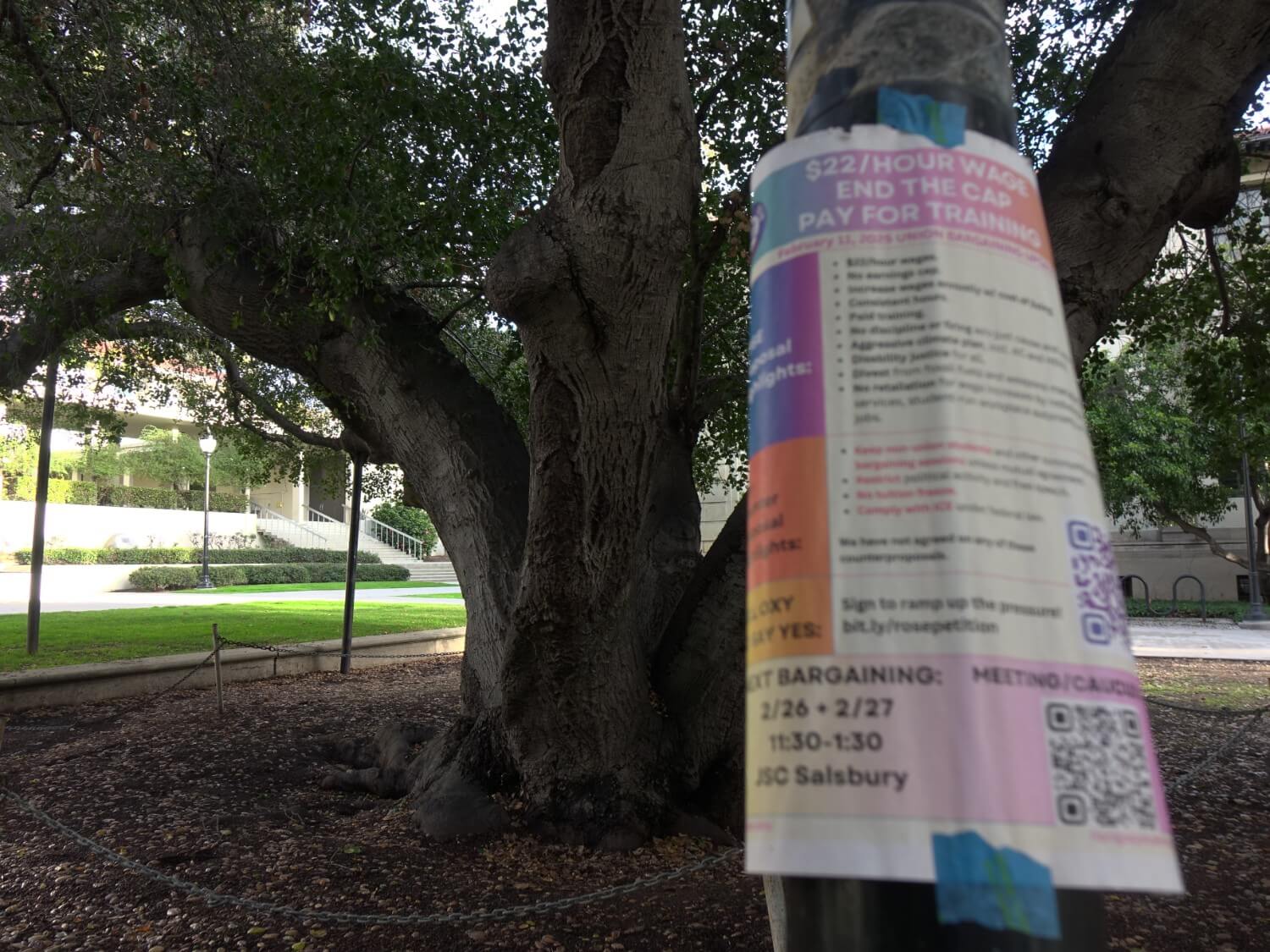
SEIU’s initial wages proposal eliminates the college’s earnings cap and states that “no bargaining unit member shall be paid less than $22 per hour as a base wage, or its equivalent in stipend,” with the base wage increasing at the same percentage the college increases tuition each year.

So far, all proposals being negotiated apply to both bargaining units of student employees, Kahn said. According to Kahn, the college is trying to keep the topics on the bargaining table specific to student employment. The college and the union may have differing perspectives on whether SEIU’s climate justice, health & safety and endowment transparency and divestment proposals directly relate to student employment and are within the mandatory subjects of bargaining, Kahn said.

“Much of the climate justice, health & safety proposal ventures out into other topics that I think are important for students, and many students are interested in and activated around those topics, and I think that’s great,” Kahn said. “But in order for the parties to really make progress towards a contract, I think we’re going to have to concentrate more on the central components of student employment — things like wages, work hours and locations, training — the true terms and conditions of employment.”

A union flyer on the Academic Quad at Occidental College in Los Angeles, CA. Feb. 12, 2025. James Miller/The Occidental

Kahn said she expects the college to present a counterproposal at the next bargaining meeting in late February.

The climate justice, health & safety proposal includes 21 sub-provisions, including the conversion of all lawns on campus to native grasses and plants; retrofitting of all dorm buildings; a carbon neutrality plan; and that “the College and the Union will explore the feasibility of retrofitting campus pavement to become permeable for the purpose of reducing runoff, controlling pollutants and reducing heat island effect on campus.”

According to Galbraith, endowment transparency and divestment is another SEIU proposal that she is passionate about. She said Occidental’s resolution regarding climate change and endowment investment policy has been insufficient and lacks an enforcement mechanism.

“What’s so important to me — that we have these common good articles in our contract — is that by weaving them into a labor contract we, the student workers, have the ability to enforce that contract and hold the college accountable,” Galbraith said.

According to Telefund bargaining representative Casey Scott (sophomore), the divestment article has three main points: divestment from fossil fuel companies and firms committing human rights violations, giving students a voice on the Board of Trustees during endowment discussions and establishing a human rights framework for future investments.

“We have a vested interest, one, in the school itself, as student workers. We go here every day, we rely on the vestiges of the college to propel us into our future employment […] we want to have a say in where the money we get paid out of comes from,” Scott said.

According to Kahn, there are other representative bodies for students to bring about change at the college, like ASOC and Sustainability Fund, a branch of ASOC.

“SEIU […] is representing students only with respect to its terms and conditions of employment, not for all purposes,” Kahn said.

According to Kahn, at the start of the bargaining process, she hoped negotiations would be streamlined with straightforward proposals applicable to the entirety of the student workforce brought to the table.

Galbraith said workers need to be represented fairly across the diversity of employment roles on campus. According to Galbraith, the variation between positions is the reason that ROSE will ask SEIU to present a counterproposal to Occidental’s initial union stewards proposal, which specifies that the union appoint no more than six stewards per year.

“If you only have six union stewards — whose job it is to help every student worker on campus through the grievance process or other workplace issues — that’s going to result in a weaker union,” Galbraith said.

Galbraith said the bargaining sessions can be fun.

“They are open to every worker,” Galbraith said. “It’s a great opportunity to actually see who is representing Oxy.”

Kahn said the negotiation process may take longer than a year.

“All of the participants so far — both the union and the college and each of their bargaining teams — have really been coming to the table in good faith,” Kahn said. “So, I expect that we’ll find some common ground.”

Contact James Miller at jmiller4@oxy.edu.

Loading

Opinion: The temptation of tracking apps has consumed us

I woke up early on Monday to go for a run around Eagle Rock. The sun was shining, and I wore my favorite shorts. I saw the LA River and called my mom around mile two. I listened to a lot of instrumental music, and some nice bikers gave me water.

This moment seems to be personal — I went for a run by myself and did it exclusively for me. But you, a stranger, could know all of this information as well as my mileage, map route and mile time down to segments of less than half a mile. Strava, the run tracking app where I log all of my miles, shares my runs to both friends and strangers. The app allows me to track my pace, mileage and progress. But Strava goes further than recording the basics of running — it has become another form of social media for me. My following is small, but we give each other ‘kudos,’ Strava’s parlance for likes, and I check the app even if I don’t run. I post my runs with a carousel of photos and what I like to think of as a witty caption.

Apps such as StravaGoodreadsBeli and Letterboxd now offer spaces to track almost everything including running, books, restaurants and movies. This constant obsession and devotion to the collection of personal data feels strange to me, even as a user. Why do we all feel the need to share these personal aspects of our lives?

For me, at the essence of these apps lies the perversion of personal acts into something that is done for other people or for others to see. These apps are just another way that our personal data is transformed into public data, and it is masked by a sense of community and connection. The current interconnectivity of the world offers us all the ability to cultivate and curate a detailed public image. These apps provide additional data that go into my overall public image. I am not lying about the books that I read or the length of my Monday run. However, part of me must be influenced by these apps, and the knowledge that they are a part of how I present myself to the world. Do I go into the book store thinking about my Goodreads profile? Do I think about my mileage in terms of my Strava posts?

I like to think the answers to these questions are no and that my use of tracking apps have been relatively healthy. I don’t feel a sense of competition with my peers, but I know that with platforms such as these, especially ones that track athletic progress, the line between healthy and unhealthy easily fades. Some of my friends refuse to download Strava because they do not feel comfortable sharing their mile pace, especially in comparison to their friend’s profiles. Aversion to the tracking apps is fair, since fitness tracking has reached a whole new level of obsession. Through the apps, we have even more forms that can track us, as different devices such as Garmin watches and Oura rings collect and compile our health data, offering users yet another way to share their data with friends.

Yet, at the same time, the tracking apps are incredibly useful to me. They allow me to connect with my friends and get recommendations and responses from people I love. On Strava, I can see one of my best friends run through her college town in Ohio, complete with a photo and funny caption. Even though I can’t see her every day, I cherish this information, and if we were in person, it would not feel like data at all.

So, why do we continue to track? For one, tracking can promote consistency — which, when it comes to running and reading, is always a goal of mine. Beyond consistency alone, tracking — and sharing — our data is part of a social contract. While the form the data takes online is an issue, I believe that in order to be part of a community, we must share something. For me, my bargaining token is the data from my Monday run — even if it is shared through an app.

I hope that we can reframe our use of these apps in this light. When we share our data, we ought to consider it as something vulnerable and fun, something that adds to our community in a healthy way.

Contact Nora Youngelson at youngelson@oxy.edu

Loading

Opinion: Trump’s game of tariff peekaboo evinces the weakness of a lame-duck president

Growing up, my family used to drive to Maine every summer. The car ride took six hours, during which my two sisters and I were left to occupy ourselves in the back seat. Like clockwork, every time we reached the last hour of the drive — when we had bored ourselves with books, games and conversation — we’d invariably devolve into bitter sibling squabbles: bickering and pinching each other for no other reason than to entertain ourselves through the home stretch of our journey.

These car-ride spats were front of mind for me Feb. 1 as Donald Trump made the sudden and bizarre decision to impose steep tariffs on imports from Canada, Mexico and China. As the Wall Street Journal editorial board rather snarkily observed, these tariffs were inexplicably destructive and destabilizing. Within hours, both Canada and Mexico hit back hard with counter-tariffs on U.S. imports — the former opting rather shrewdly to target red-state economies specifically — and the stock market opened in free fall Feb. 3 as experts forecasted collateral damage to the economy.

Perhaps, then, it should have been no surprise that — just days after the original tariffs went into effect — Trump hit a thirty-day pause on his trade war with our neighbors. Under pressure from industry — not to mention Republican lawmakers concerned about what a trade war could mean for their constituents — Trump blinked, taking vague and insubstantial border security commitments from Canada and Mexico as a “bargaining chip” for stepping back from the brink.

In the wake of this mind-numbingly pointless fiasco, some Republicans praised Trump, hopelessly credulous of his “dealmaker-in-chief” facade — in spite of the fact that no “deal” (to the extent one could even call it that) was made here.

To explain what I mean, let us return to the back of the car on a long road trip. If, say, I pinched both of my sisters until they screamed, stopped pinching them and then congratulated myself when they stopped screaming, could I possibly consider myself a dealmaker? A peace-keeper? It is a tragic reflection on the state of our republic that a child in diapers could see past such a ruse.

Still, big and important questions remain. Like, why poison the well with our closest trading partners? Why pursue such profoundly inflationary policies when prices are already high? And whatever happened to the hawkish anti-inflation rhetoric Trump deployed on the campaign trail last fall? At what point did this administration decide to abandon its promise to “Make America Affordable Again?”

The answers here, in my view, go deeper than mere boredom (as in the cabin-feverish final hour of a car ride): I think Donald Trump is trapped.

After mounting a campaign for the White House predicated (at least in part) on his desire to avoid being sent to prison — and cashing in on raging anti-establishment sentiment in the process — the president now finds himself in an impossible position. He must helm a nation facing myriad crises: from a fragile economy, staggering income inequality and bitter partisan divisions, to uncertainty and instability on the world stage.

Worse, the president has few tools at his disposal for addressing these issues head-on. Among the American public, precious little faith in government remains. The Republican Party controls Washington, yet there is little indication that major legislative changes are forthcoming. Indeed, majorities in both houses of Congress are so slim, it appears that Republicans’ main challenge in the coming weeks will be keeping their own government from shutting down when funding runs out March 14.

Trump has reclaimed the crown of oldest president to take oath — ever. He has no more campaigns to run and thereby little incentive to govern with levelheadedness, dynamism or an eye toward the future. His only responsibility now is to those who helped him get elected (Elon Musk comes to mind). Everything else is icing on the cake: he gets to play president — both on TV (see: his trip to the Super Bowl) and in the privacy of his home — while letting the sycophants who surround him run buck wild through the halls of power.

But the politics of treating the presidency in this way (that is, partly like a cash grab and partly like a luxury retirement resort) are extremely fraught. The president, after all, did not (openly) campaign on being a shameless kleptocrat.

So it is surely no wonder that he aimlessly picks fights with neighbors and allies, only to chicken out at the last second.

This never-ending “will-he-won’t-he” charade — of which the tariffs are only a part — is merely a facade obscures the primary aims and goals of his presidency. While the president is off playing golf or watching TV — leaving Musk and his band of teenage hackers to pilfer government databases — the press and the public are obsessing over whether or not he’s actually serious about nuking our trade partnership with Canada.

This is a smokescreen (and a rather obvious one at that). Beyond it, though, there is a road out of the wilderness. And the sooner we refuse to let our attention be manipulated this way, the sooner we will see this administration for exactly what it is: a rabid pack of ultra-wealthy dorks pickpocketing our country for loose change.

Contact Beatrice Neilson at neilson@oxy.edu

Loading

Opinion: Studying for success may be different that you think

If you have never had to cram the night before a big test, consider yourself lucky. A study done by the BBC reports 99 percent of students admit to cramming for their exams. Whether you only cram for tests as a last resort, or do so on a regular basis, we can all agree that it’s not the best study method. According to the Washington Post, cramming is often the result of procrastination and tends to only be effective for short-term memory.

Unfortunately, cramming is not the only dangerous habit that tempts students. Cramming not only fails to help long-term memory, but also deprives students of their recommended 7–9 hours of sleep.

According to Professor of Cognitive Science Carmel Levitan, sleep is essential for building memory.

“The thing I wish all of my students would do would be to sleep more […] one of the best things you can do if you want to remember things is to get sleep,” Levitan said.

Getting better sleep also allows students to pay more attention inside the classroom, permitting students to take notes so they can better understand the material. I remember numerous times when I persisted studying late into the night, only to forget all of the information when given the test. Eventually, I discovered that going to sleep at a reasonable hour helps retain the information. The way we take notes during lectures also greatly impacts how much of the material we remember.

“It’s actually more effective to take notes in a way where you’re trying to integrate the information or reflect on it as you’re writing it down,” Levitan said.

According to Department Chair of Psychology Professor Andrew Shtulman, including different representations of the same concept or topic in one’s notes helps students remember material by giving them multiple ways to retrieve the information.

Assistant Professor of Psychology Jamie Amemiya said she thinks handwritten notes are better than typed notes, because it allows students to personalize them by making connections, rather than just typing left to right on the computer.

I have found taking notes and explaining concepts to both be incredibly helpful when preparing for tests. During high school I began taking history tests orally, and by pretending to teach a lecture, I developed a more thorough understanding of the material.

According to Levitan, Amemiya and Shtulman, self-testing is a great study strategy for students to employ.

“When you start to test yourself on the material, even if you don’t recall it, when you look up the answer, you are strengthening the memory representation, so the testing forms a stronger memory in and of itself,” Shtulman said.

A crucial part of self-testing is forcing yourself to explain all the concepts and taking note of the ones you cannot understand, rather than passively looking over flashcards. According to Amemiya, connecting concepts when studying separates the novices, who learn things isolated from each other, from the experts, who can easily link concepts together.

“It’s a process of integrating what you’re learning into prior knowledge,” Shtulman said. “One strategy is to organize the material into categories that are meaningful to you rather than the categories in which the material was presented or the order in which it was presented.”

Speaking, or rather writing, about explaining concepts and connections brings us to explaining the concept to someone else.

“Having students generate and talk out loud [about] what they just heard and explain it to someone else […] really helps you identify your gaps in the knowledge and it facilitates more learning because you’re like ‘Oh this is the thing I don’t understand,’” Amemiya said.

The last element brought up by Shtulman was how crucial it is for students to learn to manage their time effectively when studying.

“Introducing spacing in between your study sessions is helpful […] space study is always better than mass study, although it’s hard to accomplish that given a very tight schedule in the semester,” Stulman said. “One way of accomplishing it is to review the material you learn that day at night rather than waiting until the night before the exam, like continual review.”

I know it’s hard not to fall to the temptation of procrastination because it serves our short-term memory — which helps when the test is the next day. However, college classes are designed so the material continues to build, and concepts do not remain isolated. If these methods don’t work for you, find the ones that do and adapt your study schedule to maximize academic success.

Contact Arlo Gallati at gallati@oxy.edu

Loading

Opinion: St. Sargis will tell you who you will marry…or will he?

Usually, I drink a glass of water every night before I go to sleep — I’ve done this for as long as I can remember. However, on the eve of Feb. 14, I did not, and neither did thousands of young, unmarried Armenian men and women.

St. Sargis, or Surp Sargis, was a Cappadocian Greek general of the Roman army and is the patron saint of youth and love in the Armenian community. The holiday dedicated to him, St. Sargis Day, is a movable holiday that fell on Feb. 15 this year. On the eve of the holiday, young, unmarried men and women eat a salty pastry called aghablit to make us thirsty before bed, with the hope of seeing our future spouse bring a cup of water in our dreams.

When I first learned about this tradition, I found it very romantic and sweet, but I was also a bit skeptical as to whether it even works. I began asking a few of my older family members about it, and to my great surprise, there have been a few successes.

The first success story is my mother’s from when she was 22. In her dream, she was in the front yard of her parent’s house — the same house of my grandparent’s where I spent most of my childhood — and the hose was broken. An unknown man, my father, fixed the hose for her. When my mother experienced this dream, she had not met my father yet. In her dream, her family told her that he was her cousin’s friend, and that was confirmed in real life when she met him.

The second story is my aunt’s, my mother’s sister. When she was 19 and talking to her current husband, my uncle, she tried the experiment. She remembers being in a green field where there was a well. My uncle filled a cup with the well water for her. She ate another aghablit a year later and once again saw her husband.

A distant relative saw her future mother-in-law. She had yet to meet her husband and his mother.

This year, my friends and I decided to partake in this tradition. It was my first time trying it out, and I couldn’t tell if I was nervous, excited or confused.

On a surface level, it feels incredibly exciting to know who your future spouse will be. This is a question that often dwells in the minds of young people. The question of who they will marry is such a big mystery to some, and the chance of that question being answered within a mere night can be peaceful. It is almost as if it is one less uncertainty in life — one more thing that we have had the chance to figure out about ourselves.

However, there is also the possibility of the dream being wrong. I have been looking at this cultural practice as a scientific experiment, and an important aspect of an experiment is not having multiple variables that might have a consequence on the validity of the results. What if on the eve of Surp Sargis and before eating the aghablit, one has an interaction with a friend or a classmate and that has an effect on their dream? What if someone is on one’s mind and they see them? How will I know if my dream is flawed or correct? More importantly, is the future spouse a soulmate?

It is also possible to not even have a dream, which happened to my father, his sister, a great uncle and my grandma when they ate aghablit.

There have also been failures, some very funny, within my family.

For example, my grandpa had a dream where a woman did bring him water, but he refused to take it. One of my mother’s cousins, when she was around 14, saw her celebrity crush of the time, Iranian actor Farhad Jam. Her older sister saw Jon Bon Jovi, but instead of giving her a cup of water, he gave her a cassette tape saying “This is our new album.” The album of that year was “Crush.”

Feb. 15 arrived, and my friends flooded my messages asking me whom I had seen and telling me accounts of their dreams.

These were the results of our experiment:

Friend No. 1 saw her crush in her dream. He gave her two glasses of water.

Friend No. 2 saw the same faceless man she had seen when she was 16.

Friend No. 3 saw multiple people.

Friend No. 4 saw only a hand giving her water.

Three other friends didn’t see anyone.

Similarly, the results of my test happened to be null. I saw no one, and I am convinced it was because of my alarm that woke me up. However, this got me thinking — did I even want to know who my future husband will be?

I’m a bit glad that I didn’t see anyone. Seeing the evidence of success in this love experiment makes me a bit scared. Looking at my own thought process from a different angle, I feel that a huge part of why youth is so romanticized and what makes being young so exciting is the uncertainty of the future. I don’t know what’s going to happen in a week from now, where I will work within the next five years, where I will live when I’m older, what countries I will visit or what new friends I will make — and that makes me excited. There are so many things that I have yet to experience, and I wouldn’t want to get a pre-planned calendar of my entire life handed down to me.

Contact Francine Ghazarian at ghazarian@oxy.edu

Loading