Occidental College’s cross country teams competed at the 2024 NCAA Division III Pre-Nationals Invitational Oct. 4 in Terre Haute, IN. The men’s team placed 36th out of 46 teams, and the women’s team placed 24th out of 44 teams. Jenna LeNay (junior) placed 28th among 389 competitors in the women’s 6K.
Assistant Coach and Recruiting Coordinator for the Cross Country and Track Teams Dave Foley said Pre-Nationals is an opportunity for the teams to experience the course where the National Championship will take place in November.
Fall 2023 cross country team at Jack Kemp Stadium at Occidental College in Los Angeles, CA. Oct. 17, 2023. Amalia Rimmon/The Occidental
“It’s that chance that you get to know [the course] a little bit — not just watch it on video, but to actually race on,” Foley said.
Noe Barraza (sophomore) was selected to represent Occidental men’s cross country this year and said that staying healthy is crucial during the training.
“I was just basically taking it day-by-day, just doing the stuff I need to do during the training, making sure I hit my mileage on each time and stay healthy going there and coming back,” Barraza said.
Barraza also said he tried to maintain a consistent schedule for nutrition.
“I get at least one banana per day, and I will grab Gatorade or something for an extra boost in electrolytes,” Barraza said.
According to Foley, Pre-Nationals always features high-quality athletes and rigorous competition from different colleges. Joshua Lo, (senior) who was selected the second time for Pre-Nationals, said that as the race gets closer, the nerves increase.
“Everyone is in the same boat. Everyone is super stressed. Everyone is anxious. So just talking to each other helps – like talking to your coach and knowing that we’ve done everything to prepare for it,” Lo said.
According to Foley, the teams are encouraged not to be overly concentrated on the outcome of a race.
“It’s an exercise of delayed gratification. It’s about showing up every day. You can see the improvement over time if you are not being so focused on things like ‘what’s the goal’ and being focused on the process of getting better,” Foley said.
Foley said that there is good stress and bad stress and knowing the difference between those two can help the teams.
“If you are nervous in a big race, that’s okay. That means you care. That’s good stress,” Foley said. “But being nervous and hyper-focused during a big race, that’s bad stress because it only brings you negative perceptions of yourself. My goal is to try to help people understand the difference between the two.”
Cross country is both an individual and team sport. The team score is comprised of scores from the five fastest runners from each team. Barraza said the team put forth a strong collective effort, and they all motivated each other in their own ways.
“We grew our team bonds through a lot of workouts and running together. People were always saying ‘good job’ to each other when we passed each other on workouts. So I think together we had a very strong team,” Barraza said.
Lo also said that simply seeing each other around was helpful and motivating to the team.
Fall 2023 cross country team at Jack Kemp Stadium at Occidental College in Los Angeles, CA. Oct. 17, 2023. Amalia Rimmon/The Occidental
“Not all of us run together, but each one of us has at least one other person they run with, so we all work with each other.” Lo said. “Everyone racing in Indiana had someone else that’s a similar speed, so we each have at least one teammate that we work out with and can race with.”
Foley said the sport is always competitive and requires a lot of time and effort throughout the process.
“Sport matters to me a lot, but in the grand scheme [of things], it’s not that big of a deal. If you have fun while doing it each time, you’re gonna have a better time at the end,” Foley said.
Among an already vibrant food scene in Northeast LA(NELA), the immediate area surrounding Occidental College has seen some new openings since last semester. Between delis, pizza, frozen treats and Sichuan eats, even seniorshave new dining options just blocks from campus. Whilethis does not encompass every recent opening, we picked out a couple of stories behind the origin of these new eats.
Ggiata Delicatessen
By Eliza Bodden
Ggiata Delicatessen opened its fourth deli location on York Boulevard in July, according to co-founder and co-owner Noah Holton-Raphael, which marked their biggest opening thus far. Holton-Raphael said he has been coming to Highland Park since moving to LA in 2018 with his childhood friends and co-owners, Max Bahramipour and Jack Biebel. They chose to open a location here because it reminded them of the neighborhood they grew up in, he said via email.
“The neighborhood has been great to us,” Holton-Raphael said. “We’re proud of the hospitality we give to the neighborhood, and we feel that reciprocated. We love it here.”
According to Holton-Raphael, Ggiata was inspired by the childhoods of the three owners, Holton-Raphael, Bahramipour and Biebel, who are from Montclair, NJ. Montclair was a sandwich town, and they felt that LA lacked delis, Holton-Raphael said.
“The menu is mostly inspired by the neighborhood spots we grew up going to,” Holton-Raphael said via email. “It’s east meets west.”
According to Holton-Raphael, Ggiata has a number of different vendors, ranging from farms in California to producers of cured meats in Italy. Two local brands they purchase from are RC Provisions and Bread Artisan, he said.
Holton-Raphael said that the Spicy P and the Chicken Caesar Wrap are the two most popular sandwiches, but his favorite is The Draper, which was inspired by one of their favorite childhood sandwiches in Montclair. All of these sandwiches can be found on their website.
According to Holton-Raphael, the name that inspired Ggiata captures their mission for their business in the community.
“There’s a phrase in Italian, ‘passeggiata.’ It refers to a neighborhood stroll that families take,” Holton-Raphael said via email. “It captured all the things we wanted our business to stand for. Community, inclusivity, leisure [and] nostalgia.”
Ggiata is open from 9 a.m. to 8 p.m. Monday through Thursday and until 9 p.m. on Friday through Sunday.
Tic Tac Toe Pizza on Eagle Rock Boulevard in Los Angeles, CA. Oct. 6, 2024. Marty Valdez/The Occidental
Tic Tac Toe Pizza
By Eliza Bodden
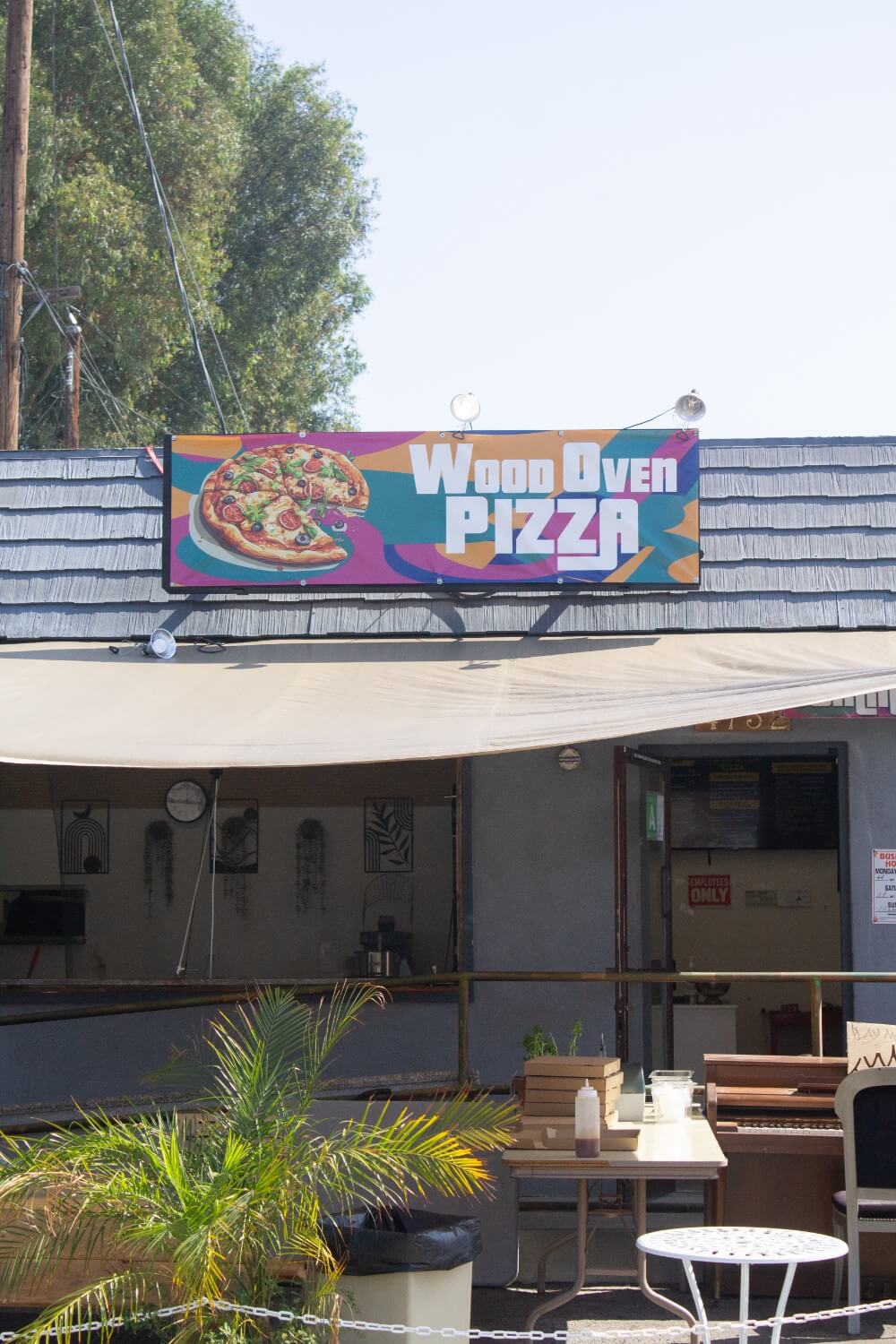
Tic Tac Toe Pizza, a new wood oven pizza shop located on Eagle Rock Blvd., opened its doors two months ago, aiming to fill a gap in the neighborhood’s dining scene. Co-owner and manager Jacob Boghossian initially opened the shop as a small set-up with minimal space, but said he soon realized that he would need to expand to accommodate demand from the community.
“I had a small oven sitting outside just to see if the neighborhood and the students would like us,” Boghossian said. “Immediately, I just didn’t have any more space in my oven.”
Today, Tic Tac Toe Pizza operates with an expanded setup featuring fresh ingredients and homemade recipes. According to Boghossian, the restaurant prides itself on making dough every morning and creating its own sauce, ensuring that the pizza is made to the best quality.
“Everything is fresh from the market. We slice them up in our kitchen. Nothing is canned, nothing is in bags,” Boghossian said.
The Tic Tac Toe employs eight staff members, half of whom are Occidental students, with another quarter being alumni.
“We try to kind of keep it in the community, and it’s working out for us,” Boghossian said.
Tic Tac Toe Pizza offers an Occidental student discount, allowing students to enjoy a complimentary refreshment with any pizza purchase.
According to Boghossian, there is also a patio with seating open to Occidental students and the Eagle Rock community.
“We just want to create an area where they’re welcome to come sit, do their work, they can socialize, they can just relax, whatever they would like,” Boghossian said.
Tic Tac Toe Pizza is open 11 a.m. to 11 p.m. every day of the week.
Contact Eliza Bodden at bodden@oxy.edu
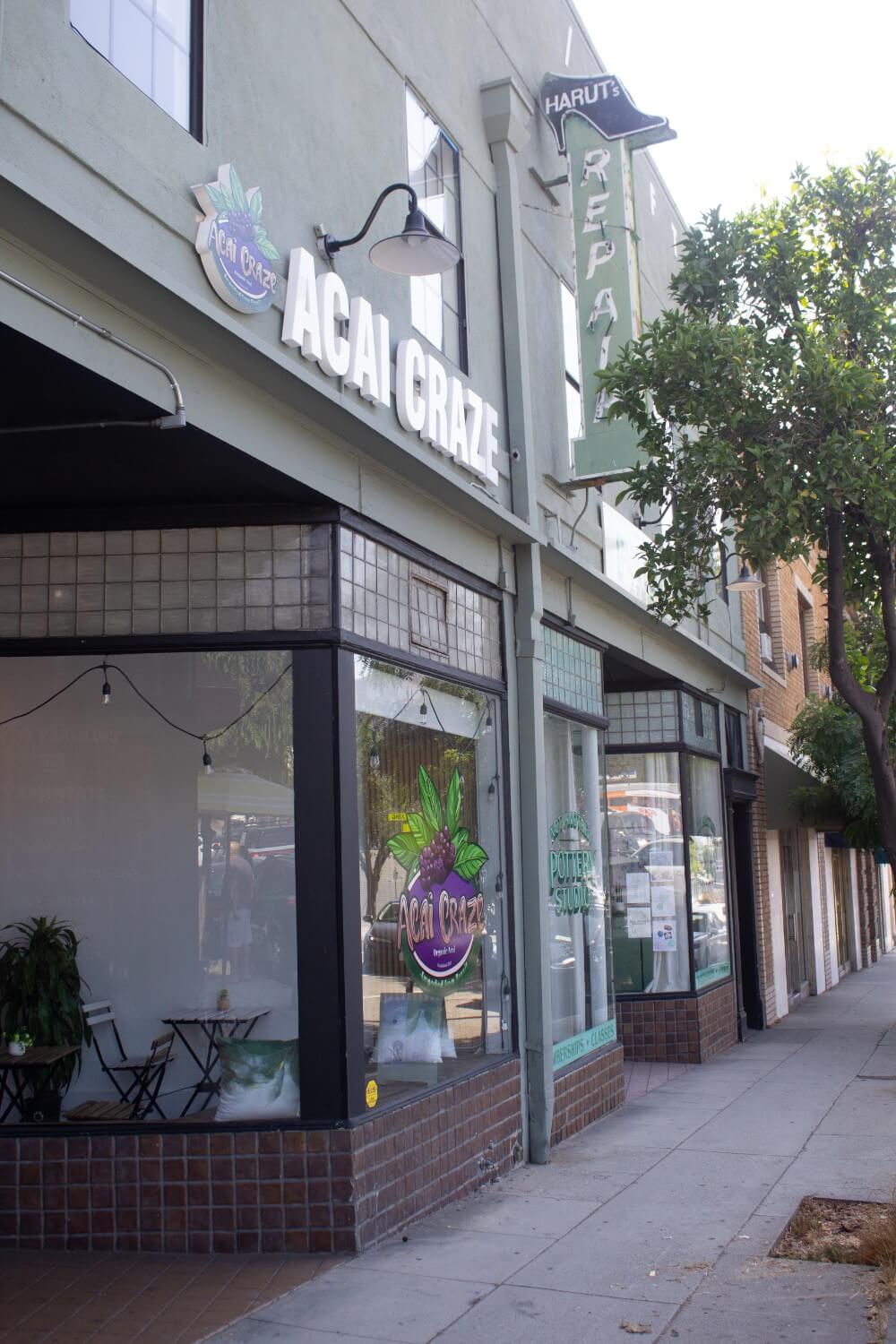
Acai Craze on Eagle Rock Boulevard in Los Angeles, CA. Oct. 6, 2024. Marty Valdez/The Occidental
Acai Craze
By Wura Ogunnaike
Acai bowl cafe, Acai Craze, co-owned by brothers Haike and Anthony Espinoza, opened on Eagle Rock Boulevard in July. According to Anthony Espinoza, going into business together was a natural idea.
“It’s just a family thing, we just decided,” Anthony Espinoza said. “It takes a lot of money to invest into a business, and in yourself and take that risk, and I can trust my brother.”
They sell a variety of preset smoothies, acai bowls and overnight oats bowls ranging from $8–$14. They also have a build-your-own option for acai bowls and oats where customers can customize their bases and toppings.
According to Anthony Espinoza, opening the restaurant took 30 days from beginning to end.
“I was designing the menus [and] figuring out every little detail about a month prior to opening,” said Anthony Espinoza. “I would go into other cafes and smoothie bars to see what they were doing, and get an idea of how to implement that in my own way.”
Haike Espinoza said that his favorite menu item is the S-berry Sensation Bowl, but most people get the Classic, which comes with strawberry, banana and granola.
“People get the health benefits from it, but they get a sweet treat as well,” said Haike Espinoza.
According to both brothers, the community in Eagle Rock has been very welcoming.
“We see all different types of people, and everyone loves us,” said Haike Espinoza. “We’re for the community. We want to be a part of it and experience what it has to offer, and we also have something to offer.”
Acai Craze is open Monday through Saturday 10 a.m.–7 p.m. and until 6 p.m. on Sundays.
Viet Tapas Bar
By Wura Ogunnaike
Viet Tapas Bar, a tapas-style restaurant serving Vietnamese food, opened in May of last year on Colorado Boulevard. Owner Viet Tran also owns two locations of Viet Noodle Bar, in Santa Monica and Atwater Village. According to Tran, he wanted to explore different styles of Vietnamese cooking and was inspired by street food. Originally, he tried to house the tapas bar in one of his noodle bars, but it didn’t work out.
Tran said that the tapas style allows him to experiment with different menu items and seasonal ingredients.
“The idea of tapas is that you have more variety to try out,” said Tran. “When people come to a restaurant like a noodle bar, they already know what they want. But here, they want to be surprised [and] see what’s new.”
The menu includes items like bison roll, diced lamb and watercress salad. The drinks selection included imported beer, sake, wine and non-alcoholic beverages. Prices range from $8–$22.
“I cook here, and sometimes I also serve the customers because that’s the only way you can see [what they like],” Tran said. “Our customers are very reactive.”
Tran said that he doesn’t advertise his restaurant on social media and wants to rely on word-of-mouth.
“I have the luxury that I can maintain and run it because I have a very good customer base, and I’m happy with moving slow and steady,” Tran said. “In the restaurant business, the most important thing is pace, and if you run at a steady pace, you can maintain quality.”
Viet Tapas is open Tuesday through Thursday 5 p.m.–9 p.m. and Friday through Saturday until 10 p.m.
Yellow Paper Burger
By Wura Ogunnaike
Yellow Paper Burger is a pop-up smashburger restaurant co-owned by Colin Farhner and Katie Burnett. According to Farher in an article for Eater, they began by working out of their backyard during the pandemic.
They frequently collaborate with different restaurants to host their van, including Side Pie owned by Kevin Hockin. According to Hockin, Side Pie has hosted Yellow Paper Burger three times.
“I first heard about them through a friend, actually my friend who owns Walt’s on York,” said Hockin. “He mentioned that they were hosting a burger popup, so I went, and I thought it was incredible.”
Hockin said that he was excited to bring something new to his community by hosting the pop-ups.
“We don’t have options for a good smashburger in this area, so I thought that this would be cool to bring not only to the community but to also expose them to something that isn’t readily available,” said Hockin.
The pop-up currently sells burgers, hand pies and other sides ranging from $1–$13. They advertise where they will be located on their Instagram.
According to Yellow Paper Burger’s Instagram, they are fundraising for a permanent location in Eagle Rock. Their GoFundMe says that they are looking for an early 2025 opening day.
According to Hockin, having a pop-up concept move to a brick-and-mortar location is like graduating.
“You realize that it is just better to have more consistency,” Hockin said. “If you’re stationary somewhere and people can rely on you within those days or hours that you’re open, you become like an anchor.”
Yellow Paper Burger is expected to open in the coming months.
Contact Wura Ogunnaike at ogunnaike@oxy.edu
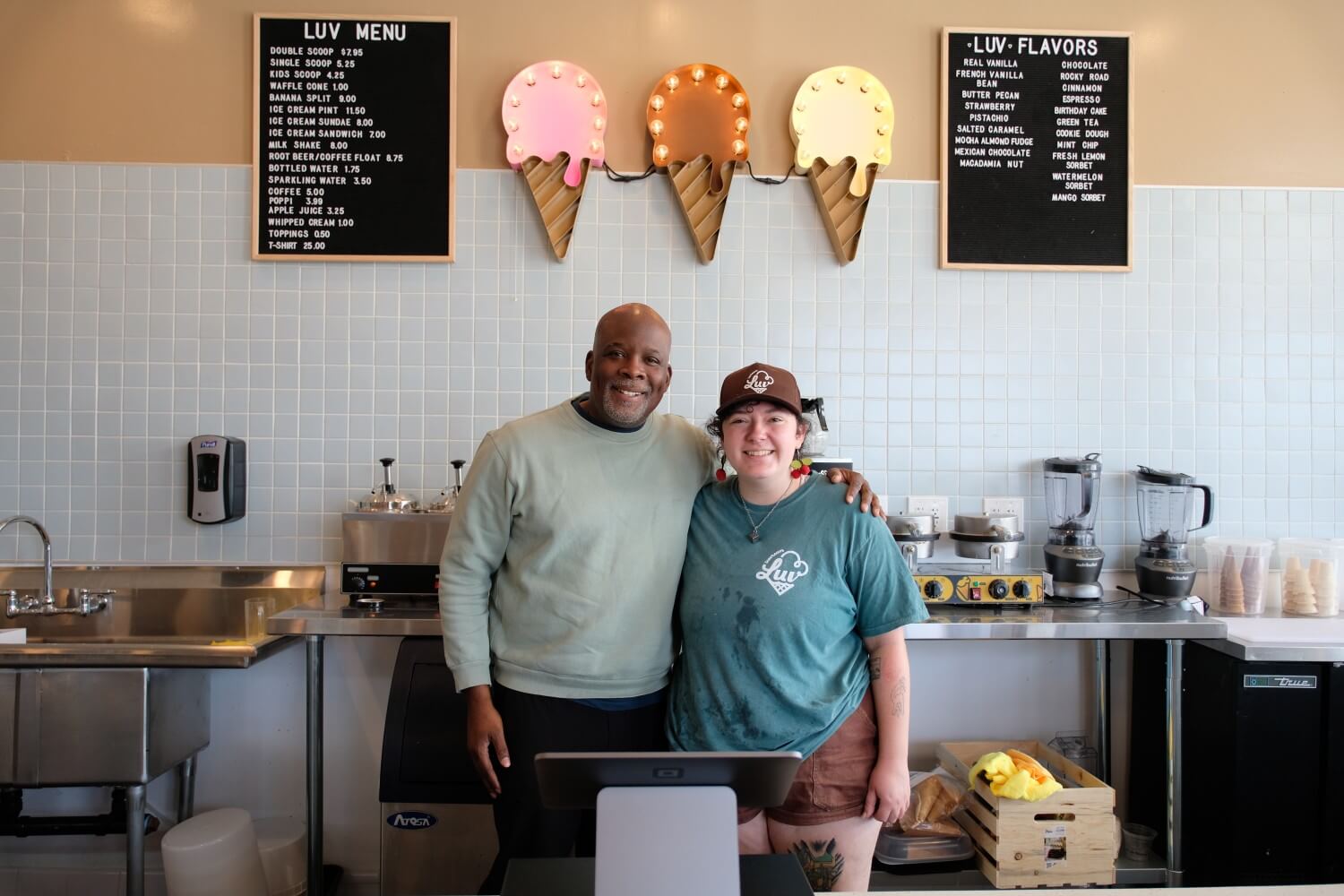
Service counter and menu at Ice Cream Luv in Los Angeles, CA. Sept. 27, 2024. Talia Goddard/The Occidental
Ice Cream Luv
By Diana Trutia
Situated on Colorado Boulevard, less than two miles from campus, Ice Cream Luv opened Aug. 31. The shop’s interior is themed to evoke nostalgia for the 80s and 90s, and owner Ray Williams said that his lifelong love of ice cream and his business background motivated him to open the business.
“My mom had some recipes, and we wanted to test them out with a wholesome partner,” Williams said.
A single scoop costs $5.25, while a double scoop is $7.95 and a sundae is $8. Williams says that he is proud of the shop’s selection of vegan flavors.
“All three of our vegan flavors are coming on the first of October,” Williams said. “One of those vegan flavors will be honeycomb, another will be Cookie Monster, and another will be strawberry fields.”
Additionally, the shop has selection of dairy flavors, including cinnamon, almond fudge and green tea.
“Let’s not forget about our dairy lovers as well,” Williams said. “I recommend the Mexican chocolate. It is absolutely out of bounds.”
As the owner, Williams said he manages all aspects of the shop.
Ice Cream Luv owner Ray Williams and staff member Sarah Cook at Ice Cream Luv in Los Angeles, CA. Sept. 27, 2024. Talia Goddard/The Occidental
“I manage all our vendors, hire our team and work with our team to make sure that we’re consistent on ice cream delivery sizes and on having a consistent brand to deliver to the community,” Williams said.
Williams said that customer satisfaction and service to the community are crucial to how he runs his business.
“I wanted an ice cream shop that was hand-packed ice cream, that was tasty, that was elegant, well-done and simple,” Williams said. “I wanted to introduce the community to a great ice cream charm.”
Luv Ice Cream is open Monday 3 p.m.–9 p.m., Tuesday through Thursday 2 p.m.–9 p.m., Friday and Saturday 2 p.m.–11p.m. and Sunday 12 p.m.–9 p.m.
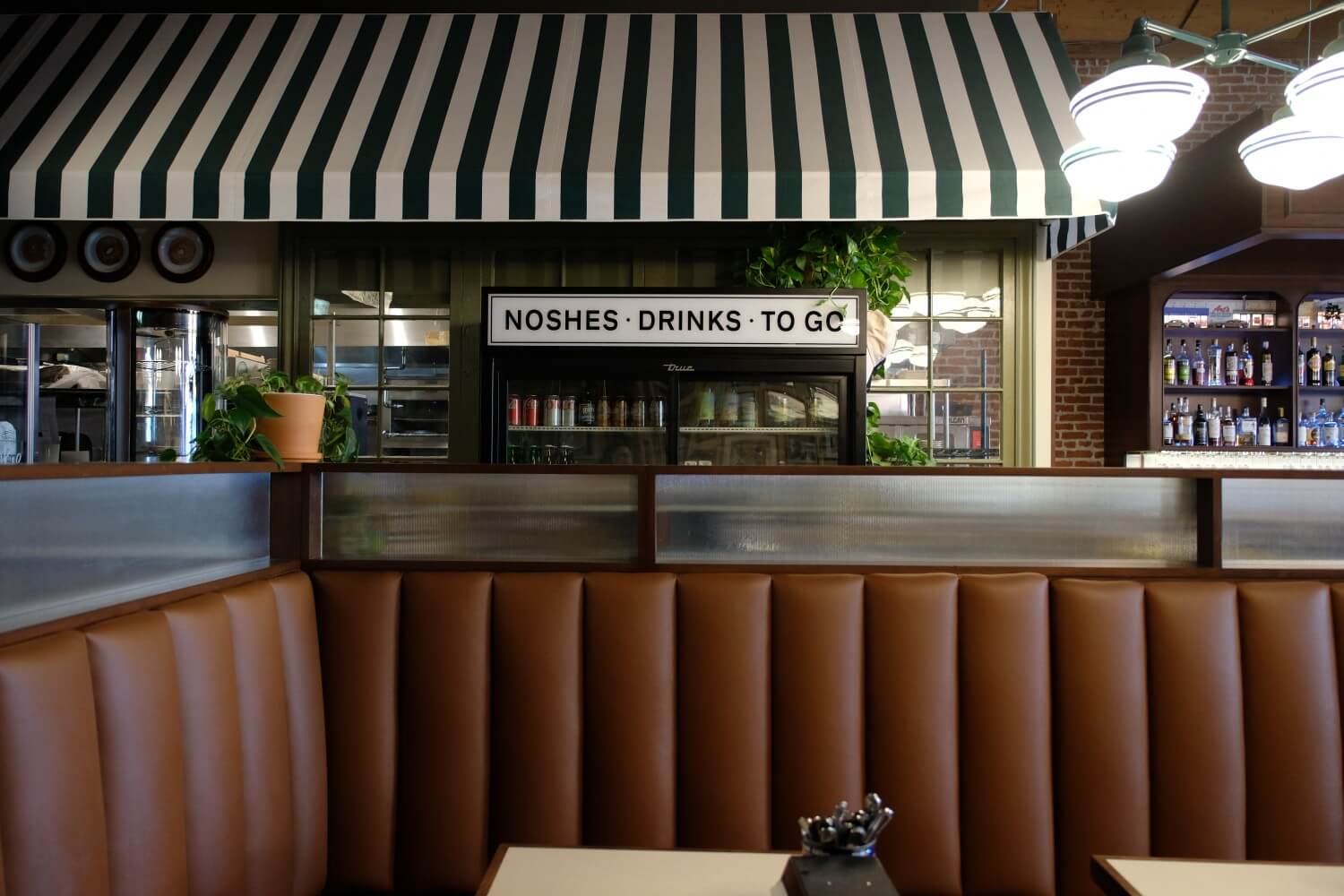
Interior of Belle’s in Los Angeles, CA. Sept. 26, 2024. Talia Goddard/The Occidental
Belle’s Bagels
By Diana Trutia
Belle’s Bagels, co-owned by James Dean Rocchio and Nick Schreiber, opened as a pop-up shop in 2012. Belle’s later transitioned to an outdoor seating-only brick and mortar location, and Aug. 1, Belle’s opened with indoor service for lunch and dinner, as well as a newly-added deli and bar.
“It was always the dream to have a regular bagel place,” Rocchio said. “Over the course of 2020, 2021, I think we just got a little bit more ambitious, and we’re like, ‘What else could we do?’”
Rocchio said that the idea to add a deli came from wanting to fill a new gap created by the large number of Jewish delis closing in LA.
“There seems to be an opportunity there. It’s meaningful to us, it might be meaningful to the community,” Rocchio said.
Co-owner of Belle’s J.D. Rocchio in the outdoor seating area at Belle’s in Los Angeles, CA. Sept. 26, 2024. Talia Goddard/The Occidental
Belle’s sells breakfast bagel sandwiches, ranging in price from $8–$14, and cold sandwiches, including Jewish specialties, which range in price from $11–$17.
“We’re definitely making a name for ourselves with the pastrami. Our Westlake is our version of the Langer’s sandwich, with Swiss cheese, coleslaw, pastrami,” Rocchio said. “It’s not that popular yet, but I’m a fan of the patty melt, and we also have a broccoli melt and we can make that vegan too.”
According to Rocchio, during renovations customers would look inside the restaurant and ask about the progress. While he and Schreiber originally thought about staggering openings for each new component of the restaurant, they decided to go all-in with one grand opening.
Customers at the bar at Belle’s in Los Angeles, CA. Sept. 26, 2024. Talia Goddard/The Occidental
“If we’re doing it, we’re doing it all,” Rocchio said. “And hopefully people will wait and hopefully it’ll be worth it.”
Belle’s Bagels is open every day except Tuesdays. Breakfast and lunch service is from 7 a.m.–3 p.m. on weekdays, and 8 a.m.–3 p.m. on weekends. Dinner service is daily from 5 p.m.–10 p.m.
Exterior of Mala Class in Los Angeles, CA. Oct. 3, 2024. Talia Goddard/The Occidental
Mala Class
By Diana Trutia
Mala Class, a Sichuan restaurant on York Boulevard, opened August 2024. Co-owner Kevin Liang said that he and co-owner Michael Yang met working in restaurants together in New York City, becoming fast friends. Three years after Yang left to open a restaurant of his own, he approached Liang for a partnership.
“He said, ‘Hey, I’m trying to go out to LA. I want to open a restaurant and I want you to be my business partner,’” Liang said. “We packed up our things and drove across the country and came up to LA in September 2019.”
Interior of Mala Class during a dinner rush in Los Angeles, CA. Sept. 26, 2024. Talia Goddard/The Occidental
Liang said that he manages customer interactions, with Yang serving as the head chef.
“I always joke around that he makes the food, and I sell the food,” Liang said.
Mala Class is open every day for lunch and dinner, except Mondays. Small plates are $7–$9, noodles are $12–$16 and main dishes are $15. Liang said that current customer favorites include cucumbers and bean curds, the mushroom fries and mala chicken wings.
“I would definitely recommend our dan dan noodles,” Liang said. “It’s sesame-based, as traditional Sichuan dan dan noodles should be, and it gives off a nice, right flavor mixed in with chili oil, garlic and the preserved vegetables. There’s tons of layers of flavor in that dish, and it really showcases what we’re capable of doing here with our menu.”
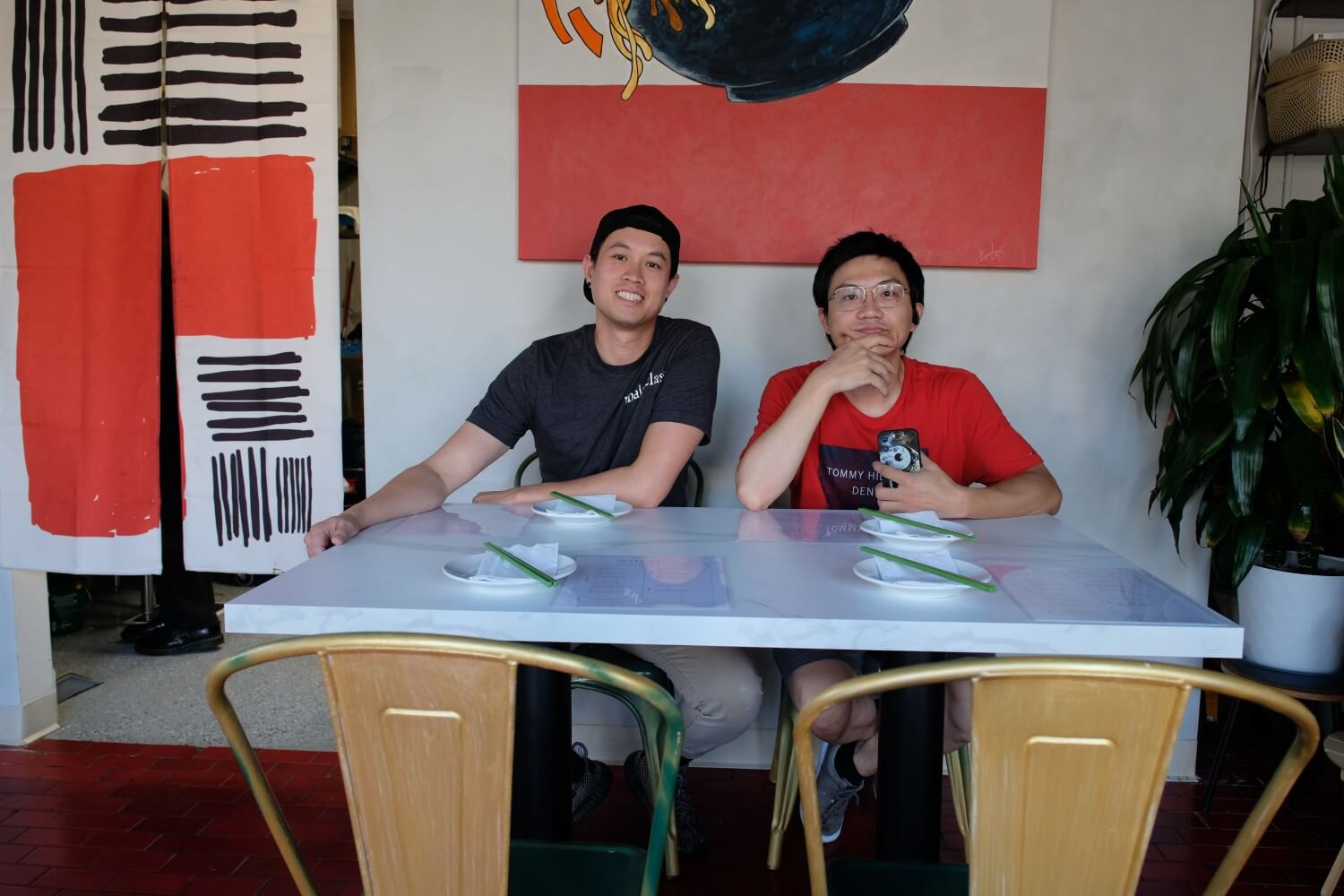
Co-owners of Mala Class Kevin Liang and Michael Yang at Mala Class in Los Angeles, CA. Oct. 3, 2024. Talia Goddard/The Occidental
Liang said that he and Yang chose Highland Park as the location for their restaurant because of its nostalgia to them, as well as its status as a proliferating neighborhood in LA.
“Highland Park is becoming an up-and-coming neighborhood in terms of restaurants. It’s like a destination spot, which is awesome,” Liang said. “So we thought it was a great place for us to start and grow.”
Mala Class is open Tuesday through Friday and Sundays 12 p.m.–3:30 p.m. and 5 p.m.–10 p.m. and Saturday 12 p.m.–1 p.m.
Washer and dryers in the first-year dorms of Stewart-Cleland Hall, Pauley Hall and Braun Hall have begun to break down since the beginning of the semester, leaving residents from Stewart-Cleland Hall and Pauley Hall flocking to Braun Hall’s facilities in search of functioning washers and dryers.
Joy Gao (first year), a resident of Stewart-Cleland Hall, said her experience navigating the laundry issues has been frustrating.
“It has been going on for three weeks now,” Gao said. “I went to my house off campus to do it once, but I plan to go to Braun to do it next. It’s the dryers — they don’t dry at all.”
According to Gao, Stewart-Cleland Hall residents received an email from the administration informing them of the efforts to repair the machines, but the timeline for fixing the issue remained vague. Gao said this email also told students to go to Braun Hall, located just north of Stewart-Cleland, as a temporary solution.
“We got an email saying it would be fixed sometime this month,” Gao said. “In the meantime, we would have access to the Braun laundry room.”
According to Gao, this situation has led to an overflow of students from Stewart-Cleland Hall, straining Braun Hall facilities. Carlos Abram (first year), a resident of Pauley Hall, said that some students from Stewart-Cleland Hall are utilizing Pauley Hall’s — just south of Stewart-Cleland Hall — laundry facilities, instead of Braun Hall.
Abram said this has led to an influx of students using Pauley’s laundry machines, which has broken down some of the dryers from increased wear and tear.
“Since [the dryers] have broken down, it’s been hard to get my laundry done in one fell swoop,” Abram said. “It’s put a strain on the flow of laundry and ultimately has led to some malfunctions in our laundry machinery.”
Abram said the deterioration of Pauley Hall laundry facilities has influenced Pauley Hall residents to find alternative solutions.
“That’s now forcing Pauley residents to dry their clothes elsewhere,” Abram said.
Dryers in Braun Hall at Occidental College in Los Angeles, CA. Oct. 4, 2024. Marty Valdez/The Occidental
Khylee Jackson (first year), a resident of Braun Hall, said the laundry room in Braun Hall has become significantly more populous since these issues began. According to Jackson, this has made it more difficult for Braun residents to find available washers and dryers.
“The laundry room has been packed for days,” Jackson said. “It [was] easy to do my laundry, but now I have to fight for a spot. As an athlete, this makes utilizing my already limited time much harder.”
Jackson said the increased demand has created long waiting periods, with students attempting to secure washers and dryers as soon as they become available. Aitan Milman (first year), a resident in Stewart-Cleland Hall, said he is frustrated with the administration, seeking a more immediate resolution from campus facilities.
Milman said that while he understands that the administration has acknowledged the issue, the temporary measures in place haven’t provided an adequate solution for a number of students.
“We pay a lot to live here,” Milman. “The least they could do is ensure we have working laundry machines.”
Milman said that a number of students have started to coordinate among themselves in an effort to make the best of the current situation.
“A lot of us have started working together to deal with the laundry problem,” Milman said. “It’s not ideal, but coordinating with each other is the only way to get things done without waiting all day.”
According to Milman, some students have begun to alternate machine usage, where one student washes while the other dries their clothing to maximize efficiency.
“We’ve figured out that taking turns helps make things move a bit more smoothly,” Milman said. “One person washes their clothes while another dries their clothes right after, and it saves us from standing around.”
Table with detergent and laundry in Stewie Hall at Occidental College in Los Angeles, CA. Oct. 4, 2024. Marty Valdez/The Occidental
Some students are considering alternative solutions, Milman said, such as off-campus laundromats, despite their inconvenience.
“It’s not a great option,” Milman said. “It’s more expensive and takes up time we really don’t have, but at least there’s no waiting line.”
He said he wants the machines to be fixed, as the situation is negatively affecting residents in every dormitory involved.
“Hopefully this issue can be resolved quickly,” Milman said. “But for now, it’ll be annoying to get laundry done and furthermore at the expense of inconveniencing residents of other halls.”
Contact Aiden Martin-Bradley at martinbradley@oxy.edu
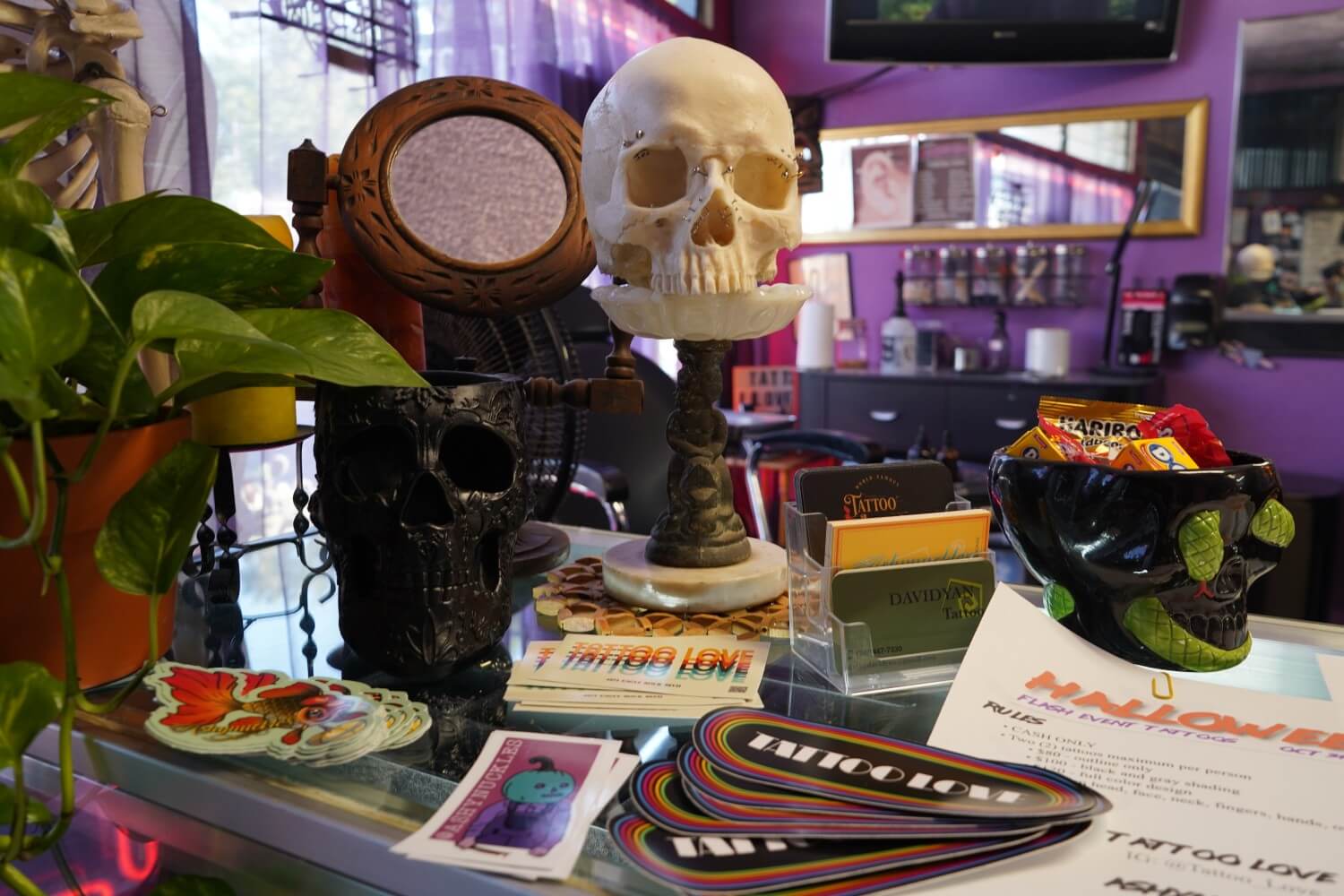
Tattoo Love & Body Piercing Co. (Tattoo Love) was the first tattoo and piercing shop established in Eagle Rock, according to George Tavera, the company’s owner. He said that Tattoo Love, founded 15 years ago, is one of the last remaining American traditional tattoo shops in the US.
“[Tattoo Love] is more rock and roll, traditional, what you see is what you get, 500-square-foot shop, badass artists,” Tavera said.
Tavera said he grew up close to Occidental and has been involved with the local Eagle Rock community since childhood. He said he loved drawing and coloring books as a child, learning from his grandma and uncle who also loved drawing. Tavera said that for three years he juggled a corporate job and a tattooing apprenticeship before deciding to open his own studio and work full-time as an artist.
“I decided to take an early retirement, in a sense,” Tavera said. “I always feel like you should love what you’re doing.”
Tattoo Love & Body Piercing Co. sign in Los Angeles, CA. Sept. 24, 2024. Lupin Nimberg/The Occidental
Diana Davidyan said she has been tattooing for three years, and joined Tattoo Love a few months ago as the studio’s newest member. Davidyan said she is originally from Russia and came to the United States 15 years ago to pursue higher education. She said she has obtained two associate degrees at a fine arts college and is currently working a degree in the medical field, because she believes healthcare workers are needed at the moment.
“I’m still doing art, I’m not going to stop doing that; it’s good to do both,” Davidyan said.
Davidyan said she has done art throughout her life, but that it was her husband — covered in tattoos when they first met — who encouraged her to go into tattooing. Davidyan said she was initially against the idea, as she hated shots and needles.
“I never imagined myself poking someone with a needle,” Davidyan said.
Interior of Tattoo Love & Body Piercing Co. in Los Angeles, CA. Sept. 24, 2024. Lupin Nimberg/The Occidental
Davidyan said she realized she enjoyed tattooing more than painting or drawing after taking lessons and apprenticing under a tattoo instructor. Davidyan said tattooing feels special to her, because she is able to create art that is permanent on someone’s body. She said she is continuing to grow as a tattoo artist while at Tattoo Love.
“I learn from other artists right now, and it’s nice to [work with] artists who are more experienced than you, because you can always ask their advice and opinion,” Davidyan said.
Xavi Campbell ’22 said they went to Tattoo Love for the first time during their sophomore year for a touch-up and soon became a regular client, eventually getting their nose and ears pierced at the store.
“[Tattoo Love] became a place that I really enjoyed going to,” Campbell said.
Manuel Cruz’s work station at Tattoo Love & Body Piercing Co. in Los Angeles, CA. Sept. 24, 2024. Lupin Nimberg/The Occidental
Campbell said they appreciate the customer service at Tattoo Love.
“They are very good about working with you, trying to figure out what’s best for you and trying to tailor it to you,” Campbell said.
Campbell said they have built a trusting and loyal relationship with Poison Ivy, the artist who did their touch-up and their now go-to tattoo artist in LA.
“It’s something that can be very meaningful, and it’s a shared experience between you and your tattoo artist where it’s like, ‘I’m trusting you to have my best interest at heart when it comes to the tattoo on my body, what I’m comfortable with, pain tolerance, all of the above,’” Campbell said. “It is essentially a partnership.”
Tavera said he sees many Occidental students at Tattoo Love and that staff and faculty visit the studio often as well. He said that at Tattoo Love, they emphasize building strong client-artist relationships and that an Occidental professor once donated a pair of skulls to the studio.
Interior of Tattoo Love & Body Piercing Co. in Los Angeles, CA. Sept. 24, 2024. Lupin Nimberg/The Occidental
Tavera said he likes interacting with the Occidental community and is always excited to see Occidental students at Tattoo Love.
“We are true Oxy fans, and we want you guys to be a part of us,” Tavera said.
Tattoo Love’s Halloween Flash deal will run from Oct. 31 to Nov. 2. Flashes are available to view in advance on Tattoo Love’s Instagram.
The Occidental chapters of Students for Justice in Palestine (Oxy SJP) and Jewish Voice for Peace (Oxy JVP), participating in a national Rage Week tied to the anniversary of the Hamas attacks on Israel, were rebuffed by Campus Safety and private security outside of Swan Hall Oct. 7 as they marched toward a Board of Trustees meeting taking place inside the building. Amid the standoff between protesters and security, a private security guard and professor made physical contact, and the professor fell or was pushed to the ground.
Associate Professor of History Michael Gasper shared a video with The Occidental of the incident. The video, taken by a protester standing few feet behind and to the right of the entrance pathway to Swan Hall, shows Gasper and another professor, separated from the protesting students behind them, conversing with four security guards roughly a quarter of the way up the walkway into Swan Hall. Gasper, looking slightly down and away from the guards, tries to walk around the rightmost security guard. The security guard ropes his arm around Gasper’s waist, and they move out of the right of the frame. Two seconds later the video reestablishes on Gasper collapsing in the shrubbery roughly halfway up the main walkway to Swan Hall. Gasper clutches his left knee, which is wrapped in a brace, and struggles to get up as the rightmost security guard continues walking backwards with his hands raised.
Gasper said via email that he was wearing the knee brace because of a severely torn left meniscus.
“I can’t even tell you how angry this whole utterly preposterous incident makes me,” Gasper said via email.
Occidental’s Director of Communications Rachael Warecki said via email that there is a disagreement about what transpired and that the incident is under review.
Protesters outside of Swan Hall at Occidental College in Los Angeles, CA. Oct. 7, 2024. Evan Lirette/The Occidental
Earlier that day at 10:10 a.m., roughly 50 students marched from the AGC steps to the main entrance of Swan Hall, where a Board of Trustees meeting was in progress. Protesters chanted, “Trustees, trustees you can’t hide / We charge you with genocide” and “Long live the Intifada,” among other slogans.
According to the media spokesperson for the protest, Occidental JVP Executive Board member Tobias Lodish (sophomore), Campus Safety selectively allowing students and faculty to enter Swan Hall is a terrible policy.
“It was just wrong of them to do that, especially considering the misconduct from these police officers today. Harassing students, harassing faculty members, not allowing students into academic buildings — it seems like they were in direct violation of the school’s policies,” Lodish said. “Not only was it wrong for the school to bring private security to campus, I think their behavior was inexcusable.”
The protest coincided with Oxy SJP and Oxy JVP’s installment of a day-encampment on the AGC steps as a part of their Week of Rage. Lodish said that students plan to protest from 6 a.m. to midnight, abiding by the college’s updated protest policy, every day this week.
Community guidelines outside of Johnson Hall at Occidental College in Los Angeles, CA. Oct. 7, 2024. Evan Lirette/The Occidental
Lodish said that protesters’ demands include an acknowledgement of a Palestinian genocide from Occidental administration, a realignment of the Board of Trustees behavior with the college’s mission and four cornerstones and a commitment from the administration to keep the Los Angeles Police Department off campus.
During a regularly scheduled all-faculty meeting in Lower Herrick Chapel that began around noon, Oct. 8, Occidental College President Tom Stritikus made statements and listened to questions from roughly 100 faculty members about student demonstrations and the free movement of Occidental community members on campus.
Stritikus said he could have done a better job communicating to faculty, those who had business in Swan Hall and at large, about the administration’s use of private security to secure the building Oct. 7 while a Board of Trustees meeting took place.
“It probably was an unforced error,” Stritikus said.
Stritikus said he chose not to change the date of the meeting or move it off campus. According to Stritikus, he did not consult with Faculty Council President John McCormack before deciding to secure Swan Hall during the Board of Trustees meeting. Stritikus said he could not guarantee that the college would not hire private security again in the future, and that bringing police onto campus is “100 percent a last resort.”
One professor who spoke at the meeting said that she was very chilled by the administration’s response to the protest.
“There’s a really big communication gap about what’s going on,” the professor said.
Campus Security filmed faculty members outside Swan Hall Oct. 7 during the student protests. One professor who spoke at the meeting said that Campus Security’s actions made him feel “wrong in the gut.” Another professor said that being filmed “is provocation, not de-escalation.”
Occidental’s General Counsel and member of the senior leadership team Nora Kahn said, “Once there is something happening, we need to make sure there is evidence being collected.”
A professor who spoke at the meeting said that Occidental’s Right to Dissent and Demonstration Policy pays lip service to students’ right to protest. According to the policy, Occidental is allowed to limit the time, place and manner of any form of protest or dissent under federal law. According to California’s Leonard Law, private colleges cannot punish conduct or speech that is protected under the First Amendment or a similar section in the Constitution of California.
During the meeting, several faculty members made an unsuccessful motion to amend the meeting agenda to discuss and vote on a resolution calling on the administration to not bring LAPD or private security on campus.
Roughly 100 people established a day-encampment on the Academic Quad Oct. 8, encircling the middle of the Academic Quad at 11:30 a.m. and chanting, “Disclose, divest, we will not stop, we will not rest.”
This story was updated at 6:30 p.m. Oct. 8 to include information from the faculty meeting and the protesters’ actions on Oct. 8.
Beginning in October, Emmons Wellness Center will resume Survivors Circle, a confidential support group for student survivors of sexual assault to reflect on and work towards healing from their trauma. The group will be facilitated by Emmons Staff Therapist and Training Coordinator, Dr. Paloma Franco, who said she plans to select a regular meeting time and location for the group in the coming weeks based on the needs of participants.
“Survivors Circle is a safe and confidential space for survivors on campus,” Franco said. “A safe space to heal, recover from trauma [and] reestablish some safety while connecting with others and being able to share experiences”
According to Franco, Survivors Circle will meet for 45 minutes weekly, discussing content designed to fit the needs of participants.
“The specific content will depend on students’ needs and what’s coming up [emotionally] for them,” Franco said via email. “The general content that I plan to cover [includes] practicing self-care during times of crisis, mindfulness and trauma healing.”
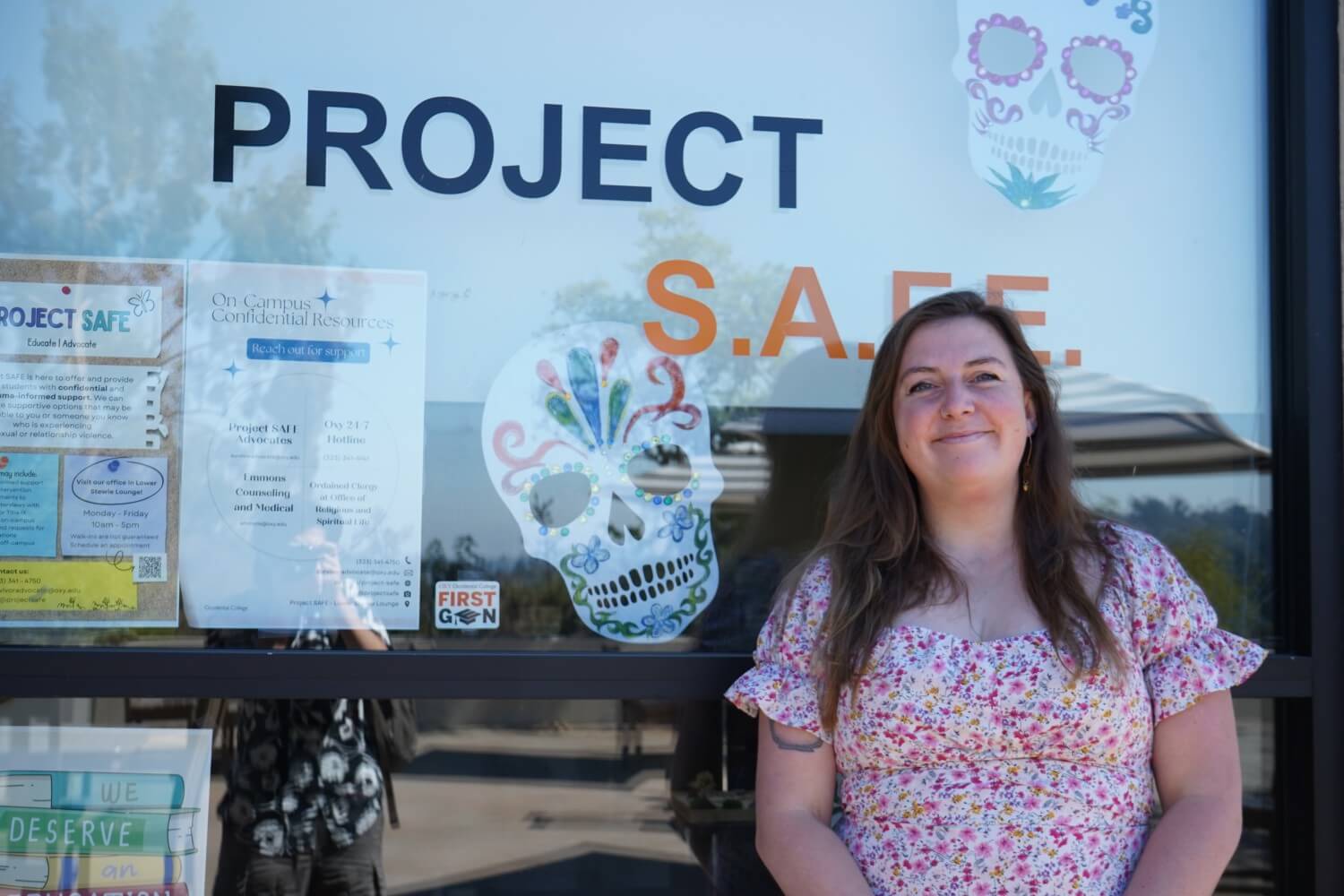
Lizzy Denny in front of the Project for a Sexual Assault-Free Environment (SAFE) building at Occidental College in Los Angeles, CA. Sept. 24, 2024. Lupin Nimberg/The Occidental
According to Lizzy Denny, Project SAFE Director and Survivor Advocate, this will be Franco’s first year facilitating the group but not her first time working on issues of sexual assault at Occidental. Denny said she facilitated the group last year.
“[Franco] has a lot of background in working with survivors, especially in a mental health capacity,” Denny said. “So it just made sense with Project SAFE’s limited capacity to ask her to [facilitate].”
Survivors Circle will work to combat the dismissal of trauma that survivors so often experience — internally, within their social spheres, and on a societal level, Denny said.
“Being a survivor of any kind of violence, but especially intimate partner violence, sexual violence, stalking [or] harassment, is a very isolating experience,” Denny said. “When an individual is a survivor of violence, they often start second guessing themselves, as society often teaches them to do.”
To combat this isolation, Denny said, Survivor Circle offers a unique outlet for participants to build connections and process the experience of their trauma in a communal environment — both the experience where they encountered violence, and the ongoing intersectional experience of being a student and a survivor.
Taylor Rokala (senior), a member of the Occidental Sexual Assault Coalition (OSAC), said on a campus like Occidental, it is essential for resources like Survivors Circle to be available for students.
“Oxy is such a small campus where it is impossible not to see people everywhere,” Rokala said. “If a survivor is dealing with an abuser on campus, having a designated safe space where they can talk about their feelings and share with other people that are experiencing the same thing is really important.”
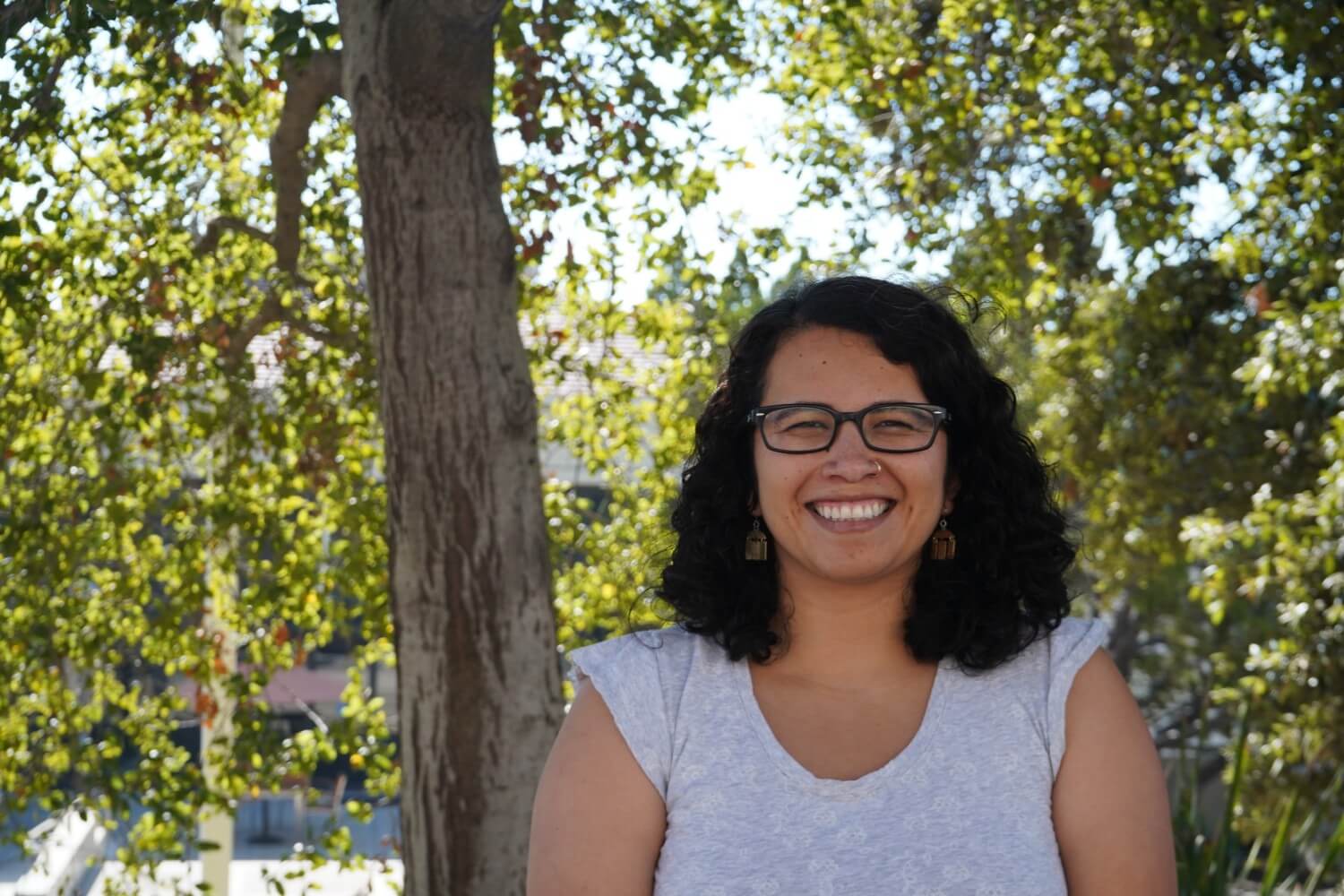
Doctor Paloma Franco at Occidental College in Los Angeles, CA. Sept. 24, 2024. Lupin Nimberg/The Occidental
Part of the Survivors Circle model is guaranteed confidentiality for participants, which does have some legal limits, Franco said.
“I meet with [participants] prior to the group starting and talk about what [confidentiality] means for them, and what it means to be in a confidential space,” Franco said. “It’s also so that they’re aware that what is talked about in that room with the other members is not leaving.”
Franco said that anyone interested in the Survivors Circle should contact her with questions, but they would be under no future obligation to participate in the group.
“I think it’s important for students to be able to choose whether or not they want to be part of this group,” Franco said.
Denny and Franco both encourage students to get support when they are ready, but to take as much time as they desire.
“It can be really scary and emotionally draining to reach out for resources,” Denny said. “Give yourself time. You get to decide when or if you access resources, and there’s no timeline on getting support […] we’re here for you.”
Contact Estel Garrido-Spencer at garridospenc@oxy.edu
Philanthropist and former New York City Mayor Michael Bloomberg donated a large sum of money — $1 billion dollars— to Johns Hopkins University’s medical school in July 2024, making tuition free for all students whose families make under $300,000 per year. At first glance, this seems like an exceptional act of generosity, assisting and helping increase access for a vital profession. In reality, this donation does not benefit the public, but a select group of people that earn their riches by extracting money from the rest of society.
I am, of course, talking about doctors.
Before you scroll down to the bottom of this article to write me an email, please do listen to my argument. I do not blame individual doctors for their rational decision to pursue medicine — I only blame the structure that doctors (inevitably) uphold, one that maximizes their salaries by reducing access to healthcare for the rest of society. It is immoral to remove the costs doctors partially bear for their profession’s decisions without also removing the benefits they reap.
The United States has a shortage of doctors — for instance, countries such as Italy, Spainand Hungary (paragons of wealth they are not) have more general practitioners and specialists per capita than the land of the free. Of course, doctor salaries in America rise to match their scarcity — 17 of the 20 highest paying professions in the U.S. are physicians (the other three are dentists). However, it is seldom acknowledged is that this doctor shortage was engineered by the very professional organization doctors pay dues to, the American Medical Association (AMA).
Contrary to popular belief, the AMA is not an arm of the United States government, but a private trade organization. This isn’t necessarily a bad thing — I support the right of workers and professionals to organize and promote their interests — but the success of the AMA in driving up their salary through restrictions on access to healthcare is profound.
The AMA’s history of restricting access to medical education and medical care stretches back upwards of 100 years. After the publication of the Flexner report in 1910, sponsored by the AMA’s Council on Medical Education, all but two medical schools (in the entire country) serving African-Americans were closed, and nearly half of all medical schools in the U.S. were closed in the following decade. Following Kristallnacht, the AMA instituted an English language requirement for licensure, fearing the effects that competition from Jewish doctors fleeing Nazi Germany would have on their bottom line. The AMA also routinely halted the expansion of more cost-effective group practice models by stripping doctors that joined such organizations of their licenses, in addition to lobbying against President Harry Truman’s universal healthcare plan.
However, none of these shameful moments in the AMA’s history have persisted in their damage as much as their advocacy for directly reducing the supply of doctors from the 1970s through the 1990s. After a decade-long campaign of fear mongering over the possibility of a doctor surplus, the 1980 Graduate Medical Education National Advisory Committee (GMENAC) endorsed a moratorium, supported by the AMA, on medical school enrollment expansion — the moratorium was only lifted in 2005. The belt tightened through the 1990s, culminating in the Balanced Budget Amendment of 1997, which capped federal funding for residencies — again, supported by the AMA.
While the AMA is now in favor of increasing the number of residency slots, their tepid statements of support do not obviate their decades of efforts to reduce the number of doctors. Nor do they justify their current opposition to scope of practice expansion. According to the best evidence available, allowing nurse practitioners and physician assistants to perform routine medical care currently reserved for physicians has no negative effect on health outcomes. Unfortunately (for the AMA), scope of practice expansion also increases access to healthcare, potentially reducing the salaries doctors can command.
Some may argue that by making medical school free, students will be more free to choose lower-paying specialties like primary care. However, there is no stipulation that students pursue such a specialty contained in these gifts — an anesthesiologist or radiologist will still receive free tuition for medical school at Johns Hopkins if their family makes $299,000 per year.
Philanthropy, like any other decision, has opportunity costs. When Bloomberg donated his money to Johns Hopkins, he did not donate that money to any of the charities in the GiveWell Top Charities Fund (which directly benefit the global poor), or any other effective charity for that matter. If Bloomberg sought to be more directly involved in medical education, he could have used that money to establish a six-year program that includes both undergraduate and medical education — a system commonplace in the rest of the developed world. Instead, the money will, inevitably, end up in the hands of an organization that has worked against the general public’s interest time and time again.
The AMA has crafted a devil’s bargain for aspiring doctors: four years of needlessly difficult pre-medical undergraduate programs, four years of medical school (including two years of clinical rotations), a brutally challenging licensing exam and two to seven years of underpaid and overworked residency; and in exchange, the highest salaries in the land, funded by brutally high healthcare costs for the rest of us. Philanthropists ought not use their funds to further enrich this profession.
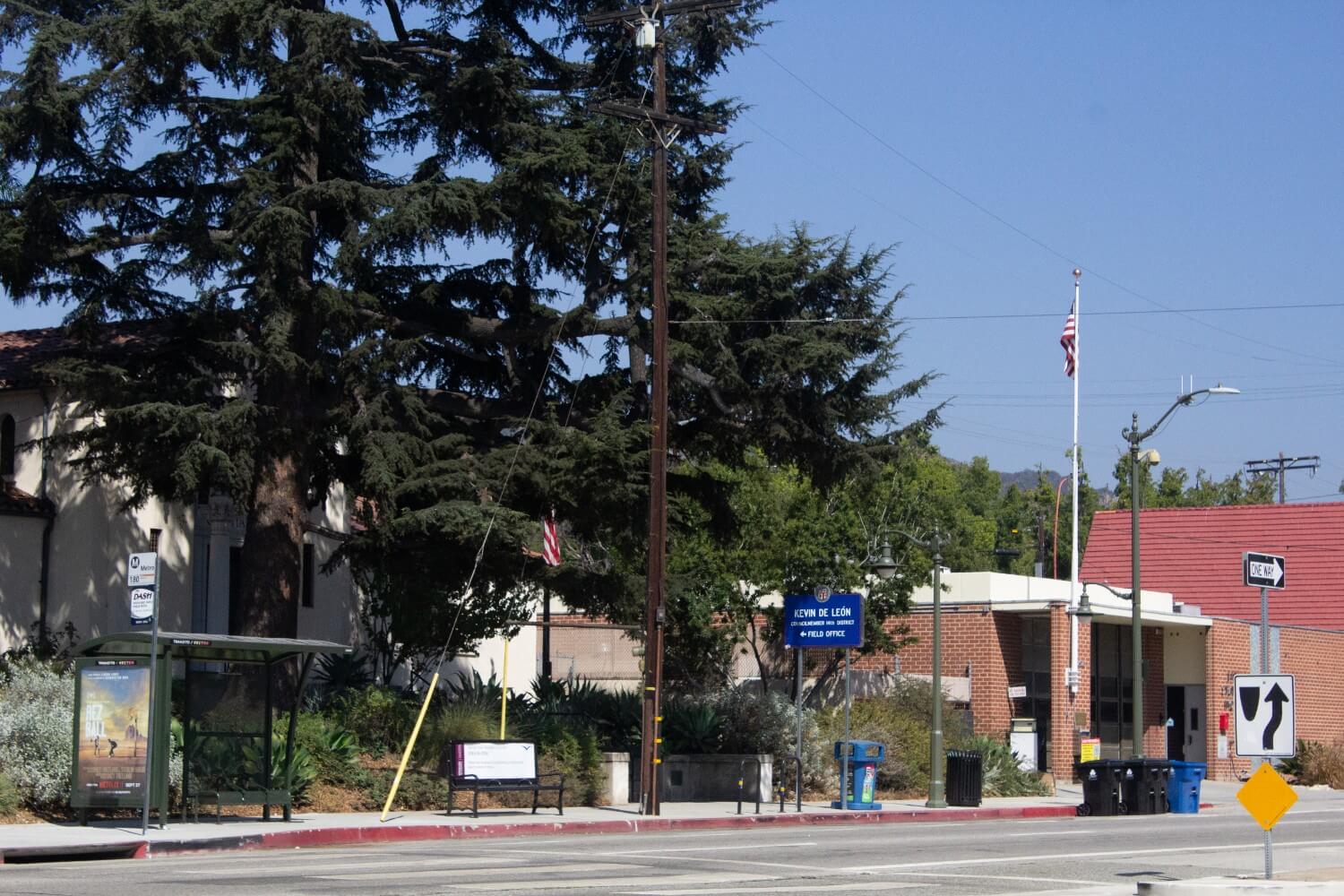
In response to several break-ins to shops on Colorado Blvd, the City Council of LA approved $100,000 January 2024 to increase foot patrols in Eagle Rock in a motion spearheaded by Kevin de León.
Luciano Alcorta co-owns Malbec Market, an Argentinian restaurant, alongside his brother. Alcorta said that no one has broken into his store since January. He said he credits the safety of his store to de León’s initiative.
“Mr. de León got involved very quickly,” Alcorta said. “I think he got the right message, and he jumped on it right away.”
Alcorta said he had an experience where several maintenance staff were working on the restaurant at 2 a.m., when police officers stopped by to check in on them to make sure they were safe.
“They were checking on them because it was after hours, and they wanted to make sure [everything was okay],” Alcorta said.
Alcorta said he feels like crime is not a problem specific to Eagle Rock, but one that is prevalent to the wider city of LA in general.
“It wasn’t like Eagle Rock was isolated,” Alcorta said.
He said he thinks the increase in crime over the last several years is due to Proposition 47 — a law classifying any theft under $950 as a misdemeanor.
“[Crime] was all around [the country] and mostly due to changing laws on how you punish people,” Alcorta said.
Exterior of Eagle Rock City Hall on Colorado Boulevard in Eagle Rock, CA. Sept. 24, 2024. Marty Valdez/The Occidental
Arvin Parayno, manager at Found Coffee, said he has not noticed any additional foot patrols since the investment.
“It’s kind of just the same,” Parayno said.
Parayno said that while he has not seen any foot patrols, he did notice LAPD officers stopping by in the past but that they would only come early in the morning when the shop had just opened.
“[LAPD officers] would come at 7 a.m., just say hi, and then leave,” Parayno said. “They wouldn’t even park their car.”
Arvin Parayno at Found Coffee on Colorado Boulevard in Eagle Rock, CA. Sept. 24, 2024. Marty Valdez/The Occidental
Parayno said it has been months since the last time an LAPD officer stopped by the store.
“Even after all that, we had an incident where someone came in and then just sat inside here,” Parayno said. “[They] didn’t buy anything — just caused problems and took a shirt from the racks.”
Parayno said he called LAPD, and that the police did come, but only arrived after the issue had been resolved. He said that he felt like nothing had changed since the initiative.
Sham Miller, the lead salesperson at Native Boutique, said that though people do enter the store at times, there has never been a break-in or attempted thefts.
“This one time, this woman who was maybe unhoused, but definitely on drugs, was shopping here,” Miller said.
Miller said that at the cash register, the woman tried to pay him with nail polish.
“She was like, ‘Did you know that when you’re pregnant, if you don’t clip your bellybutton during the eclipse, your child will have a cleft lip?’” Miller said.
Lead salesman Sham Miller at Native Boutique on Colorado Boulevard in Eagle Rock, CA. Sept. 24, 2024. Marty Valdez/The Occidental
Miller said he hasn’t noticed any increased police presence in the area, but said that he prefers it that way.
“I’d be fine with police [coming in] if they buy stuff,” Miller said. “I don’t really love police vibes.”
Alcorta said he believes that Eagle Rock is a community with a lot of potential for business and that he hopes to see it continue to blossom in the coming years.
“I think Eagle Rock is in transition [and] is going to be better,” he said.
Occidental College’s Student Organization Advisor of the Year Award recognizes a community member who advises and supports an organization outside of their normal duties. Occidental’s Associate Director of Jewish Student Life Ben Greenberg won the award in May 2024. According to the Rev. Dr. Susan Young, he was nominated by students as a part of Occidental’s Hillel group.
“It was a deeply unexpected thing but it was a lovely, wonderful surprise,” Greenberg said.
According to Greenberg, this academic year marks his first school year in a full-time role. Greenberg said that before January 2023, he had filled the position in a part-time capacity. Greenberg said he not only acts as the advisor for the campus’s Hillel group, but organizes logistics for major Jewish holidays, spearheads the Jewish Learning Fellowship and provides a Jewish lens in conversations within the campus’s student life team.
Greenberg said that during his undergraduate experience at Binghamton University, he did not always feel welcomed by their Hillel group. Greenberg said the unwelcoming experience he had with his campus’ chapter defined the nature with which he takes on his work within the Judaic world.
“My [motivation] to do this work is [the desire] to embody radical hospitality to the best of my abilities,” Greenberg said.
Greenberg said that to him, radical hospitality means setting aside prejudices people tend to create about others. He said mentors such as Rabbi Kalmanofsky, his hometown rabbi, taught him the value of radical hospitality.
Ben Greenberg at Sycamore Glen during Shabbat dinner at Occidental College in Los Angeles, CA. Sept. 13, 2024. Lupin Nimberg/The Occidental
Greenberg said he is a New York native from the Upper East Side and has long been surrounded by Judaic influences through his family involvement in Jewish community centers and synagogues.
According to Greenberg, he had a remote position at nonprofit Limmud North America prior to working at Occidental. However, he said he yearned for in-person connections and felt unfulfilled by remote work. When the part-time position as Associate Director of Jewish Student Life became available, he said it aligned well with his personal and professional needs.
Here at Occidental, Greenberg said that his primary role is to act as an advisor toward Jewish students, who account for 7–10% of the student body.
“The goal of this work, if you’re doing it well, is you give the students that you work with the tools to be able to build their own Jewish life when they graduate,” Greenberg said.
Greenberg said that since Judaism touches upon both his professional and personal life, he often grapples with his relationship to his spiritual identity and how it can help in his mentorship and life beyond.
According to Vice President of Occidental’s Hillel chapter, Danielle Levin (junior), the religious transition from high school to college can be difficult at times. Levin said that she too came from an environment in which the Judaic lifestyle was incorporated into her everyday experiences.
“I think that it can be kind of hard to navigate that piece of your identity when it’s not happening with everyone else around you,” Levin said.
Levin said that for Jewish students, Greenberg has played a large role in piecing together logistics on practicing Judaism on campus.
Ben Greenberg outside the Herrick Chapel at Occidental College in Los Angeles, CA. Sept. 13, 2024. Lupin Nimberg/The Occidental
Since the Oct. 7 Hamas attack, Greenberg said he has met with Jewish students from all perspectives who revealed general feelings of distress and felt pressured to be spokespeople for the Jewish community. Greenberg said that for many Jewish students, the line between anti-Zionism and antisemitism can feel very blurred, hence the feelings of fear and unease he’s been met with from his students.
“[I’m] trying to figure out how I can be supportive to folks across different spectrums and who also aren’t seeing the moment with unanimity. [It] requires a lot of work and a lot of careful consideration about how to be receptive to everybody, wherever they’re coming from,” Greenberg said.
Greenberg said he hopes the addition of a Muslim Student Life Coordinator will begin a partnership and encourage productive dialogue for Occidental students to move forward from the divisive quality of student life semesters prior.
Young said there are plans for a new initiative aimed at engaging in dialogue across different identities with President Stritikus, Greenberg, the new coordinator of Muslim Student Life and students.
“Occidental College is very diverse but we’re not very pluralistic. Meaning, we’re diverse but we don’t create the space for diverse people to participate in authentic communication, to learn from one another and celebrate differences,” Young said.
According to Greenberg, he will continually utilize lessons learned from Judaism to help him navigate mentorship on campus after last spring.
“There’s a really beautiful Jewish teaching that I love that is very inspiring,” Greenberg said. “It’s something along the lines of ‘You are not required to finish the work, nor are you free to desist from it.'”
Greenberg said this encompasses the idea that in our limited human lifespans, we are called on to make the world a better place for future generations.
“I’m not naive enough to think that I will ever be [able] to do all that work so that by the time I die, [it] will be in a perfect world,” Greenberg said. “But that is not a case for nihilism — quite the opposite. […] It’s both a radical study of humility and also a radical call to action.”
Occidental students Emma Galbraith (senior) and Luci Johnston (junior) took to the stage to speak on the climate crisis Sept. 20, as Angelenos of all ages and backgrounds gathered in front of the LA City Hall. This speech happened as part of a yearly climate strike organized by Youth Climate Strike LA (YCSLA), a local climate organization that fights to enact progressive climate policy and spreads climate education. According to Johnston, members of Sunrise Oxy — the biggest climate activism group at Occidental — attended the event to show their support.
Johnston said the Sept. 20 climate strike is part of a five-year-long tradition of global strikes that originated with Greta Thunberg and the Fridays for Future Movement.
“Every year, a group of climate organizers and activists — people from different parts of society — join together to voice our hope that city hall and other levels of government will call for a climate emergency,” Johnston said.
According to Johnston, a comprehensive list of demands explaining the term “climate emergency” can be found on the YCSLA website. This list includes demands for an end to the sale of fossil fuel vehicles and the creation of a set of bills outlining how LA will achieve carbon neutrality within the next decade.
Oxy Sunrise student activist Luci Johnston (junior) at Occidental College in Los Angeles, CA. Sept. 19, 2024. Marty Valdez/The Occidental
Sunrise Oxy member Karina Kachler-Glynne (senior) said that her family’s history of migration initially inspired her to become involved with the climate movement.
“The climate affects everybody. I can’t think of anybody in my family who isn’t an immigrant of some sort,” Kachler-Glynne said. “Those cases were not directly climate-related, but as the crisis continues, so many more people will have to flee their homes [as they] become uninhabitable. As a member of Sunrise Oxy, I want to be actively doing everything I can to prevent that.”
Kachler-Glynne said that as the earth becomes hotter, climate change will become increasingly visible and damaging to economically developed cities like LA.
“We saw it just a couple of weeks ago with the extreme heat wave here,” Kachler-Glynne said. “[LA has] such a prominent homeless population, and there was talk about public cooling centers being necessary to prevent people from suffering and potentially dying of heat stroke.”
Several of YCSLA’s demands deal with measures to reduce the impact of urban heat stress in LA. These include a clause advocating for the expansion of canopy covers in areas affected by extreme heat and the reduction of heat-absorbing pavement.
Johnston said that along with provoking legislative change, part of the aim of the Sept. 20 strike was to increase awareness in LA about the connection between current weather patterns and carbon emissions.
“We want people to notice that the heat waves we’ve had recently are not random events,” Johnston said. “We want people to know that they’re connected to climate change and that they’re worsened and made more frequent by emissions.”
According to Johnston, Sunrise Oxy has made significant progress advocating for some of its key issues, such as plastic waste and emission reductions.
“We helped get the eco-clamshells in The Marketplace two years ago, and we’ve done various mutual aid projects,” Johnston said. “In January [2024], [the Board of Trustees] also signed a document called the Second Nature Climate Commitment promising to reduce the college’s carbon footprint.”
The signing of the Second Nature Climate Commitment followed a 2015 student-led campaign by Fossil Fuel Oxy calling for the Board of Trustees to divest from fossil-fuel company stocks.
According to Occidental’s Director of Communications Rachael Warecki, signing the Second Nature Climate Commitment was recommended by the Occidental College Climate Resiliency and Equity (OCCRE) Task Force, which was founded in May 2022
However, Johnston said they worry that Occidental’s implementation of their promises is not happening fast enough to have an impact.
“Unfortunately, we haven’t heard much from the admin since January,” Johnston said. “They signed [the commitment], but now we’re not sure what’s happening. We haven’t heard any clear commitments after that. It’s just moving too slowly.”
Oxy Sunrise student activist Zoe Bush (junior) at Occidental College in Los Angeles, CA. Sept. 19, 2024. Marty Valdez/The Occidental
Vice President and Chief Operating Officer Amos Himmelstein said that as of September 2024, Occidental College still retains some investments in the fossil fuel industry, but that the college is committed to decreasing its reliance on fossil fuel-related investments in the future. According to Himmelstein, the Occidental College Board of Trustees Resolution Regarding Climate Change and Endowment Investment Policy is the most recent document detailing the college’s fossil fuel-related investments.
According to the resolution, Occidental will “no longer make investments in fossil fuel-related private partnerships and will not make additional direct fossil fuel-related investments, unless such investments support lower carbon emission transition strategies to renewable sources.”
According to Kachler-Glynne, Sunrise Oxy’s plans for the semester center around encouraging the student body to register to vote and advocating for local candidates who Sunrise believes can tackle the challenges of climate change.
“We’re campaigning for some of the local candidates like Ysabel Jurado for City Council and David Kim for Congress — people that will center climate policy and affordable housing as top issues,” Kachler-Glynne said.
Kachler-Glynne said that a major point of striking is to encourage students to get out of their routine and get directly involved with action, even if it means giving up valuable time.
“People ask, ‘Why does it have to be on a Friday when we have class or work?’ But that’s the point of a strike. You have to do it when you’re supposed to be doing something else so that your absence is noticed.” Kachler-Glynne said. “Sometimes making a difference takes sacrifice.”