The Occidental newsroom won five 2025 California College Media Awards this March, including Best Newspaper website in the state for colleges under 15,000 students. The award is for work done in the 2025 calendar year. Occidental’s awards are for the category of colleges under 15,000 students.
The Occidental Editor-in-Chief Nora Youngelson (senior) said, “I am incredibly proud of the team of talented journalists who work on this paper, and it is an honor to receive recognition for our work.”
James Miller (senior) and Emma Cho ’25 won first place for Best Feature Story for their Feb. 5, 2025 article, “‘Did we just lose everything we’ve invested all our lives into’: Occidental community grapples with Eaton Fire.” Miller and Cho interviewed faculty, staff and a student who were affected by the Jan. 7, 2025 fires.
Jacob Whitney ’25 won second place for Best Breaking News for his May 8, 2025 article, “Oxy SJP protest and confrontation with security at Stritikus’s inauguration expose strong divides across campus communities.” Whitney’s coverage of the event also won an honorable mention in the national Associated Collegiate Press contest October 2025.
Francine Ghazarian (junior) won third place for Best Non-Breaking News Story for her Nov. 12, 2025 article, “Occidental ranked 151st out of 257 colleges for free speech climate.”
Anthony Cordova (first year) won Third Place for Best Sports Photograph for his Nov. 8, 2025 photo of celebrating Occidental soccer teammates in the article, “Men’s soccer wins SCIAC, women’s team makes playoffs for first time in four years.”
“The CCM Awards are a reflection of the time and energy that our team dedicates to the newsroom every single week. Now more than ever, student journalism is crucial not only to our college campus but to all the communities that we are taking part in,” Youngelson said.
To contact The Occidental staff, email theoccidental@oxy.edu.
Maciel’s Plant-Based Butcher Shop, a vegan restaurant co-owned by husband and wife Joe Egender and Maciel Bañales Luna, was featured in an Only In Your State ranking of “The 50 Best Sandwich Shops Across the U.S.,” coming in at No. 1 in California and No. 5 nationwide. The restaurant, located at 5933 York Blvd., is known for its plant-based meats and cheeses made in-house, according to the restaurant’s website.
According to Senior Editor of Only In Your State, Marisa Roman, the publication wanted to highlight Maciel’s Plant-Based Butcher for thinking outside the box.
“Being a ‘plant-based butcher and deli’ is so wildly cool,” Roman said via email. “They’re stepping outside the mold of what we’ve, as a culture, always known delis and butcher shops to be.”
Roman said selecting Maciel’s was not a challenge, as the shop is doing something really special.
“Creating a vegan sandwich that’s truly craveable [is] rare, and it’s absolutely worth sharing with our audience,” Roman said via email.
Egender saidneither he nor Bañnales Luna currently eat meat, but he grew up eating a lot of it in Kansas City.
“I think there‘s a misconception that vegans and vegetarians don’t like meat, […] but I think a lot of people love the taste of meat; it’s delicious and humans have been eating it for a long time,” Egender said.
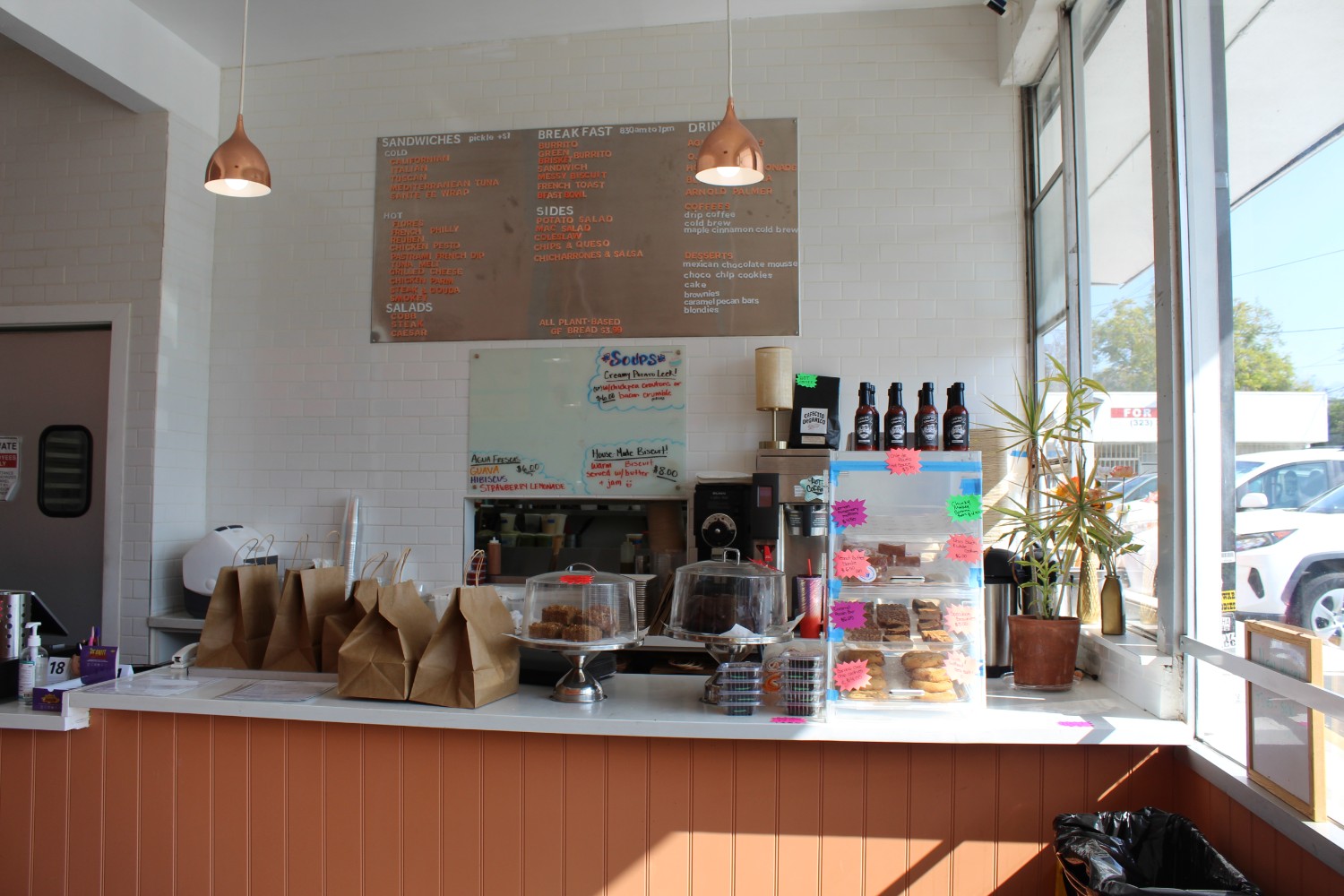
The counter and menu inside Maciel’s Plant-Based Butcher Shop on York Boulevard in Los Angeles, CA. March 25, 2026. Lila Weiner/The Occidental
According to Egender, Bañnales Luna, who has both a master’s and PhD in nutrition, cares deeply about the environment, animal rights and food.
“For a long time, vegans and vegetarians had one or two options in the grocery store that weren’t necessarily very delicious,” Egender said. “[Bañnales Luna] thought, ‘Why can’t there be really good, delicious plant-based meats that are healthy for you and […] come close to looking, tasting, smelling like, real meat?’”
According to Egender, their meats are mostly legume-based with seitan added for extra protein. Egender said figuring out the techniques for making their meats was a challenge.
“Some of them were steamed, some were cooked, some were in the oven,” Egender said. “We have someone that comes overnight, kind of like a bakery, and makes the meats.”
Egender said Bañales Luna started making meat at home when they were living in New York. Then, the COVID-19 pandemic hit.
“COVID changed everybody. It made everybody go: ‘Am I looking at my life the way I want to be looking at my life?’” Egender said. “People made bigger decisions around COVID, and that’s certainly what we did.”
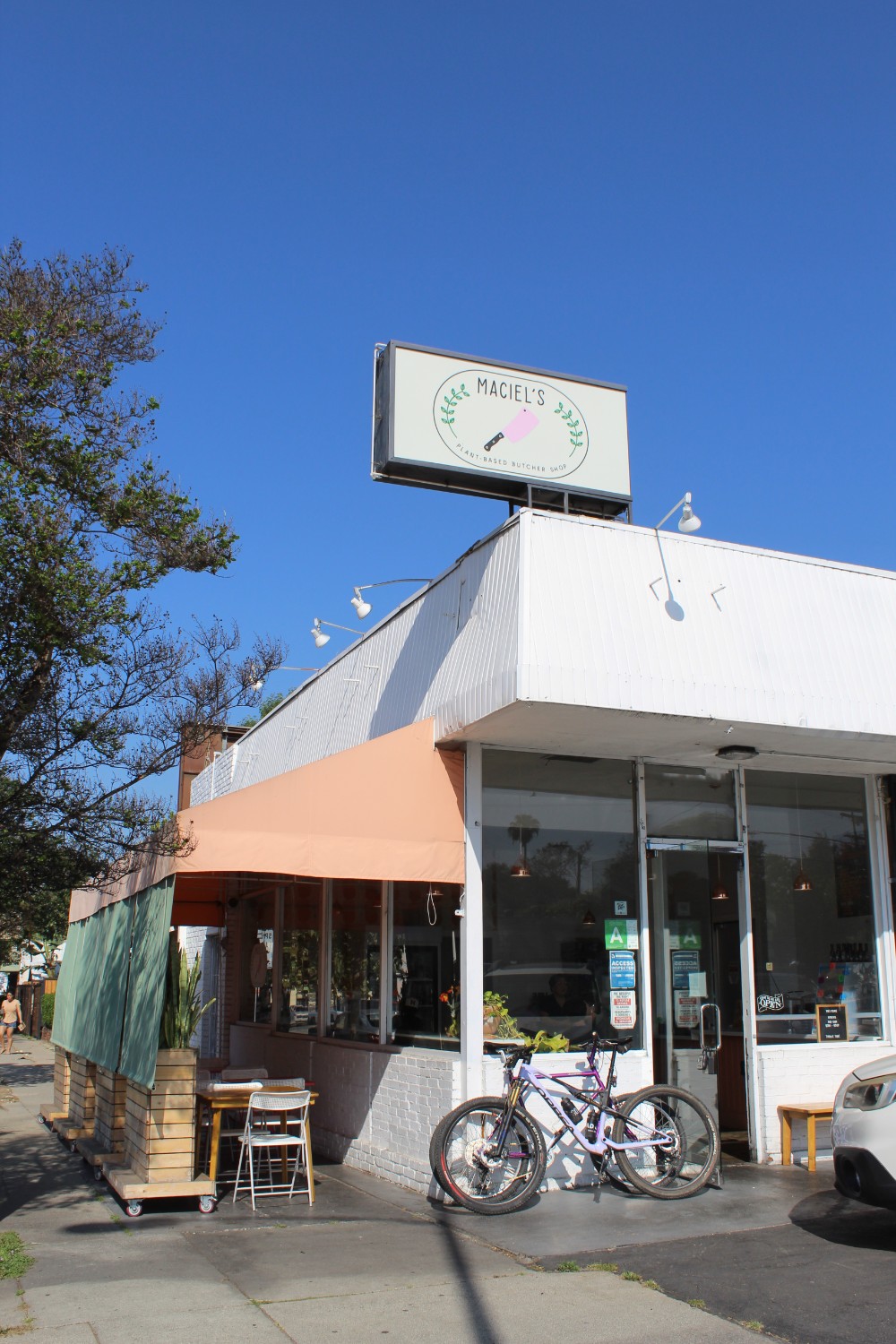
Maciel’s Plant-Based Butcher Shop on York Boulevard in Los Angeles, CA. March 25, 2026. Lila Weiner/The Occidental
Egender said the couple decided to open their shop in LA because, after previously living in the city and knowing people in its restaurant scene, they had a strong foundation here. Egender said they also wanted to be closer to Mexico.
“Maciel is from Mexico, so we’re closer to her family. There’s also some Mexican elements to influence [our food],” Egender said. “We thought that it made a little bit more sense in Los Angeles.”
According to Roman, Only In Your State looked for restaurants paying respect to their heritage when creating its ranking.
“When it came to naming the best restaurants, we looked beyond buzz,” Roman said via email. “We also considered accessibility, inclusivity, affordability, hours and overall value — while giving extra credit to spots that balance creativity and innovation with respect for their culinary roots.”
Egender said initially, the idea was to sell plant-based meats, but they wanted to escape the small bubble of vegetarian and vegan customers. Now, Egender saidcustomers can get hooked on the sandwiches and come back to buy just the plant-basedmeat products. According to Egender, customers sometimes come in skeptical, but once they try a sandwich, they return for the plant-based turkey or bacon.
“We needed to make sandwiches so people could come and experience the meats and then come back and start buying [the other products],” Egender said.
Returning customer Crystal Newcomer said she keeps coming back because the food is really good and she strives to support local businesses.
“We get something different every time,” Newcomer said. “The food is fantastic […], and we’re big fans of the restaurant.”
When new customers walk into the shop, Egender said they do not alwaysknow it is a vegan sandwich shop. Egender said they try to be conservative with branding, sticking to classic names for their sandwiches like ‘Reuben,’ ‘Philly Cheese Steak’ and ‘Fried Chicken Sandwich.’
Students for Justice in Palestine (SJP) announced March 6 via Instagram that they are planning to submit a new divestment proposal to the Board of Trustees this semester. According to the post, students can sign the proposal in person, while non-students can sign online.
SJP member Aurelia Mendez-Ortega (sophomore) said the proposal is going to be submitted in late April. According to Mendez-Ortega, companies llike Maersk, a transport company involved with shipping weapons to Israel, and The Geo Group, a private prison company that owns immigration detention centers and holds contracts with ICE, have been added to the divestment proposal.
“It’s important for students to be aware of the school’s investments in the genocide that’s happening right now […] and to understand where the money they’re paying is going,” Mendez-Ortega said.
Jewish Voices for Peace (JVP) member Evan Zeltzer (sophomore) said the proposal stems from research done by both SJP and JVP into how investments play into the Palestinian genocide.
“While divestment is focused on Palestinian liberation, something that we are very aware of is that all of the issues oppressed people are facing are integrated,” Zeltzer said. “The proposal is addressing technologies that are developed in Israel and [exported] to the United States and other countries in the world.”
Mendez-Ortega said SJP is aiming for about 1,000 student signatures and will be tabling on the Academic Quad.
“Having this petition be an in-person thing for students is a way to get conversations started […] and to actually have students understand what this petition is for, as opposed to signing something online where they can do it in 12 seconds or maybe not read the whole thing,” Mendez-Ortega said.
SJP plans to submit its proposal to ASOC before it goes to the Board of Trustees. According to SJP, there has previously been no formal process for submitting a divestment policy to the Board of Trustees.
Last semester, the Board of Trustees revised its policies on how investment policy proposals should be submitted, according to ASOC President Trisha Bhima. The finalized policy stated that any investment policy proposal would have to be submitted through “… (ASOC), Faculty Council, the Alumni Association Board of Governors or a designated all-staff council before it was submitted to the [Board of Trustees],” Bhima said via email.
According to Zeltzer, ASOC will review the proposal not for content, but to check it if it meets specific informational requirements before sending it to the Board of Trustees.
Mendez-Ortega said this will be the third time SJP submits a divestment proposal to the Board of Trustees.
“[The proposal] outlines how the college’s values can be reflected through divestment,” Mendez-Ortega said. “That is a way to [see] if they actually care about the values they say they hold.”
SJP and JVP incorporate discourse about divestment in education sessions in order to keep the effort going as students who have submitted proposals in the past graduate, according to Zeltzer.
“There was so much excitement around divestment [on campus] immediately in the aftermath of when the genocide started,” Zeltzer said. “The centrality of divestment […] permeates through everything we do.”
Angie Bos was named incoming Vice President for Academic Affairs and Dean of College, as announced in a campus-wide email, March 2. Bos will step into the role July 1, taking over for Interim Dean Kathryn Leonard, who will return to teaching.
“Occidental is just such a strong community, and that is the kind of place that I want to be — a supportive community where every person on campus is contributing to the mission and matters to that,” Bos said. “I’m really excited about Occidental, where you have these opportunities for really strong relationships with students.”
Bos joins Occidental after four years at Boise State University, where she currently serves as Dean and professor in the School of Public Service. While the role of the Dean is centered in organization and administrative work, Bos said her approach to the job is primarily people-oriented.
“[As a Dean] you’re really just the connector,” Bos said. “You are immersing yourself in both [administrative and faculty] sides, communicating within and across. I think communication is a key aspect. It is also a people job. I’m really trying to recruit and retain the best folks to enhance the student experience.”
According to President Tom Stritikus, the search for the Dean began in the fall semester, when a search advisory committee was formed with faculty, trustee, alumni and student representatives. The committee aided the search process through interviews, campus visits and debriefing discussions, Stritikus said.
“Oxy is a multi-constituent network and every constituency really deeply cares about Oxy and has a stake in it,” Stritikus said. “It was important to have those voices in the room to help determine who a lot of different people would think is going to be most successful here.”
Grahm Tapp (sophomore) served as the student representative on the search advisory committee. Tapp is a member of ASOC’s Diversity & Equity Board (DEB), and Stritikus and Professor Alexander Day chose Tapp for the role, Stritikus said. Tapp said he participated in the interview process and debrief sessions, all while collecting information from students.
“[Bos] was one the most student-centered candidates that we had,” Tapp said. “Every conversation was tied back […] to ‘How is it going to help students?’ That is what I, as a student representative, am supposed to be advocating for. That’s what I want to hear.”
Department Chair and Professor of Geology Darren Larsen alsoserved on the search advisory committee. During the interview process, Larsen said Bos had a meeting with various department chairs, during which Bos immediately stepped into the role of Dean.
“There is a wide range of perspectives on what are the best qualities of Dean and what their attention should be tuned into,” Larsen said. “[The meeting] was a rewarding experience in general [and] it was very reassuring that all of us really felt that Dr. Bos was our top choice, unanimously, and that is terrific.”
The role of the Dean, according to Larsen, is multifaceted— they must interface with students, faculty and administration. Stritikus said Bos confidently navigates this challenging aspect of the role.
“She brings an orientation as a leader that is primed to help people solve the problems that they really want to solve,” Stritikus said.
The most important hire for a small liberal arts college like Occidental is the Dean, Stritikus said. The Dean is a central part of the overall administration and leadership of the school, Stritikus said, especially because if the president isunable to discharge the duties of the office, the Dean becomes the president. Stritikus said that while the application pool was incredibly talented, Bos stood out.
“I want to hire someone who I know could beat me in an argument,” Stritikus said. “So, if we were arguing about something and I had a particular opinion, but the Dean thought [the opposite,] I would hire the person who I thought would make the stronger case. And in this case, it was clear that Dr. Bos would be able to do that.”
At Boise State University, and previously at College of Wooster, Bos said she worked on different ways to connect classroom with outside of the classroom learning. Bos said she plans to continue this work at Occidental.
“Occidental’s urban location is really exciting to me,” Bos said. “I am really passionate about the ways that we take classroom learning out into the world, and just the vast opportunities to do that in Los Angeles are really exciting.”
According to Tapp, during the interviews, Bos made it clear that she understands an essential aspect of Occidental life.
“[Bos] talked about the totality of student life a lot,” Tapp said. “I really like that because I mean, Oxy’s unique: we live here, we breathe here, we all eat here. Our academics and our curriculum can affect every aspect of our life at Oxy because we are in it, and she really talked about the comprehensive, holistic student experience.”
Most of all, Bos said, she is excited to meet and serve the Occidental students.
“I really love finding all those connection points with students,” Bos said. “Those are the ways that I learn things and can bring it back to when we’re having curriculum discussions or thinking about different programs or offerings. I’m excited about all the opportunities to meet students, to meet faculty, to meet staff, and to find all the ways that I can contribute to making the connections that bridge and make Occidental an even more amazing place.”
The war in Iran began Feb. 28 after the United States and Israel bombed Iran, killing their supreme leader Ali Khamenei and continuing an ongoing military assault by the U.S. in the Middle East.
Most recently, U.S. warplanes and attack helicopters have been attacking Iranian drones and naval vessels in an attempt to reopen the Strait of Hormuz as the war approaches the three-week mark.
Sara Tina Kazemi (senior)
Kazemi said although she was born in the U.S., both her parents emigrated from Iran during the Iran-Iraq War. Kazemi said her father and mother came to the U.S. for a postsecondary education.
“After he left Iran, my father lived in Turkey, Austria and modern-day Serbia back when it was Yugoslavia,” Kazemi said. “Everywhere else he lived did not seem as promising as the U.S. [for postsecondary education].”
Kazemi said her first language is Persian and that she went to Persian school growing up. Kazemi said she has visited Iran a handful of times, although she has never spent longer than a month there.
“[Iran] is so many things to me,” Kazemi said. “Obviously it is my family connection, but it is also going to the market with my grandma and […] getting bread with her. It is finding out that I really like mountains and gardens when I was 9. [It is] my love of history, [which was] sparked by going to museums in Iran.”
Kazemi said she currently has family in Iran, but it is difficult to stay in contact with them because the regime has been cutting phone lines.
“Iranians right now constantly feel surveilled,” Kazemi said. “They can’t speak to their family outside of Iran. All we’re getting is from all these different news outlets.”
Kazemi said although she acknowledges the Iranian regime has violated queer and women’s rights, she does not think the U.S. and Israel are justified in bombing Iran and manufacturing consent from their respective populaces.
“I’m sick of all these propaganda campaigns,” Kazemi said. “People are justifying bombing Iran in the name of [queer] rights and women’s rights. Where were you a few months ago, or a couple years ago when every major protest movement [happened] in Iran? I’m sick of the people that are just speaking up now about Iranian suffering.”
Sophia Hoo (sophomore)
Hoo said her grandfather is from Iran and moved to the U.S. when he was 15. Hoo said she mainly connects with Iranian culture through food.
“My grandma can make really good Persian food, even though she’s Chinese, because my grandfather’s mother [taught her],” Hoo said.
Hoo said that while her grandfather moved to the U.S. at a young age, he has family currently living in Iran.
“My grandfather’s siblings [are] in hiding [in Iran],” Hoo said. “It is pretty scary to have people over there that you can’t really do anything about.”
Hoo said it is hard to embrace U.S. nationality right now because of the choices the administration is making, but that she does not agree with the Iranian regime either.
“The U.S. is being unnecessarily greedy, and none of it makes any sense,” Hoo said. “It’s too much chaos […] civilians just want peace. Nobody really wants this meaningless war.”
Hoo said the war in Iran has created a feeling of sorrow among Iranian students at Occidental, although they still frequently interact with Iranian culture.
“I don’t think it has affected the way we participate with the culture,” Hoo said. “But it has brought a sadness that [did not] exist last year […] As we talk about our families […] there’s a need to facilitate emotional check-ins.”
Alireza Tofangdar (first year)
Tofangdar said he moved from Iran to the U.S. when he was 8, but that most of his family members still reside in Iran. Tofangdar said his father served in the Iranian Revolutionary Guard for five years.
“His experience was terrible, so much so that he told me, ‘If you join any military you’re not going to have a good time — you’re going to change,'” Tofangdar said. “[My father] does not like military conflict. He experienced it firsthand in the Iran-Iraq War.”
Tofangdar said his family moved to the U.S. for better educational and financial opportunities, but also because of the Iranian regime.
“We don’t call ourselves refugees, because we’re not,” Tofangdar said. “People had it way worse than us. We just got lucky to be sponsored by a family member here […] but we did technically escape.”
Tofangdar said as a child in Iran, he was not wealthy and moved three times in the span of five years.
“We had no opportunities in Iran,” Tofangdar said. “My father didn’t have a stable job. My mom didn’t work at all. We were practically living off of my dead grandpa’s support. We didn’t have food […] water was just tap water […] Life was hard in Iran, and education was terrible.”
Tofangdar said upon moving to the U.S., he lost admiration for items and experiences he once saw as extravagant, like watching cable television.
“[In Iran], a lot of mundane things became cool to me,” Tofangdar said. “Once I went to the U.S., all those things became normal and they were no longer a luxury. I got accustomed to everything that used to be a privilege.”
Courtesy of Alireza Tofangdar
Tofangdar said he and his family feel they have no right to comment on how Iranians feel about the warbecause they are safe in the U.S.
“Nothing’s ever gonna happen to us, regardless of what Iran says about what their weapons are capable of,” Tofangdar said. “No, they’re not gonna reach the U.S. We’re safe. [I’m more] worried about the people of Iran and [my] family members. [The regime] cares so much about winning that they would much rather see their own people die than lose […] They’ll take everyone down with them.”
Tofangdar said he thinks the U.S. and Israel do not know what they are doing, and that installing an Iranian leader of their own accord is a bad idea.
“Iranian people are not stupid,” Tofangdar said. “These are some of the smartest people in the world […] They know what they want, and they’re very passionate. They are more than capable of installing their own leader.”
According to the Occidental Mission Statement, the college aims to support international and multinational students by promoting diverse backgrounds, interests and ideas. Tofangdar said he feels welcome as an Iranian student at Occidental.
“It’s a blessing to be at a school like this,” Tofangdar said. “I’m sitting here in cowboy boots and boot-cut jeans. If I showed up in this outfit in Iran […] they would call me [names].
Tofangdar said the war in Iran is an internal battle, and that the U.S. and Israel are hypocritical for trying to install a democratic government in another nation.
“This is the Iranian government against [its] people,” Tofangdar said. “The most ‘liberal [countries] in the world’ want to come in and take over. What about that is liberal? What about that is free?”
Tofangdar said Occidental students should know Iran does not need help, and that Iranians were successful in protesting the regime through their own resistance efforts.
“You [need to] understand that instead of saying, ‘Help Iran’ [or] ‘Free Iran,’ the correct [saying] is ‘Leave Iran alone,’” Tofangdar said.
Contact Josey Long at jlong2@oxy.edu
This article was updated April 6 at 10:55 a.m. to remove information a student was no longer comfortable sharing and a photo of the student.
When I first arrived at Occidental, I didn’t notice the trees or the architecture. I noticed the cigarette butts — pressed into the pavement around the quad, scattered along staircases and collecting near doorways. They were everywhere, small and easy to overlook, but once I saw them, I couldn’t unsee them.
I grew up in the Bay Area, where smoking in public feels almost taboo. Not illegal, exactly, but socially out of place. So when I saw someone light a cigarette on campus, it didn’t feel routine. It felt deliberate. Less like a habit than a decision, something chosen and performed rather than absentmindedly done.
At first, it seemed easy to explain. Gen Z came of age in a culture obsessed with optimization: wellness routines, curated diets, the “clean girl” aesthetic and the constant pressure to refine and improve the self. Against that backdrop, the cigarette reads as a kind of refusal. A rejection of discipline. A visible indifference to the demand to be perfect.
But the more I paid attention, the less it felt like a rejection at all.
The same logic that turns green juice, intermittent fasting and sculpted abs into markers of discipline also shapes how the cigarette is read. It still revolves around control — control over consumption, the body and how one sees that body. Even what looks like carelessness begins to feel intentional, part of a larger aesthetic of restraint. Thinness, minimalism and even carefully constructed messiness all seem to speak the same language: your body is a project, and your choices should say something about you.
Sociologist Pierre Bourdieu describes taste in similar terms, not as pure personal preference but as a way of signaling identity and distinction. What we consume, and just as importantly, what we refuse, becomes a way of communicating who we are. Seen this way, a cigarette starts to function less as an act and more as a symbol — another choice that can be read, interpreted and understood.
That logic shows up beyond campus. Cigarettes have reappeared not just in practice, but in images. On runways, in beauty campaigns and across TikTok and Instagram, where influencers hold cigarettes as casually as they hold their iced matcha. Products like Lip Ciggies lipstick and cigarette-shaped makeup packaging have gone viral. Valentino Beauty has staged Studio 54–themed events with candy cigarettes as props. Even as smoking rates remain relatively low, the image persists.
It is tempting to read this as rebellion.
But it doesn’t quite hold.
We’ve seen this before. In 1968, Philip Morris launched Virginia Slims cigarettes, marketing them directly to women with slim silhouettes, glamorous imagery and the slogan “You’ve come a long way, baby.” Earlier campaigns, like Lucky Strike, were even more explicit, urging women to “reach for a Lucky instead” rather than eat. What looked like autonomy was often a repackaging of restraint: a way of aligning consumption with thinness and control.
Something similar is happening now, though the language has shifted. Today, discipline is framed as wellness, control as self-care and identity as something to be carefully constructed and displayed. Within that framework, the cigarette doesn’t disrupt the system so much as fit neatly inside it. It appears disordered while remaining legible as a style.
On a campus like Occidental, that dynamic becomes easier to see. Liberal arts spaces often pride themselves on cultivating individuality and critique. But when everyone is already trying to resist dominant norms, that resistance can start to look the same. It becomes something to perform, not just something to believe.
The idea of rebellion begins to feel less stable.
Much of contemporary culture places the burden of resistance on the individual — on personal choices, habits and aesthetics. But when resistance takes that form, it often remains contained within the very systems it is meant to challenge. It becomes visible, even expressive, without necessarily changing anything.
This is where Frantz Fanon offers a useful distinction.For Fanon, resistance is not just about opposing power on its surface, but about refusing to understand oneself through the terms that power imposes. It requires a deeper shift, a reorientation of how subjectivity itself is formed.
By that standard, the cigarette feels limited. It may signal disaffection, but it does not escape the framework that gives it meaning. It does not change the conditions it responds to, nor does it fundamentally alter how the self is constructed within them.
What looks like rebellion begins to resemble something else. Systems of power do not only suppress resistance; they can also absorb it, redirecting it into forms that are visible but ultimately harmless. The gesture remains, but its impact is contained.
Still, the appeal is understandable.
Wellness culture can feel suffocating. When the body becomes a project and habits become a measure of worth, even small acts of refusal can feel meaningful. A cigarette offers something immediate and finite, a break from the endless cycle of optimization. In a world shaped by algorithms and delayed gratification, that kind of immediacy can feel grounding.
But even that relief is not outside the system. Like hyper-curated wellness routines or the rise of GLP-1 weight-loss drugs, it exists within the same logic of visibility and control. It allows for a moment of deviation without challenging the structure itself.
The cigarette butts scattered across campus do not suggest an indifferent generation. If anything, they point to the opposite: a generation deeply aware of how it is seen, even in its attempts to appear not to care.
That is what makes this moment feel significant.
Not because smoking is fully back, but because harm has been reinterpreted as choice, and individuality has become a way of performing resistance rather than enacting it.
The cigarette, in this sense, becomes less a symbol of rebellion and more a symbol of something else entirely: a culture where even refusal can be absorbed, styled and made legible.
When Harry Styles released his new album, “Kiss All The Time. Disco, Occasionally” Mar. 6, I was so busy writing midterm papers, I couldn’t listen to it properly. To cope with my intense fear of missing out, I decided not to read any reviews or social media headlines until I had time to really soak up the album in full. When I finally did, I was instantly enamored. The songs felt fresh, eclectic and imbued with a sense of reckless joy I felt was noticeably missing from the last album.
When I returned to the flurry of incoming reviews, I was shocked to find that critics did not share my positive sentiments. In fact, “Kiss All The Time” received widespread scrutiny from day one, despite the popular appeal given Styles’ enthusiastic fanbase (myself included). The album has an average rating for production and has received even harsher criticism for its lyrics, which some have deemed “nearly incoherent.”
At first, I felt like my initial excitement about the album was simply a biased response to an artist I’ve loved since middle school. But in every subsequent listen, I’ve realized the album is being criticized for everything I find meaningful about it. Styles engages in a playful refusal of any type of norm, down to the unconventional album title, and opts to write songs that he finds personal catharsis in, rather than catering to expectations or capitalist barometers of success. Given the critical audience response, it is clear we are not ready for an album exercising this level of artistic freedom — and yet, why shouldn’t we be? The discourse, it seems, is getting in the way of our ability to disco.
For once in his career, Styles is trying to shed the image he has cultivated since he was 16, when he skyrocketed into boyband stardom as part of One Direction. Gone are the sequined outfits of his former self, replaced by pastel sweaters and graphic tees. His odd lyrics on this record don’t fit neatly in an Instagram caption, and his music can’t be manipulated into easily digestible sound bytes. I don’t see this transformation as a loss — I am rather intrigued by a mega pop star’s attempts to be ordinary, and in his words, boring.
Personally, I don’t care for internet gossip that tries to decipher who exactly the lyrics are about. Music is not always autobiographical, and Styles seems to use absurdism and paradox to counter the idea that songs must always have an objective, discernible meaning. The existential questions implicit in the album are underscored by a pervasive sense of loss, in which Styles seems to question his own decisions, reassuring his listeners that nothing is stable and that maybe instability is a good thing. These emblematic shifts in genre throughout are united by an analog feel that humanizes the larger-than-life artist, even when he isn’t necessarily confessing his sins (or his love) in the lyrical content.
The lead single, Aperture, is an instant rejection of industry standards. With a runtime of over five minutes and a beat saturated with synths long before lyrics start to kick in, Styles is not interested in radio replayability. The verses remain cryptic while the chorus bursts into celebration, yet an anxiety underlies the ecstasy. Right from the outset, we know this is an album dealing with the harshest of contradictions — the boundless freedom of the dance floor among friends and the walk home alone afterwards in the dead of night — both of which shaped the making of this record.
Even the live performances from this era in Styles’ career are breaking the mold. He returned to the SNL stage as host and musical guest Mar. 14. The second song he performed was the string-accompanied piano ballad “Coming Up Roses,” the only song on the album written solely by him. In the first verse, Styles faltered and lost track of his wording, humming a few notes before smoothly regaining his footing. In a song with the lyrics, “As I fumble my words and fall flat on my face through the truth,” it was a moment so genuine it nearly felt choreographed in advance.
It’s small gestures, even accidental ones like these, that illustrate the central thesis of the album: sometimes a fracture, a breakage and the perspective gained from distance is more intimate than an easily accessible, well-packaged vulnerability. “Kiss All The Time” asks the audience to make our own meaning out of the songs, to find our own rhythm in the cacophony of synths and bass lines. It’s an album that relishes in imperfections and lingers in the uncertainties. It’s a cheeky turn away from paparazzi camera flashes and the intrusion of the spotlight as much as it is a love letter to fans that offers us a glimpse into the man beneath all of the sparkle, albeit not in the ways we expected.
The disco itself is a kind of metaphor: don’t go looking for one singular message, because the album is a refraction of everything that has preceded it, as well as a projection of who we may become when we truly let ourselves go under the glimmers of light on the dance floor. Harry Styles is letting the light in, but he’s also spreading it out further and wider than he ever has before. It’s time we look up, beyond the review headlines, to see it for ourselves. It’s all waiting there for us.
My grandmother has been a forager since she was 10 years old. In the aftermath of the Korean War, my grandmother recalls having nothing to eat. In the southern countryside of Korea, she turned to the fields and forest of Gayasan Mountain for sustenance. Often left in charge of her three younger siblings for days at a time while her mother worked, my grandmother would collect dandelions, mugwort, wild potatoes, ferns and edible flowers —anything to make a bigger portion of the little rice they had.
When I asked her how she learned to forage safely, my grandmother replied that her knowledge came from the past experiences of others whose standard practice of identification was essentially trial and error. The desperation for food was such that being accidentally poisoned seemed like a small sacrifice in the quest for nourishment. I would not recommend this.
Even after moving to the U.S. in her twenties, my grandmother continued to forage. I remember, as a toddler, collecting dandelion leaves and acorns with my grandmother on the trail behind her house. Even now, my grandmother will gather seaweed from the ocean or pull up something she recognizes on a hike.
Have you ever picked blackberries from a wild bramble or harvested the occasional handful of raspberries? Chances are, you have in passing. One of the oldest practices in human history, foraging is rising in popularity. Obviously, it’s not a good idea to go off into the nearest forest to pick random mushrooms, but there are many benefits to responsibly foraging in the wild.
Perhaps you’re not ready to stop going to the grocery store and subsist entirely off of naturally grown shrubs. Don’t worry. Foraging can be a way to augment your diet with disease-preventing nutrients. Wild plants offer high-quality nutrition, specifically antioxidants not found in the typical processed products we pass off as food.
The truth is, processed food ischeaper, plentiful and easy. For the average American, fresh and nutrient-dense produce is often more expensive and not consistently available. Foraging in one’s local ecosystem can help balance out the lack of accessibility most people have to healthy foods.
When energy and calorie-densefoods replace nutrient-dense foods, our bodies take the toll, often leading to lowered immunity and chronic diseases. Imbalance in metabolism is a major contributor to chronic degenerative diseases. Natural foods are a great source of antioxidants and vitamins that we all need to live healthier lives.
Foraging also contributes to sustainable harvesting from the environment. Instead of disrupting natural habitats for the mass production of a single fruit, just taking what you need from the wild allows for the ecosystem to heal and continue to thrive. In this way, foraging can be a way for people to connect with nature and remember the impact of our actions on the environment. The next time you hike Fiji Hill or grab something from the Marketplace, take a minute to recognize the delicate balance of ecosystems that provide us with nutritious food and clean air to breathe.
To forage responsibly, you must be aware that there are many risks to foraging that should not be taken lightly: plant toxicity, allergies, exposure to dangerous chemicals and pollution. Make sure that when foraging, you are always accompanied by a very experienced forager who really knows their stuff— a guidebookwon’t drive you to the hospital. Also, avoid difficult-to-identifyplants (hello, mushrooms!) and be aware of areas where herbicides/pesticides are being used, as well as urban areas where plants are exposed to car exhaust.
Although foraging can be risky, there is strength in numbers.Group foraging can foster communities and strengthen bonds between people. Because of the safety risk, foraging requires a fair amount of collaboration, trust and humility. In fact, there are many official foraging associations around the world. Not only do they know the best places to forage and what’s safe to eat, but associations alsooffer the opportunity to connect with others over a shared interest. During a time when loneliness is more prevalent than ever and most of us are glued to our screens, getting outdoors and participating in group activities like foraging are all the more necessary to keep people connected.
Foraging is an activity that everyone can enjoy, from the most adventurous hiker to the risk-averse plant nerd. All skills and temperaments are valued foraging in the forest. Foraging requires strategic risk-taking: it’s always a risk eating plants from the wild, but the more research and background knowledge you have on what you’re harvesting, the better. Foraging is a joint effort, from research to identification, harvesting, preparation, cooking and eating.
While less of an active forager than I was when I was younger, I know I’m always in for a treat when I visit my grandmother’s house for dinner.
Since Feb. 28, it increasingly appears the President of the U.S. has started a pointless conflict he has no idea how to get out of.
The apparent successes achieved by the U.S. and Israel in this war against Iran so far — the assassination of the Ayatollah, the decimation of the Iranian leadershipand the major destruction of infrastructure — are all rendered rather hollow given that they appear disconnected from any sense of strategy.Iran continues all it needs to do to cause maximal damage to the global economy: its blockade of the Strait of Hormuz and its attacks on oil and gas infrastructure in the Gulf in response.
Who can even confidently name the stated goals of this conflict when the responses have so often been vague and contradictory? Was the goal, from an administration high on capturing Maduro, a change of government in Iran? The protests of January have already been ruthlessly and brutally crushed, and the opposition shows no signs of revival even as the conflict progresses — many seemingly focused on survival rather than on change.
Ali Khamenei’s assassination has only led to his replacement by his perhaps more hardliner son. Besides offhanded considerations of arming Kurdish insurgencies or somehow facilitating the return of the former Shah, the main thrust of Donald Trump’s push for regime change seems to have been merely calling on Iranians to “take over their government,”with no explanation of how or why they should do so, which appears to have had the expected results.
So, is the objective the complete nuclear disarmament of Iran, a dream of finishing the job that was started in the Twelve-Day War? Despite their setbacks, Iran’s refined material remains in Isfahan and other sites, and the country will continue to have the capacity to construct one. If they weren’t building a nuclear bomb before, the current regime has certainly been incentivized to attain deterrence against future attacks. The Trump administration, having moved past demanding Iran give up nuclear enrichment, now weighs the possibility of a ground operation to recover the uranium there. It is an operation that innately holds an extreme degree of risk, and even if successful, would likely not eliminate the entirety of Iran’s supply. The U.S. and Israel appear to have hit a wall: even with all their vague aims that may be surmounted through escalation of force, they appear reluctant to cross it.
Meanwhile, the Iranian regime, in contrast to previous conflicts,clearly considers thisan existential crisis. Their aim in this war is very clear: stay standing. As long as the regime makes it out the other side of this ordeal intact, they may claim they absorbed the blows and forced the other side to back down. In lieu of the capacity for direct retaliation, their strategy is to maximize the global economic pain this war will cause by leveraging their geographic position.
So far, the strategy, as desperate as it might be, appears to be effective. Oil and gas prices continue to rise as the conflict progresses and fears of a true energy crisis abound. Of course, few know what is truly going on within their government, but at the moment, Iran seems to show no indication of backing down in spite of the extensive damage done.
President Trump appears dismayedthat the war has not ended already. In fact, some reports say that he seemed to believe he could facilitate the fall of the regime even before they could close the strait. He thus resorted to what appear as desperate measures, including removing sanctions on Russian oil even as the war in Ukraine continues. He has begun to demand that allies initially uninvolved in any kind of planning for the conflict join the U.S. in efforts to open the Strait.
One could argue, notwithstanding a miracle such as a coup by moderate Iranian officials, that there are two routes President Trump may take to resolve his current predicament. He may take what now looks to be the least poor option to exit the situation, and do what he has done over the last year with his bungled trade wars and previous foreign strikes: boldly declare victory to the press, claim that American objectives have been accomplished and then plead with Oman to get Iran back to the table — all while pressing Prime Minister Netanyahu for an end to Israel’s own strikes.
Otherwise, he may double down and lengthen the conflict. He may deploy boots on the ground to Kharg Island to seize the centre of Iran’s oil infrastructure, and at Isfahan to seize the uranium stored there, and further operations hoping to salvage the situation through escalation. He may take the risk of Iran retaliating by calling on the Houthis to block traffic through the Red Sea, or by striking more energy infrastructure, or bycyber-/terrorist attacks not yet seen. When the Pentagon, under Secretary Hegseth, appears ready to request $200 billion from Congress to fund this war, one cannot help but wonder whether the administration is leaning toward this outcome. It would leave every party involved muchworse off, but has the current President ever cared about that?
Maebe Pudlo, also known as Maebe A. Girl, said they were the first drag queen elected to public office in the country when they were elected to the Silver Lake Neighborhood Council (SLNC) in 2019. Now, Pudlo is running for California State Senate to represent District 26, which includes Highland Park and Eagle Rock. If they win, they will be the first drag performer in the state legislature.
“This district deserves progressive representation, and I’m excited to be in the race,” Pudlo said.
Q: How has your experience on the SLNC prepared you for the CA State Senate?
Pudlo saidtheir eight years of experience on the SLNC have helped them gain a greater understanding of local politics and what the community’s needs are.
“I helped co-found the LA LGBTQ Alliance of Neighborhood Councils,which is across the entire neighborhood council system,” Pudlo said. “[My involvement] in local politics has really allowed me to have an understanding of what’s important to my neighbors, why they vote, or why they don’t vote, and what they would like to see in terms of representation.”
Q: How will being on the state senate differ from your role on the neighborhood council?
According to Pudlo, neighborhood councils have limited power because they serve as advisory boards to the city council, while a position in the state senate would afford Pudlo the power to legislate.
“I’m primarily running because I want to see universal healthcare, housing for all [and] free state college,” Pudlo said. “These are policies that are beneficial to everybody, and they make sure that our most vulnerable neighbors are not left behind.”
Q: What experience outside of politics is relevant to your campaign?
Pudlo works full-time as a project manager at the SELAH Neighborhood Homeless Coalition, an organization that offers outreach programs, material aid and works to connect neighbors who experience homelessness with resources like medical services.
“I started off as a volunteer for this organization […] and I’ve been working full time for SELAH for over a year and a half now,” Pudlo said. “It’s been a real blessing for me.”
Q: Where does your platform land on the political spectrum?
Pudlo is running as a Democrat and identifies as a Democratic Socialist. Pudlo said moving away from the corporatism that has been present in the Democratic Party for the last few decades is the way forward.
“It’s always been important to me to reject corporate influence,” Pudlo said. “Someone who is taking money from pharmaceutical companies is not going to bring you universal healthcare.”
Q: What makes this race different from your past political endeavors?
This election is not Pudlo’s first experience running for higher office: Pudlo ran in three primary races for the U.S. House of Representatives.
“[As] somebody who has been openly queer for a long time, that’s given me a thick skin and has developed a resilience within me,” Pudlo said.
According to Pudlo, a major difference between their past campaigns and this one is that the Congressional districts they previously ran in were home to more conservative and centrist voters.
“What do you think of when you think of a politician? Unfortunately, the stereotype is a cisgender, heterosexual, wealthy, college-educated, white, wealthy male,” Pudlo said. “This is not what our neighborhoods are like, and yet, for some reason, these are the people that are overwhelmingly representing our communities.”
Q: How has being a drag queen influenced the conversation surrounding your campaign?
According to Pudlo, there is a tendency to sensationalize the fact that they are a drag performer and a trans person.
“I think there is something to be said about being a very openly, visibly queer person in the room and having a position of power and a seat at the table,” Pudlo said. “I’m here to show that we are entering a new era of politics where everybody is included and everybody has a voice.”