Home Blog Page 16

DEB announces boycott and funding changes

ASOC’s Diversity and Equity Board (DEB) released a statement via email Dec. 12, 2025 detailing funding changes and listing businesses they are boycotting, citing inspiration from the Palestinian-led Boycott, Divestment, and Sanctions (BDS) movement.

According to DEB’s email, these businesses “[…] have been identified as facilitating apartheid, colonialism, deportation, militarization, surveillance, and genocide,” and therefore go against DEB’s stance against discrimination.

“Many of the companies which DEB is boycotting work alongside the U.S. government to further Israel’s ongoing ethnic cleansing of Palestine,” the email states.

Dean of Students Vivian Santiago sent an email Dec. 12 to students in response to DEB’s announcement stating “Occidental College does not approve or endorse the boycott.”

“As stated in ASOC’s operating agreement, the expenditure of ASOC funds should reflect the ‘broadest variety of student interests.’ Use of ASOC student fees to promote individuals’ political causes, on the other hand, threatens the College’s longstanding commitments to free speech and academic freedom and can negatively impact the College,” Santiago said in the email.

ASOC President Trisha Bhima said the Executive Committee took a vote on whether or not to allow DEB’s funding changes, because if one branch of ASOC wants to add specific funding specifications, it alters ASOC’s funding guidelines.

“[DEB] came to the Executive Committee saying ‘We as DEB have voted to make these changes to our funding guidelines’ […] and the rest of the Executive Committee passed it unanimously to add that as a funding guideline for DEB specifically,” Bhima said.
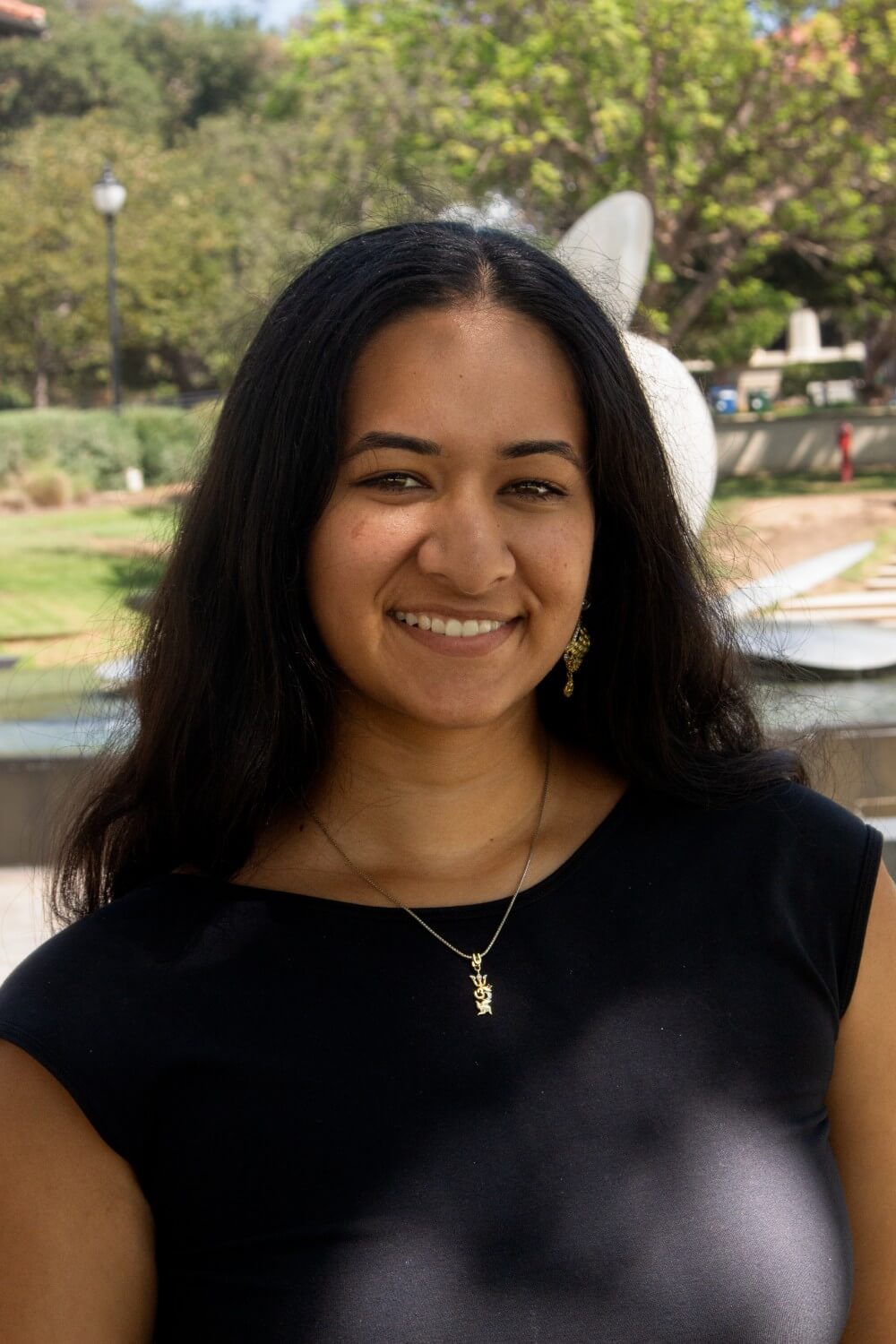
Courtesy of Trisha Bhima

Bhima said the Executive Committee’s decision to vote to allow these changes was based on the belief that DEB should have agency on how they choose to spend their money.

“It’s not outrageous. [They’re not] refusing to fund people on the basis of whether they publicly support DEB or not,” Bhima said. “Because they’ve voted unanimously, we want to support DEB and their judgment more than anything else.”

The Dean of Students’ office sent another email Dec. 26, encouraging students to keep submitting funding requests to ASOC.

“Student Affairs has been working with ASOC student leadership, with the goals of ensuring their funding guidelines represent the interests of all students, avoid potential inequities, and reduce any risk to faculty research,” the email said.

According to Bhima, DEB often takes funding requests from affinity groups that hold events to increase diversity and equity on campus.

“DEB is unique in that they also fund individual funding requests, so a lot of times if there are students who are struggling to pay for food, for shelter, for transportation, DEB is able to provide those needs for them,” Bhima said. “A lot of those are done very privately because we don’t want all the students knowing of the financial needs of a specific student.”

Bhima said DEB’s funding restrictions are similar to those of the Sustainability Fund (Sus Fund), which recommend that students put forth sustainable funding requests to their branch. According to Bhima, DEB was following in the footsteps of Sus Fund to be intentional about where their money is spent.

“The boycott that DEB [announced] last semester was essentially saying that DEB did not want to fund any requests to buy materials from the companies that they had listed,” Bhima said.

Some of the boycotted companies listed by DEB include Amazon, Target, Domino’s Pizza and The Home Depot.

In an email to The Occidental, Santiago said, “The college has been working with ASOC student leaders to ensure that funding decisions continue to be equitable and inclusive of our pluralistic student body.”

According to Bhima, there is a mismatch of expectations between DEB and college administrators in terms of the control DEB has over their funding guidelines.

“The college believes that DEB’s actions are violating the ASOC operating agreement, and obviously, if DEB thought they were violating the ASOC agreement, they wouldn’t have put out something like that, and so their discussions are mainly based on that,” Bhima said.

Contact Ava LaLonde at lalonde@oxy.edu

Loading

‘Poets are the voice of radical change’: Robin Coste Lewis to join Oxy Live! lineup

Oxy Live! starts the spring semester with a conversation between artist Alexandra Grant and Robin Coste Lewis, National Book Award winner and former Poet Laureate of Los Angeles. According to Meldia Yesayan, Executive Director of OxyArts, the Oxy Live! program strives to serve as a space for attendees to come together and sit with ideas. Lewis and Grant will be in conversation in Thorne Hall at Occidental College Feb. 10.

“Robin Coste Lewis is a widely respected writer, poet [and] thinker, whose work is at the intersection […] of literature, culture and critical inquiry,” Yesayan said. “I think her perspective kind of invites audiences to think about language and meaning in a different way as a poet.”

Associate Professor of English and Black Studies James Ford is the current Mary Jane Hewitt chair for Black Studies. Ford said he taught Lewis’ “Voyage of the Sable Venus” in two of his courses at Occidental College: Introduction to Black Studies and Contemporary American Poetry.

“We start off by reading other poetry that isn’t as intense, but still is thinking about the relationship between poetry and visual art,” Ford said. “In the African American literature course, we pair [‘Voyage of a Sable Venus’] directly with a scholarship that talks about the activism that occurred in the 20th century for African Americans to reclaim museums as Black spaces.”

According to Yesayan, Lewis will be introduced by two Occidental students from the English Department, Madéleine Hladky (senior) and Marley Marshall (senior).

“This is for the students to come and engage with not only the speaker and the ideas, but also other community members and kind of be in this space with faculty and community and other peers,” Yesayan said.

According to Yesayan, Alexandra Grant is the moderator for all 2025–26 Oxy Live! conversations.

“[Grant] is a pretty prominent artist in Los Angeles, and is very interested in conversations and collaborations,” Yesayan said. “It felt like the right fit for her to be a host this season.”

According to Allie Gordon, Director of Advancement Communications in the Occidental College Department of Marketing and Communications, Yesayan works closely with the marketing team to find meaningful ways to connect with community partners.

“There are so many artists doing interesting and important work, and Oxy Live! is often my first introduction to them,” Gordon said via email.

Ford said Lewis is a very down-to-earth and aware person who is committed to writing poetry that intervenes with the world around her, especially within Southern California.

“This is another important instance of Occidental being an urban liberal arts institution,” Ford said. “She’s a 30-minute drive away, and we shouldn’t take [her visit] for granted when there are museums, galleries and conferences that invite her to travel the world. We should make the most of the rich talents that we have right here.”

Yesayan said she hopes audience members will benefit from this shared community and they will find space for genuine exchange and reflection.

“This is one of those extraordinary experiences that stay with you after college that you remember and recollect, ‘Oh, I met that artist, or that musician or that poet when I was in college,’” Yesayan said. “Having these types of incredible speakers here on campus is such a wonderful opportunity.”

Ford said he will be attending the event and believes the conversation with Lewis is not to be missed.

“In turbulent times, poetry is essential,” Ford said. “Poetry and poets are normally the voices of radical change. And the poet, the poetic styles may vary, but the role of the poet is always to help us adapt to those moments where the typical storyline no longer works. So we have a lot that we can learn from Lewis.”

Contact Abigail Montopoli at montopoli@oxy.edu.

Loading

College phases out blue-light emergency phones for safety app

According to a Dec. 11 email from Campus Safety Director Stacy Spell, Occidental is removing the blue-light emergency phones and fully transitioning to the LiveSafe app, a more modern incident-reporting platform. Spell’s email said the college has used the LiveSafe app to put students in contact with Campus Safety since 2017.

“With technological developments and the ubiquity of cell phones, emergency blue-light phones have become an unused and outdated incident response tool,” Spell wrote in the email. “The College has decided to remove the blue light phones on campus over winter break.”

According to the initial email, Spell considers this an upgrade.

“The most effective emergency tool is the one you have in your hand,” Spell wrote.

Luke Bringhurst (senior) said the blue-light system seemed outdated and inaccessible.

“I haven’t heard of a single person who has ever used it,” Bringhurst said. “I think that there are a lot better ways to get [help] than running over to one of those things.”

Thomas Quick (senior) said that he did not know the blue-light emergency phones were being removed and thinks that people would reach for their own phones first in an emergency.

“I think if you have it on your phone, then it’s probably more useful,” Quick said. “And everyone has phones on them all the time.”

Elliot Lehman (senior) said this transition could be problematic.

“It can’t cost that much money to service a telephone like that on campus. It feels like something stupid to defund,” Lehman said.

Lehman said that with the exact location, the addition of the loud sound and instant connection to safety personnel, the blue-light system was an accessible aspect of Campus Safety.

Quick said he’s never used the emergency blue-light system himself and does not intend to download the app.

In an email interview with The Occidental, Spell said that according to usage data, the emergency phones had only been activated a handful of times over the last decade, becoming antiquated as mobile phones gained popularity.

“The telephone lines that support [the emergency phones] are increasingly no longer maintained by telecommunications providers,” Spell said.

Lehman said the blue-light system had a frightening effect on potential predators and made campus feel safer to him.

“If someone is trying to actively chase this person and they see a blue-light phone, they’re going to be more scared off, rather than someone having a phone trying to call 911,” Lehman said.

Kylie Jones (senior) said the blue-light system added a visual aspect of safety to campus.

“It’s not only for people to use, but [to have] something visually,” Jones said.

According to Spell’s Dec. 11 email, the blue-light phones were a visible safety symbol, but could not offer some of the safety aspects LiveSafe brings to the table.

“[The blue-light phones] are rarely used and only helpful if you are standing next to one,” Spell wrote. “LiveSafe offers essential features the old phones could not.”

According to the Apple App Store, the LiveSafe app has an accumulated rating of 2.8 stars. Reviews cite unreachable safety escorts, poor customer service and general app bugs.

A top review reads, “stupid app hate my school for this.”

Jones said the introduction of the app makes safety less accessible.

“Sometimes I don’t have my phone on me, or it’s dead,” Jones said. “The last thing I’m gonna do is […] pull out an app.”

Jones said that both the LiveSafe app and the blue-light safety system would make for the safest campus environment.

“You could have both options,” Jones said. “Bring it back.”

Contact Amelia Darling at adarling@oxy.edu

Loading

Revived OSCAR leads campuswide composting effort

After a pause in Fall 2025, the Occidental Student Compost Actions for Remediation (OSCAR) has returned to operation in residential halls. OSCAR was formerly a student-led club where students volunteered to collect compost waste, but is now run by one paid student worker and managed by Facilities Management, according to Assistant Director of Sustainability Alison Linder.

Student Compost Facilitator Julien De Goldsmith (senior) said the responsibility of the job includes designing bins and flyers, collecting and sorting the weekly compost and educating and informing the student body.

“This year in residential dorms, we installed compost bins so essentially every dorm has one or two bins,” De Goldsmith said. “There are clear instructions as to how to compost, and we’re hoping that people will successfully compost.”

De Goldsmith said contamination poses a challenge to the work and that it would make the student worker’s job easier if everyone sorted their waste.

“It’s kind of frustrating because you’re not supposed to [put trash in compost bins], but people nonetheless do it,” De Goldsmith said. “I guess it’s convenient for them to just discard their waste wherever it’s easier.”

Sustainability Fund President Graham Luethe (senior) said composting is important because it repurposes leftover food that would otherwise sit in a landfill and that lack of knowledge and trust regarding composting presents a challenge.

“I think there’s a lot of misinformation,” Luethe said. “A lot of people don’t understand or trust recycling, compost [or] garbage bins so they just throw it all in the trash. That’s something that Sus Fund talks a lot about, is trying to work on getting people to have a better understanding and knowledge of how waste works.”

As a former OSCAR volunteer, Luethe said collected organic material is weighed both before and after being sorted to measure how much food is composted.

“Compost in the [Tiger] Cooler, in the residential halls are truly sorted and they definitely are composted,” Luethe said. “I don’t think a lot of people believe that.”

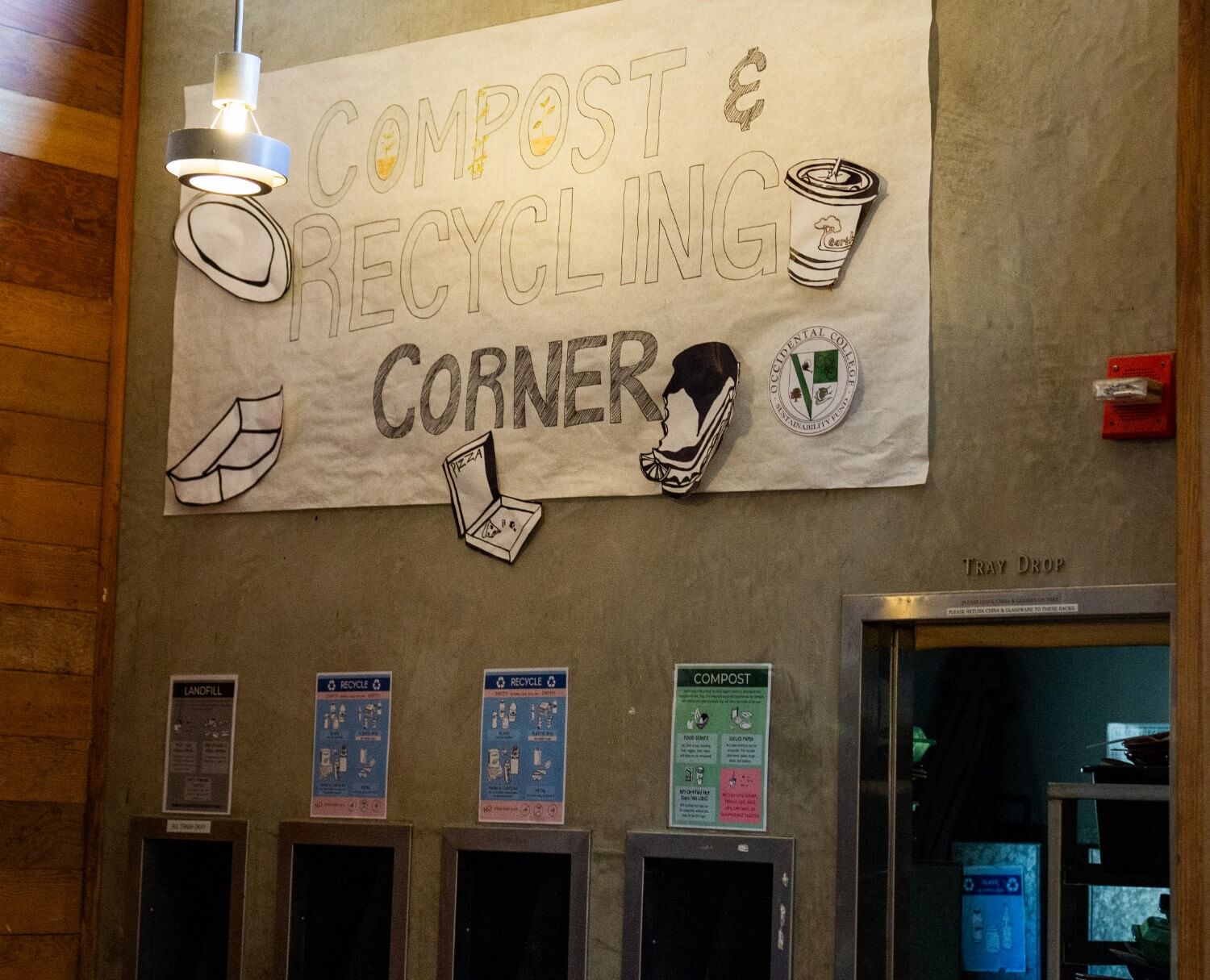
Compost & Recycling Corner in the Tiger Cooler at Occidental College in Los Angeles, CA. March 26, 2025. Addie Fabel/The Occidental

According to De Goldsmith, the Student Compost Facilitator is now the person behind all the collection and sorting of compost from residential halls.

“There’s always someone in the facilities going through that waste to make sure everything is allocated properly,” De Goldsmith said.

Linder said the organic material collected is picked up by the College’s provider, Universal Waste Systems (UWS).

“UWS takes the material for processing in an anaerobic digestion facility,” Linder said via email. “The methane, also called biogas, is recaptured as energy, then the remains are used for agricultural enhancements.”

Drey Chan (sophomore) said composting can reduce food waste if leftover food from the dining halls and bakeries are not allowed to be consumed by staff or donated.

“In my opinion, composting is the best solution for that because it actually turns the food into something that we can use,” Chan said. “We give back to the environment.”

Jeslyn Lara (sophomore) said a few ways to increase students’ interest in this initiative are promoting OSCAR at club fairs, hosting workshops on sustainability and the importance of composting and collaborating closely with Residential Education & Housing Services (REHS).

Luethe said composting is a way to make a difference.

“At Oxy, there’s a collective understanding that climate change is bad and [we] don’t want to have a big impact [on] the world,” Luethe said. “People know that food waste is waste, it’s not the best thing, but composting is a way to relieve that guilt of wasting food and contributing to climate change.”

Linder said collective student enthusiasm surrounding the program can make a big difference.

“Everybody eats, and knowing how our food is disposed properly can really make an impact,” Linder said.

Contact Villathina Ly at lyv@oxy.edu

Loading

HBO’s ‘I Love LA’ can’t help but love Eagle Rock’s local restaurants

From the green exterior of Chifa to the neon lights of Capri Club, the HBO show “I Love LA” features familiar establishments from the Eagle Rock neighborhood.

“I Love LA” tells the story of Maia Simsbury, played by show creator Rachel Sennott, as she navigates her role as an influencer manager on a social media platform. In the show, Maia and her friends visit a handful of LA establishments, including some of Eagle Rock’s local restaurants.

Chifa, located on Eagle Rock Boulevard, is featured in Episode 3 of “I Love LA” under the name “Ginny” in the show. Opened in November 2020 by Humberto Leon, Chifa serves a unique blend of Peruvian and Chinese food and is on Michelin’s Bib Gourmand list.

“The show is really good at touching on the LA zeitgeist […] It’s definitely almost like an insider in LA taking you around to all the fun spots,” Leon said.

Another Eagle Rock spot, Capri Club, premiered in Episode 2. Danny Webber, the general manager, said this is the first show ever filmed at Capri Club.

“I was glad they thought of us,” Webber said. “One guy […] came by with a card and said, ‘I’m a scout. This place looks nice. Do you mind if I take some pictures?’ And we were like, ‘sure, take some pictures.’”

Colombo’s Italian Steakhouse & Jazz Club on Colorado Boulevard in Los Angeles, CA. Jan. 30, 2026. Amy Wong/The Occidental

Colombo’s Italian Steakhouse, a local Italian restaurant featured on “I Love LA,” underwent a similar scouting experience, according to manager Bre Alvarez. When the shoot day came, the process was a lot more intense, Alvarez said.

“All of a sudden, there are a hundred people and they’ve taken over your entire restaurant,” Alvarez said.

According to Alvarez, the film crew was on site from early morning until late into the evening.

“They take down the entire restaurant and make it their own,” Alvarez said. “It’s really amazing and it’s an all-day process.”

After “I Love LA” premiered on HBO Nov. 2, people flooded to Capri Club and commented on seeing their favorite restaurants on the show, Webber said.

“It’s funny hearing: ‘Hey, I saw you on TV,'” Webber said.

At Colombo’s Italian Steakhouse, a group of people came in willing to wait an extra hour to sit in a booth where a scene from the show was filmed, Alvarez said. According to Alvarez, the high-tension scene filmed at Colombo’s, in which Maia meets with her mentor, played into the mysterious nature of the restaurant, which is even named-dropped in the show.

“It’s so on-brand with having a love interest and wanting to bring [them] here,” Alvarez said. “Your bae is gonna ask you to come [to Colombo’s] and maybe ruin your life […] It’s nice that [the restaurant] translates onto film.”

In an interview with LA magazine, Sennott said “I Love LA” is a love letter from transplants to LA, including Eagle Rock, and specifically credits the Eastside as her home.

Exterior of Chifa on Eagle Rock Boulevard in Los Angeles, CA. Jan. 30, 2026. Amy Wong/The Occidental

Chifa is situated in Eagle Rock, which Leon said is his hometown.

“We immigrated to Eagle Rock, so […] it’s exciting to bring business back to this area that accepted us when we moved here in the [19]70s,” Leon said.

According to Webber, Capri Club serves families of all ages and many of their regulars live in the neighborhood.

“[Capri Club is] your neighborhood bar, your neighborhood spot, and not some fancy destination where you’re gonna get treated differently if you’re not our demographic,” Webber said.

Alvarez said she thinks Eagle Rock is one of the best places in Northeast LA.

“If anyone in LA is watching that show, they should definitely visit, not just our businesses,” Alvarez said. “Anything in Eagle Rock is so freaking cool.”

Contact Emma Williams at ewilliams4@oxy.edu


Loading

The Plus Bus boutique finally hits the road

The Plus Bus, a plus-size fashion boutique that operated out of a brick-and-mortar storefront on York Boulevard for nearly a decade, has transitioned into a fully mobile boutique. Owner Marcy Guevara-Prete said the shift fulfills an idea that existed long before the business had a permanent location. Now, according to Guevara-Prete, the store is finally living up to its name.

“It was always confusing,” Guevara-Prete said. “People would ask, ‘Where is The Plus Bus parked?’ and I’d have to say, ‘It’s brick-and-mortar.’”

According to The Plus Bus website, the boutique serves customers sizes 12 and up and offers a curated mix of fast fashion, vintage and new-with-tags clothing. The website said the business also positions itself as a community-oriented space centered on inclusion, sustainability and body acceptance.

According to Guevara-Prete, she and co-founder Jen Wilder came up with The Plus Bus in 2015 when they were both hosting clothing swaps and realized how much unused clothing was circulating within the plus-size community.

“[Wilder] said, ‘I’ve always dreamed of having a mobile boutique,’” Guevara-Prete said. “I said, ‘Oh my god — like a plus bus.’ And that was it.”

Despite early enthusiasm, Guevara-Prete said the mobile concept was not immediately feasible. Instead, The Plus Bus opened as a brick-and-mortar boutique in 2016, and eventually moved to York Boulevard, a long-held dream location according to Guevara-Prete.

According to Guevara-Prete, the move to York Boulevard was only possible for a small business like The Plus Bus because of federal Economic Injury Disaster Loans made available during the COVID-19 pandemic. While the pandemic devastated many small businesses, Guevara-Prete said it also created rare opportunities.

“As much as it was horrible for our country, on a small business level it really was a game changer at the time,” Guevara-Prete said.

According to Guevara-Prete, York Boulevard became home not only to her store, but also to a tightly connected network of small businesses. She said leaving the space was difficult, and that it was important to her for the storefront to remain a retail space rather than being converted into offices or storage.

“It took a lot of guts to own up to the reality that it was time to move on,” Guevara-Prete said.

The opportunity to adopt a mobile model came unexpectedly, according to Guevara-Prete, when a friend sent her a listing for a boutique bus. According to the business’s website, The Plus Bus purchased the vehicle in 2022.

Guevara-Prete said acquiring the bus shifted the direction of the business and introduced new logistical challenges, including staffing, insurance and transportation.

“Having a mobile boutique is a whole business of its own,” Guevara-Prete said. “I don’t know that we were fully prepared for what it would take.”

The shift to a mobile model, Guevara-Prete said, also reflects broader economic pressures facing small businesses in Los Angeles.

“This is a story about the rising rate of rent,” Guevara-Prete said. “Small business owners were squeezed. We’re all struggling. We’re all figuring out how we can do it.”

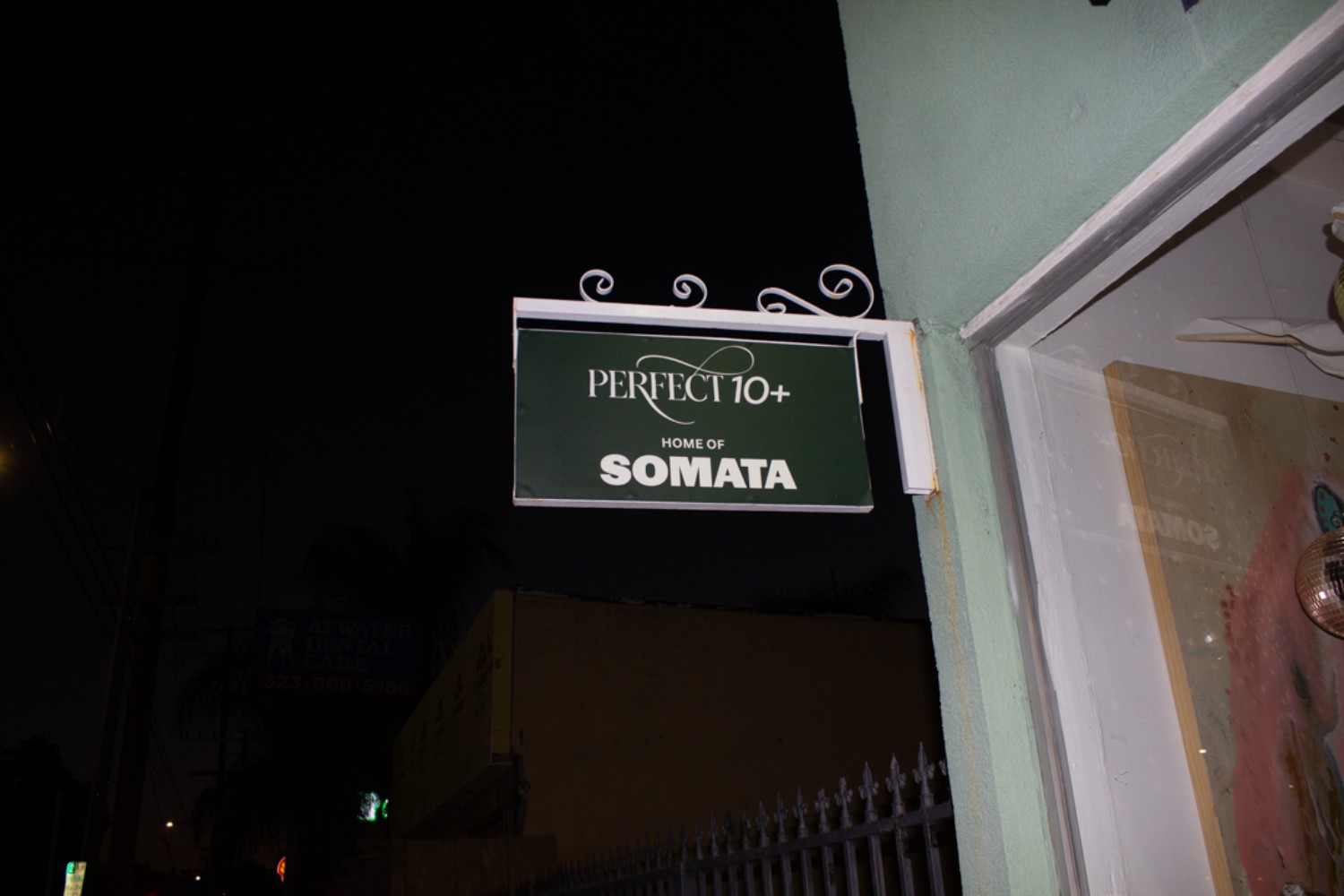
Perfect 10+ sign on Glendale Boulevard in Atwater Village, Los Angeles, CA. Feb. 2, 2026. Marty Valdez/The Occidental

After several years of adjustments, Guevara-Prete said the bus is now fully operational. According to Guevara-Prete, The Plus Bus parks outside Perfect 10+, a boutique she recently opened in Atwater Village, every Sunday, and appears monthly at the York Boulevard Second Saturday Art Walk.

The transition has been visible to longtime customers and staff. Brittany Everett, who works with the business, said she first discovered The Plus Bus years ago while walking through Highland Park.

“They said, ‘Yeah, we’re all plus size,’ and it was like I walked into heaven,” Everett said.

Everett, who now works for the store, said she was initially a customer before becoming more involved through online sales and events. Everett said the mobile bus helps connect longtime Plus Bus customers with the new Perfect 10+ location.

“People see the bus, shop the bus and then come inside,” Everett said. “A lot of customers from The Plus Bus are coming to Perfect 10+.”

According to customer Dana Tunier, the store has long represented more than retail. Tunier said she encountered The Plus Bus before it had a permanent storefront, when clothing racks were set up in temporary spaces.

“You can count on one hand any plus-size store anywhere in LA,” Tunier said. “So any place where you can walk in and try on everything, that’s immediate validation.”

According to Tunier, the York Boulevard location functioned as an affirming social space, particularly for queer and plus-size communities.

“It was a body-celebration space,” Tunier said. “Everyone was hyping each other up.”

Tunier said she became more involved during last year’s fires, when Guevara-Prete organized a donation drive focused on plus-size clothing and essentials.

“Plus-size stuff in an emergency, it’s not readily available,” Tunier said. “That’s when I realized this is actually a community.”

Guevara-Prete said the mobile format allows The Plus Bus to maintain its relationship with Occidental and the surrounding Highland Park community. Guevara-Prete said the bus has visited campus events in the past and will continue to do so.

“We love being in this college town,” Guevara-Prete said. “Now that I’ve finally found someone who can drive it and style people and sell, we can bring the bus to Oxy anytime.”

Now that the bus is back on the road, Guevara-Prete said the business has come full circle.

“I feel like the dream is all kind of coming together,” Guevara-Prete said. “It’s a very exciting time.”

Contact Lily Snyder at lsnyder@oxy.edu

Loading

Men’s soccer wins SCIAC, women’s team makes playoffs for first time in four years

The men’s soccer team clinched the SCIAC tournament title with a close at-home 1-0 win over Redlands Nov. 8. Their victorious path to the finals began with a 2-1 regular season win against Cal Lutheran, Oct. 29. In the semi-finals SCIAC tournament match, the Tigers took down La Verne by a score of 4-1, Nov. 6, securing their place in the finals.

The SCIAC victory marks the Tigers’ second SCIAC championship in three seasons and earned them an NCAA tournament berth. The team will travel to Minneapolis and face Augsburg in the first round Nov. 15.

SCIAC Offensive Athlete of the Year Devin Bening (sophomore) led the men’s team in goals, and four other players received All-SCIAC honors for the season.

Men’s Assistant Coach Brian Wright said the team’s mentality played a crucial role in their regular season victory against Cal Lutheran.

“There are two ways to look at it,” Wright said. “You can either shy away from [the moment], or embrace [it]. We went into the game with confidence, and we took care of business.”

Justin Nishimoto (senior) said he noticed an increased energy amongst the team before the Cal Lutheran game.

“I felt like the energy was definitely up in the pregame warmups,” Nishimoto said. “The adrenaline was high for sure. There was a little nervousness, but it felt so good to get that win on our head coach’s birthday.”

Nishimoto said he felt the team hit its stride at the right time.

“Going from last place at the beginning of the season to first was such a good feeling,” Nishimoto said. “It felt like we were hitting the potential we knew we had, finding our form and showing people that we’re the real deal.”

Aidan Aley (senior) said the team’s journey this season has been rewarding.

“It’s been super gratifying,” Aley said. “It’s essentially a brand-new team from last year. We had 13 newcomers on the team, which is the most since the COVID-era […] I think we’ve come together as a team and gotten through the season in a fantastic way. We’ve had a renewed hunger that we haven’t had since we last won SCIAC.”

Aley said soccer alumni have set an example for team leadership.

“The team is a family,” Aley said. “I’ve learned so much from the alumni who have come before me. They set the groundwork for how to be a leader, and how to keep the familial values and brotherhood of the team.”

Aley said the Tigers are prepared for the challenges that come with postseason play.

“I think we’re our biggest opponent,” Aley said. “We can beat any team out there. It’ll just come down to us playing our best, and I think that we will.”

The Occidental women’s soccer team clinched their first SCIAC tournament berth since 2021 by defeating Whittier in a 2-0 shutout Oct. 29. The team defeated Chapman 2-0 in the first round of the SCIAC tournament Nov. 3 before falling to Pomona-Pitzer by a final score of 3-0 in the semifinal Nov. 5.

The women’s team had four players earn All-SCIAC honors, and Logan Morris (senior) received the SCIAC Award of Distinction.

Melanie Rodriguez (sophomore) said the women’s team demonstrated great teamwork throughout the season.

“It’s truly been an inspiration—coming back from last season and persevering [to become] the kind of team that we are now,” Rodriguez said. “It’s really easy for teams to turn against each other, but we uplift each other. I’m very grateful to be a part of that.”

Melanie Rodriguez (sophomore) at the Mary Norton Clapp Library patio at Occidental College in Los Angeles, CA. Nov. 6, 2025. Anthony Cordova/The Occidental

Rodriguez said the quarterfinal against Chapman was her favorite game of the year.

“I think that’s the best I’ve ever seen us play,” Rodriguez said. “It was a beautiful game, from [our] camaraderie to [our] communication. Chapman is a difficult team to beat, so winning that [game] was wonderful.”

Rodriguez said this season’s success can be a stepping stone for future triumph.

“I think we can definitely take it further for sure,” Rodriguez said. “I’m just very excited to be a part of this team and help grow the program even more.”

Mia Steadman (junior) said the past season demonstrated the team’s growth over the years.

“I think we’ve come a really long way,” Steadman said. “We’ve all grown together and learned from each other. This season was a testament to how much work we’ve put in over the past years. It’s been an incredible journey for everyone, and I’m really glad to be a part of it.”

Mia Steadman (junior) at the Mary Norton Clapp Library patio at Occidental College in Los Angeles, CA. Nov. 7, 2025. Anthony Cordova/The Occidental

Steadman also said she believes the team’s future is bright.

“I think there’s a lot of potential,” Steadman said. “We have a lot of talented players. We’re losing our phenomenal senior class, but we’ll be excited to come back next year and hopefully go even farther.”

Women’s Head Coach Colm McFeely said he was happy the team’s seniors got to experience a playoff run.

“We had seven seniors who had been with us for all four years,” McFeely said. “It was such a rewarding time to see all of them on the field. Those things are special, and we were really happy that they managed to make it into the playoffs. They [will] take that memory with them.”

Women’s soccer coach Colm McFeely on Patterson Field at Occidental College in Los Angeles, CA. Sept. 16, 2025. Anthony Cordova/The Occidental

McFeely, who is set to retire after this season, said he has faith in the program’s future.

“I looked at where this program can go and I think it’s a good time to hand the reins over,” McFeely said. “I’m sure they’ll get someone in here that takes the program to the next level. […] Next season, this group has got a good number of quality players coming back, and I’m hoping that they’ll be able to take that next step.”

Contact Mac Ribner at ribner@oxy.edu

Loading

Oranges, loquats, prickly pears — campus fruit trees are for all to harvest

Occidental has several varieties of fruit trees, including crabapple, Catalina cherry, fig, natal plum and loquat, according to the Office of Sustainability. Reagan Rosenthal (freshman) said she first noticed the fruit trees when she moved into Chilcott Hall.

“I live in Chilcott Hall, so I passed by the fruit trees and really wanted to try the limes — I know that there are limes over there, or at least I hope they’re limes,” Rosenthal said.

Caden Mann (sophomore) said she picks from the orange and loquat trees near Haines Hall.

“I see them every day when I walk to the quad,” Mann said. “They only bloom every so often.”

Rosenthal said she uses the fruit to supplement her meals from the Marketplace.

“I had fish tacos from the Marketplace and they didn’t have any limes,” Rosenthal said. “I was like, ‘Oh, I might as well just go and get some limes from over here and squeeze them on top.’”

Sam Ludwig, the campus Grounds Supervisor, said there is less incentive for students to pick fruit off the trees due to the commercial accessibility of fruit.

“In the olden days you would […] walk to an apple tree and go pick an apple,” Ludwig said. “There’s none of that going on when you have the [Marketplace] — you can get anything you want.”

Occidental’s campus is also home to a variety of fruit-bearing bushes, according to the Office of Sustainability. The selection includes lemonade berry, prickly pear and rose bushes. Assistant Director of Sustainability Alison Linder said the berries are picked by families in the community.

“I haven’t picked my own fruit, but it gives me much joy to see families from the neighborhood eating the berries off the bushes,” Linder said.

Linder said the fruit trees are for all to harvest. She said since it is a shared resource, people are expected to pick fruit in moderation.

“It’s a great example of demonstrating respect for each other enjoying the benefits [of the fruit trees],” Linder said.

Fruit tree outside Haines Hall at Occidental College in Los Angeles, CA. Nov. 5, 2025. Amy Wong/The Occidental

According to Linder, all trees serve important functions on campus.

“Trees sequester carbon, help keep areas cool through shade and evapotranspiration, provide habitat, stabilize soils and are an important part of the water cycle,” Linder said. “I love the term ‘nature-based services,’ and trees are a great example [of that].”

Ludwig said the fruit trees do not require any special maintenance.

“Maintenance is the same whether it is a fruit tree or not,” Ludwig said. “If they are damaged we’ll make some cuts on the tree, but if not we’re probably not touching [them].”

The Office of Sustainability recommends students follow the principles of the Honorable Harvest. This includes taking only what students need, harvesting in a way that minimizes harm and using everything they take. Mann said she thinks Occidental could use the fruit trees to promote sustainable practices.

“When [the fruit] doesn’t get eaten, a lot of them just fall on the ground and rot,” Mann said. “I noticed that the MP has a lot of fruit — it would be cool if they sourced that fruit from the campus trees.”

According to the Office of Sustainability, the olive trees near Thorne Hall are harvested by volunteers and pressed by Ojai Olive Oil Company, a small olive farm 80 miles northwest of campus. They said while Occidental Campus Dining Catering does not use the olive oil on a frequent basis, they use it for special events like Earth Month, Alumni Weekend and the Olive Harvest Fest.

Mann said she wants to start a fruit and vegetable garden outside of Haines Hall.

“By Haines there’s a big lot of dirt, [so] I wanted to get my friends together and make some flower beds to start a little garden,” Mann said. “I think it would be really cool to be able to plant and eat our own food that we grow — it’s more sustainable.”

According to Linder, the Office of Sustainability accounts for the fruit trees in their project planning.

“As the Office of Sustainability is developing Oxy’s first Climate Action and Sustainability Plan, we will be considering the implications of how we manage our landscape,” Linder said.

Rosenthal said she hopes the fruit trees remain on campus.

“I like the fruit trees,” Rosenthal said. “If they’re trying to get rid of them, [I hope they] don’t.”

Ludwig said there is viable space on Fiji hill to plant more fruit trees.

“If you want to grow [more] for usage, there’s plenty of space to do it up there on the hills,” Ludwig said.

Contact Nick Dobbs at ndobbs@oxy.edu

Loading

Oxy Student Film Fest showcases students’ creative lenses

The 21st annual Oxy Student Film Festival will take place on Nov. 20 in Choi Auditorium. The event is sponsored by the Media Arts & Culture (MAC) department and receives assistance from MAC professors, faculty, and administrators who comprise the judging panel. Abigail Montopoli* (senior), Claire Li (junior), Addie Fabel** (senior) and Tess Taplin (sophomore) are the organizers for the festival.

According to Li, head of the voting and submissions team, the festival is open to all types of short films, with the only requirements being that submissions must be under ten minutes long, cannot have hate speech of any kind and must contain a trigger warning for sensitive content. Li said the few restrictions allow for a strong and diverse variety of submissions.

Assistant Professor of MAC Amanda Tasse said she has agreed to be on the judging panel for this year’s festival. According to Tasse, despite the event being put on by the MAC department, all students are encouraged to submit short films simply for the fun of it.

“It gives a greater insight to the student body, both within the classroom and outside,” Tasse said. “[It is great] seeing submissions from students who are not MAC majors and [have] their [own] creativity and passion and voice and filmmaking in their spheres besides MAC.”

Director of Digital Media and Production and MAC professor Diana Keeler, who oversees the student board for the project, said people should attend the event because it is almost impossible to find a film one will not like.

“We have a lot of variety of submissions this year. You are sure to find something that’s your jam,” Keeler said. “We have narratives, music videos, documentaries, experimental films; You will find something, connect with the filmmakers and find people that are into the same stuff you are.”

Li, who is in charge of selecting the submissions that will be shown at the event, said they have received approximately three hours of submissions.

Tasse said she hopes the festival’s strong variety of submissions will inspire fellow students to submit in the following years.

“The nice part about the film festival is that there’s such variety, and I hope it can inspire students to create work outside of class on their own,” Tasse said.

Courtesy of La Encina

According to Fabel, the publicity team leader, Oxy Student Film Fest provides an opportunity not only for students to display their work, but also allows them to network and make connections with fellow students who share common interests and the hope of working together in the film industry.

“It [allowed] me [to] meet a lot of upperclassmen MAC majors, which gave me a first boost of motivation to make things because I was like, ‘I wish I had something to submit,'” Fabel said. “They are so encouraging for people to submit their work.”

According to Taplin, a publicity team member, the event allows students to gain real-world experience working within the film industry as they see what it takes to produce, edit and direct a short film with the help of their classmates.

“Honestly, it’s good to have on your resume that you’ve been part of a film festival.” Taplin said, “I am trying to gain experience in the film industry, so working on this is helpful to have seen how a film festival actually works.”

According to Tasse, the event sparks community because it brings alumni back to Occidental, who offer students advice.

“Alumni sometimes come back and help,” Tasse said. “I had some seniors presenting their production plans, and I got to see some of the alumni coming back and acting, or helping with sound or just offering support.”

According to Li, there are many people behind making this event happen.

“We have multiple teams working on different things.” Li said, “For example, we’re trying to get the greater community outside of Oxy involved, whether that be catering or if they have rewards to specific stores.”

Keeler said the event is a great way for everyone to build connections on campus and showcase their work.

“One of my favorite parts is just seeing how many filmmakers we have across campus, not just limited to our department,” Keeler said. “It’s exciting to see what everybody elsewhere is making and creating.”

Keeler said students who submit films to the festival learn how to collaborate and persevere through conflict, which is truly inspiring.

“So many people have ideas, so many people start projects, but these are all students who saw it all the way through and took the time to submit and promote their work,” Keeler said. “They should be celebrated.”

Li said the purpose Oxy Film Fest goes beyond simply submitting and watching films.

“We could all use a little art right now,” Li said. “For students, it’s that part of the semester where things are chaotic, and with everything going on in the world right now, it’s important to remember there’s community.”

*Abigail Montopoli is a section editor for The Occidental.

**Addie Fabel is a photographer for The Occidental.

Contact Mars Gallati at gallati@oxy.edu

Loading

LA Breakfast Club celebrates a century of mornings served sunny side up

It’s another 7 a.m. Wednesday in LA. In the southernmost point of Griffith Park, eggs sizzle and tradition endures. This year marks the 100th anniversary of the Los Angeles Breakfast Club (LABC) — an avid equestrian-turned-morning bird social group, according to Club Historian Rachel Skytt.

Skytt said LABC members gather every Wednesday in Griffith Park’s Friendship Auditorium for hearty and heartfelt meetings. After a buffet-style breakfast, Skytt said club members — referred to as “hams” during meetings — sing customary ditties, “eggcersize” with calisthenics, listen to guest speakers and pick up where last week’s conversations left off.

“We’re just here to be goofy and have friendship,” Skytt said.

Board member and head of the LABC’s PR and marketing Brianne Richard said newcomers say there’s a special sauce — perhaps partly “Pee-Wee’s Playhouse” and partly David Lynch — to the club that leaves them wanting more. And so, Richard said, they return for seconds, thirds, years and decades. Like many fellow hams, Richard said once she cleared the 7 a.m. hurdle, she was hooked.

“I’m really not a morning person, but the club turned me into enough of a morning person that I am there every Wednesday,” Richard said.

According to Skytt, current hams join a star-studded legacy of early risers. Skytt said some past LABC members include: Walt Disney, Charlie Chaplin, Calvin Coolidge, Ronald Reagan, Amelia Earhart, William Randolph Hearst, Babe Ruth and Knute Rockne. Although stuffed with celebrities, Skytt said the club has always been open to everyone — even con artist Death Valley Scotty.

Courtesy of Bri Richard

“It’s kind of mindblowing who Breakfast Club was celebrating: you have the president and then an eccentric character-man who wants to build a castle in the desert,” Skytt said.

During the 1920s LA boosterism period — an era of city-wide marketing to attract prospective residents — Skytt said the LABC distinguished LA and made the city a multinational attraction.

“People from around the nation — and even around the world — would go to Breakfast Club,” Skytt said.

Once a staple of LA culture, with connections to the Warner Brothers, promotion of the first feature-length talkie — “The Jazz Singer” — and tie-ins to the LA Dodgers, Skytt said the LABC has since disappeared from the public eye.

“The club was so important and vital in the [19]20s and ’30s, and then it just got forgotten about,” Skytt said.

According to Richard, the LABC reached its lowest point in 2014, when only 33 members remained. Since then, Richard said former LABC president Lily Holleman spearheaded a larger online presence for the club, and membership has grown.

“Lily Holleman is the one largely credited with saving the club from falling into obscurity,” Richard said. “She got the club onto social media, made sure the website was up to date and invited everyone she knew.”

Courtesy of Bri Richard

Head of the LABC Board of Directors Jason Berk said the club has seen a 640 percent membership increase since 2015. Berk said the 233 tickets to events often sell out. According to Berk, the Board of Directors receives three to seven new member applications each month that sample from all generations.

“Every time we get new member applications, there are Millennials, Gen X, Boomers. There’s that in-between Generation Jones age,” Berk said. “I think that speaks to the club’s ability to reach those people and make everybody feel comfortable.”

According to Richard, the multigenerational component of the LABC offers a perspective on life she hadn’t experienced since moving to LA, away from family.

“Just to be in the orbit of people that are much older than me is something that I didn’t have before,” Richard said.

Richard said one of her favorite club members is Joe, whom she described as an older widower who works the LABC check-in.

“He’s just the sweetest, kindest man,” Richard said. “He always just has kind words to say. He came to my birthday party.”

Richard said, similarly to the people, many club traditions are silly in nature. According to Richard, member initiations require sitting blindfolded on a sawhorse named Ham and pledging allegiance — one hand placed on a plate of fried eggs — to the democracy of ham and eggs. Richard said at the LABC, play is not only accepted; it’s expected.

Courtesy of Bri Richard

“That’s who we are: Breakfast Club,” Richard said. “Horses and eggs and ham, it all just comes together.”

According to Berk, the LABC hosted its centennial celebration Nov. 8. According to Berk, this celebration honored 100 years of friendship and 60 years at Friendship Auditorium — a building the club constructed, donated, and dedicated to the city of LA.

Berk said he wants revisiting the club to be like revisiting an old classroom — decoration and furniture may change, but the spirit of the room remains. He said he hopes the club stays the same.

“After all of the regular faces I see are not there anymore, I almost want to be able to go: Okay, so that’s their Patti, and those are probably the new Terenzios and those are the snowbirds that everybody adores who come for four months in the winter and then go back to Chicago,” Berk said.

After his first LABC meeting, Berk said he and his brother hiked through Griffith Park. On the trail, Berk said he knew the club would be central to his future.

“I immediately had a sense that this is going to be a thing going forward,” Berk said. “The club is one of the best things I’ve ever done — not just in my life — but with my life.”

Contact Zoë Beauchamp at beauchamp@oxy.edu

*A correction was made Nov. 24 at 3:37 p.m. to reflect the correct lowest membership number of the LABC, in 2014.

Loading