Nico Aviña, artist and resident of Boyle Heights, was featured in the LA Local Jan. 26 for his silk-screened soccer jerseys. Aviña’s jerseys combine religious and Indigenous symbols with slogans that directly challenge immigration enforcement, racism and xenophobia.
Aviña said he has played soccer since he was 5 years old, collecting jerseys from different eras, teams and idols. Aviña said jerseys have since become a canvas for him to take a stance on immigration and challenge the commercialization of the sport.
“I wanted to do a mashup of cultural elements that represented the community, myself and the passion that I have for soccer in one garment,” Aviña said.
According to Aviña, the project started as a piece he made for himself, which quickly gained attention after he posted it online and people began to resonate with the message and imagery he had woven together. With the recent ICE raids that have been affecting LA, Aviña said his jerseys have become wearable statements within the community while also reaching an international audience.
“I’m getting people that are coming in from outside of the United States, and they make sure that they stop by because they’ve seen the jerseys,” Aviña said.
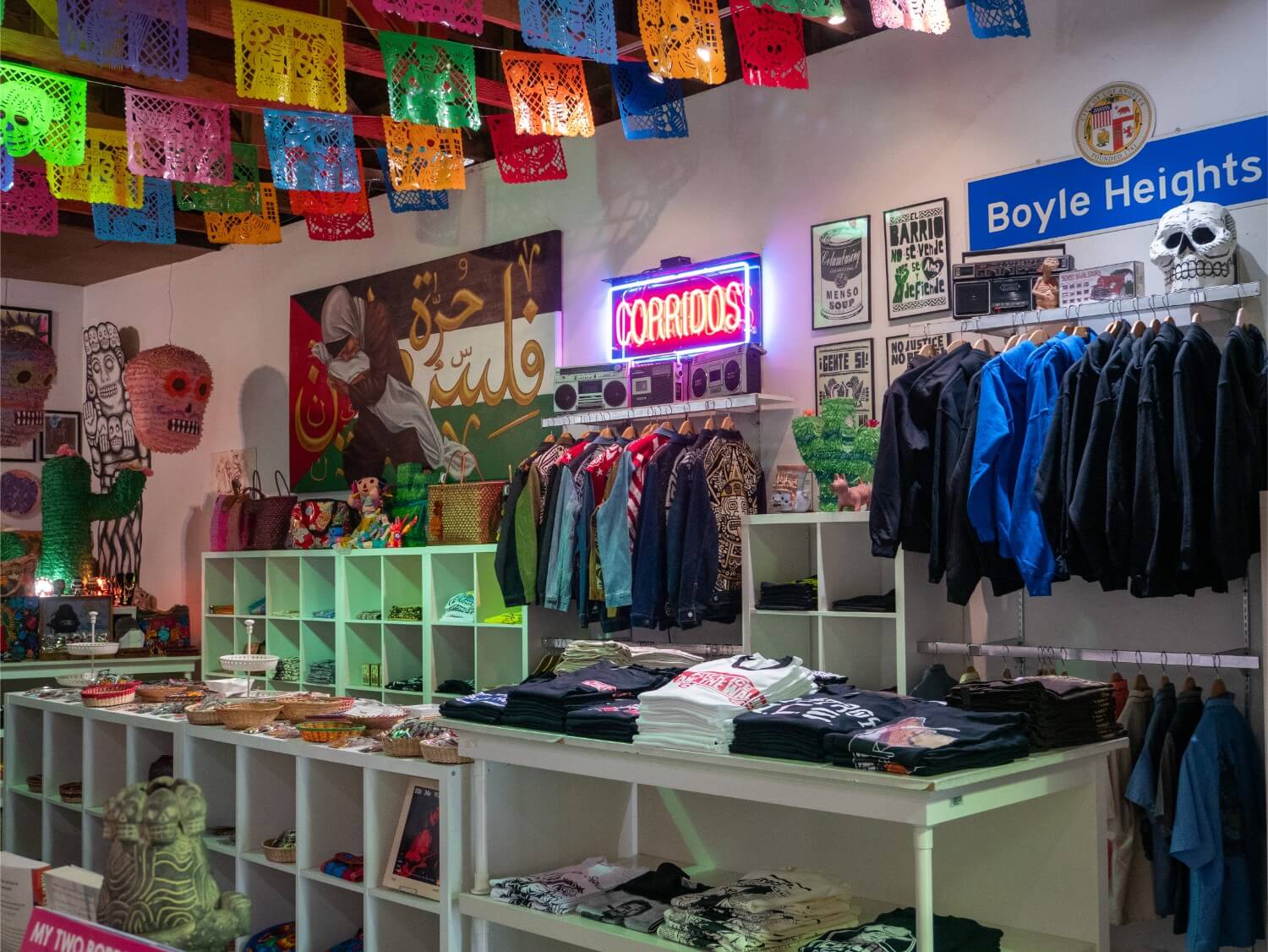
Merchandise and art on display at Espacio 1939 in Boyle Heights in Los Angeles, CA. Feb. 26, 2026. Jane Hutton/The Occidental
According to Aviña, customers wear the jerseys at protests, events and in everyday life as a way to express solidarity and resistance. Aviña said he feels artists cannot always predict how a piece will resonate, but the role of an artist is to uplift the voice and sentiment of a community.
Jocelyn Becerra, a Boyle Heights makeup artist who owns one of Aviña’s shirts, said she feels wearing the jersey helps her find a sense of belonging.
“There’s a lot of pain and hurt with what’s going on, not being accepted because of the color of your skin,” Becerra said. “It’s a way for me to express the way I feel without having to say anything.”
Becerra said as a Latina who is vocal about supporting and uplifting her community, the jersey’s messaging immediately resonated with her identity and lived experience.
Jocelyn Becerra outside Café de Leche in Los Angeles, CA. Feb. 25, 2026. Jane Hutton/The Occidental
“When I saw it, I felt like I need one — I want one,” Becerra said. “It’s a form of protest for me. For you.”
According to Aviña, the jerseys are inseparable from the space where they are created and sold. Aviña said he is a co-founder of Espacio1839, a Boyle Heights storefront that functions as both a retail shop and a community arts hub. Aviña said he has been operating out of the space for the past two years.
“We feel that the fundamental theory of an organizer is to facilitate space,” Aviña said. “This space belongs to the community.”
Espacio 1839 in Boyle Heights in Los Angeles, CA. Feb. 26, 2026. Jane Hutton/The Occidental
According to Aviña, in recent months Espacio1839’s mission has expanded beyond art shows and poetry readings, hosting pop-ups to support families affected by ICE raids.
According to Krystal Ramirez, cofounder of Trenzas Amigas, a Feb. 1 collaboration with Aviña raised more than $5,000 for families impacted by ICE. Trenzas Amigas is a braiding initiative inspired by the Adelitasof the Mexican Revolution, women who wore their braids as symbols of identity and resilience during wartime.
According to Ramirez, she first connected with Aviña after purchasing several of his jerseys. Ramirez said the partnership felt natural — both the jerseys and her braiding work are accessible forms of protest.
“Fashion is political,” Ramirez said. “They’re both showing empowerment, resistance. If you take them out to a public space, people are going to know what it signifies — it has culture and history behind it.”
Becerra said she attends various Espacio1893 events and sees the jerseys and collaborations, such as with Trenzas Amigas, as part of something larger.
“I think it’s beautiful,” Becerra said. “I feel it’s like a unity. A community is uniting. We’re standing strong […] supporting one another.”
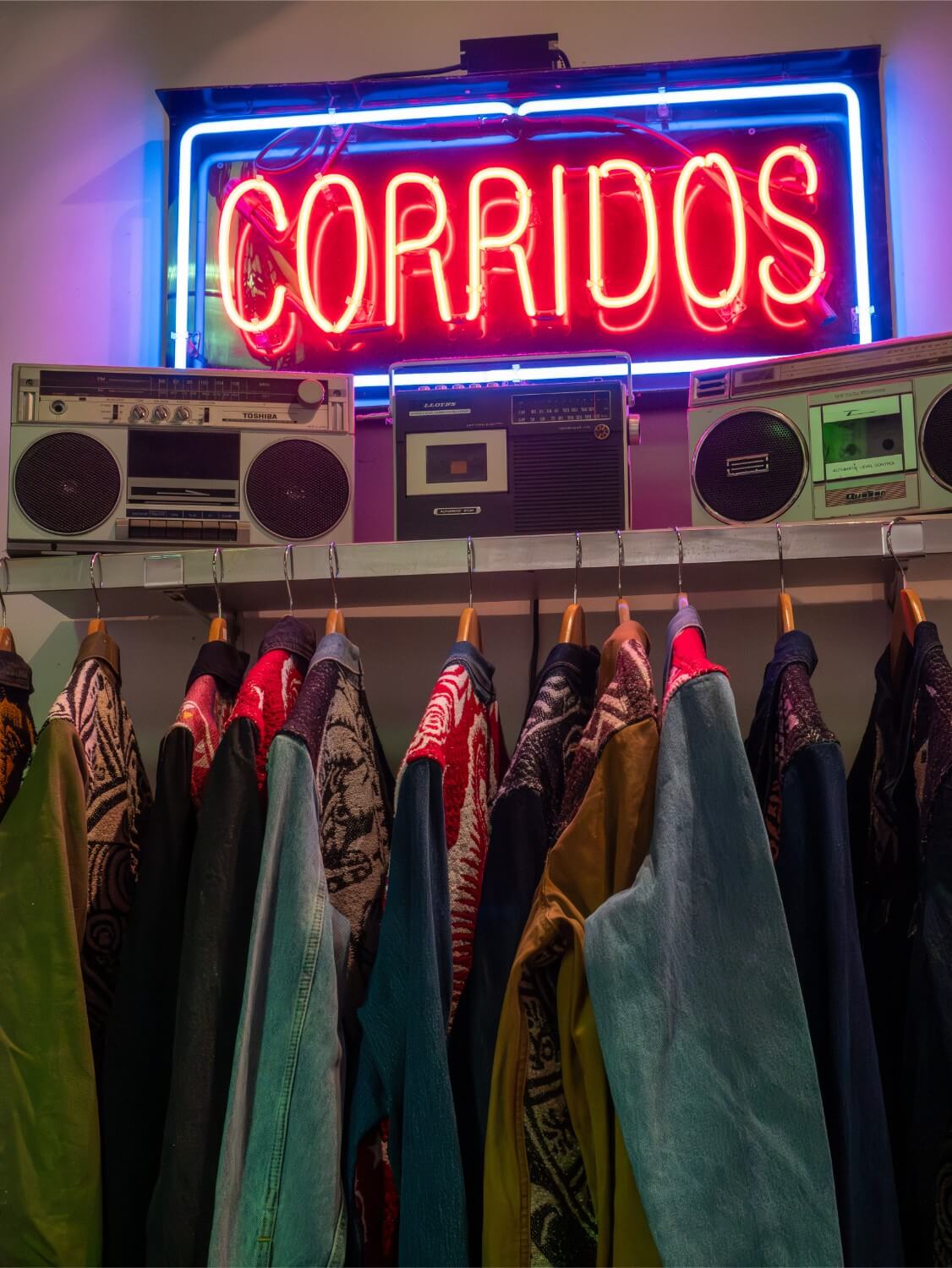
Merchandise and art on display at Espacio 1939 in Boyle Heights in Los Angeles, CA. Feb. 26, 2026. Jane Hutton/The Occidental
Beyond the jerseys, Espacio1839 continues to host community-centered events, including its upcoming 10th annual “Eres Poderosa” art exhibit organized by Aviña’s wife Myra Vasquez, featuring female artists, poets, DJs and local vendors — another reflection of the space’s commitment to uplifting and unifying community voices.
Aviña said he will continue pushing the movement forward as long as injustice persists.
“We’re always going to be on the side of the people and the side of the community,” Aviña said. “Until we see the injustice stop — and it doesn’t seem like that’s going to happen — we’re going to continue doing the work. We’re going to continue printing T-shirts, we’re going to continue printing jerseys.”
As LA prepares to host matches for the 2026 FIFA World Cup, Aviña said he hopes his jerseys will continue to serve as tools for expression, echoing the message emphasized by Becerra and Ramirez.
“I honestly hope that people are able to use them to express themselves,” Aviña said. “They have sayings on them, and it allows us to speak without actually being out there and speaking. You’re just wearing it, and they speak for themselves.”
Six candidates have declared for the June 2 primary election in California’s 34th Congressional District, including incumbent Jimmy Gomez. Gomez, a Democrat endorsed by Alexandria Ocasio-Cortez, seeks re-election for the sixth time. The top two candidates, regardless of party, will progress to the Nov. 3 general election.
Angela Gonzales-Torres, a candidate in the race, is endorsed by Justice Democrats, a prominent progressive political action committee. Gonzales-Torres said over email she is running for Congress because she does not believe status quo politics are good enough for CA-34.
“Our community is hungry for change and real representation,” Gonzales-Torres said.
Gonzales-Torres said her father was deported when she was fifteen, leaving her family to struggle with housing insecurity. Because of this experience, Gonzales-Torres said she understands the struggling families in the district.
“My life’s work has been rooted in building a future where the next generation has more of a fighting chance than I feel I did when I inherited this broken two-party system we are wrestling with today,” Gonzales-Torres said.
Gonzales-Torres said she views CA-34 as the heart of LA.
“I was born and raised in East Los Angeles,” Gonzales-Torres said. “Unlike nearly anyone else in this race, I didn’t move to this district to become a politician and certainly not one nearly fully funded by corporate super PACs like the incumbent.”
According to Gonzales-Torres, her focus is getting corporate money out of politics.
“We deserve community-informed decisions that puts people and the planet before profit,” Gonzales-Torres said.
Gonzales-Torres said she supports Medicare for All, a Green New Deal, small business protections and ending U.S. weapons funding for wars abroad.
“Our tax dollars should be building housing, healthcare, and opportunity here at home,” Gonzales-Torres said.
Gonzales-Torres said she hopes to bring leadership rooted in moral clarity to the race for CA-34’s congressional seat.
“My connection to CA-34 isn’t political, it’s personal,” Gonzales-Torres said. “It tells me this: it’s time for change, it’s time for courage, and it’s up to us.”
Rob Lucero, also a candidate in the race, said he is running to become a leader in the Democratic Party.
“I’m very concerned with the state of the country, and I’m concerned with the state of Congress and the Democratic Party,” Lucero said.
Lucero previously ran for Senate as a Republican, according to his website. Lucero said he nevertheless identifies as a lifelong Democrat.
“The short time that I was in the Republican Party, it was to try to get the dying Republican Party to join me, not the other way around,” Lucero said.
If Lucero wins, he will be the first member of Congress to represent CA-34 after growing up in the district, he said.
“I used to walk to the Oxy campus every day to go to school,” Lucero said. “[My family has] been here five generations.”
According to Lucero, his campaign addresses infrastructure problems, homelessness and fire danger.
“In our history as a nation, we wait too long to deal with these [issues] until there’s a real crisis like the Depression or World War II,” Lucero said. “A lot of our infrastructure […] goes back to that era.”
Lucero said community banking is another top priority for his campaign.
“There should be about 10 more local banks that are in just Eagle Rock and Highland Park alone,” Lucero said. “The important thing about this is these are the banks that can actually look a community member in the face and say ‘Putting aside your credit rating, we know you’re right here down the street, we want you to have a business [and] support.’”
Loren Colin, an independent in the running for CA-34, said he is a progressive option for voters.
“I have been a lifelong independent going back to 1996, because starting with Bill Clinton, I have watched the Democratic Party move away from the party of FDR,” Colin said.
Colin said he grew up spending time with his grandmother in CA-34, going to Dodgers games and getting french dip at Phillipe The Original.
“I have lived, worked, eaten and partied in this district for 30 years,” Colin said. “We have the best people in Los Angeles in our district, and the best food and the best event spaces.”
According to Colin, his campaign prioritizes four issues: taxing the wealthy, healthcare for all, creating more homes and abolishing ICE.
“Walking around [CA-34,] the number of people who don’t have health care […] is frightening,” Colin said. “We need something that is truly universal, and I can make that happen.”
Colin said his policies are Jeffersonian.
“We get the government we deserve,” Colin said. “I want to help convince Americans that we can actually create the government that best serves us.”
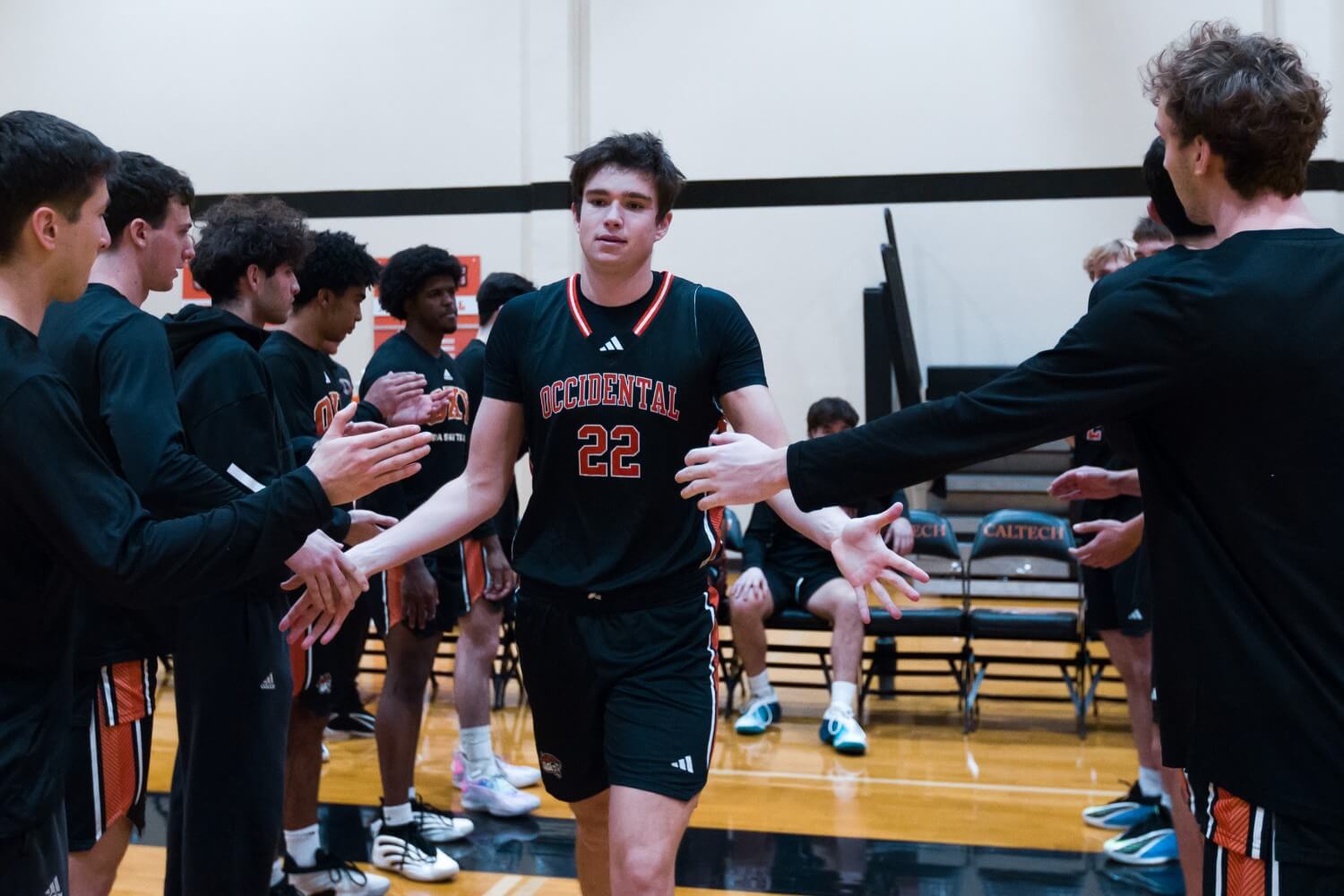
Occidental men’s basketball played in the SCIAC tournament for the first time since 2020, beating Cal Lutheran 88-84 in the tournament’s inaugural first-round game Feb. 25.
Guard Nasir Luna (sophomore) scored 13 of Occidental’s first 16 points, opening up an early lead for the Tigers, the fourth seed in the tournament.
At around 10:30in the first half, guard Perry Rainey (first year), a mid-season transfer from DI Howard University, ran into guard Ethan Hanning (senior) on defense. On the Tigers’ next possession, Rainey got up and knocked down a 3-pointer — widening Occidental’s lead to 25-12 and forcing the Kingsmen to take a time out.
Guard Jacob Koretz (senior) said Rainey has made athletic plays all year — and his redemptive 3-pointer was one of Koretz’s favorites.
That play, Rainey “had a one-on-one opportunity,” Koretz said. “Usually he goes to the rack every time,” but Rainey passed the ball to Clotfelter.
“Nicky [Clotfelter] kicked it back out — wide open 3,” Koretz said. “Bang. I was hyped.”
Occidental played without injured guard Alex McCleery Brown (sophomore), who scored 28 points in the team’s 86-82 upset win Feb. 14 over Redlands, the top-seeded SCIAC team and No.10 in DIII at the time.
Assistant coach Dominic Maynes said many players stepped up against the fifth-seed Kingsmen.
“They were doubling a lot of our lost post entries, whether it was Nicky or Nas [Luna],” Maynes said. “Nicky made the right read, kicked it right back out to Perry — that was a big 3.”
Occidental’s lead over Cal Lutheran hovered around 10 points the rest of the first half, which finished 44-35.
During the second half, the Tigers grew their lead to 19 points. Cal Lutheran outscored Occidental 19-3 in fast break points during the second half and cut the Tigers’ lead to single digits at the clock dwindled under sixminutes. With 11 seconds remaining, the Tigers were up 2 points with Luna at the line.
Luna, who led Occidental in scoring with 26 points, made both of his free throws. In the game’s final moments, Occidental’s defense held on for the win.
According to Maynes, the pressure, composure and speed of the last six minutes defined the game.
“It was new for all of our guys to be in that situation, playing beyond the regular season,” Maynes said. “So for them to be confident and not allow the moment to overtake them — I was really proud of that.”
Guard Mateo Tangaan (senior) said the game was electric.
“We prepared all week for it, so we were very confident in it, but obviously we don’t want to close it out that close, since we were winning the whole time,” Tangaan said. “But all in all, just a great win.”
According to guard Ethan Hanning (senior), playing in front of a packed gym was exciting.
“They took our big away really well — Nicky — and we’re without our best player right now — without Alex [McCleery Brown],” Hanning said. “It was awesome though. Just so fun to be out there.”
Occidental lost to Redlands 76-100 in the SCIAC tournament semifinals Feb. 28.
The Feb. 25 victory over Cal Lutheran was the final home game at Occidental for six seniors: Tangaan, Hanning, guards Koretz and Henry Wilson, and forwards Clotfelter and Chase Miller.
Wilson said he became instant friends with Koretz, Miller and Clotfelter when they met freshman year. Tangaan and Hanning both transferred to Occidental as juniors, from Merced College and Vanguard University, respectively.
Wilson, who is from Columbia, Missouri, said he and the other four-year seniors have visited each other’s hometowns. Koretz is from Kingston, Pennsylvania, Miller is from Littleton, Colorado and Clotfelter is from San Diego, California.
“Every time any of us drive across the country, we all stop at each other’s houses,” Wilson said.
According to Maynes, his first season as a coach in Occidental’s program was also three years ago, and the team was still emerging from the remnants of COVID-19. Maynes said the 2022-2023 season was the first time in many years that the team did not have a junior varsity program, so players were competing for a smaller roster. Still, that year’s freshman class came in looking to learn right out of the gate.
Maynes said that Koretz, Clotfelter, Wilson and Miller are playing college basketball after being some of the better players on their high school teams. As younger players at Occidental, Maynes saw them “allowing themselves to kind of start from the bottom again and work their way up.”
“Seeing that through each year has been phenomenal,” Maynes said.
Maynes talked with them about building a foundation for Oxy basketball after COVID-19 by improving the program bit by bit. And they listened.
“You just want to be proud of what you’ve done,” Maynes said. “So in 10 years, whatever it is, you’re looking back at what you did for the four years during your time here at Occidental, and it’s like, ‘I left it better than I found it. I built a program that’s, again, trending in the right direction.’ And so far they’ve done nothing short of that.”
Hanning said the team had seven freshmen last year, when he and Tangaan transferred.
“It was nine new guys that came in, so it was basically a whole new team,” Hanning said. “I think that helped in a way, because usually it’s new guys trying to get assimilated, but more than half of the team was new.”
That campaign was “a building year,” Hanning said. The team had less turnover this season, “so we jumped into the same system we ran last year, and we could build on top of it a bunch.”
According to Hanning, this year’s squad is the closest team he’s ever been a part of.
“We knew this would be a special year,” Hanning said. “Especially in college sports, I’d say it’s pretty common for there to be divides on teams, or people don’t like their captain. I’d say we don’t have that at all. There’s no cliques.”
Working out everyday with Hanning, Tangaan said they became close friends. Wilson and Clotfelter, who were co-captains this season and last, helped integrate the junior year transfers.
“I still feel like they’re a little older,” Tangaan said of Wilson and Clotfelter. “Just because I stepped in and they were those leaders that introduced me to the team. But just coming to the new program, they sold me on being unselfish.”
Koretz said that the seniors are his brothers.
“I’ve never been a part of a basketball team that has trusted me so much, and I’ve been able to genuinely trust them,” Koretz said.
Wilson said Koretz is naturally a quiet guy, but a leader by example who shows the team how to work.
“It might be a little bit untraditional having a point guard not talk so much, but he’s our rock,” Wilson said. “When things are unsteady — even you saw it tonight, things getting crazy, the game is back and forth — get the ball to Jake. He’s going to slow it down, he knows what play to call. So everyone trusts him.”
Miller said part of what makes Koretz a successful basketball player is his emotional consistency.
“I’d say there’s an element of mystique around Jake in general,” Miller said. “He keeps to himself a little bit in some ways, at least in terms of how he presents himself … I think that’s one of the reasons he’s been so successful as a basketball player, because keeping your emotions out of it and staying consistent, no matter what’s happening around you, is really one of the most powerful traits as a player.”
Maynes said Koretz and Wilson work in tandem.
“Henry’s voice is truly what goes above and beyond. Everybody knows he’s our vocal leader, and it’s something that he’s taken strides in,” Maynes said. “I would say it really transcended his sophomore year. That’s where it took shape, and he’s grown each and every year, leading by example and through his voice.”
According to Miller, Wilson started for two years before coming off the bench this season.
“What really spoke to his character more than anything is how he handled that,” Miller said. “He always came to practice with a good attitude. He always showed everybody, by example, how you deal with those kinds of situations.”
Because of his poise in a new role, Miller said Wilson had many big moments down the stretch for the team. Wilson nailed two crucial 3-pointers with less than 10 minutes left against Whittier in early January. Occidental ended up winning by 1 point.
“I think Henry is a prime example of how to continue to be a leader and continue to keep your head up through all that adversity,” Miller said.
Wilson is always one of the first guys in the gym, Miller said, and supports his teammates when they don’t feel like things are going their way.
“He’s really kept us together in a lot of meaningful ways,” Miller said.
While Wilson is the team’s vocal leader, Maynes said Clotfelter reinforces the standard Wilson sets.
According to Maynes, Clotfelter is “very within himself. He’s not somebody who’s going to be overly loud, but you understand — talking to him, watching him play, how he acts in practice — what the expectation is.”
On a team that lacks big players — only Clotfelter and Miller are 6-foot-6 or taller — Tangaan said the team often runs the offense through Clotfelter. The San Diegan’s size pays dividends on the other side of the court, too.
“He can guard guards — that’s why we’re able to switch everything,” Tangaan said. “That’s why we’re so good at defense this year.”
According to Tangaan, because Clotfelter is 6-foot-7 and moves like a guard, he “doesn’t belong” in DIII ball.
“He’s definitely DII, DI caliber,” Tangaan said.
Miller said both he and Clotfelter dealt with injuries during their college basketball careers. During the Eaton Fire in January 2025, Miller said Clotfelter invited the team to wait things out at his home. While they were in San Diego, Clotfelter was lifting weights and dropped one on his foot, causing him to miss the rest of the season.
“Nicky is someone who, like me, has dealt with substantial injuries in his career,” Miller said. “He only played seven games last year, [and] had a multitude of unfortunately timed injuries. So just thinking about both of us, I think he and I played in a combined 46 of 54 games this year, which is just absolutely incredible. So I really could not be more proud of him.”
Miller has dealt with knee and ankle injuries since the summer after his sophomore year, and missed playing the entirety of his junior year. Those injuries lingered around last fall, and he wasn’t sure if he was going to be able to play this season.
“My body’s definitely not the same that it was a few years ago,” Miller said.
According to Miller, the mental toll that his physical injuries took was the hardest part his recovery journey.
“With physical therapy, with rehab and timelines constantly getting pushed back, adjusted, changed, it becomes really mentally taxing … particularly when it’s an entire season,” Miller said. “I kind of have an understanding of why people who do miss that amount of time do not come back, because there’s just so many physical and mental hurdles that you have to clear to get to that point.”
Wilson said he doesn’t know any college athlete who cares for their body as diligently as Miller does.
“This year we have so much talent, but the one thing that we had less of is size,” Wilson said. As such, Miller has “been enormous for us.”
Hanning said he expected to start his first game as a Tiger last season, but suffered a concussion. He came back from the concussion only to break his foot. Hanningwas a starter this season before he tore his MCL in late December, in the weeks leading up to conference play.
“After I got hurt, my role completely changed,” Hanning said. “I’m just happy to be back.”
Hanning said Tangaan was his high school team’s best player and was one of Merced College’s main shooters. Like Hanning, Tangaan’s role evolved in Oxy’s program.
Hanning said Tangaan is “an amazing player. He kills the practice, but he puts the team above himself, which is, I think, part of the reason why we’re so successful.”
Tangaan said Hanning, a Physics major, is probably the hardest worker he knows — and a guy who just loves the game.
“I work out with him every day and I see how hard he works, how much he cares, how much he takes care of his body on and off the court,” Tangaan said.
Miller said sports can often focus on wins and losses — and Occidental’s 19-8 record speaks to the team’s success. Being a Tiger taught him that you accomplish more working together than you can on your own.
“I think what I’m going to miss most is being around a group of exceptional, high character young men who are willing to give those sacrifices every day,” Miller said.
Cheerio Collective is a storefront that hosts live events and sells vintage clothing atop a mosaic stone floor. Some of Cheerio Collective’s past events have been flea markets, repair vendor fairs and jam sessions. Located at 5917 N Figueroa St., they are open to the public as a resale store and event space.
Cheerio Collective co-founder Griffen Thompson said his wife, Lureena Thompson, deserves much of the credit for the space they have created. According to Thompson, his wife’sinterests influenced the vision of their store.
“She loves collecting clothes, knickknacks and vintage goodies,” Thompson said. “She also has a background in comedy and improv, which was the impetus for creating a space for live events as well.”
Thompson said his wife was also a driving force behind their mosaic floor.
“She’s the mad artist behind it; she hand-placed every single stone,” Thompson said. “We had this 16-footscaffolding. She would place one stone down, climb up, look down at the stone in context of everything else, and say ‘It needs to be rotated 30 degrees.'”
Cheerio Collective in Highland Park in Los Angeles, CA. Feb. 21, 2026. Marty Valdez/The Occidental
According to Thompson, the floor was made of free recycled material from people’s kitchen countertops. Thompson saidthe process of creating the floor also created a bond with the community; the fire station next door cheered them on during construction.
“When we were installing the floor, it wasn’t intended, but it was almost like performance art,” Thompson said, “People would walk by, poking their heads in. Even our neighbors were our partners.”
According to Thompson, Cheerio Collective’s event space can be moved around for various occasions.
“Everything is on wheels, so we can change the layout in an hour, set up chairs, and we have our stage,” Thompson said. “We’re able to transform from a vintage store to a live comedy show.”
Temporary bulletin board of the Cheerio Collective in Highland Park in Los Angeles, CA. Feb. 21, 2026. Marty Valdez/The Occidental
First-time visitor Rebecca Sader said she loved the concept and design of the space.
“I’d heard about it from friends, and I like the idea of a performance space that’s also another space,” Sader said.
Sean Sader said he is a musician and a returning visitor at Cheerio Collective and hopes to perform in the space one day.
“I’m really interested in experiencing the events and maybe booking an event myself sometime,” Sean Sader said.
Cheerio Collective is not just a store or community space, Thompson said, but a combination of both.
“With everything together, we love the energy — dare I say vibe,” Thompson said. “So we decided not to have it be a separate store and event space.”
Thompson said he is very grateful for the long journey that he and his wife have been on and is grateful for how it has turned out.
“Seeing the hard work pay off, […] we’re graced with a full room of people standing on these stones,” Thompson said. “The stones were crooked and uneven for so long until we finally installed them, and no one tripped.”
Content warning: The following article discusses suicide.
When news broke about 16-year-old Adam Raine, I found myself rereading the details with growing disbelief. Raine’s parents said an AI chatbot encouraged his suicidal thoughts. It wasn’t just the tragedy of a life cut short; it was realizing that a tool marketed as “safe” and “responsible” had allegedly reinforced the very impulses it claimed to guard against.
Like many people, I had assumed that AI systems came with guardrails, that the stories about bots “hallucinating or producing odd responses” were merely quirks, not potential threats. But as more cases emerge, it’s becoming clear that AI mental health support carries far more risks than we are anywhere near ready to confront. The most unsettling part is that these risks are now hiding in plain sight.
The New York Times reported that during the weeks before Adam’s death, ChatGPT sent responses that validated his darkest thoughts, telling him things like “let’s make this space the first place where someone actually sees you.” NPR echoed the same: The AI allegedly framed Adam’s suicidal ideation as a form of inner strength.
For a young person in crisis, language like that is not just inappropriate — it is dangerous. It’s moments like this that force us to ask the question: What happens when someone turns to AI in a moment of panic or despair?
The answer, based on cases like Adam’s, is painfully clear: they receive feedback that no trained professional would ever give or say.
Parents often imagine that digital tools are neutral — that they cannot actively harm, only occasionally “glitch.” The Raine case shatters that assumption. A malfunction of any kind, a poorly tuned safety protocol or even an ambiguous input from a teenager can lead to real-world consequences. The stakes are no longer theoretical.
Even as tech leaders insist that their systems prioritize safety, the evidence suggests otherwise. OpenAI’s CEO claimed the company made ChatGPT “pretty restrictive” for mental health issues. But reported outcomes contradict that promise.
The Guardian documented at least 16 instances of individuals developing psychosis symptoms in the context of AI use — cases where the boundary between chatbot conversation and reality blurred. Adding the Raine case to that list makes the pattern impossible to overlook.
AI cannot reliably interpret crisis language, nor can it substitute the grounding that occurs in real human conversation. Amandeep Julta from The Guardian wrote: “If this is Sam Altman’s idea of being careful with mental health issues, that’s not good enough.”
Restricting outputs isn’t enough if the underlying systems still aim to be agreeable or validating: traits that can backfire catastrophically for someone who is in distress. What stands out across these cases is not just the technical failure but the deep misunderstanding about who is considered “vulnerable.”
We all form distorted beliefs at times. We all lose perspective. And it is other human beings — not machines or chatbots — who help reorient us back to reality. AI, despite its friendly tone and conversational ease, cannot provide that. It lacks emotional intelligence, ethical reasoning and accountability. Yet users, especially teenagers, often feel as though the system “understands” them. The illusion can be a source of comfort until it becomes harmful.
This is perhaps the most unsettling question of all: If an AI produces a harmful response, who is accountable? If we question the most powerful people, such as ChatGPT and OpenAI’s CEO, Sam Altman, that’s our direct point of blame. However, if we do blame him, we also face a risk: Altman holds a lot of power. Therefore, it feels like the system cannot be punished, cannot explain why it generated a particular sentence, and cannot take responsibility for the consequences of its output. Yet the emotional stakes for the user feel real. Conversations amongst chatbots can mimic friendships, trust and even intimacy. However, beneath the surface, there is nothing, no empathy, no moral compass and no duty of care. The disconnect we see between how AI feels and what it actually represents is one of the most urgent public health issues of our time.
Although AI chatbots may appear harmless or even helpful, there is strong evidence that they should never be viewed as substitutes for licensed professionals. AI is a tool, and like any tool, it can fail, sometimes catastrophically.
Users must understand the limits, parents must be aware of the risks and developers must face scrutiny when systems malfunction. We need open, public discussions — through schools, community programs and accessible media — to help people understand how these systems work and where they can be risky. It must go beyond tech optimism and truly confront the implications of delegating emotional support to machines.
Even with its limits, AI can offer immediate, nonjudgmental support at moments when no human is available. This can make a real difference in a crisis, providing a stabilizing presence that helps someone feel less alone while they wait for real-world help.
Yet this potential doesn’t erase the bigger risks that are at stake. In a world where loneliness and anxiety are on the rise, it’s tempting to see AI as an easy solution. But Adam Raine’s story reminds us that emotional vulnerability should never be met with algorithmic guesswork. Until we fully understand the risks and establish strict accountability, the safest stance is caution. When a teenager in crisis reaches out for help, the difference between a human and an AI system is not abstract. It may be the difference between life and death.
It isn’t up for debate: Over the last year, the mayor of the City of Los Angeles has become increasingly unpopular. Karen Bass’s polling has gone sharply underwater, with polling showing 49 percent of Angelenos rating her unfavorably in 2025, compared to just 37 percent favorably.
The elephant in the room, of course, is in the mayor’s response to the fires across LA last January. Her actions and decisions, both before and during the fires, have been questioned from various angles. She’s come under scrutiny following recent allegations that she directed a cover-up of both the city’s and the LAFD’s failings in fighting the blaze. The incident has thrown her previously respected leadership into question, and one of the primary reasons she appears electorally vulnerable as she seeks reelection as the incumbent in a year that appears favorable to Democrats. But I believe there are more factors behind Bass’ drop in popularity than the fires — a steadily piling-up list of grievances among the same voters who helped her defeat Rick Caruso in 2022.
Bass’ progressive base has become alienated by her insistence on increasing LAPD funding despite city budget shortfalls, and as Police Chief Jim McDonnell appears reluctant to confront ICE. On the other end, LA’s growing pro-development movements have become increasingly frustrated as the city’s housing crisis continues to worsen — in October 2025, Bass made clear her opposition to SB79, a California State Bill intended to expedite the construction of dense affordable housing near transit stops, and accusations that she was beholden to “NIMBYs” and hostile to necessary development began to inch into the mainstream.
The job of the LA mayor is hard. Unlike New York City, where the mayor’s strongest obstacle is the state government, the LA mayor, while not a figurehead, has far less power, and Bass lacks the political leverage to act decisively on issues that have plagued the city. Bass has also failed to use much of the soft power that inherently comes with being the mayor of the second-largest city in the United States. She has been almost invisible in the anti-Trump movement despite LA’s status as a focal point for the administration’s indiscriminate raids on immigrant populations. She has also been slow to respond to unfolding events – for instance, taking an entire two weeks to call for Casey Wasserman’s resignation as Chairman of the LA Olympic Committee after his ties to Ghislaine Maxwellwere revealed in the Epstein files.
Others recognize this electoral weakness: 40 candidates have decided to try their luck against the incumbent Bass in the 2026 mayoral election. And yet on Feb. 7, the morning of the filing deadline, I saw her position looking practically secure for the next four years. LA’s population had united against the heinous actions of the federal administration. Many of her more prominent prospective challengers had dropped out, such as former LA Unified School District (LAUSD) Superintendent Austin Beutner, following the tragic death of his daughter, or had declined to enter, such as LA County Supervisor Lindsey Horvath.
Her remaining challengers were either fairly obscure, such as the Rev. Rae Huang, a Democratic Socialists of America (DSA) member, or simply electorally dead on arrival, such as TV star and registered Republican Spencer Pratt. Pratt is a candidate I would certainly like to be up against in the runoff as Bass: a simple question of Democrat against Republican in LA, of all places, and of all times.
Then, just hours before the deadline, City Council member Nithya Raman made a last-minute entry and that security began to evaporate.
Unlike some of the right-wing candidates looking to unseat Bass, Raman, another member of the DSA, is running against Bass from the left, making her arguably better-positioned to pick up the progressive vote by framing Bass as a status quo candidate. At the same time, Raman, unlike many other progressives, is perceived as pragmatically pro-development – she voted against the resolution that the LA City Council passed. Bass signed to oppose SB79 and has made efforts to reform Measure ULA, a sales tax on high-value real estate that has been criticized for hindering new housing construction in LA due to its broad scope.
If the opposition to Bass in LA is to coalesce behind anybody, I believe it would most likely be Raman, who also has one of the strongest degrees of name recognition on her side as a member of the City Council. The news appears inclined to agree, with most coverage of the race so far focusing on her surprise entry, and particularly on her nature as a former ally – one who previously gave an endorsement to Bass before choosing instead to run against her.
That is not to say that I believe that Bass is doomed. Given the last-minute nature of her candidacy, Raman will have to scramble to put a campaign structure in place. While Bass herself has avoided attacks, some of her campaigners have sought to highlight what they perceive as a betrayal and disruption in a moment where neither is needed. Many of LA’s strongest institutions have also coalesced around Bass.
What I do believe is that the question of LA’s next mayor has gone from one that was relatively easy to answer to one that is rather open-ended. I’d encourage everybody, however you feel about the mayor, to learn about all the candidates – not just Raman and Bass – and cast a ballot June 2 and, in the likely scenario of a runoff, November 3. This is the city that we all live in, and whoever you prefer probably has a shot now.
The Occidental Ski and Board Club (OSBC) has plans for a very active spring season, and has already taken ski trips to Big Bear and Mammoth. According to President Jasper Clarkson (junior), the club hopes to ski every weekend and host social events such as yoga and hikes.
The current OBSC is a revival of a ski club that dissolved during COVID-19, according to club treasurer Keean Stauber (junior).
“My freshman year, I met up with some of my friends who also really loved to ski, and we started going to Big Bear,” Stauber said. “We floated the idea of making this into an official thing because we realized there’s a lot of benefits to forming a club.”
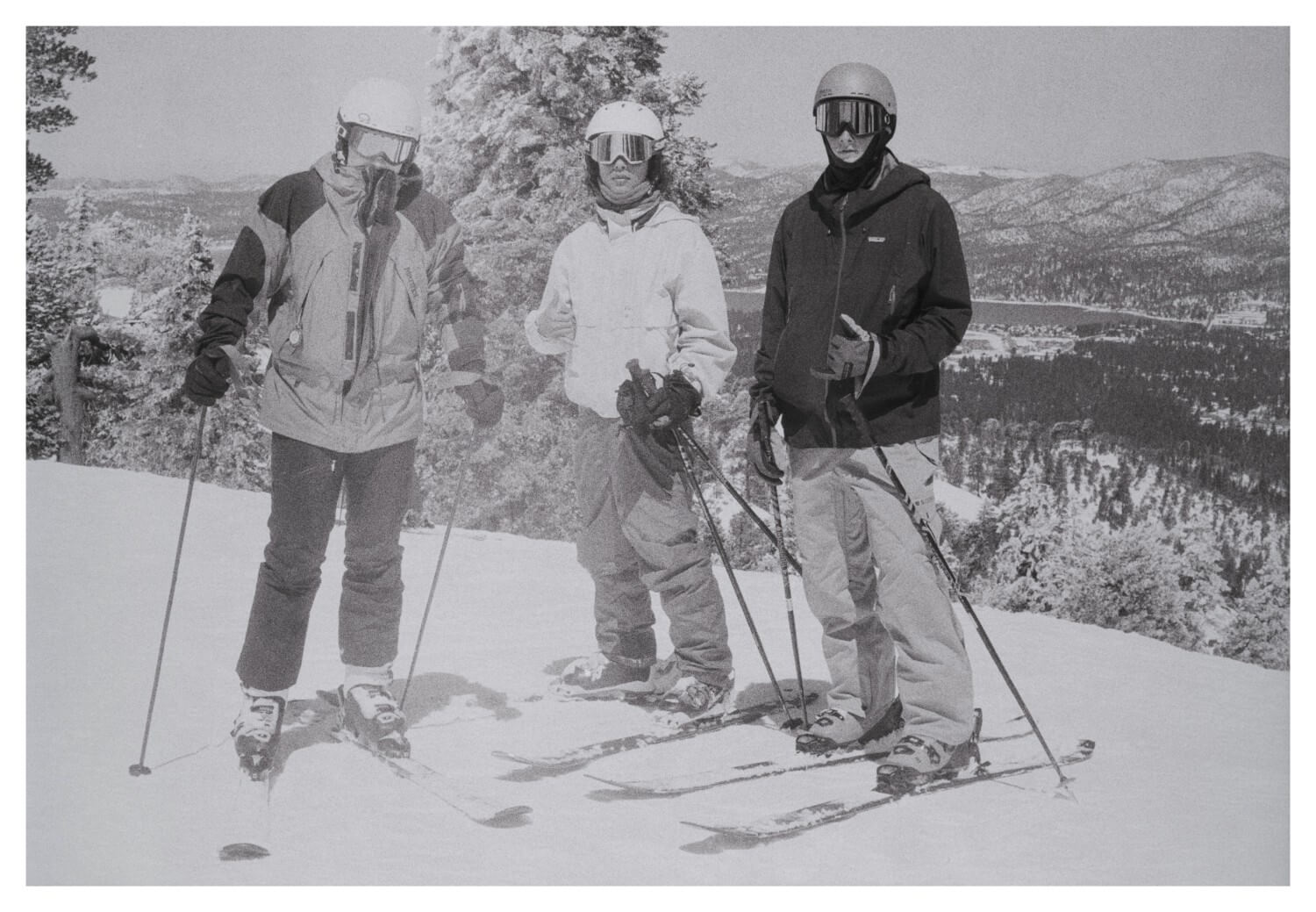
Courtesy of Keean Stauber
Clarkson said he was among the skiers whose intention for the club was to make snow sports financially accessible for students. He said Alterra — one of the largest owners of ski resorts — offers college students discounts for Ikon passes, which are available through OSBC.
“We can get a [basic] season pass for under $600, where it’s normally $700 to $900,” Clarkson said.
Stauber said the club has held raffles for passes and advises members on the optimal time to purchase passes. The club is not only concerned with making passes more accessible, but they also focus on accommodating skiers and snowboarders of different experience levels, according to Clarkson.
“I think my expectations were to be able to ski with my friends and get club money to […] support ski adventures,” Clarkson said. “But it’s totally gone beyond that now.”
OSBC Creative Director Ella Lietzau (junior) said members’ skill levels range from beginner to advanced.
“We did a beginner day last year to encourage people to […] try something new,” Lietzau said.
According to Clarkson, Big Bear is especially novice-friendly because of its mild weather and close proximity to Occidental. He said this year, the club has been organizing groups depending on people’s preferred speeds and difficulty of terrain.
“We have point people from the [executive] board that are designated to each group and people can text them and [ask], ‘Where are you guys skiing?’” Clarkson said.
Courtesy of Jasper Clarkson
OSBC took a trip to Big Bear Feb. 14, according to their Instagram. Maya Johnson (sophomore) said this was her first ski trip with the club.
“I had an amazing day,” Johnson said. “I was like, ‘This is great, it’s great to get back into skiing.’ It’s crazy that I can be on campus one morning and then be skiing the next.”
Club members carpool and share lunch together on their day trips to Big Bear, according to Clarkson.
“We all did some runs together and it was a lot of fun,” Clarkson said. “Carpools went well. I think people were gelling with each other in the car and it was fun to ski with a bunch of new people.”
According to Vice President Paige McCarthy (junior), future trips for the club include skiing and boarding at Mammoth Mountain, a resort five hours from LA, from Feb. 20 to 22 and from March 27 to 29.
During a spring break trip to Mammoth last year, Clarkson said the club had a series of great ski days as a result of a large snow storm.
“We just got a crazy powder day after the storm,” Clarkson said. “We found some big cliffs to jump off. It’s always fun in the Sierras when there’s so much snow. Because the snow is so deep, you won’t hurt yourself.”
Skiing and boarding weren’t the only activities the group participated in on the trip, according to McCarthy.
“We had spent three days skiing which can be hard on your body,” McCarthy said. “The second-to-last night we went to the hot springs that are right outside the town of Mammoth, and we all just soaked in them and watched the sunset. It was so beautiful and fun.”
Clarkson said sharing meals together is a large part of OSBC. He said the club plans to have weekly dinners at members’ houses.
“We had one night in Mammoth where we all worked together to make dinner for the entire club,” Stauber said. “We all ate together […] and it was a fun community event that was separate from skiing [yet] probably the highlight of the trip.”
The club also organizes yoga sessions led by Occidental College yoga instructor Maja Zimmerman, according to Clarkson.
“We’re trying to do more club events on campus, so it’s not like you have to pay a bunch of money to go ski to be a part of the club,” Clarkson said.
According to Clarkson, the club plans to do the “California Challenge” as their last big event for this spring.
“We’re going to camp out in Joshua Tree, […] ski a couple runs [at] Big Bear and then drive out to the ocean and surf — try to do it all on the same day,” Clarkson said. “It’s pretty magical to be able to have 70 degree weather here every day, be able to see the ocean from Fiji and drive to the snow just for a day trip.”
The Highland Park Community Support Group is installing sirens to alert neighbors if Immigration and Customs Enforcement (ICE) is in the area, according to KM, an organizer assisting the effort who will remain anonymous due to safety concerns.
KM said 38 sirens have been installed on private properties, ranging from outside people’s homes to local businesses in Highland Park, mainly near the 110 Freeway exit.
“We saw ICE coming off the freeway really fast, and then picking people up and getting back on the freeway,” KM said. “The rapid response teams, it takes time for them to get down to where it’s happening and do the work, so we thought creating a louder system [would] be more effective in warning residents.”
When the installation is complete, the residents and business owners will get a notification that ICE is in the vicinity, and they will turn the sirens on, KM said.
KM said this effort is community-run, with funding coming from a GoFundMe page that raised $5,000 to buy the sirens and other necessary components like extension cords.
Because the sirens are only being placed on private properties, there is no need for a permit, KM said.
“There’s a noise ordinance, but we won’t have the sirens on that long, maybe a minute or two, so that shouldn’t be a problem,” KM said.
According to KM, the sirens should be fully up and running by the end of February. Participating businesses are not advertising if they have one of the sirens due to threats received from ICE supporters who said they would steal or wreck the sirens, KM said.
“We’re the first ones [doing this],” KM said. “One of our goals is to influence other communities to get their own sirens […]. Some communities reached out already, so we’ll be helping them.”
Darren Gold, president of the Historic Highland Park Neighborhood Council (HHPNC), said he has lived in Highland Park for over six years and believes it is important for neighbors to look out for one another and share accurate information when there are legitimate concerns.
“We [HHPNC] respect that the siren effort is being organized by community members and activists,” Gold said via email. “As an official advisory body of the city, however, our role is governed by city rules and oversight. Any participation would require review and approval from the City Attorney, which limits our ability to formally engage in independently organized actions.”
According to Gold, the HHPNC has distributed whistles to help people feel prepared in the case of ICE action in the area.
“Any alert system has to be used responsibly,” Gold said via email. “I think in general, people like the idea of them.”
NBC Los Angeles reported that the Department of Homeland Security called the community effort in Highland Park to install sirens “quite literally insane.”
According to Gold, concerns regarding ICE are raised at nearly every HHPNC meeting.
“We’ve formally sent letters to the City Council requesting that towing fees be waived for vehicles left behind when residents are detained,” Gold said via email. “Within our role as an official City advisory body, we are doing everything we can to support residents who are being impacted by these raids.”
KM said the community effort is interested in potentially reactivating the air raid sirens from the Cold War era that are still installed around Northeast LA. For a project of this size, KM said the group is seeking mayor Karen Bass’s support.
In a statement to The Occidental, mayor Karen Bass’s office said that she recently signed Directive 17, which restricts federal immigration officers from using or remaining at city-owned facilities and aims to limit ICE presence on city property, including in communities such as Highland Park.
“Mayor Bass has expressed concern about the climate of fear affecting residents, noting that many ethnic minorities are becoming less visible in daily life and that the change in community atmosphere feels significant and unsettling,” the statement said.
KM said that there is so much city officials could be doing to help address the immigration enforcement issues around the city.
“It’s just terrible what’s happening right now,” KM said. “They’re not even asking for ID. They’re just picking up people because they’re brown or Black […] Thinking outside the box of different ways to help the community from these ICE raids is very important.”
Mason Lopez, an employee at Villa’s Tacos, said he began working at the restaurant about four months ago. Lopez said he feels Villa’s energy and personality are why he was selected to be a part of the halftime show.
According to Villa, being in the halftime show meant representing his family, his community, LA, Mexican Americans and all the Mexicans who came before him. Villa said he feels the reason he and Villa’s Tacos were given opportunities like appearing in the halftime show is the love that is put into all the food at the restaurant.
“Our food is a testament to the love we put in there, the love that we have for everybody who comes to our doors,” said Villa.
According to Villa, he got a call from a friend explaining they wanted tacos to be a part of the Halftime Show and asking if Villa wanted to participate.
“He called me back about a month later, and then he told me, rehearsals were going to start soon,” Villa said. “We [rehearsed] for about two weeks, and then the last 10 days leading up to the Super Bowl, we went to Santa Clara.”
Villa’s Tacos sign at the original restaurant location on North Figueroa Street in Los Angeles, CA. Feb. 20, 2026. Lila Weiner/The Occidental
According to Villa, there have always been long lines at Villa’s Tacos, but after the show, the lines don’t seem to stop. Lopez said the reaction has been positive, as there were a lot of people coming in to compliment the restaurant on the halftime show.
Mackenzie Bunyi, a first-time customer at Villa’s Tacos, said she had heard of Villa’s Tacos before the show but was trying it for the first time Feb. 21.
“I love how Bad Bunny brought the spotlight to small businesses, not just in one area of America,” Bunyi said.
According to Condé Nast Travelers, there were many other businesses featured during the halftime show, such as La Marqueta Bodega, a corner store from New York, and Johana Castillo, a nail tech from LA.
“I met a lot of good people, a lot of people I consider my family now,” Villa said. “We text each other every day, and it was great to be around such amazing people.”
It has taken about eight and a half years for Villa’s Tacos to get to a point where they can perform at an event like the Super Bowl Halftime show, Villa said.
According to Lopez, Villa’s Tacos started at Villa’s grandmother’s house, supported by the rest of Villa’s family, before they were able to open their first location in Highland Park — a neighborhood Villa said he considers his home away from home.
Sign inside Villa’s Tacos on North Figueroa Street in Los Angeles, CA. Feb. 20, 2026. Lila Weiner/The Occidental
There are now three Villa’s Tacos locations, according to the Villa’s Tacos website, with the Highland Park location earning a Michelin Bib Gourmand award. The restaurant was also featured in the Netflix show “Taco Chronicles: Cross the Border.” Villa said he uses mountains as an analogy to describe the restaurant’s success.
“The Netflix [show] was a high mountain […], but [the Super Bowl] was like climbing Mount Everest,” Villa said. “I don’t know if there’s even a higher mountain than what we just did two Sundays ago.”
According to Villa, three more stores are planned to open, one in Hollywood, one in South Pasadena, and one in his home neighborhood of Atwater Village. Villa said he is incredibly grateful for the journey he has been on to make Villa’s Tacos what it is today.
“This wasn’t only a win for myself, but this was a win for everybody, for my community, for my people, for my culture, for all the taqueros of the world,” Villa said. “It’s been an honor to represent that.”
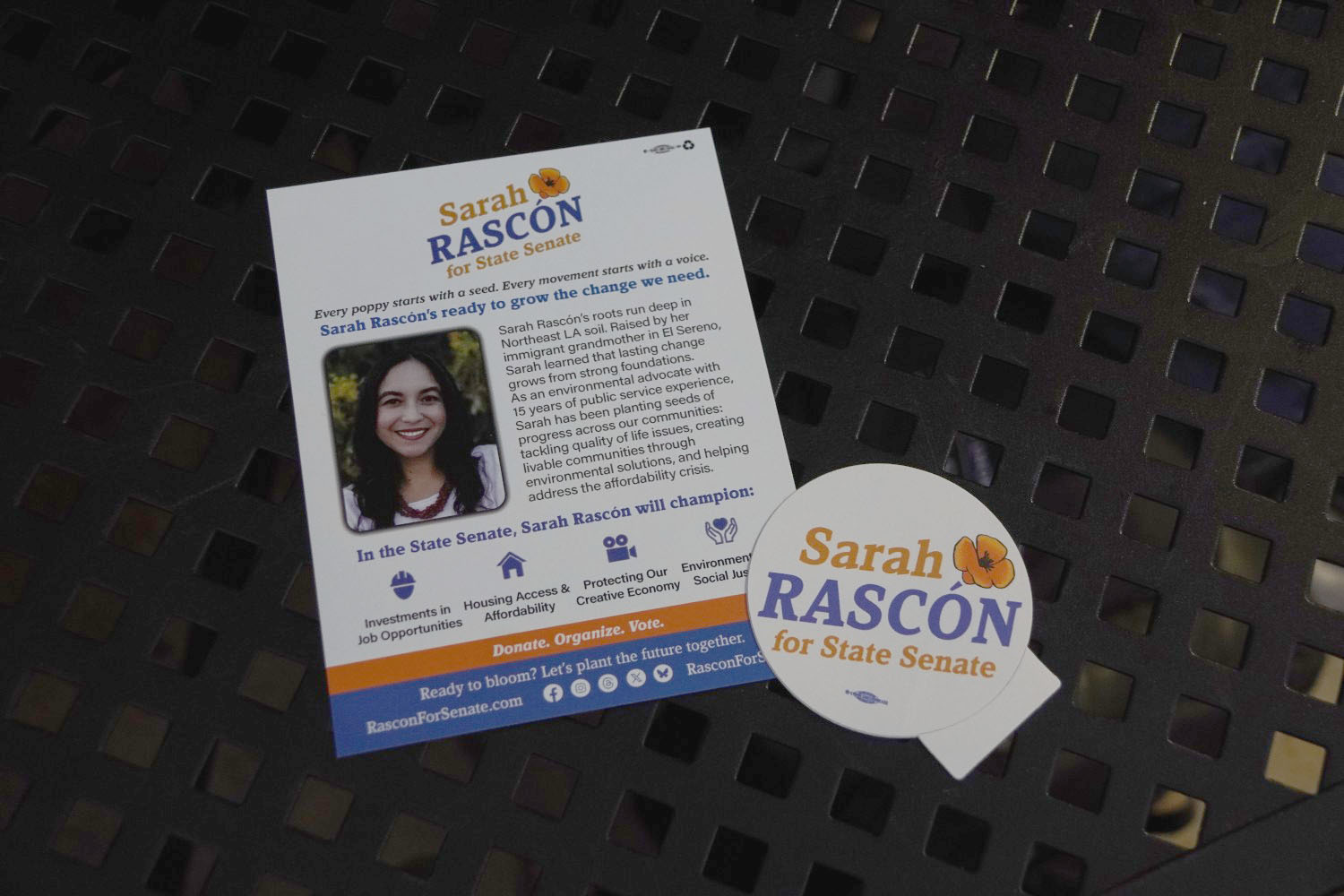
Sarah Rascón is running for State Senate in California’s 26th District, which includes parts of Northeast, East and Central LA. Rascón, whose campaign website emphasizes environmental and social justice, housing affordability, small businesses and workforce development, faces four other candidates in the primary election June 2.
Rascón said she was raised by her immigrant grandmother after her parents’ divorce. According to Rascón, her life was shaped by children’s court and social workers from a young age, and her early exposure to government services motivated her to run for office.
“It was time to stop complaining about [our government] and do something about it,” Rascón said.
Rascón said her upbringing in El Sereno influenced her interest in government and policy,
“From a young age I questioned, ‘Why does our infrastructure look different?’ ‘Why does my community feel different?’” Rascón said. “Public service is very personal to me, and I knew, even as a young person, that it was government’s invisible … hand that has a say over how our communities look. It was very important [for me] to figure out this system that affects us, whether we like it or not.”
Rascón said her career path demonstrates her dedication to Northeast LA (NELA). She said she interned on Capitol Hill and worked for Southwest Voter Registration Education Project, a nonprofit that helps with voter registration. After those experiences, Rascón said she joined a state assembly campaign, worked for assembly member Jimmy Gomez — whom she helped to elect — and later in mayor Karen Bass’ office. Rascón currently works for the Mountains Recreation & Conservation Authority, an environmental agency where she focuses on revitalizing the LA River.
“I love being in the community and being able to help people, and that’s where it all started,” Rascón said. “Now, … I’m going to do the biggest thing I’ve ever done in my career, all for … a constituency greater than myself.”
Danielle Cendejas, a campaign consultant for Rascón’s campaign, said she joined because of Rascón’s care for NELA.
“[I’ve] known Sarah Rascón for a very long time,” Cendejas said. “She grew up in El Sereno, she attended local schools, she came back and worked for assembly member Jimmy Gomez.”
According to Cendejas, Rascón has been dedicated to bringing resources to her community.
“[She’s committed to] doing everything from improving the LA River and making that an enjoyable experience for families, to preserving acres of natural landscape,” Cendejas said.
According to Rascón, her time spent working for assembly member Gomez in Sacramento gave her a greater understanding of what candidates should be offering.
“I wasn’t satisfied with our options,” Rascón said. “As someone who’s worked in Sacramento, a status quo Democrat isn’t good enough for me. I wanted to see someone who is going to be a community candidate and who is here to serve others, not themselves, in their political career.”
Pudlo said they are hoping to win the district on an anti-ICE, pro-Palestine, and pro-human rights campaign.
“The seat is currently held by Maria Elena Durazo, who is somebody that I … would have never challenged … because I was satisfied with her representation,” Pudlo said. “But when I saw that she was not seeking re-election, I thought … this is actually a great place where I can try to legislate for progressive politics.”
Pudlo said they feel like a party outsider, despite identifying as a Democrat.
“I think that it is incredibly democratic to challenge even within party lines, just because there is no singular idea of what a Democrat is,” Pudlo said.
Rascón said she is disappointed in Democrats in Sacramento, who have yet to pass statewide rent control or universal health care despite controlling the state legislature.
“[Real change] takes some bold progressive stances that our legislators as a majority haven’t been willing to take,” Rascón said. “Yes, we’re sending a Democrat [to Sacramento], but what kind of Democrat are you going to be? [Will you be] for the greater good or for just … the interests that are lobbying you?”
Advertising materials from the Sarah Rascón campaign in Los Angeles, CA. Feb. 20, 2026. Abigail Montopoli/The Occidental
According to Rascón, her duties on the campaign trail are comprised of three major components — organizing with community members, seeking endorsements and fundraising.
“As a community candidate, it’s a lot of crowdfunding and crowdsourcing, and I’m really proud to [say] that we have over 500 individual donors, which speaks to the type of campaign we’re running,” Rascón said.
According to Cendejas, state senate races can be difficult because voters do not always understand the importance of state government.
“California is not only the biggest state, it’s one of the most consequential economies on the entire planet,” Cendejas said. “When you think of all of the laws and policies that get set, these state senate seats are really important.”
Rascón said state government is out of sight and out of mind for a lot of voters.
“People, more often than not, don’t know who their state electeds are,” Rascón said. “Because of that, you have a lot of special interest in the capital that can run amok and influence policy and the way policymakers vote.”
Cendejas said Rascón’s ability to relate to the constituents of California’s 26th District is one of her greatest assets.
“I think folks are looking for problem solvers, and [Rascón’s] somebody who’s worked in government, she’s worked in nonprofit spaces,” Cendejas said. “She’s the type of person rooted in values that we need right now. [She] understands what it’s like to struggle and [is able to] help people navigate that. That’s what she’s done her entire career, and what she’ll continue to do in her future as well.”